Financial spread betting lets you take a position on a market’s price without owning the underlying asset. You choose whether to buy or sell, then set a cash stake for each point the price moves. Your result depends on the movement between your opening and closing prices, multiplied by that stake, with charges affecting the final balance.
Learning the mechanics is straightforward. Keeping the risk under control takes more care. Spread betting uses leverage, so a modest deposit can support a much larger market exposure. These are high-risk products covered by the FCA’s rules for CFDs and spread betting, not a substitute for cash savings or a dependable income.
This learning section covers the trade itself: quotes, stakes, margin, orders, costs and closing a position.
Where to Start Learning Spread Betting
If you are new to the product, begin with the spread betting beginner’s guide. Work through the mechanics before considering trading strategies. A price forecast is not much use if the stake on the ticket means something different from what you expected.
A practical learning order is to read a quote, calculate the cash exposure, check the margin requirement and decide how the position will close. Then add the costs of holding it. Each step answers a different question; none replaces the others.
Read the Quote Before Choosing a Direction
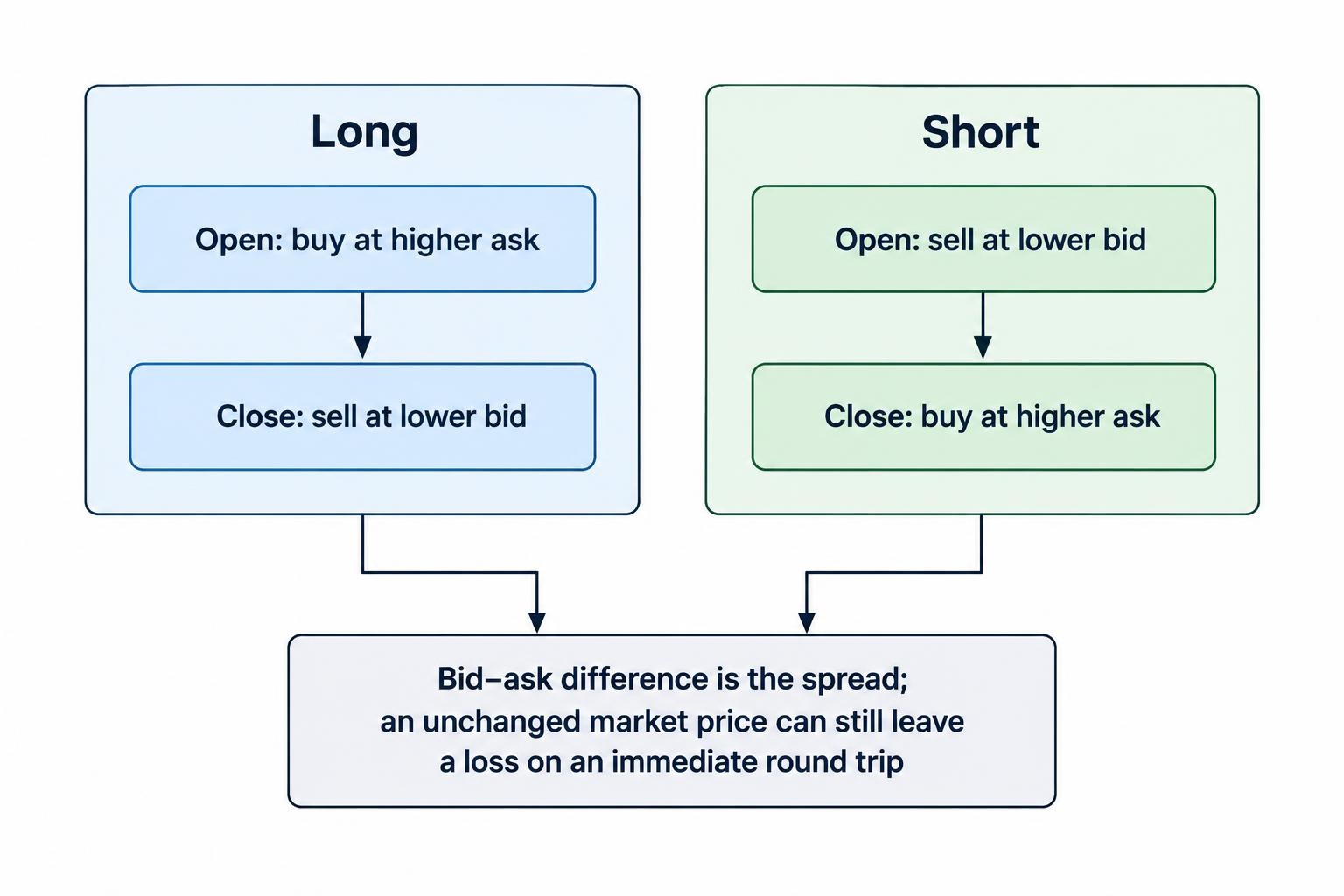
A spread betting quote has two prices. The lower price is the sell price, also called the bid. The higher price is the buy price, or ask. The difference between them is the spread.
Buying opens a long position, which benefits from a rising price. Selling opens a short position, which benefits from a falling price. To close a long position, you sell; to close a short position, you buy. The guide to how spread betting works covers that opening and closing process in more detail.
Suppose an index quote is 7,998–8,000. You buy at 8,000 because you expect it to rise. If the quote stays unchanged, closing immediately means selling at 7,998. You start two points behind because of the spread, not because the market has moved against you.
Check what counts as one point on the chosen instrument. An index point, a share price increment and a currency pair’s quoted movement need not use the same convention.
Translate Points into Pounds
Your stake determines the cash effect of each point. At £2 per point, a 40-point movement between your entry and exit prices produces an £80 trading gain or loss. At £10 per point, the same movement produces £400. The chart has not changed; your exposure has.
Using the hypothetical index purchase at 8,000 and a £2-per-point stake:
| Closing sell price | Movement from entry | Result before separate charges |
|---|---|---|
| 8,040 | 40 points in your favour | £80 profit |
| 8,000 | No movement between entry and exit | £0 |
| 7,960 | 40 points against you | £80 loss |
These calculations use executable opening and closing prices, so the spread is already reflected. Do not subtract it again. Financing and other separate charges still need accounting for. The guide to calculating spread betting profit and loss develops the arithmetic for both long and short positions.
Separate Margin from Money at Risk
Margin is the money required to support a position. It is not the purchase price of an asset, and it is not automatically the maximum you can lose on that trade.
In a simplified example, an index position opened at 8,000 for £2 per point represents £16,000 of exposure. If its margin requirement were 5%, the opening margin would be £800. A 40-point adverse move would still lose £80: 10% of that margin, despite a market movement of only 0.5%.
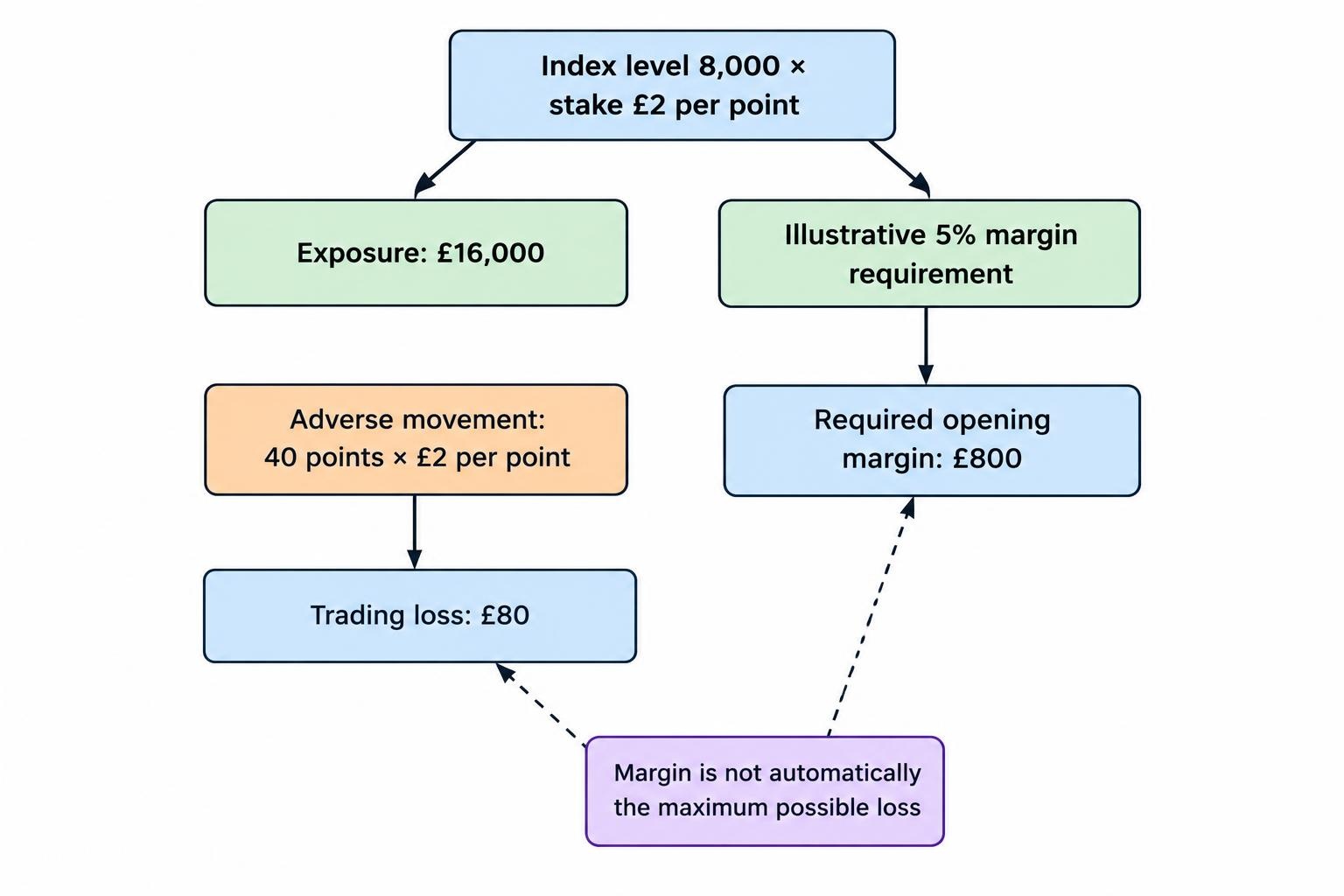
The percentage here is illustrative. Check the actual requirement on the ticket and leave room for losses and charges. The spread betting margin guide explains how margin requirements differ from account equity and available funds.
For UK retail accounts covered by the rules, FCA negative balance protection and margin close-out requirements provide account-level safeguards. They do not protect the money committed to trading from losses. Negative balance protection is not a separate loss allowance for each position.
Know What Your Orders Will Do
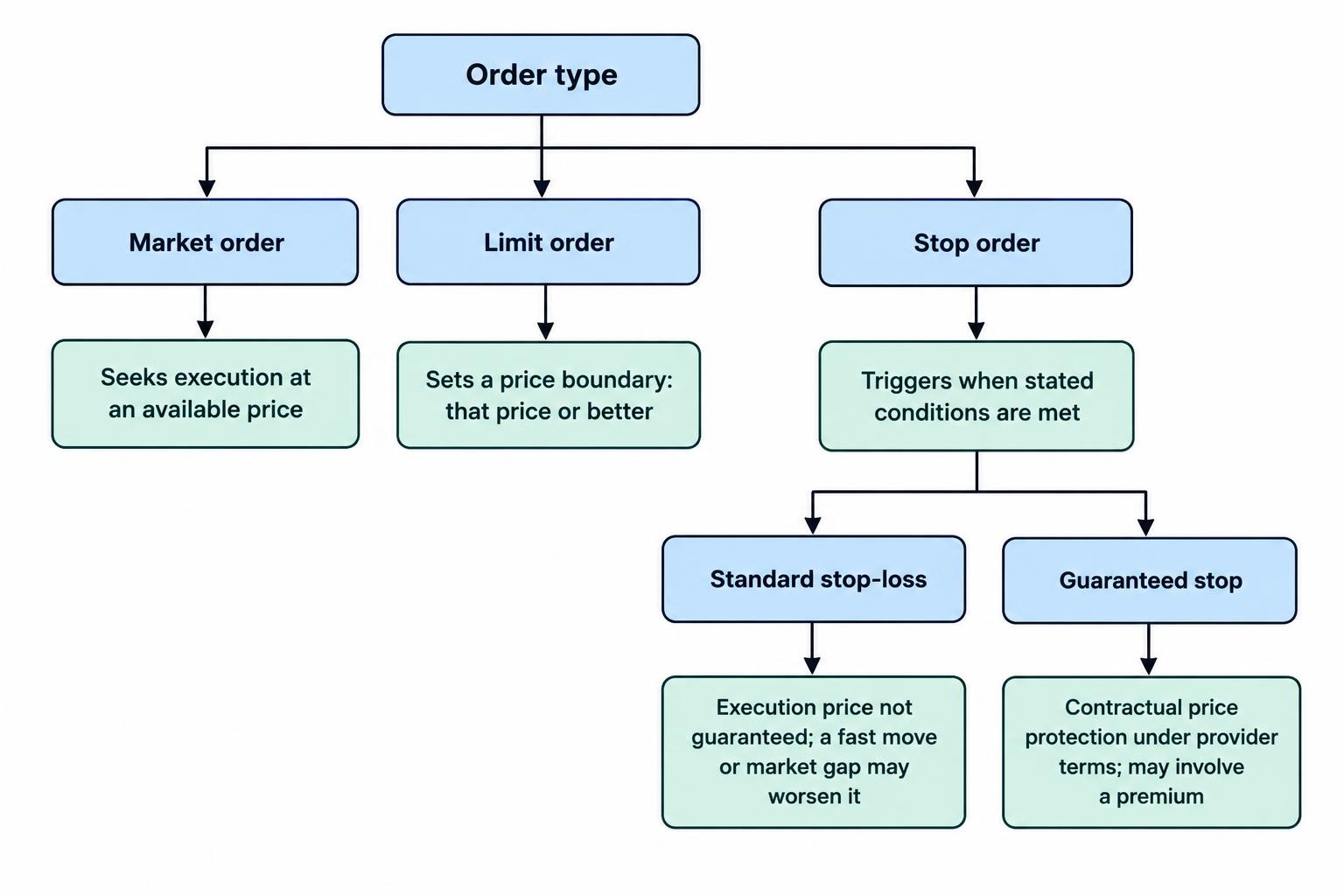
An order controls when you enter or leave a position. A market order seeks execution at an available price. A limit order sets a price boundary: that price or better. A stop order triggers when its stated conditions are met.
A standard stop-loss order does not guarantee its execution price. A market gap or fast move can produce a worse result than planned. Where offered, a guaranteed stop provides contractual price protection under the provider’s terms, potentially with a premium.
Before placing a trade, distinguish the trigger price from the eventual execution price. The spread betting order types guide covers market, limit, stop, guaranteed stop and trailing stop orders.
Check Costs and Holding Terms
The spread is only part of the calculation. Depending on the product and account terms, costs can include overnight financing, guaranteed stop premiums and currency conversion.
Daily funded bets can attract financing adjustments when held past the provider’s stated cutoff. Dated bets have an expiry and may reflect financing differently in their quoted price. A narrow spread does not automatically make one product cheaper for your intended holding period.
Read the instrument details before opening. Check trading hours, expiry, financing cutoffs and any applicable dividend or corporate action adjustments. A position left open overnight is still a position, even when you have closed the app.
Practise the Full Trade, Not Just the Entry
Use practice trades to test whether you can explain every number on the ticket. Keep the exercise manageable: one instrument, a consistent stake convention and a written record of each decision.
- Record the buy and sell quote, stake per point and opening margin.
- Calculate the planned loss at your stop, while allowing for execution uncertainty.
- State how and when you intend to close the position.
- Compare the final result with your calculation, including charges.
Practise losing scenarios as well as profitable ones. What happens if the market opens beyond your stop? What if several positions move against you at once? A learning exercise should expose gaps in your knowledge, not simply produce a reassuring balance.
Before considering real money, you should be able to explain the position’s direction, cash exposure, costs and exit conditions without guessing. If any of those remain unclear, return to the relevant lesson. There is no deadline to place the first trade.