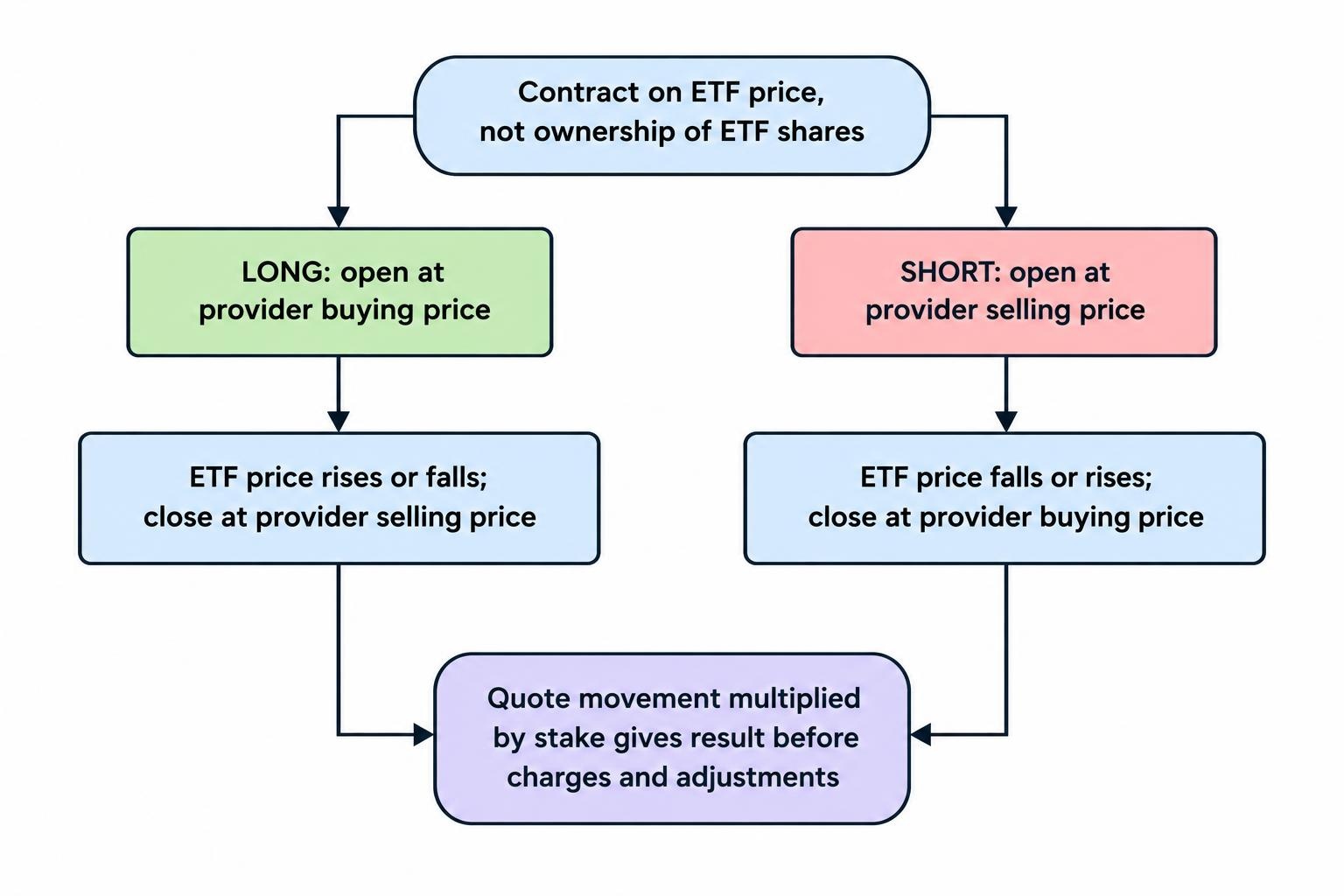
ETF spread betting lets you take a position on an exchange-traded fund’s price without buying its shares. You choose a stake per point, buy if you expect the price to rise, or sell if you expect it to fall. Your profit or loss depends on the price movement and your stake, after charges and adjustments.
The attraction is access to a basket of assets through one trade. The catch is that a diversified fund does not make a margined position low risk. Before placing an ETF spread bet, check exactly which fund the contract follows, what one point means, and how much exposure your stake creates.
How ETF Spread Betting Works
An ETF holds or provides exposure to a portfolio of assets. It may track an index or follow an actively managed strategy. Its shares trade on an exchange, and their market price can sit above or below the value of the fund’s underlying assets per share, known as net asset value. These distinctions matter because an ETF spread bet follows the fund’s quoted market price, not simply the headline movement in its benchmark. The SEC investor bulletin on ETFs covers fund pricing and premiums or discounts to net asset value.
Your spread bet is a separate contract with the provider. You do not own ETF shares, acquire voting rights, or become entitled to fund distributions as a shareholder. Any income adjustment comes through the betting contract’s terms.
The provider quotes a selling price and a buying price. You open a long position at the buying price and close at the selling price. A short position works in reverse. Availability, minimum stakes and permission to open short positions depend on the individual contract.
Check what counts as one point
A point might represent one penny, one US cent, or another price increment defined by the provider. Never infer it from the number of decimal places alone.
If one point equals 1p, a £1-per-point stake gains or loses £100 when the ETF moves £1. That is price exposure equivalent to 100 ETF shares, although you own none. The stake per point calculation should come before the margin calculation, not after it.
ETF Spread Betting Worked Example
Assume a fictional UK-listed ETF has a spread betting quote of 4,996–5,000. Prices are expressed in pence, one point equals 1p, and you buy at £1 per point. The following figures are illustrative, not a live quotation or an offer of trading terms.
| Trade detail | Amount |
|---|---|
| Opening buying price | 5,000 points, equivalent to £50 per ETF share |
| Stake | £1 per point |
| Equivalent price exposure | 100 shares, worth £5,000 at entry |
| Assumed opening margin | 20%, or £1,000 |
| Later selling price | 5,100 points |
| Profit before other charges | (5,100 − 5,000) × £1 = £100 |
If the selling price instead falls to 4,900, closing produces a £100 loss before other charges. An immediate close at the original selling price of 4,996 would lose £4 because of the spread.
The £100 profit represents 2% of the £5,000 opening exposure, but 10% of the assumed £1,000 margin. The same amplification applies to losses. Margin is a deposit supporting the position, not its maximum possible loss.
For a short trade, subtract the closing buying price from your opening selling price, then multiply by the stake. A falling ETF price benefits the short position; a rising price hurts it. Financing and any distribution adjustments still need to be included.
Which ETF Exposures Can You Trade?
Start with the exposure you want, then check whether a suitable contract exists. Broad equity ETFs can provide exposure to markets such as UK large companies or US equities. Regional and country funds offer a more focused position, but introduce different currency, political and market risks.
Sector and thematic ETFs need closer inspection. A technology fund and a semiconductor fund may share several large holdings, yet have very different concentration and trading characteristics. Read the holdings and weighting rules rather than treating the fund name as a complete description.
Bond ETFs need a separate assessment of interest rate sensitivity, maturity and credit quality. A short maturity government bond fund is not interchangeable with a long maturity corporate bond fund.
Also check the product’s legal structure. ETF, exchange-traded commodity and exchange-traded note are not interchangeable labels. ETCs and ETNs can be debt securities rather than fund shares, with different issuer risks. Deutsche Börse’s explanation of ETF, ETC and ETN structures distinguishes these products.
If your view concerns a mainstream equity benchmark, compare the ETF contract with spread betting directly on an index. The ETF route adds fund selection, fund expenses and listing details that may not be necessary for a straightforward index trade.
Margin Requirements and Retail Protections
Do not assume an ETF receives the same margin treatment as the index it tracks. The FCA schedule requires at least 5% opening margin for major stock market indices, compared with 20% for shares and assets outside its other listed categories. Confirm the classification and actual requirement for the ETF contract; a provider can require more than the regulatory minimum.
For covered UK retail accounts, the rules also require position close-out when account net equity falls below 50% of the relevant margin requirement, as soon as market conditions allow. Negative balance protection restricts liability for covered speculative investments to the funds dedicated to them in the account. These protections operate at account level, not as a guaranteed loss limit on each trade. The requirements appear in FCA COBS 22.5 on retail speculative investments.
Keep cash available beyond the opening deposit. An adverse move can reduce account equity while other positions are also losing money. The spread betting margin guide separates the amount needed to open a position from the resources needed to keep it open.
The Costs of an ETF Spread Bet
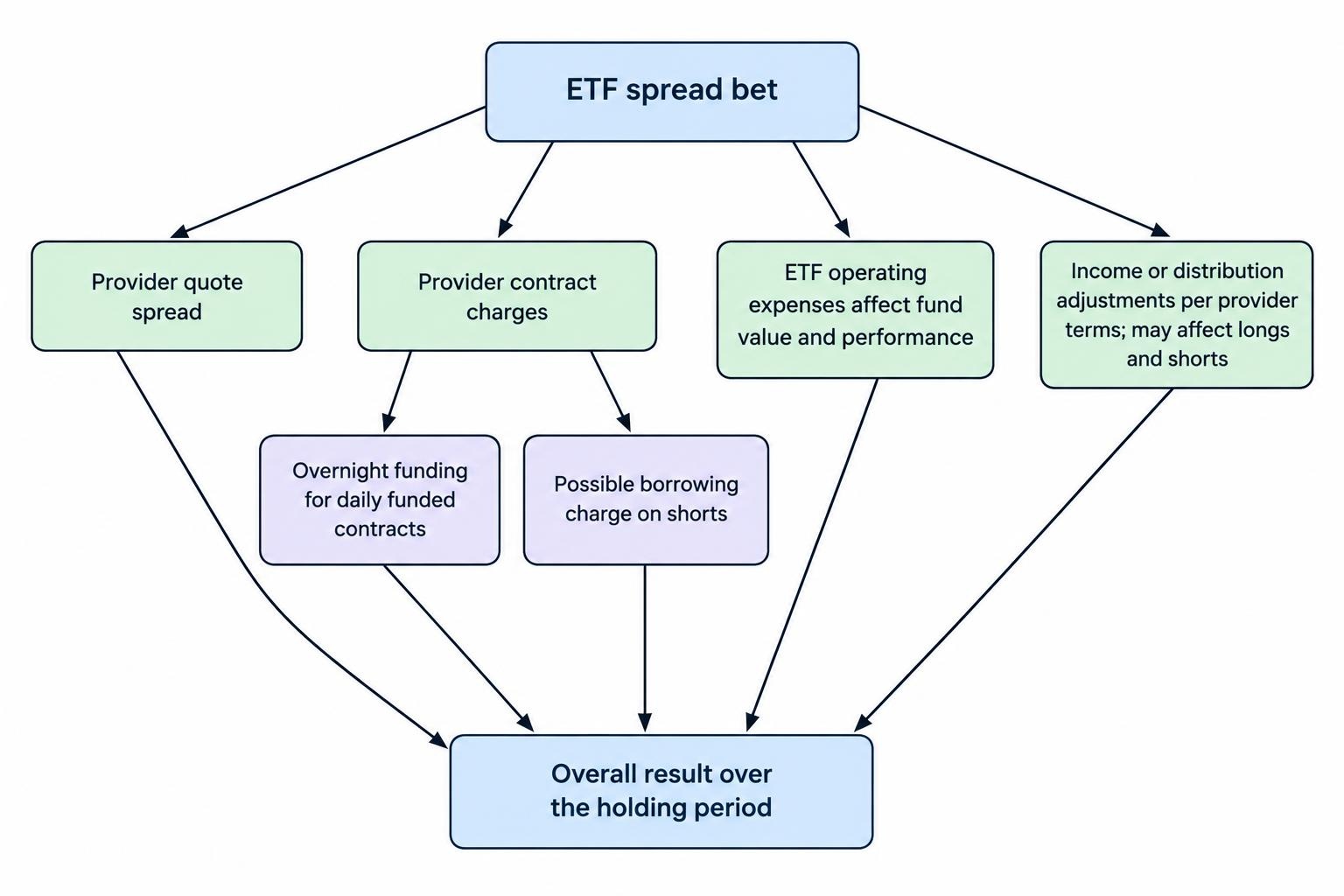
Assess costs across your intended holding period. A narrow opening spread does not tell you what a position will cost over a week or a month.
The quoted spread
The spread is built into the difference between the provider’s buying and selling prices. Compare the actual tradable quote at your intended size, rather than an advertised minimum.
In the example above, a four-point spread costs £4 at £1 per point if you open and immediately close without a market move. A trade targeting only 15 points has much less room for costs than one targeting 150 points. Neither target guarantees a better trade, but the arithmetic should be visible before entry.
Overnight funding and short position charges
For a daily funded contract, check the funding benchmark, provider adjustment, charging time and treatment of weekends or holidays. Funding generally relates to the position’s full exposure rather than only its margin deposit. Use the contract’s stated calculation, particularly for foreign currency ETFs.
A short position may also carry a borrowing charge. Do not assume selling automatically earns interest or that an ETF available to buy will always be available to short. The overnight financing guide explains how holding costs can change a trade’s break-even point.
Fund expenses and income adjustments
The ETF’s own operating expenses affect its asset value and performance. They are separate from the spread betting provider’s charges, even if they do not appear as a debit on your betting statement. Compare fund performance with the correct benchmark and distinguish price returns from returns that include reinvested income.
Check whether the share class distributes income or retains it within the fund. For distributing funds, inspect the provider’s treatment of the ex-distribution date. A long position may receive an adjustment and a short position may incur one, subject to the contract’s calculation and deductions.
These are contractual dividend adjustments, not shareholder payments. A price fall around the ex-distribution date should not be assessed separately from the associated adjustment. Selling immediately before that date is not a free-money shortcut.
Listing Currency Is Not the Same as Currency Exposure
There are three separate questions: what currencies the fund’s assets are exposed to, what currency the ETF listing trades in, and what currency your spread bet settles in.
A sterling-traded listing does not automatically remove foreign currency exposure from its portfolio. Currency hedging requires a separate strategy; changing the trading currency alone does not provide it. The Xtrackers ETF currency exposure FAQ distinguishes underlying exposure from fund and trading currencies.
A sterling stake may make the betting calculation simpler without making the underlying investment currency neutral. Conversely, a dollar-quoted ETF contract may calculate gains and losses using a fixed sterling amount per cent of price movement. Check the ticket rather than assuming conventional share dealing conversion rules apply.
Match the fund name, exchange, ticker, share class and hedging status. Two listings with similar names can produce different contract calculations, even when they refer to the same portfolio.
Trading Hours, Liquidity and Execution
Check three trading schedules: the provider’s quoting hours, the ETF’s exchange session, and the hours of its underlying markets. They may not overlap completely.
When underlying markets are closed, pricing and hedging the ETF can become harder, which may widen spreads. State Street’s ETF trading guidance identifies underlying market overlap and opening or closing periods as execution considerations.
For a spread bet, the price you can actually trade remains the provider’s quote. An exchange chart or delayed ETF price is not a promise of execution. Compare the live spread, available size and order conditions before submitting an order.
A standard stop loss does not guarantee its execution price. Overnight news, suspended trading or a sharp reopening move can produce an exit beyond the stop level. Assess market gap risk against the ETF’s trading schedule, especially if its holdings continue trading after its own exchange has closed.
Geared and Inverse ETFs Add Another Risk Layer
An ordinary ETF spread bet already creates geared exposure because you support a larger position with a margin deposit. If the ETF itself targets a multiple of its benchmark’s daily return, you add another layer of gearing.
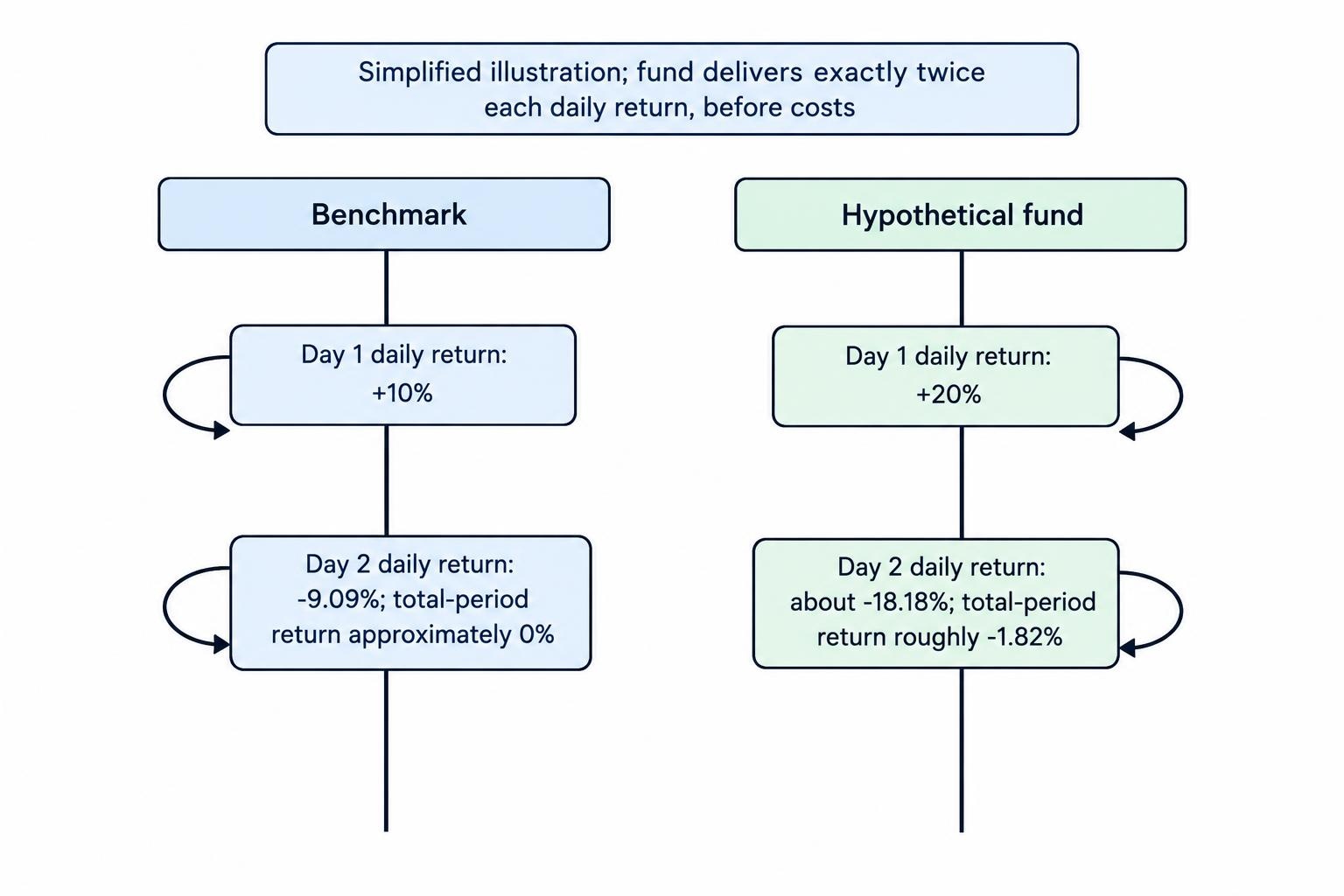
Many geared and inverse ETFs reset their exposure daily. Their returns over several days can differ from the stated multiple of the benchmark’s return over that whole period. The SEC bulletin on leveraged and inverse ETFs addresses this daily reset and compounding risk.
Consider a simplified benchmark that rises 10%, then falls 9.09%. It finishes approximately where it started. A fund delivering exactly twice each daily return would rise 20%, then fall about 18.18%, leaving it roughly 1.82% lower before costs. Your spread bet follows the fund price, not an imagined twice-the-total-period benchmark return.
Direction also needs care. Buying an inverse ETF generally expresses a bearish benchmark view. Shorting that same inverse ETF generally expresses the opposite view. Write the intended direction in plain English before opening the ticket; two negatives can make a surprisingly expensive positive.
Position Sizing and Practical Uses
An ETF contract can suit a defined sector view, a temporary regional position or a hedge, provided its exposure matches the purpose. A broad fund may reduce dependence on one company’s announcement, but it does not remove market risk or the consequences of an oversized stake.
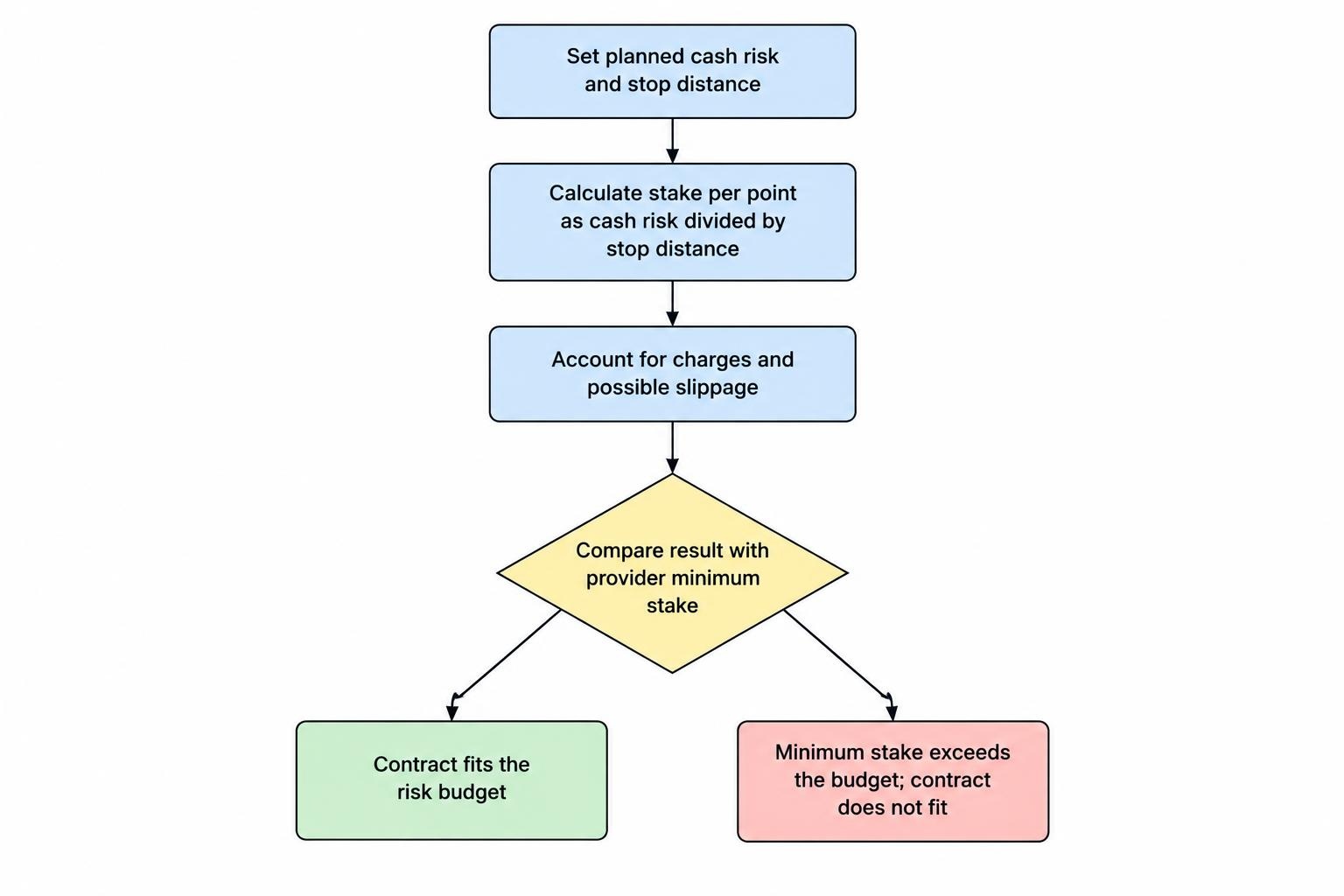
Set the planned cash risk before choosing the stake. With an 80-point stop distance and an £80 planned price risk, the calculation is £1 per point, before charges and slippage. If the provider’s minimum stake exceeds that amount, the contract does not fit that risk budget.
This is the same position sizing discipline used elsewhere in spread betting. Do not work backwards from the largest stake your available margin permits.
Review overlapping holdings across your account. A US large company ETF, a technology ETF and a growth fund may all depend heavily on some of the same businesses. Different tickers do not necessarily mean different risks. Check portfolio correlation and shared exposure before treating several ETF positions as diversification.
For hedging, compare economic exposure rather than matching nominal stakes. Differences in holdings, currency and benchmark behaviour can leave part of the original risk unhedged. Funding and distribution adjustments can also make a hedge costly to maintain.
UK Tax Treatment
For an individual placing an ordinary financial spread bet, HMRC states that no assets are acquired or disposed of and no chargeable gains or allowable capital losses arise. Profits therefore do not create capital gains tax liabilities, but losses do not provide capital gains relief. This treatment appears in HMRC’s financial spread betting guidance.
Do not turn that into a universal tax promise. Where winnings arise from carrying on a trade, the contract’s terms and economic substance can affect the result. HMRC’s guidance on spread betting and trading income addresses that distinction.
Seek tax advice for business-related positions, company accounts or residence outside the UK. The ETF’s listing country alone does not determine your personal tax treatment.
Deciding Whether the ETF Contract Fits
Before choosing a provider, identify the exact ETF and share class you need. Then compare its tradable spread, minimum stake, point definition, margin requirement, funding terms, short availability and distribution policy. Test the cash calculations in a demo account where available, while recognising that simulated execution does not establish live trading quality.
If your objective is long term ownership, regular income or gradual portfolio building, compare the contract with buying fund shares. The comparison of spread betting and ETF investing covers that broader choice.
An ETF spread bet should have a clear purpose, holding period and exit condition. Choose it because the contract matches the exposure you want, not because the opening deposit looks small.