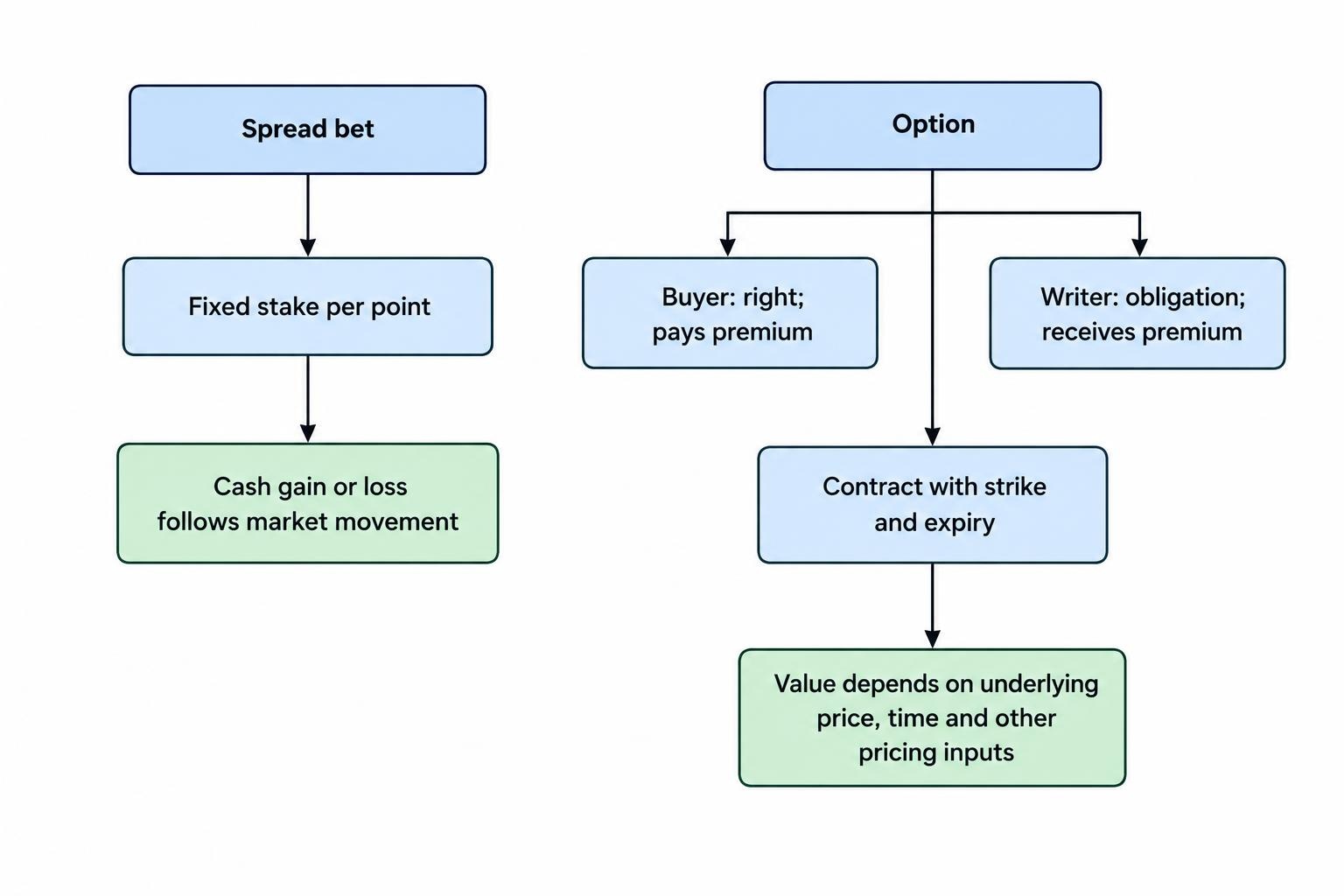
Spread betting gives you a fixed cash gain or loss for each point a market moves. Options give you a contractual right with an expiry date, and their value depends on more than market direction. That difference matters more than which product requires the smaller opening payment.
For a straightforward directional trade, a conventional spread bet has simpler profit and loss calculations. Buying a call or put can put a firm ceiling on the loss from the option itself, but you must also judge the strike price, time remaining and premium. Selling options creates a different risk profile again.
This comparison focuses on conventional spread bets on financial markets and standard call and put options, mainly exchange traded contracts. It uses UK retail spread betting rules and UK tax assumptions. Neither product is a substitute for owning an investment, and UK tax treatment should not be applied to residents of other countries.
Spread Betting vs Options: The Main Differences
| Feature | Conventional spread betting | Standard options |
|---|---|---|
| Position size | A cash stake per point, subject to the provider’s minimums and increments. | A number of contracts, each with a defined multiplier or deliverable. |
| Directional exposure | A fixed gain or loss per point while the stake stays unchanged. | Exposure changes with the underlying price, time and other pricing inputs. |
| Opening cash requirement | Margin supporting a larger market exposure. | Premium for a fully paid purchased option; collateral or margin for written options. |
| Expiry | Depends on the product. Daily funded and dated bets work differently. | Every contract has an expiry date. |
| Loss control | Stake size and exit orders help manage risk, but an ordinary stop does not guarantee its execution price. | A standalone purchased option can lose its entire premium. Uncovered written options can create much larger losses. |
| Holding costs | May include overnight funding, or financing reflected in a dated price. | Time value and carrying assumptions affect the premium; other dealing charges may apply. |
| Settlement | Cash profit or loss under the provider’s terms. | Cash settlement or delivery of an underlying position, depending on the contract. |
The broad distinction is linear exposure versus a shaped payoff. A £5 per point spread bet keeps gaining or losing £5 for each point. An option can respond quite differently at different market levels, even though its contract size has not changed.
How Each Product Creates Market Exposure
Spread betting: stake multiplied by movement
A spread bet lets you take a position on a quoted market without buying the underlying asset. You buy if you expect the price to rise or sell if you expect it to fall. The difference between your opening and closing dealing prices, multiplied by your stake, determines the trading result before other charges.
Suppose you buy an index at 8,000 for £3 per point. Closing at a selling price of 8,080 produces a £240 trading profit. Closing at 7,920 produces a £240 loss. Using the actual dealing prices already accounts for the bid and ask difference; do not subtract that spread a second time. The mechanics are covered in what spread betting is.
You do not choose an exercise price or acquire the right to take delivery of shares. Your position is a cash settled agreement with the provider. The market reference, funding method, trading hours and closing arrangements come from that agreement.
The stake is also your direct exposure control. Reducing a position from £5 to £2 per point reduces the cash effect of each point by 60%. Check the provider’s definition of a point, however: a point on an index is not automatically the same quotation increment used for a share or currency pair. Our stake per point guide covers that distinction.
Options: a right for the buyer, an obligation for the writer
A call gives its holder the right to buy the underlying asset at the strike price under the contract’s exercise terms. A put gives the right to sell. Cash settled options replace delivery with a payment calculated under the contract rules.
The buyer pays a premium for that right. The writer, who sells an option to open a position, receives the premium and accepts the corresponding obligation. Selling an option you already own to close your trade is not the same as writing a new option.
Direction depends on both the option type and whether you buy or write it. Buying a call generally expresses a bullish view; buying a put generally expresses a bearish view. Writing a call or put reverses those exposures, but it does not create a mirror image of the buyer’s risk.
An option’s quoted premium must be converted into the full contract cost. A premium of 60 points on a contract worth £10 per point costs £600, not £60. Contracts also differ in settlement method and exercise style, so the product name alone is not enough to size the trade.
A Worked Example on the Same Index
A comparison becomes more useful when both trades refer to the same market. Consider two hypothetical bullish positions with an index initially at 8,000:
Spread bet: buy at £5 per index point.
Purchased call: buy one call with an 8,050 strike, paying a premium of 60 index points, with a £10 per point multiplier.
The option therefore costs £600. This multiplier is not arbitrary: the standard ICE FTSE 100 Index Options contract specifications provide for £10 per index point, cash settlement and European style exercise. The prices used here are invented teaching figures, not current quotes.
The table compares both positions at the option’s expiry. It assumes the spread bet remains open until the same measurement point and ignores its bid and ask spread, funding and other dealing charges. The option result includes the £600 premium but excludes other fees.
| Index level at expiry | Spread bet profit or loss | Call settlement value | Call profit or loss after premium |
|---|---|---|---|
| 7,800 | −£1,000 | £0 | −£600 |
| 8,000 | £0 | £0 | −£600 |
| 8,080 | +£400 | £300 | −£300 |
| 8,110 | +£550 | £600 | £0 |
| 8,200 | +£1,000 | £1,500 | +£900 |
| 8,400 | +£2,000 | £3,500 | +£2,900 |
The spread bet benefits from every upward point before costs. The call must first recover its premium. Its expiry breakeven is the strike plus the premium: 8,050 + 60 = 8,110.
At 8,080, the index has risen and the call finishes in the money, yet its buyer still loses £300. Being right about direction was not enough. The move also needed to cover the price paid for the option.
Below the strike, the call’s loss stops at £600 before fees. The spread bet keeps losing £5 per downward point while it remains open. Above the strike, the call’s settlement value increases by £10 per point, explaining why it eventually overtakes the £5 per point spread bet.
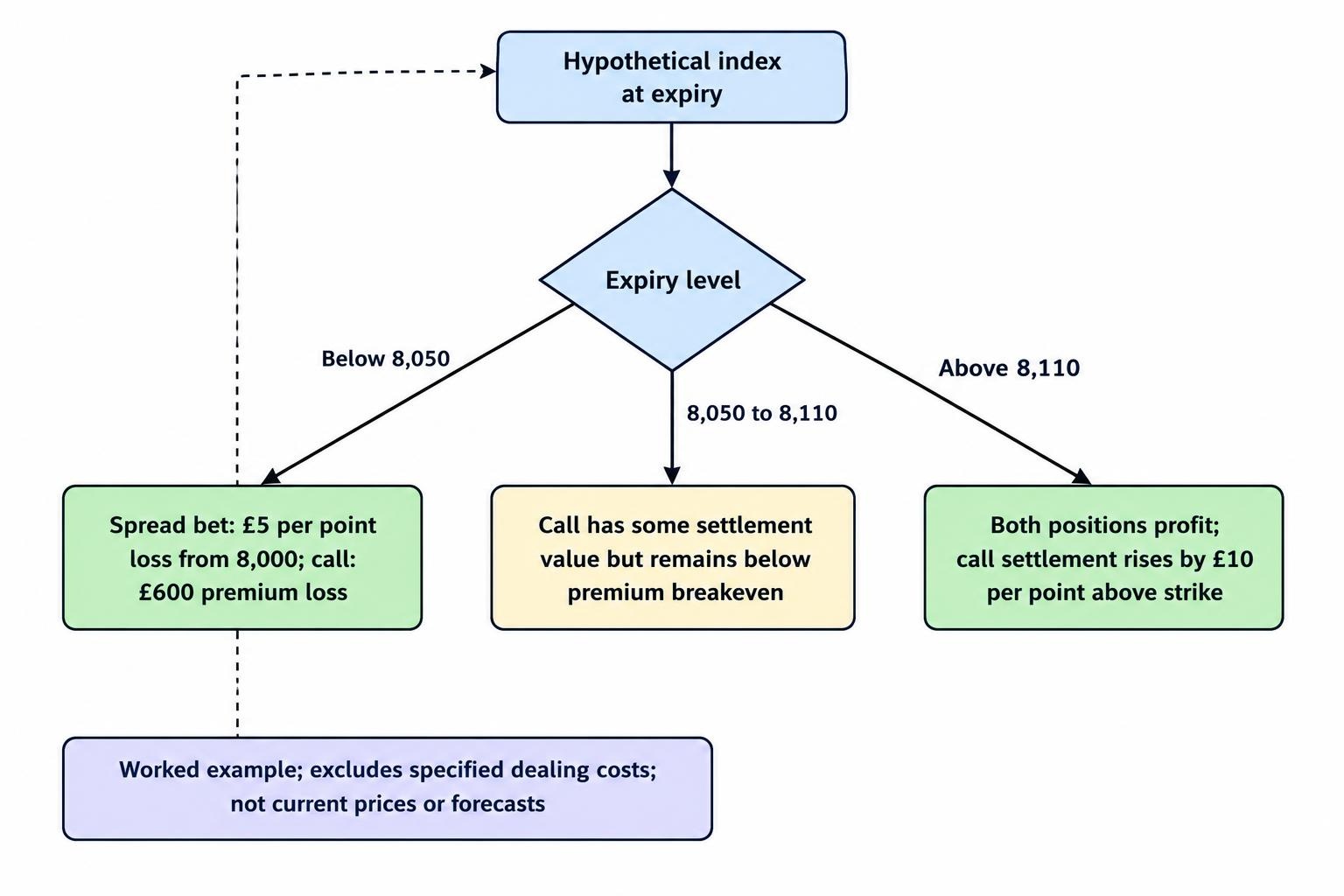
These positions are not identical exposures. If the call initially had a delta of 0.50, its approximate opening sensitivity would be £5 per index point: 0.50 × £10. That would resemble the spread bet at that moment, but the option’s sensitivity would change as conditions changed.
The table also does not predict the option’s sale price before expiry. A call can be sold profitably before the index reaches its expiry breakeven because its remaining time value still has a market price. For the underlying market rather than the option structure, see FTSE 100 spread betting.
Why Options Need More Than a Directional Forecast
A conventional spread bet has a relatively direct relationship with its reference market. Options introduce further questions: how far might the market move, by when, and how much movement has the premium already priced in?
Time value and expiry
An option premium can contain intrinsic value and time value. Intrinsic value is the amount by which exercising would be favourable before allowing for the original premium. Time value reflects the remaining possibility of a more favourable outcome, alongside other pricing inputs.
As expiry approaches, time value normally erodes for standard purchased calls and puts, with other inputs unchanged. This is not a separate invoice. It appears through the option’s changing market value.
A market that drifts sideways can therefore hurt a purchased option even without moving against the directional view. A daily funded spread bet does not have option time decay, although funding can steadily reduce the result of holding it.
Implied volatility and the Greeks
Implied volatility is inferred from option prices. It reflects the movement assumptions embedded in those prices, not a promise about future movement. Higher implied volatility generally raises standard call and put premiums, with other inputs unchanged.
Traders use sensitivity measures to estimate these effects. Delta estimates the price response to a small underlying move. Gamma measures how delta changes. Theta estimates sensitivity to passing time, and vega estimates sensitivity to implied volatility. These are model estimates, not guaranteed dealing results; the Options Industry Council’s volatility and Greeks resource sets out their roles.
Consider a call bought before a company announcement. The share price rises afterwards, but implied volatility falls. The favourable share move may be partly or fully offset by the volatility change and lost time value. The trade can lose money despite getting the headline direction right.
That does not make options defective. It means the buyer purchased a package of exposures rather than a fixed cash amount per point. The additional choices can be useful, but they must be intentional.
Margin, Premium and the Cash You Actually Need
A spread betting deposit is not a maximum loss
Margin supports the position; it does not purchase it outright. At an index level of 8,000, a £5 per point spread bet represents £40,000 of market exposure. If the applicable margin requirement is 5%, the opening margin is £2,000.
A 100 point adverse move still loses £500. That is 25% of the opening margin, although the index has moved only 1.25%. The relationship between exposure and deposit is explained in our spread betting margin guide.
You also need enough account equity to maintain the trade. A position can be closed because of insufficient funds before the market reaches your intended exit. Comparing an option premium with the smallest permitted spread betting deposit overlooks this continuing cash requirement.
A purchased option premium buys the contractual right
For a standalone, fully paid purchased option, the premium is the amount committed to the option itself. You do not normally need to replenish margin simply because that option loses value. However, exercise or automatic exercise can create a new underlying position with a much larger funding requirement.
Written options work differently. The premium received does not define the writer’s maximum loss, and the margin required to support the position can rise. A trader who treats premium income as spendable profit before closing the obligation can badly misjudge available cash.
Contract increments matter too. A spread betting provider may permit smaller cash adjustments than one listed option contract allows. Conversely, a suitable smaller option contract may exist. Check actual availability rather than assuming every options market has the same size.
Compare positions using both plausible cash loss and market sensitivity, not their opening payments alone. Our position sizing guide provides the spread betting side of that calculation.
Which Product Gives Better Control of Losses?
Purchased options have a contractual loss boundary
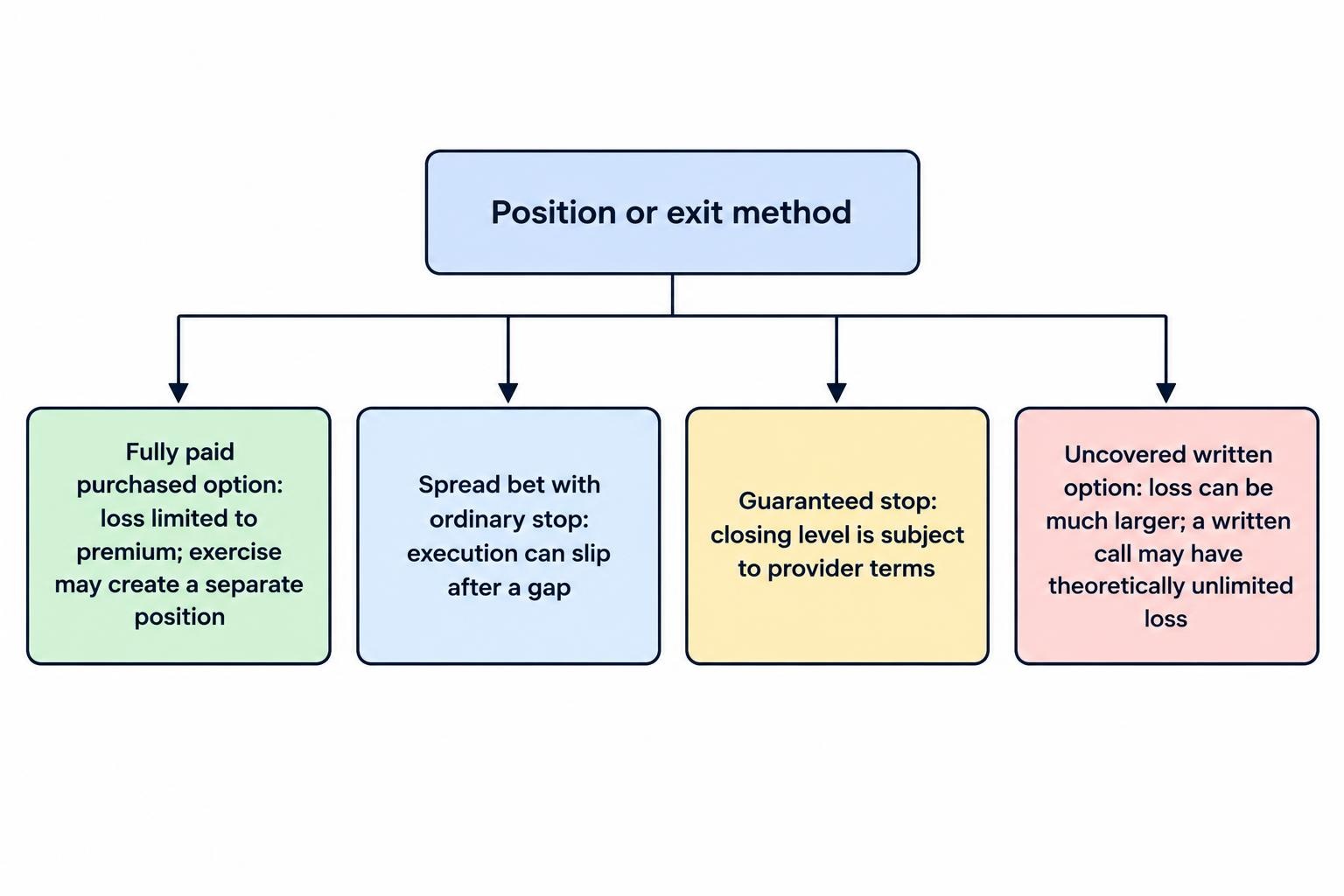
A standalone purchased option can lose 100% of its premium, potentially over a short period. An uncovered written call has theoretically unlimited loss potential, while a written put on a share can suffer a large loss if the share collapses. These are distinct exposures, covered in OCC’s Characteristics and Risks of Standardized Options.
The buyer’s premium boundary applies to the option, not automatically to anything that follows exercise. A purchased call that becomes a shareholding leaves the trader exposed to subsequent share price losses. An expiry plan is therefore part of risk control, not an administrative afterthought.
Repeated premium losses also deserve attention. Knowing that each trade cannot lose more than £300 does not make ten consecutive £300 losses affordable. A defined loss is useful only when the chosen amount fits the account.
A stop order is an execution instruction
An ordinary stop on a spread bet does not create the same payoff as a purchased option. It instructs the provider to close when its trigger conditions are met, but the available execution price may be worse after a gap or during fast trading. That difference is slippage.
Suppose a £5 per point spread bet has a stop 120 points away. The intended loss is £600 before costs. If execution occurs 180 points from entry, the loss becomes £900. Calling this equivalent to a £600 option premium would conceal the execution risk.
A guaranteed stop loss can provide a contractual closing level under the provider’s terms. Availability, premiums, minimum distances and other restrictions still matter. It also closes the position when triggered; a purchased option can remain alive through an adverse move until sale, exercise or expiry.
Defined risk option spreads require proper handling
Buying one option and writing another can create a spread with a defined expiry payoff. A bull call spread, for example, exchanges some upside potential for a lower net premium than the purchased call alone.
Its payoff diagram is not permission to ignore execution. Closing only one leg, early assignment, mismatched settlement arrangements or allowing one leg to expire without managing the other can leave an unintended position. The advertised expiry maximum loss assumes the intended structure and obligations are handled correctly.
Costs: Funding Charges vs the Price of Optionality
Spread betting costs
The bid and ask spread is the most visible cost. A wider spread requires a larger favourable move before the position can close at a profit. Its cash effect depends on the stake: a two point spread costs £10 at £5 per point.
Daily funded bets may also incur overnight financing. Dated bets can reflect carrying costs in their quoted prices instead of using the same daily funding method. Neither arrangement should be assumed cheaper without checking the intended holding period and contract terms.
A trade expected to last one session can become expensive if it remains open for weeks. Use the provider’s funding formula to estimate that possibility before entry; our overnight financing guide covers the calculation.
Options costs
Options have bid and ask spreads too. Commissions, exchange charges, currency conversion and exercise or assignment charges may also apply. A quoted midpoint is not necessarily a price at which the whole order can be executed.
The premium itself needs careful treatment. It is the purchase price of the option, not simply a fee that disappears immediately. You may recover some or more than all of it by selling the option. If the option expires worthless, the premium is lost.
A fully paid purchased option does not usually attract the same separate overnight funding debit as a daily funded spread bet. That does not make its carrying economics free: interest rates, dividends and time affect option pricing, and the cash paid as premium is committed to the trade.
Compare the cash result under several market paths and holding periods. A total spread betting cost comparison is more useful than ranking products by the absence of one particular charge.
Expiry, Exercise and Settlement
Every option has a deadline, but exercise rights differ. An American style option can generally be exercised before expiry under its terms. A European style option is exercisable only at its specified expiry exercise point. These labels describe exercise rights, not where the trader lives.
Writers of American style options must account for possible early assignment. Once assigned, they must meet the contract obligation. Dividend dates and the option’s remaining time value can affect exercise decisions; the Options Industry Council’s exercise and assignment guidance details these risks.
European style does not mean the holder must keep the option until expiry. Closing a position by trading the same contract is separate from exercising it, provided a usable market and account access are available.
Settlement also changes the practical consequences. A cash settled index option produces a cash payment under its rules. A physically settled equity option can create a share purchase, share delivery or short position. Some contracts reference futures, creating another exposure that needs to be funded and managed.
Spread bets do not give you those delivery rights or obligations. Dated positions still have settlement and rollover arrangements, however, and daily funded positions remain subject to the provider’s terms. Check spread betting expiry dates rather than assuming every open position continues indefinitely.
UK Tax Treatment Is Not the Same
For genuine financial spread bets within the relevant UK treatment, no assets are acquired or disposed of and no chargeable gains or allowable capital losses arise. This is stated in HMRC’s financial spread betting guidance.
The loss treatment is the other side of that benefit. A losing spread bet does not become an allowable capital loss that can offset taxable gains on another investment. Looking only at winning trades gives an incomplete comparison.
Standard traded options held by a private investor ordinarily fall within capital gains treatment rather than inheriting spread betting’s treatment. Whether transactions amount to a trade is a question of fact, and exceptions can apply; HMRC’s guidance on options and income or capital gains addresses that distinction.
Do not assume that every product labelled an “option” receives the same treatment. A listed option, a spread bet referencing an option price and a contract for difference are different legal arrangements. Your tax residence, circumstances and the contract itself matter.
Keep premiums, dealing costs, dates, closing transactions and settlement records. Obtain tax advice where treatment is uncertain, particularly if the position relates to a business or an existing investment. Our guide to whether spread betting is tax free covers the spread betting qualifications without turning a trading comparison into a tax manual.
UK Retail Protections: Check the Product, Not the Label
UK retail spread betting protections include minimum margin requirements, account level margin close out and negative balance protection. Under the FCA’s COBS 22.5 retail product rules, firms must close relevant positions as soon as market conditions allow when account net equity falls below 50% of the required margin. Liability for qualifying positions is restricted to funds dedicated to that account.
Negative balance protection is not a guarantee against losing the account balance. Nor does it cap each trade at its opening margin or intended stop loss. A trader can lose funds supporting other positions in the same account.
Do not transfer those protections automatically to listed options. The FCA category of restricted options has a narrower definition, including conditions concerning moneyness at sale, one for one underlying exposure and the effect of time to expiry. It is not a general label for every conventional call and put.
Check the contracting entity, client classification and product terms. Professional classification or an offshore arrangement can change the protections available. Our retail client protections guide covers those account level questions.
Which Structure Fits the Intended Trade?
A short directional trade
If the plan is to trade an index move over a few hours, a spread bet offers direct cash per point exposure. The trader can express the intended risk through stake size and an exit level without selecting an option strike and expiry.
That simplicity does not establish profitability. Spread width, execution and position size still determine whether the structure fits the opportunity. Our day trading spread betting guide covers the trading approach separately.
Options can also be traded intraday. They introduce changing sensitivity and potentially fast time value changes, especially close to expiry. A small premium should not be mistaken for an easy trade.
A position held through a possible price gap
A fully paid purchased put or call can suit a trader who wants a known maximum loss on the option while retaining exposure through an adverse move. The price of that right is the premium, which may be expensive relative to the move that eventually occurs.
A spread bet with a guaranteed stop offers a different arrangement: the exit level is protected under the agreed terms, but the position closes when triggered. Choose based on the required behaviour, not simply because both structures can define a cash risk.
Hedging an existing portfolio
A short index spread bet can offset some portfolio losses, but it also creates losses when the index rises and may need more supporting cash. A purchased index put can provide downside protection for a premium while preserving more participation in a rising market.
Neither is automatically an exact hedge. Portfolio composition, hedge size, expiry and the relationship with the chosen index all matter. The separate guide to hedging with spread bets examines the linear approach.
Trading volatility or a range
Options can combine calls and puts to express views about volatility, movement in either direction or a trading range. Those structures cannot be reduced to choosing buy or sell on one conventional spread bet.
They also create more ways to misprice the trade. A strategy that benefits from time passing may be exposed to sharp moves or rising volatility. Premium income is compensation for accepting obligations, not a yield that arrives without risk.
A Practical Decision Before Opening Either Position
Write down the intended trade in cash terms before choosing the product. Five questions expose most mismatches:
- What is the view? Direction alone, or also the size, timing and volatility of the move?
- What can be lost? Separate the opening cash requirement from the trade’s plausible or contractual loss.
- What happens along the way? Consider margin pressure, gaps, changing option sensitivity and early assignment.
- What happens at the end? Specify sale, closure, expiry, exercise or settlement.
- What is the result after costs? Include spreads, funding, premiums, dealing charges and relevant tax treatment.
Use hypothetical favourable, unchanged and adverse outcomes. Then add an adverse move followed by a recovery. That last path can expose an important difference: a spread bet may close before the recovery, while a fully paid option may remain open but lose time value.
A spread betting demo account can help practise stake calculations and order handling. It does not prove live execution quality or establish that a strategy will make money.
Common Questions
Are options safer than spread betting?
A standalone purchased option provides a clearer maximum loss on the option itself than a spread bet with an ordinary stop. Options as a category are not safer: uncovered writing, excessive premium spending and unmanaged exercise can create substantial risk. Compare the actual positions rather than the product labels.
Can an option make money before reaching its expiry breakeven?
Yes. Expiry breakeven includes the premium paid and assumes no time value remains. Before expiry, the option may sell for more than its purchase price because of a favourable underlying move, higher implied volatility or both. Use an executable closing price, not just a theoretical valuation.
Is spread betting on options the same as owning options?
No. A spread bet referencing an option price remains a contract with the spread betting provider. It does not automatically give you ownership of the listed option or its exercise rights. Check the wrapper’s margin, settlement, expiry and loss terms separately from the option price being referenced.
Are standard options the same as binary options?
No. Standard calls and puts have payoffs linked to the underlying price relative to a strike. Binary options use a different payoff structure. They should not be treated as interchangeable; see spread betting vs binary options for that separate comparison.
Choose the Exposure Before the Product
Spread betting is the simpler structure for expressing a fixed cash view on each market point. Purchased options can provide a premium defined loss and a payoff that changes across market levels. Written options introduce obligations that demand a different assessment.
The useful question is not which product is universally better. It is which contract behaves as required through the expected move, an adverse move and the planned exit. If that behaviour cannot be explained clearly in pounds, the position is not ready to open.