Spread betting margin is the money your provider requires you to set aside to open and maintain a position. It is usually a percentage of the trade’s full market exposure, rather than the full amount itself.
The distinction matters: an £800 margin requirement does not mean your maximum loss is £800. Profit and loss depend on your stake per point and the market’s movement. Other money in your trading account can also be exposed to losses.
This guide covers margin on UK retail financial spread betting accounts, including how to calculate it, how it affects available funds and why meeting the opening requirement is only part of the calculation.
What Margin Actually Covers
Margin supports your obligations on an open spread bet. Your provider reserves part of your account’s funds against the position, leaving the remainder available to support market movements or other trades.
It is not a transaction fee. Opening a position with an £800 margin requirement does not, by itself, reduce a £3,000 account balance to £2,200. Instead, £800 is committed as margin. Ignoring trading costs and price movements, the account still has £3,000 of equity, with £2,200 available after that commitment.
Margin and spread betting leverage describe the same exposure from different angles. Margin expresses the required deposit as a percentage; leverage expresses exposure relative to the money supporting it. A 5% margin rate corresponds to exposure of 20 times the required margin.
Neither figure tells you whether a trade suits your account. A provider’s opening requirement is an entry condition, not a recommended position size. The platform’s maximum is not a spending target.
How to Calculate Spread Betting Margin
For a straightforward index spread bet, where one quoted index point equals one betting point, the calculation is:
Market exposure = index level × stake per point
Required margin = market exposure × margin rate
Consider a hypothetical index quoted at 8,000. You choose a stake of £2 per point, and the provider applies a 5% margin rate.
Your exposure is 8,000 × £2 = £16,000. The opening margin requirement is therefore £16,000 × 5% = £800.
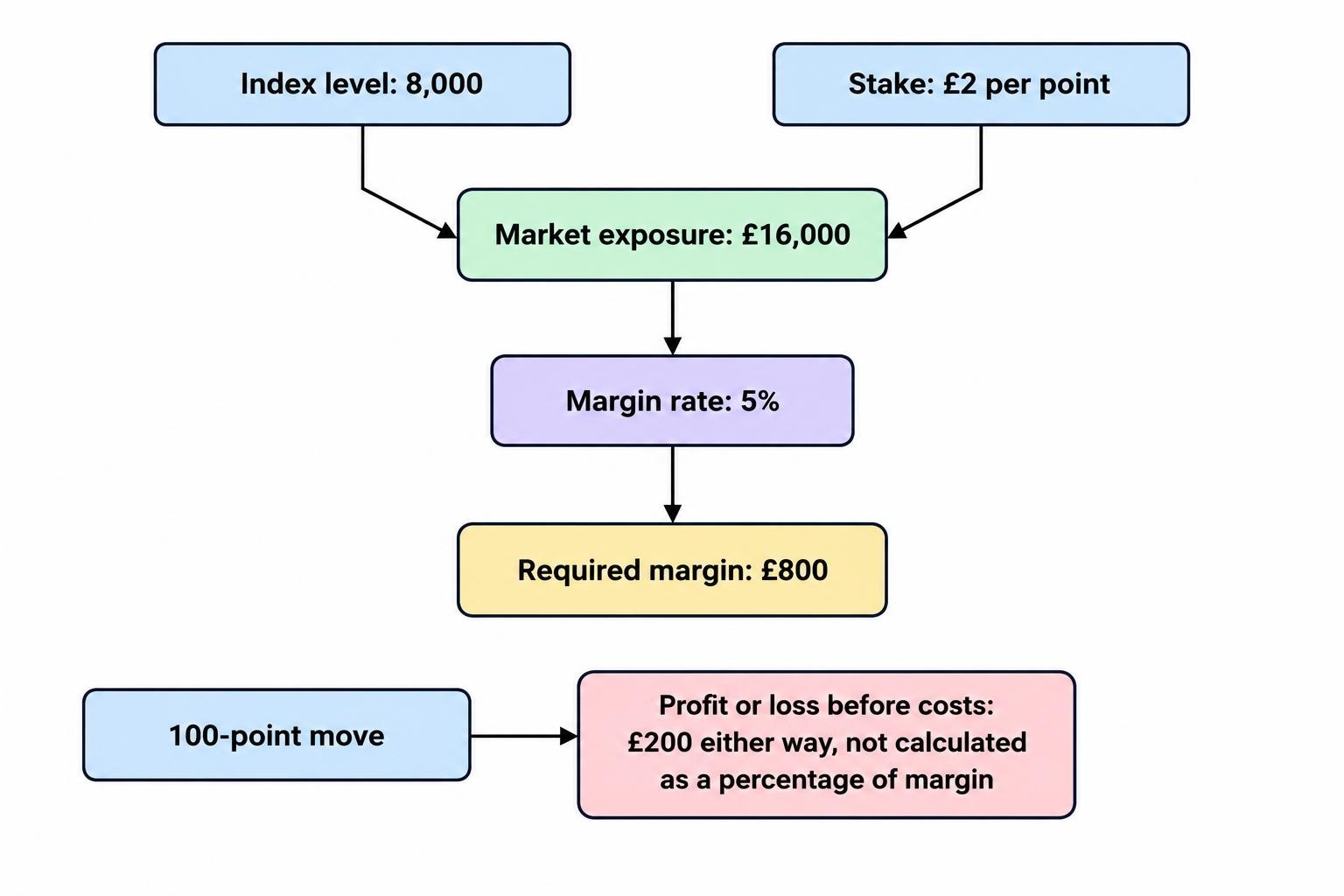
A 100-point move produces a £200 profit or loss before costs. The provider does not calculate that result as a percentage of the £800 margin. Your £2 stake determines the monetary effect of each point.
Check the contract’s definition of a point before using this formula. Share prices, currency pairs and commodities can use different quoting units. The stake per point calculation must match those units; a misplaced decimal can turn an apparently modest trade into a much larger exposure.
The exposure calculation also applies to a short position. Selling rather than buying changes which direction produces a profit, not whether margin is required.
All numerical examples here are hypothetical. Unless stated otherwise, they exclude spreads, financing, premiums and other adjustments so the margin mechanics remain clear.
UK Retail Margin Requirements
The FCA’s retail margin requirements in COBS 22.5 set minimum opening margin as a percentage of market exposure. Selected categories are shown below.
| Underlying market category | Minimum margin | Corresponding exposure to margin |
|---|---|---|
| Major foreign exchange pairs | 3.33% | Approximately 30:1 |
| Major stock indices, minor foreign exchange pairs and gold | 5% | 20:1 |
| Minor stock indices and commodities other than gold | 10% | 10:1 |
| Individual shares | 20% | 5:1 |
These are regulatory minimums, not a promise that every provider will offer those rates. A provider can require more margin. Check the actual instrument and order ticket rather than assuming every market within a broad asset class has the same requirement.
At £10,000 of exposure, a 5% rate requires £500, while a 20% rate requires £2,000. That difference affects the money needed to open the position. It does not mean that equal-sized price movements create equal risks across unrelated markets.
Account Balance, Equity and Free Margin
Margin becomes easier to follow when you separate the figures displayed on your account. Platform labels vary, but the following relationships provide a useful starting point.
Account balance generally reflects deposits, withdrawals, realised trading results and charges already booked. It excludes the running profit or loss on positions that remain open.
Equity includes those open results. In a simplified account:
Equity = account balance + unrealised net profit or loss
Used margin is the amount currently committed against open positions. Free margin, sometimes labelled available funds, is the equity remaining after that commitment:
Free margin = equity − used margin
A Worked Account Example
Return to the index position opened at 8,000 for £2 per point. Assume the account starts with £3,000, and the provider recalculates margin using the current index level at a constant 5% rate.
If the index falls to 7,750, the long position has an unrealised loss of £500. Equity falls to £2,500. Current exposure becomes £15,500, so required margin falls slightly to £775.
| Account measure | At opening | After the 250-point fall |
|---|---|---|
| Account balance | £3,000 | £3,000 |
| Open profit or loss | £0 | −£500 |
| Equity | £3,000 | £2,500 |
| Used margin | £800 | £775 |
| Free margin | £2,200 | £1,725 |
The small reduction in required margin does not offset the trading loss. Free margin has still fallen by £475.
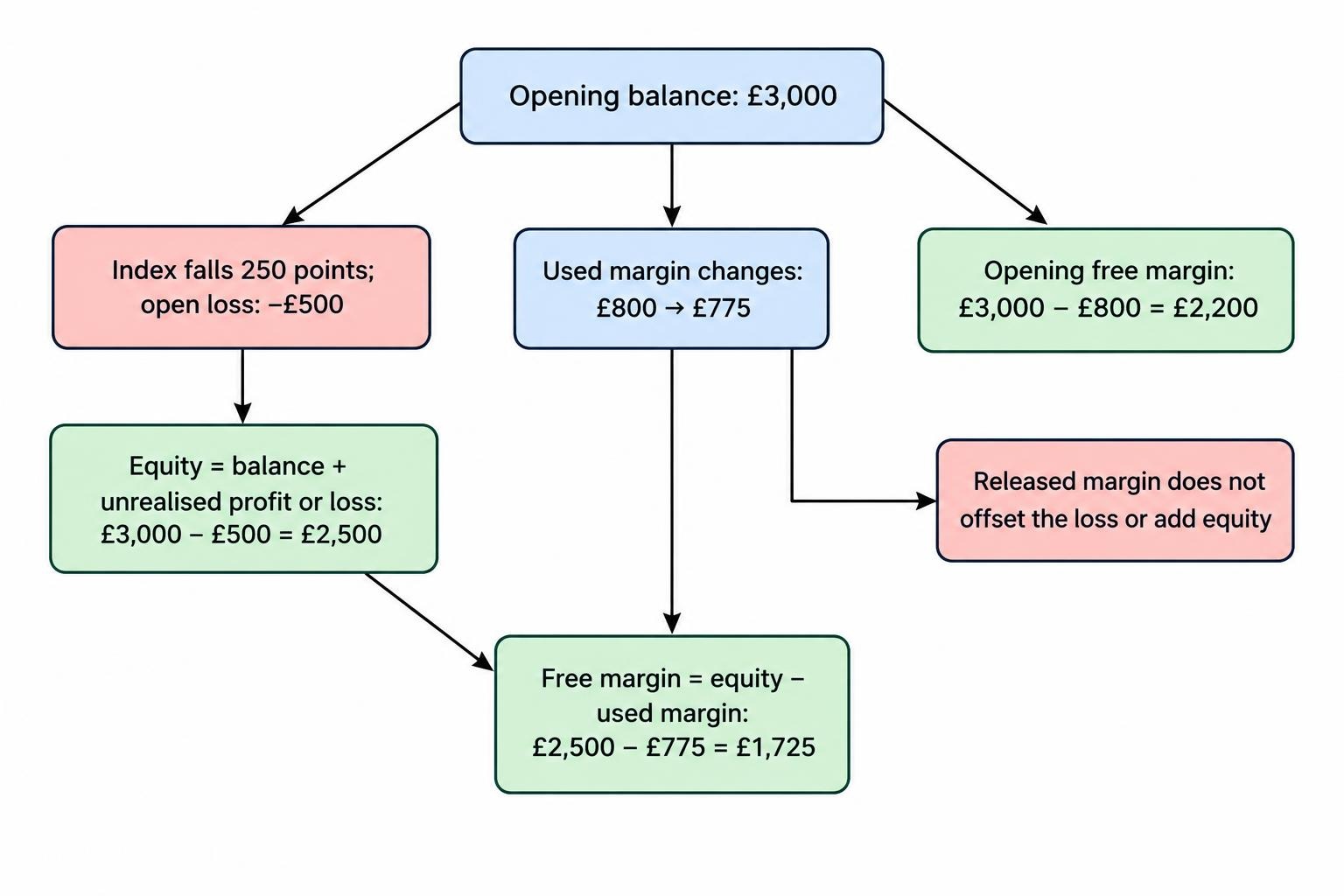
If you close at that point, the £500 loss becomes realised and the balance becomes £2,500. With no other positions or commitments, used margin becomes zero. Releasing the £775 margin does not create another £775 of equity: that money was already included.
Keep the margin calculation separate from the calculation of trading profit and loss. Subtracting both the margin and the loss from equity would count the margin commitment twice.
What Margin Level Means
A platform may express the relationship between equity and used margin as a percentage:
Margin level = equity ÷ used margin × 100
For example, £1,200 of equity against £800 of required margin gives a margin level of 150%. The account has £400 of free margin. Check the platform’s formula, because a display labelled “margin usage” may measure the reverse relationship.
Initial Margin and Ongoing Margin
Initial margin is the amount required to open the trade. Once the position is open, the account must continue to support its ongoing margin requirement.
Do not assume there is always a separate, lower “maintenance margin” percentage. Read how your provider calculates the requirement after opening, including which price it uses to value exposure.
There are two separate moving parts. Account equity changes as trading results and charges change. Required margin can also change if the exposure calculation, position size or applicable margin rate changes. A position can therefore put pressure on available funds without a fresh trading loss.
Suppose exposure stays at £16,000 but the applicable margin rate rises from 5% to 10%. Required margin increases from £800 to £1,600. With equity unchanged at £3,000, free margin falls from £2,200 to £1,400.
Where a provider uses incremental margin bands, calculate each band separately. A hypothetical schedule charging 5% on the first £20,000 of exposure and 10% on the next £10,000 would require £2,000 on a £30,000 position, not £1,500.
Holding costs are another consideration. Overnight financing charges reduce equity when debited, even if the market barely moves. Margin is not itself the financing charge, and a comfortable opening balance does not make holding costs disappear.
What Happens When Margin Becomes Insufficient?
A margin shortfall means the account no longer meets the provider’s required funding conditions. Depending on the account terms and severity of the shortfall, the provider may restrict new trades, request funds or close positions.
For UK retail accounts within the rules, firms must close positions as soon as market conditions allow when net equity falls below 50% of the regulatory margin requirement. Providers may set an earlier close-out threshold. Retail negative balance protection caps liability at the funds dedicated to the trading account, not at the opening margin for one trade. These protections are covered by the FCA policy statement on retail trading protections.
The 50% figure is easy to misread. It does not mean you can lose only half your original account deposit.
In a simplified snapshot with required margin fixed at £800, 50% of that requirement is £400 of equity. An account that started with £3,000 could have suffered £2,600 of net losses before reaching that figure. This is an illustration of the ratio, not a forecast of when a provider would close a real position.
Nor does zero free margin necessarily mean the same thing as reaching the regulatory close-out threshold. With £800 of equity and £800 of required margin, free margin is zero but margin level is 100%.
Do not treat a margin call or funding alert as a guaranteed grace period. Waiting for a message leaves the decision dependent on market speed, communication and the provider’s terms.
The separate guide to the margin close-out rule covers the regulatory process in more detail. For account planning, the practical point is simpler: forced closure should not be your intended exit.
Why Margin Is Not the Same as Trading Risk
Margin answers, “How much money must support this exposure?” Risk planning asks, “How much could this position lose, and what happens if the planned exit fails?” Those are different questions.
Suppose you set an illustrative loss budget of £200 and plan an exit 80 points from entry. Before allowing for costs and execution risk, the corresponding stake is:
£200 ÷ 80 points = £2.50 per point
At an index level of 8,000, that stake creates £20,000 of exposure. A 5% margin rate requires £1,000. The planned £200 price loss and the £1,000 margin requirement serve different purposes; neither replaces the other.
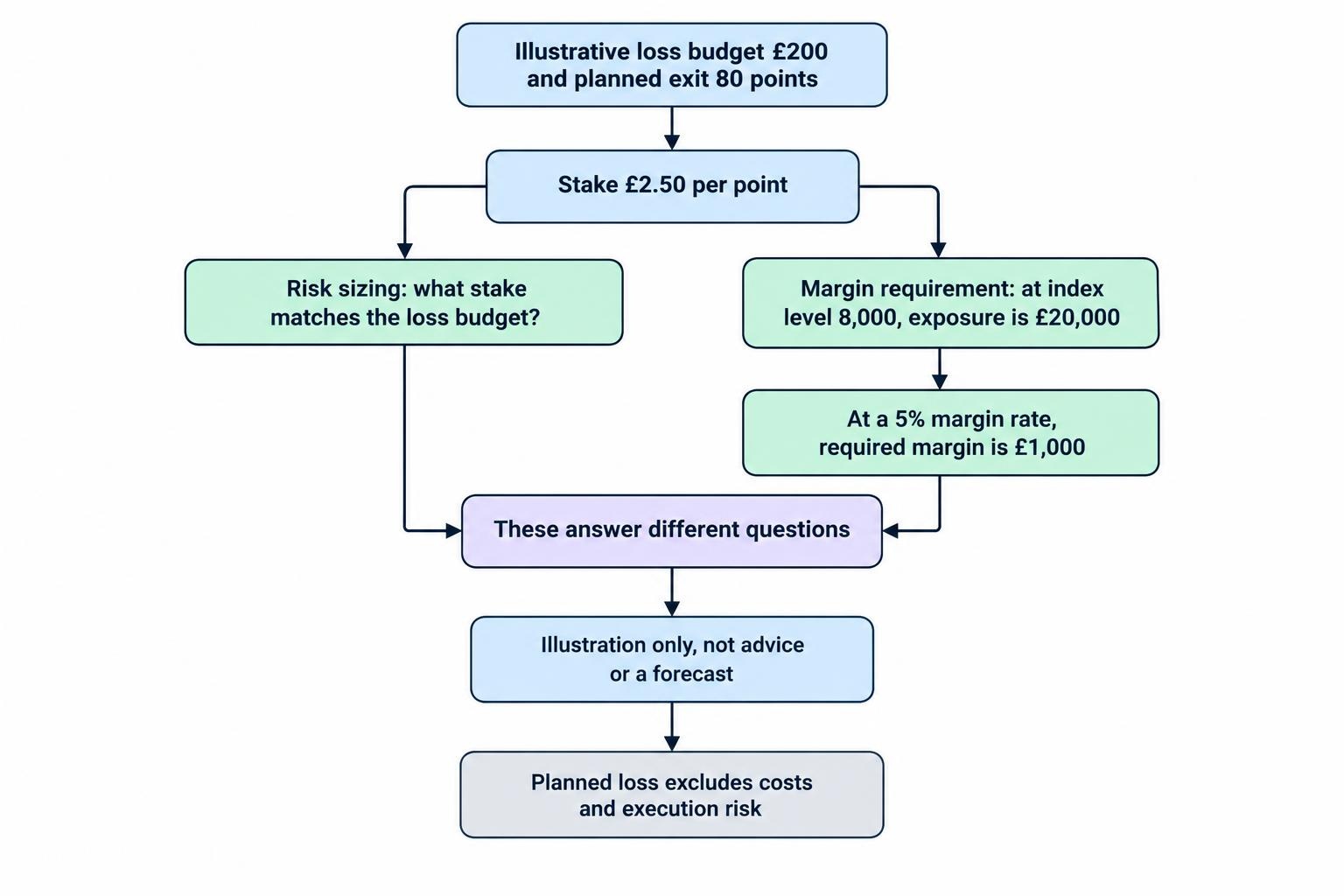
Start with the trade’s exit logic and account loss budget, then check the resulting margin demand. The position sizing process keeps the stake tied to the intended loss rather than to whichever amount the platform permits.
An ordinary stop does not guarantee execution at its trigger price. A gap or fast movement can produce a larger loss. A guaranteed stop-loss order addresses execution-price risk under the provider’s terms, but you should not assume that attaching one automatically reduces the displayed margin requirement.
Adding cash also needs careful interpretation. A deposit can improve free margin and reduce the chance of immediate forced closure. It does not reduce the existing stake or the loss caused by each adverse point. A £2-per-point position remains a £2-per-point position after a top-up.
How Much Free Margin Should You Leave?
There is no universal percentage of free margin that makes an account safe. The appropriate buffer depends on position sizes, market volatility, holding periods, exit orders and the possibility that several trades lose together.
Assess the buffer in pounds as well as percentages. If an account has £600 of free margin, three positions each losing £200 would consume that headroom before allowing for changes in required margin or charges.
Test more than one adverse condition. Ask what happens after a plausible market move, a higher margin rate, a financing debit or a withdrawal. Then consider a combination. These are scenarios, not predictions, but they expose weaknesses that a single account snapshot can miss.
A larger cash balance helps support unchanged positions, but reducing a stake changes the exposure itself. That distinction sits at the centre of managing margin risk. Repeatedly adding money to preserve an oversized position can turn a funding problem into a larger capital loss.
Also check whether available-to-trade funds are withdrawable. An account display is not a promise that every pound of apparent headroom can leave the account without affecting open positions.
What to Check Before Opening a Position
Read the margin figure alongside the proposed trade, not in isolation. Before submitting an order, check:
- Exposure: confirm the quoting unit, stake per point and full market exposure.
- Required funds: check the opening rate, any margin bands and how the ongoing requirement is calculated.
- Remaining headroom: calculate free margin after opening and after an adverse scenario, allowing for other positions and charges.
- Exit conditions: know your planned exit, the provider’s close-out terms and what protection any stop actually provides.
The useful question is not simply whether the account can open the bet. It is whether the account can support the position without depending on an immediate favourable move, a last-minute deposit or a forced exit.