Short selling shares through spread betting means opening a sell bet on a company’s share price, then buying back that bet to close it. You make a profit if your closing buy price is below your opening sell price, after costs. If the price rises, you lose money.
You do not need to own the shares or arrange a stock loan yourself. However, the absence of paperwork does not remove the borrowing costs, dividend adjustments or sharp price rises that can make short positions expensive.
This guide covers the short side of share spread betting: how the trade works, what you pay, and why your initial margin is not your maximum loss.
What a Short Share Spread Bet Actually Does
A share spread bet is a contract with your provider based on movements in an underlying share price. It does not transfer ownership of the shares. Opening a short bet gives you exposure that benefits from a falling price and suffers from a rising one.
With conventional short selling, a trader borrows shares, sells them, then buys shares back to return to the lender. A spread bet replaces those transactions with a cash settled contract. Your provider manages its own exposure, which may involve borrowing or hedging in the underlying market.
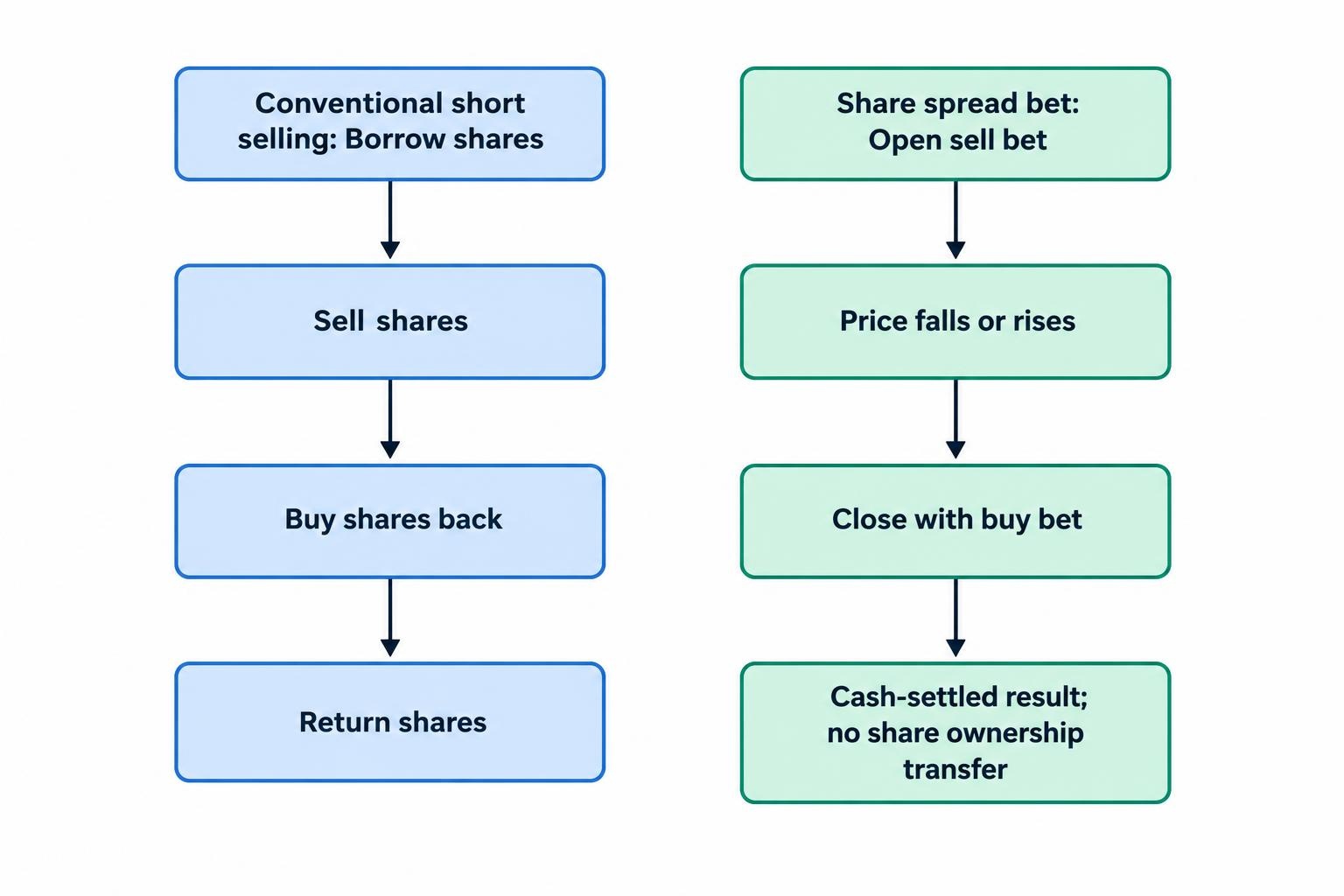
You choose a cash stake for each point of movement. For a UK share quoted in pence, one point commonly means one penny, but always check the contract specification. A £5 stake per penny produces a £50 gain or loss for a ten penny movement.
The stake per point controls your exposure, not the amount you deposit. At £5 per penny, the price sensitivity matches 500 underlying shares: a one penny move across 500 shares is worth £5.
Also distinguish opening a short from selling an existing investment. Selling shares you own reduces your holding. Opening a short spread bet creates a separate position, even if you also own shares in the same company elsewhere.
Worked Example: Selling First and Buying Back Lower
Assume a fictional UK company has a spread betting quote of 498–502. One point equals one penny, and you expect the share price to fall.
You open a sell bet at 498 for £5 per point. To close it, you buy back at the provider’s buy price, also called the offer or ask. You cannot use the lower sell price to calculate your exit.
Short bet profit or loss = (opening sell price − closing buy price) × stake per point.
| Situation at closure | Provider’s quote | Closing buy price | Trading result |
|---|---|---|---|
| The quote is unchanged | 498–502 | 502 | (498 − 502) × £5 = £20 loss |
| The share price falls | 448–452 | 452 | (498 − 452) × £5 = £230 profit |
| The share price rises | 548–552 | 552 | (498 − 552) × £5 = £270 loss |
These results already include the spread because they use the actual opening sell price and closing buy price. Do not subtract the spread again. They exclude financing, stock borrowing charges, dividend adjustments and any other applicable fees.
The unchanged quote shows why a new position starts at a loss. You sell at the lower side of the quote but must buy back at the higher side. The market needs to move far enough in your favour to cover that difference before the trade breaks even.
A chart showing a lower share price does not necessarily mean your short is profitable. Your closing buy quote, rather than a chart’s last traded price, determines the result.
Margin Is Not the Amount You Are Risking
Margin is the money required to support the position. It is not a purchase price and does not cap the loss on that trade.
For a simplified calculation, take a share priced at 500p and a stake of £5 per penny. The position has approximately £2,500 of underlying exposure. At a 20% margin rate, the opening margin would be about £500. A 100 point rise would produce a £500 trading loss, before costs, even though the underlying share had risen only 20%.
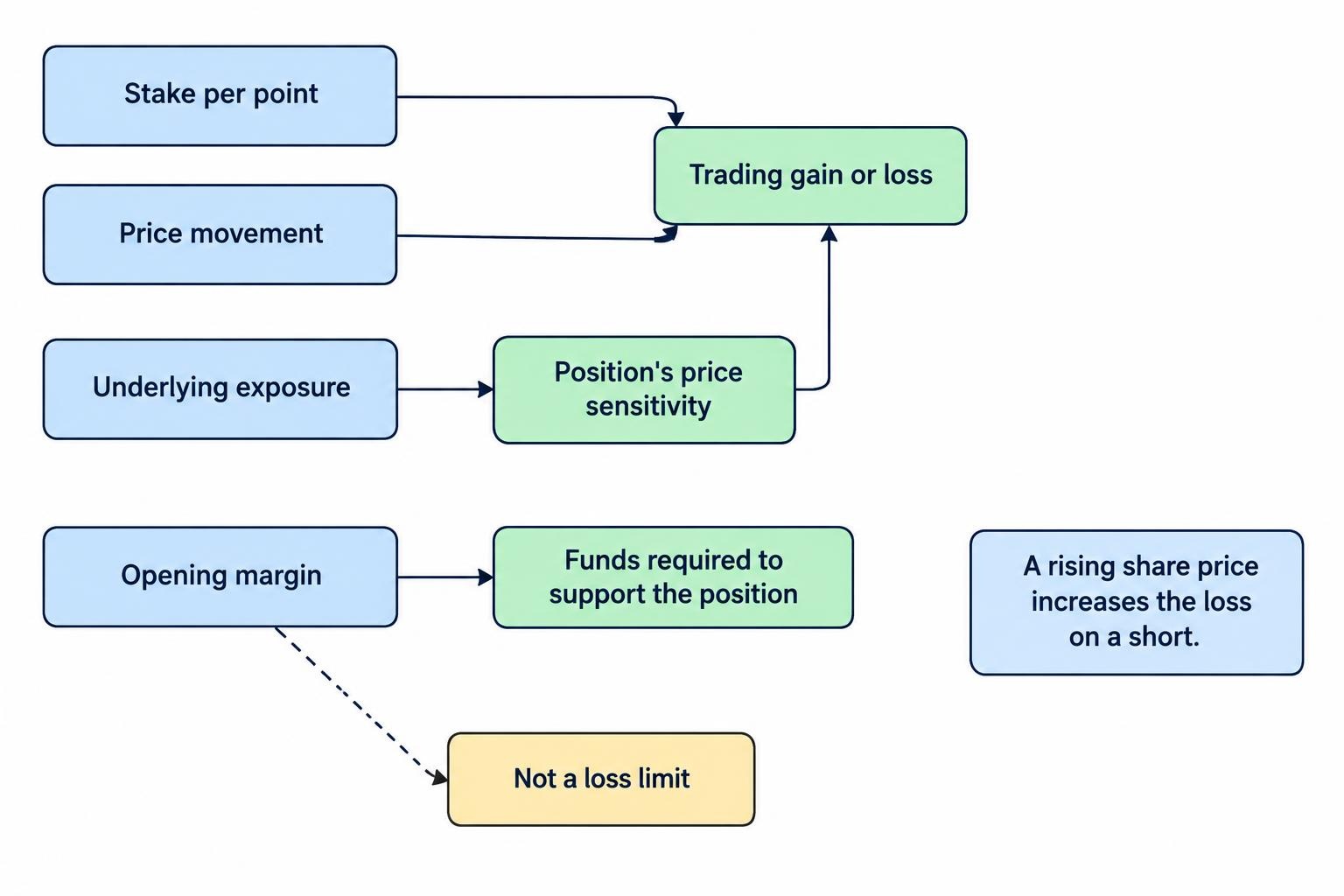
For UK retail accounts within the relevant FCA rules, individual share positions require at least 20% opening margin, equivalent to maximum leverage of 5:1. Providers can require more. The rules also require position closure as soon as market conditions allow when account equity falls below 50% of the required margin, and cap liability for the covered products at the funds dedicated to that trading account. These are separate protections under FCA COBS 22.5 margin, close out and negative balance rules.
Negative balance protection therefore does not mean that a £500 margin allocation can lose only £500. Other funds in the trading account may also be lost. Nor does the margin close out rule promise an exit at a chosen price during a gap or suspension.
Check your contracting entity and client classification before relying on UK retail client protections. Do not assume an overseas account or professional account offers the same safeguards.
How to Open and Close a Short Share Bet
The dealing ticket may make opening a short look straightforward. The preparation should take longer than the click.
- Check that the share is available to short. A company appearing in the market list does not guarantee that new sell positions are available.
- Select the correct contract. Confirm whether it is a daily funded bet or an expiry contract, and check the point size, trading currency and dealing hours.
- Set the stake from your risk budget. Work backwards from the distance to your planned exit rather than choosing the largest position your margin permits.
- Review the costs and exit orders. Check the spread, funding terms, borrowing charges and any restrictions on stops.
- Open the sell position and verify it. Review the execution price, stake, attached orders and remaining account funds.
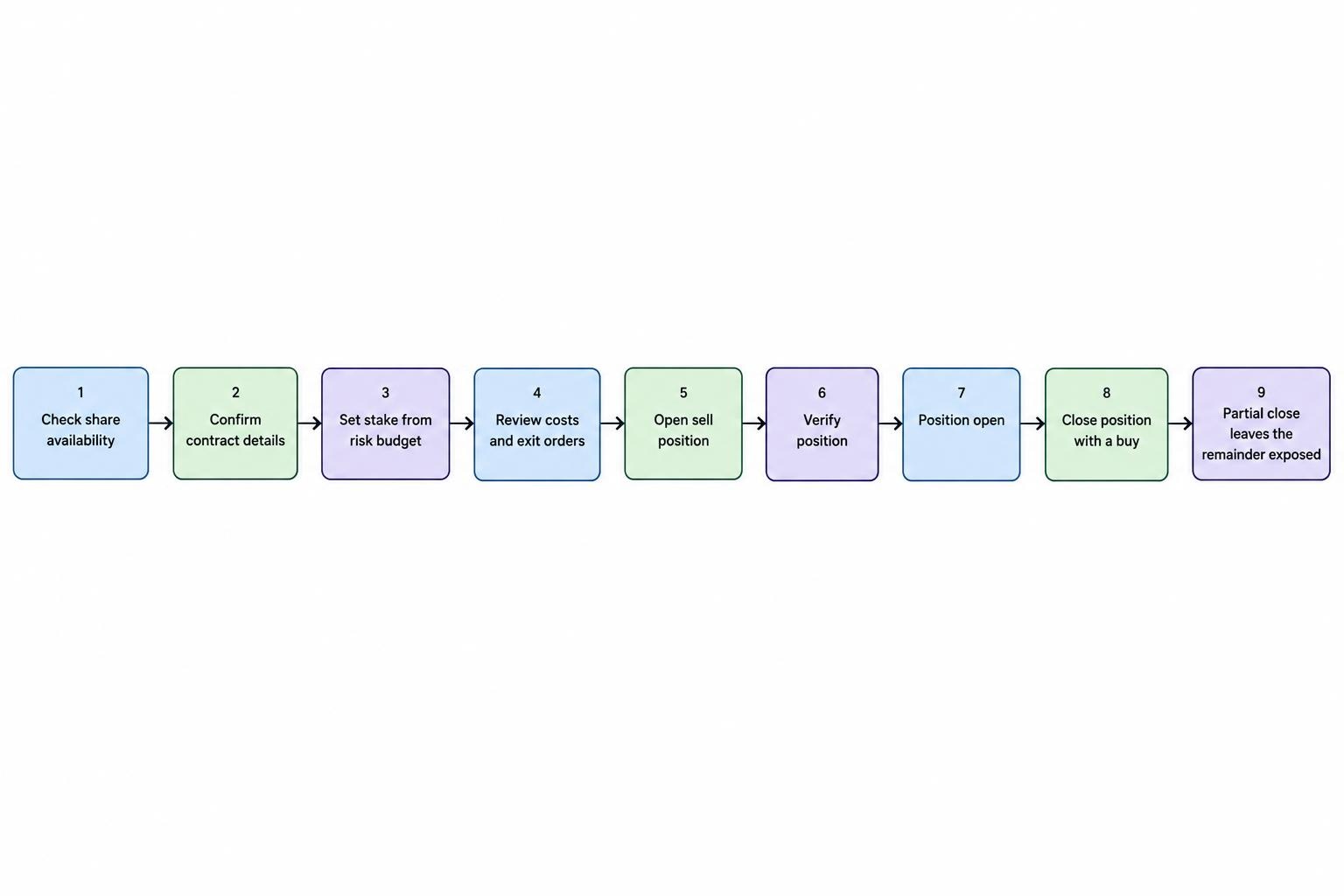
To exit, use the platform’s close function for that position. The closing transaction is a buy. A partial close reduces the stake but leaves the remaining short exposed to further price movements and applicable charges.
Simply submitting a new buy order may not close the original bet. Some account settings allow separate long and short positions in the same share. Check the resulting position list rather than assuming the two have cancelled each other.
A spread betting demo account can help you practise the order sequence and distinguish opening from closing transactions. It cannot establish how a live position will behave during scarce stock borrow, a suspension or a fast market.
The Costs That Matter When Shorting Shares
A short trade can lose money even when the share price falls. The move must cover the dealing spread and any costs incurred while the position remains open.
The spread and execution price
The spread is the difference between the sell and buy quotes. Its cash effect depends on your stake. A four point spread costs £20 at £5 per point if you open and immediately close at unchanged quotes.
Watch the executable quote around announcements and less active trading periods. A wider spread can increase the cost of exiting without an equivalent change in the share price shown on your chart. Compare share spread betting costs across the intended holding period, not just the advertised starting spread.
Overnight financing
A daily funded short position may receive a financing credit or incur a charge. Do not assume selling automatically earns interest. The outcome depends on the contract’s reference rate, provider adjustment and other applicable costs.
Funding is generally calculated against the underlying exposure rather than just the margin deposited. Ask for the annual rate, calculation basis and treatment of weekends or holidays. The FCA’s October 2026 review of CFD and spread betting charges identifies wide differences in overnight funding and confirms that some short positions receive credits while others incur charges.
An expiry contract may reflect financing within its quote instead of applying the same daily funding method. Compare the total expected cost; a different label does not make holding the position free.
Stock borrowing charges and availability
Your provider may apply a separate stock borrowing charge to a short share bet. Check whether it applies, how it is calculated and whether the rate can change while the bet is open.
Read the terms governing lost borrow availability too. They may permit the provider to close a short at the prevailing price if the supporting borrow disappears. The ability to open a bet does not guarantee you can keep it open indefinitely.
Dividend adjustments
A short cash share bet held across the relevant dividend adjustment point will normally receive a debit. It is a contract adjustment, not a dividend paid to you as a shareholder.
Suppose a 10p dividend produces a matching ten point price fall. At £5 per point, the short shows a £50 price gain, but a £50 dividend debit would offset it before other costs. Shorting just before the ex-dividend date is not a free money trick.
The actual price can move for other reasons, and adjustment amounts and timing depend on the contract. Check the terms before holding across an ex-dividend date. The guide to dividends and share spread bets covers those adjustments in more detail.
Why Short Shares Can Rise Faster Than Expected
A short position has an awkward price relationship: the potential gain from a fall is finite because a share cannot ordinarily fall below zero, but there is no matching ceiling on how high its price can rise.
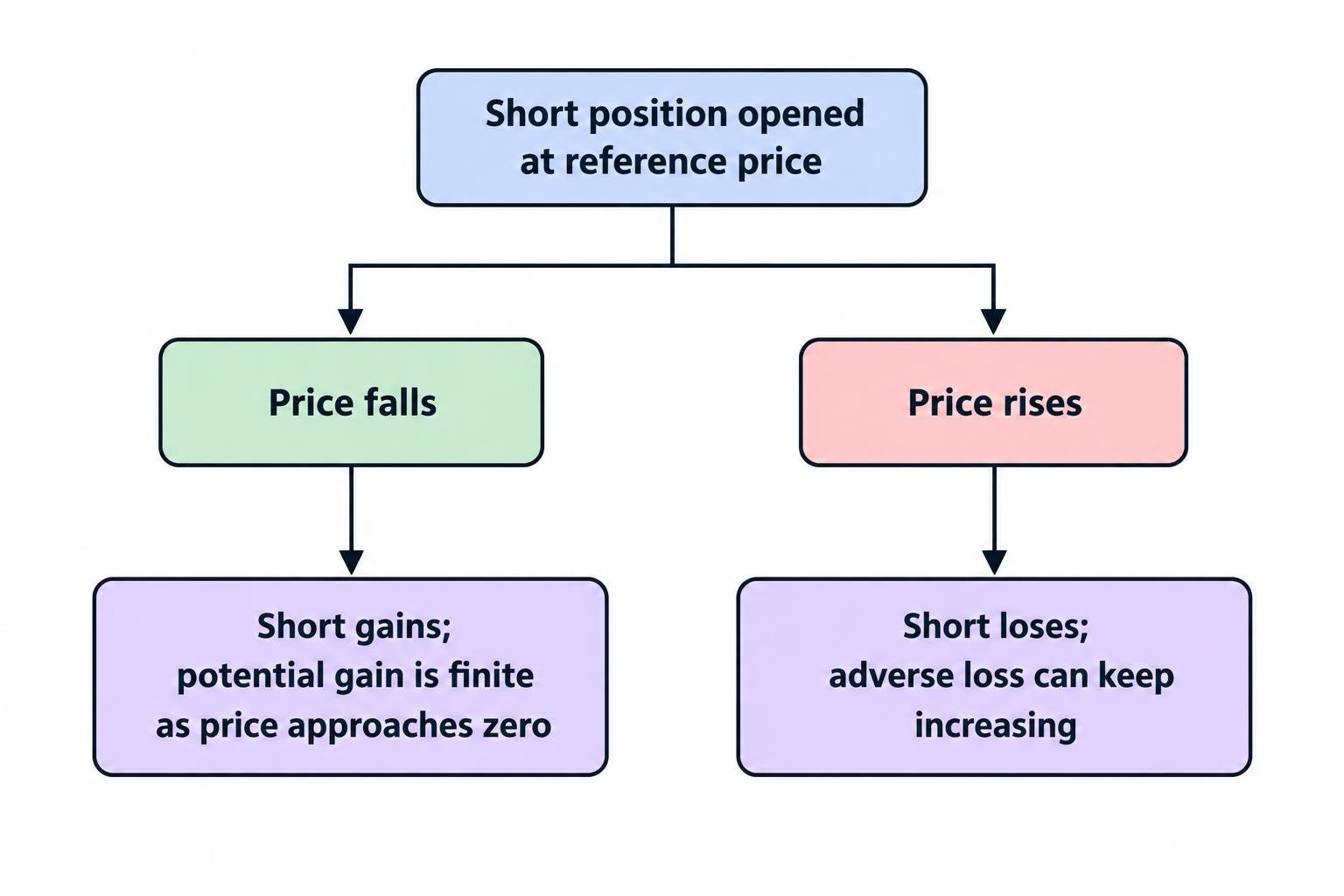
Account protections affect your liability; they do not change that underlying price exposure. Nor do they make a large adverse move manageable.
Short squeezes
A short squeeze occurs when a rising price prompts short sellers to buy back their positions, adding buying pressure to the move. Margin pressure and risk limits can force traders to exit even when they still believe the company is overvalued.
Heavy short interest is therefore not a reason on its own to join the trade. It can reflect a bearish case, but it can also mean many traders may need to buy back at the same time.
Takeovers and other company events
A takeover proposal can push a share price above the previous close before a short seller has an opportunity to react. Better earnings, new financing or a favourable court decision can also overturn a bearish case.
Share splits, rights issues and other events can alter the contract’s treatment. A change in the displayed price does not automatically represent a trading gain. Check how corporate actions affect spread bets before interpreting an adjusted position.
Gaps and trading suspensions
A share can reopen far above your intended exit. A suspension may prevent dealing altogether until trading resumes or the provider applies its contractual treatment.
An ordinary stop order does not guarantee its execution price. If the next available buy quote is well above the stop, the loss can exceed your planned amount. This is the practical problem behind market gap risk, particularly when holding a short through results or unexpected news.
Size the Position Around a Failed Trade
Start with the price at which your trade idea no longer makes sense. Then calculate a stake that keeps the planned loss within your cash budget.
Suppose you sell at 498 and plan to exit at a buy price of 518. That is a 20 point adverse move. With a £100 planned price risk, the calculation is:
£100 ÷ 20 points = £5 per point.
If the exit executes at 518, the price loss is £100. Financing, borrowing charges and other costs can increase the total. If the market gaps and the exit executes at 550 instead, the price loss becomes £260.
This is why position sizing for spread betting should include an allowance for costs and an adverse execution scenario. A stop distance is a planning input, not a promise about the final loss.
For a short position, a protective stop is normally a buy order above the market. Check which quote triggers it. A chart displaying the bid may remain below your stop while the higher buy quote reaches the trigger.
Where available, a guaranteed stop loss order can fix the exit price under the provider’s terms, including during a gap. Check availability for the share, minimum distance, premium and treatment of company events. It does not remove holding costs.
Review related positions too. Three shorts in retailers can act like one larger bet on consumer spending. Separate trade tickets do not make their risks independent.
Shorting a Share You Already Own
A short spread bet can offset some price exposure from a physical shareholding without selling that holding. The position sizes must match the share’s point convention.
Suppose you own 1,000 UK shares and one spread betting point equals one penny. The holding gains or loses £10 for each penny of price movement. A short bet of £10 per point would approximately offset that price exposure before spreads, financing, borrowing costs and adjustments.
The hedge still needs cash. If the share price rises, the physical holding gains value while the short loses money in the spread betting account. The provider will not necessarily accept the gain in a separate share dealing account as margin.
A hedge can therefore reduce price exposure while creating a funding problem. It also brings additional contract and tax questions. The guide to hedging with financial spread bets covers those decisions; a short bet should not be treated as a costless substitute for selling shares.
Decide What Would Make You Close
A useful short thesis needs more than “the shares look expensive”. Identify what you expect to change, what evidence would contradict your view and how long you are prepared to pay the holding costs.
A company can remain expensive for longer than a trading account can support the position. A profitable short can also become unattractive if borrow charges rise or the expected event passes without a price response.
Before opening, you should be able to state the point value, cash exposure, opening margin, planned exit and expected holding costs. You should also know what happens if the share gaps, borrow disappears or trading stops.
Short selling through spread betting removes the need to arrange the underlying share loan yourself. It does not remove the discipline the trade requires: a measured stake, enough account headroom and an exit plan that still makes sense when the price moves the wrong way.