Gilt spread betting lets you trade changes in UK government bond prices without owning the bonds. You choose a stake per point, buy if you expect the quoted price to rise, or sell if you expect it to fall. Your profit or loss depends on the price movement and your stake, after trading costs.
The distinction that matters most is price versus yield. A long position in a gilt price generally benefits when yields fall, not when they rise. Before placing a trade, you also need to identify the underlying contract, check what one point means and calculate the cash exposure. A government bond reference does not make a leveraged bet a low risk investment.
What Are You Trading With a Gilt Spread Bet?
Gilts are sterling securities issued by the UK government. Conventional gilts pay fixed coupons, normally every six months, and repay their principal at maturity. Index-linked gilts adjust their coupons and principal for RPI inflation, subject to their terms. The Debt Management Office’s description of gilt securities sets out these differences.
A spread bet is a separate contract with a provider. You do not become a registered bondholder, receive the gilt’s coupon as investment income or acquire a right to its repayment at maturity. Instead, you gain exposure to movements in the provider’s quoted market.
This distinction separates trading gilt prices from buying government debt for income or a future cash payment. The broader bond spread betting guide covers the surrounding market; here, the focus is the UK gilt contract and the decisions involved in trading it.
Which Gilt Contract Does the Bet Follow?
Check the instrument description rather than relying on a label such as “UK Gilt” or “Long Gilt”. Establish whether the quote follows a dated futures contract, a rolling price derived from futures, an individual bond or another reference.
The ICE Long Gilt future is a benchmark for the ten year area of the UK government bond market. It is not the price of one permanently fixed ten year bond. ICE also offers contracts covering other maturity areas, which have different interest rate exposures. The ICE government bond futures overview identifies those maturity segments.
The Long Gilt future represents £100,000 nominal value of a notional gilt with a 4% coupon. Its deliverable maturity range is eight years and nine months to thirteen years. It is quoted per £100 nominal, with a minimum movement of 0.01 worth £10 per exchange contract. Delivery months are March, June, September and December. These are ICE Long Gilt contract specifications, not a spread betting provider’s stake or margin terms.
The word “Long” in the contract name refers to its maturity segment. You can still take a short spread betting position on it. Nor does its notional 4% coupon mean a spread bettor earns 4% a year.
Gilt Prices and Yields Move in Opposite Directions
For a conventional gilt with fixed promised payments, a higher purchase price means a lower yield to maturity. A lower purchase price means a higher yield. The cash payments have not changed; the price paid to receive them has.
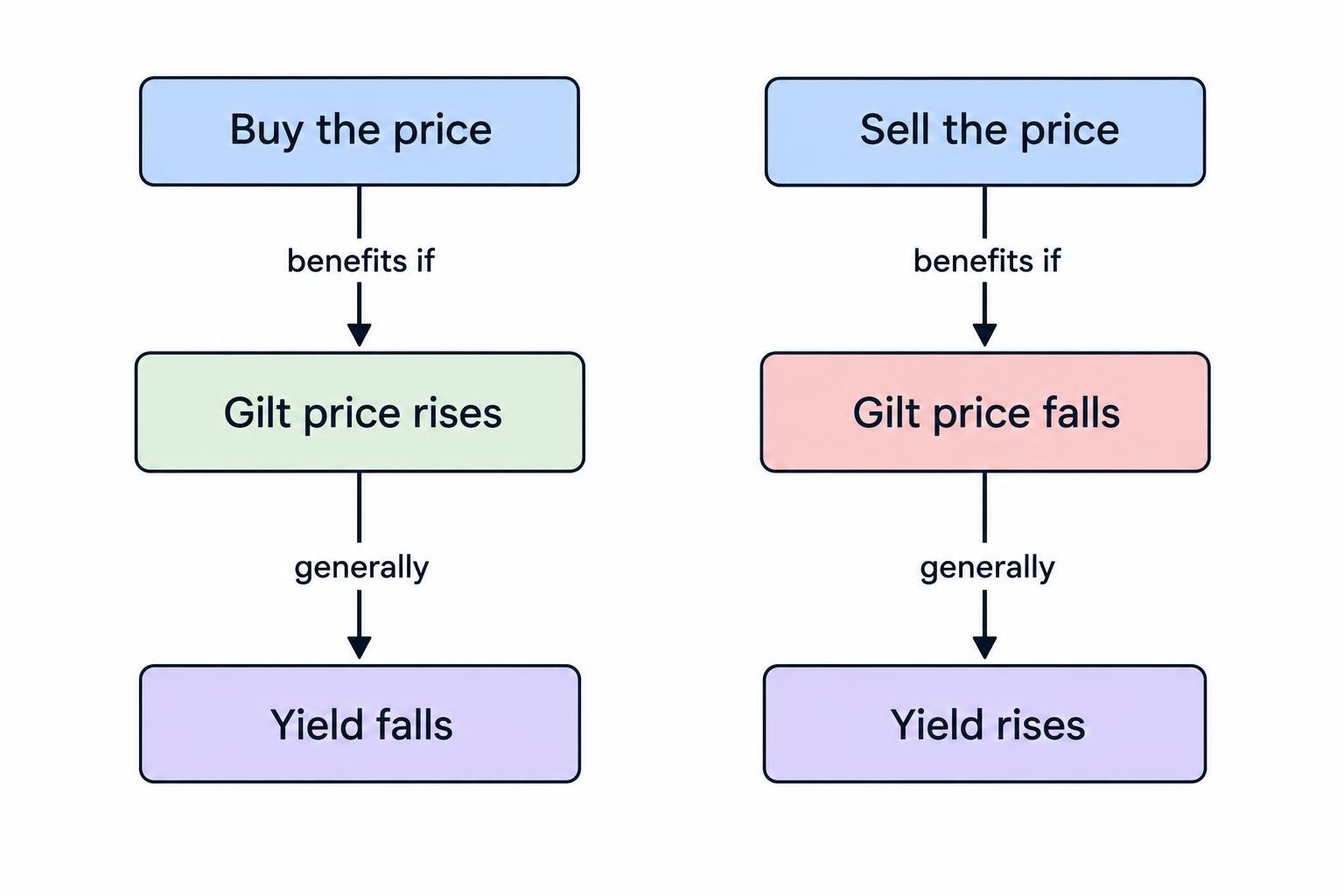
For a spread bet quoted on gilt prices, the trading direction therefore works as follows:
- Buy the price: you benefit if the quote rises, generally associated with falling yields.
- Sell the price: you benefit if the quote falls, generally associated with rising yields.
A forecast that “UK borrowing costs will rise” normally points towards a bearish price view, not a bullish one. Buying a gilt price because you expect its yield to rise gets the relationship backwards.
This relationship does not provide an exact conversion between a headline ten year yield and a futures price. The instruments, maturities and pricing details differ. Check whether the trading screen displays a bond price or a yield before deciding what “up” means for the position.
Check the Point Size Before Choosing a Stake
The exchange’s price format and the provider’s betting point are not necessarily presented in the same way. A futures-style price might appear as 104.20, while a spread betting screen could display an equivalent scaled number such as 10,420.
Suppose the provider defines one betting point as a 0.01 movement in the futures-style price. Under that convention, a move from 104.20 to 104.70 is 50 betting points. At £2 per point, that movement changes the position’s value by £100.
If one betting point instead represented a full 1.00 price movement, the same displayed stake would create very different exposure. Never transfer a point convention from another market without checking it. The stake per point guide explains how that unit controls the cash result.
A basis point is different again: it is 0.01 percentage points of yield. A yield increase from 4.00% to 4.25% is 25 basis points. It is not automatically a 25 point fall in the tradable price.
Gilt Spread Betting Worked Example
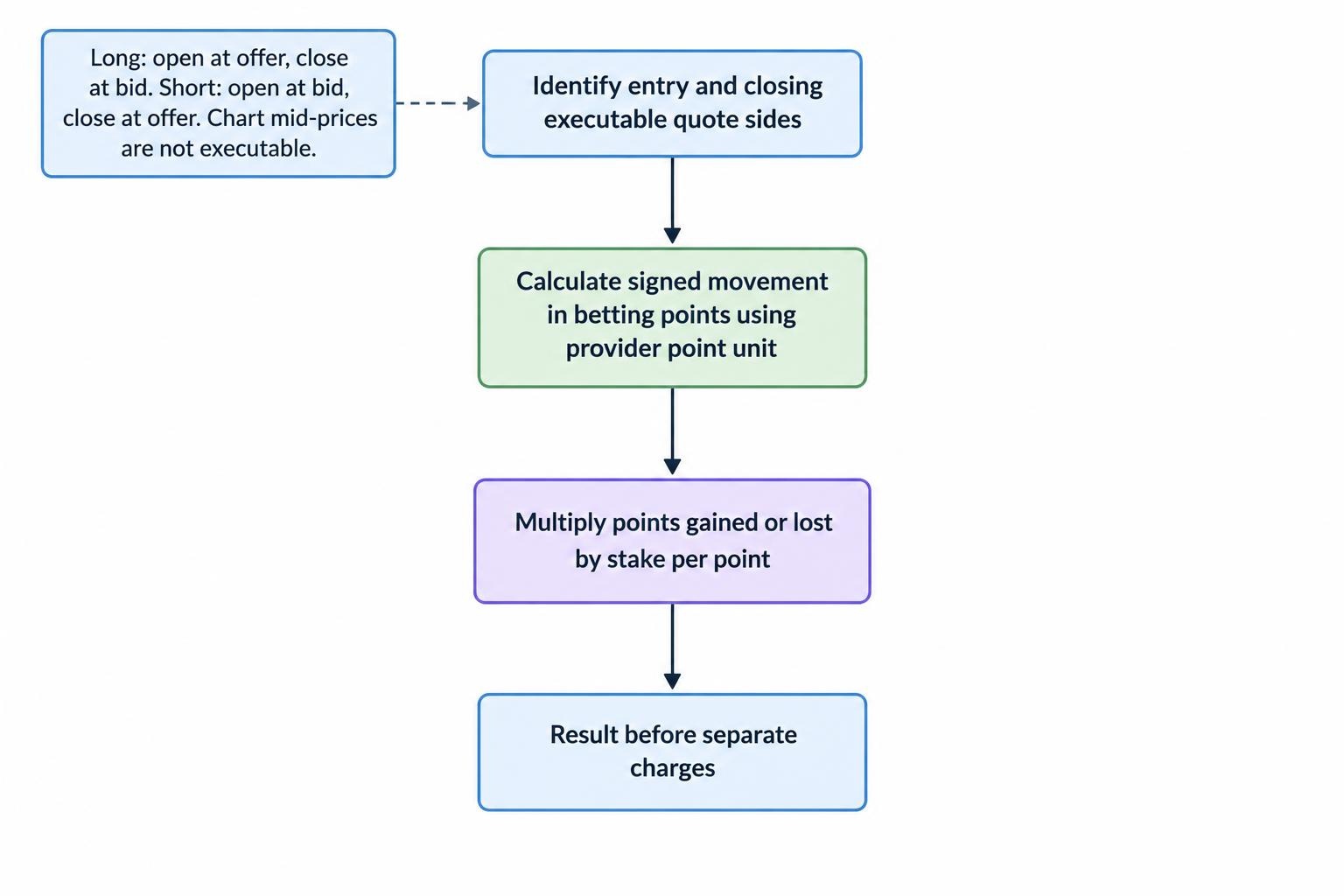
The following prices and trading terms are hypothetical. Assume the provider quotes 104.20 to sell and 104.24 to buy, defines one betting point as 0.01, and accepts a stake of £2 per point.
You expect gilt prices to rise, so you buy at 104.24. To close the position, you sell at the provider’s bid price.
| Outcome | Closing bid | Movement from entry | Trading result before other charges |
|---|---|---|---|
| Immediate close with an unchanged quote | 104.20 | 4 points against you | £8 loss |
| Price rises | 104.84 | 60 points in your favour | £120 profit |
| Price falls | 103.94 | 30 points against you | £60 loss |
The entry and exit prices already include the bid-ask spread. Do not subtract the opening spread again after calculating the result from those executable prices. Deduct any separate financing, rollover or other applicable charges instead.
For a short trade, you would open by selling at 104.20 and close by buying. If the closing offer were 103.60, the favourable movement would be 60 points, producing £120 before other charges. A closing offer of 104.50 would produce a £60 loss.
Always use the correct side of the quote. A chart’s middle price may not be available for execution. The separate guide to calculating spread betting profit and loss covers the arithmetic across different quote formats.
What Moves Gilt Spread Betting Prices?
Interest rate expectations and inflation
Gilt prices respond to expectations for future interest rates, not just the current Bank Rate. A policy decision that changes the expected path of rates can affect longer dated yields before those future decisions occur. The Bank of England’s paper on monetary policy transmission describes how expected policy rates feed into the yield curve and asset prices.
This makes the difference between a release and market expectations more useful than the headline alone. Inflation can fall yet still exceed forecasts. A rate cut can arrive alongside guidance that discourages expectations for further cuts. Neither headline guarantees a gilt rally.
For a trade built around an economic announcement, write down what outcome would support the position and what would contradict it. “Inflation is falling” is a broad observation. “The release could reduce expectations for future rates” is a testable trading premise, though still an uncertain one.
Government borrowing, supply and demand
Fiscal announcements can change expectations for borrowing and future bond supply. Investor demand matters too: the market must absorb issuance at prices buyers will accept. A forecast based only on monetary policy can miss this part of the trade.
Check scheduled supply events alongside economic releases. The DMO gilt issuance calendar provides the official timetable for planned issuance operations. Use it to identify relevant events rather than assuming that every auction will move prices in a predictable direction.
Keep the chosen maturity segment in view. A change concentrated in very long dated gilts need not translate into an identical move in a contract centred nearer ten years.
Interest rate sensitivity
Duration measures a bond’s sensitivity to changes in yield. Other things being equal, longer duration means a larger percentage price response to the same yield movement. It helps explain why a small looking change in yields can produce a substantial trading loss.
As a simplified illustration, a bond with modified duration of eight would lose approximately 2% if its yield rose by 0.25 percentage points, ignoring convexity and other changes. That is an approximation, not a forecast or a reliable calculation for every gilt future.
For a futures-linked spread bet, the deliverable bonds and contract pricing also matter. Do not assume its sensitivity remains fixed through time, or size it solely from the apparent calm of its recent chart.
Margin Is Not the Amount You Are Risking
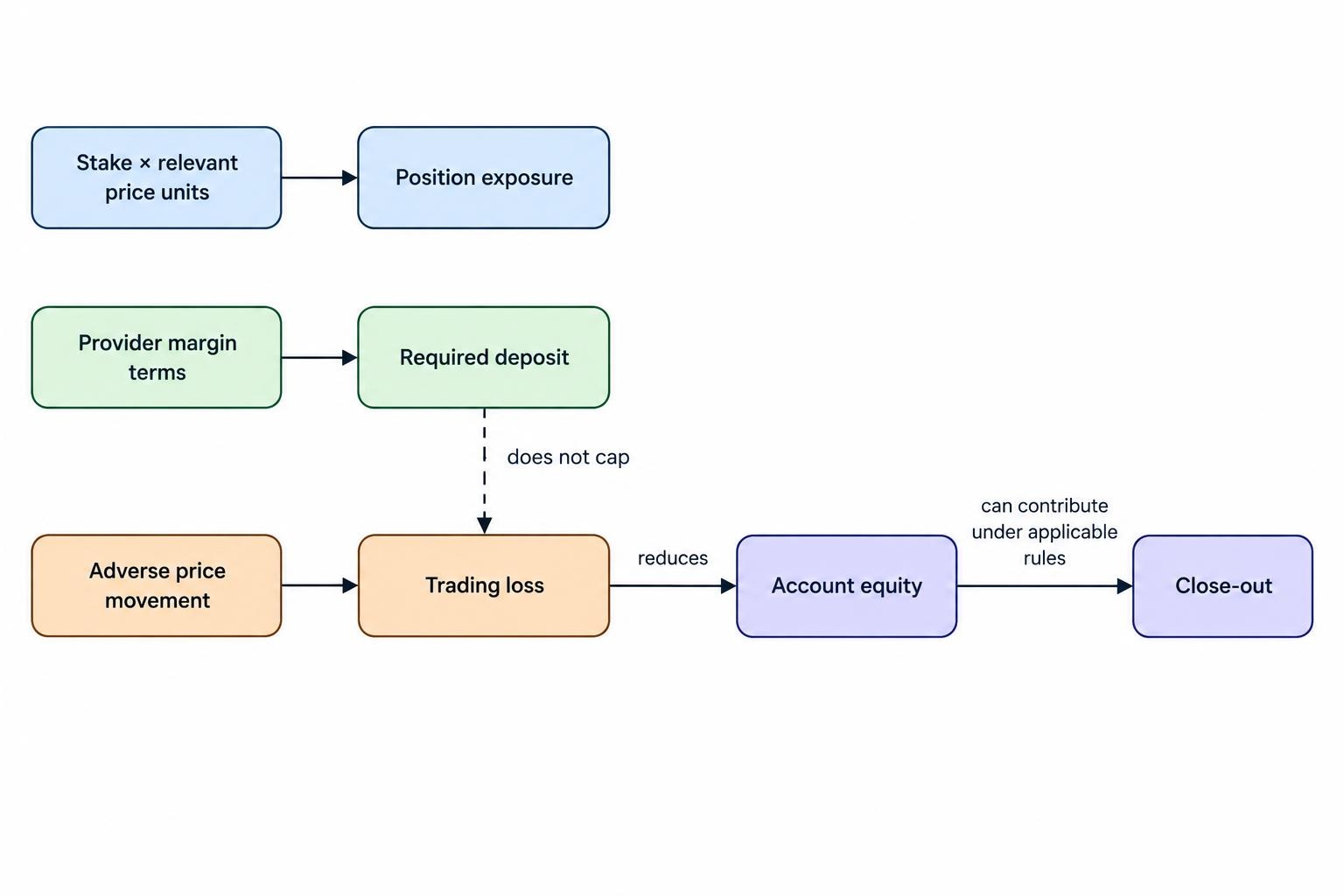
Margin is the deposit required to support the position. It is not its purchase price and does not cap its loss. The exposure comes from the stake multiplied by the relevant price units, with margin calculated under the provider’s terms.
UK retail rules set a minimum initial margin of 3.33% for relevant sovereign debt exposure, a category that includes UK government debt. Providers may require more. The rules also require account-level close-out when net equity falls below 50% of the required margin, with positions closed as soon as market conditions allow, and provide negative balance protection for the relevant account. These provisions sit in FCA COBS 22.5 on retail speculative investments.
Those protections do not make an individual trade safe or preserve its initial margin. An account can lose the funds dedicated to this trading, and forced closure can disrupt the intended holding period.
Using the earlier hypothetical point convention, a price of 104.24 represents 10,424 betting points. At £2 per point, the approximate exposure is £20,848. If the provider required 5% margin, the initial requirement would be £1,042.40. That 5% is an illustration, not a statement of a provider’s current terms.
A 1% adverse price movement would cost approximately £208.48 before charges, equal to about 20% of that illustrative margin deposit. The underlying move looks small; the effect on committed cash is not.
Check the required deposit separately from the planned loss and leave room for adverse price movements and charges. The spread betting margin guide explains the distinction between exposure, account equity and available funds.
Size the Stake From the Exit Plan
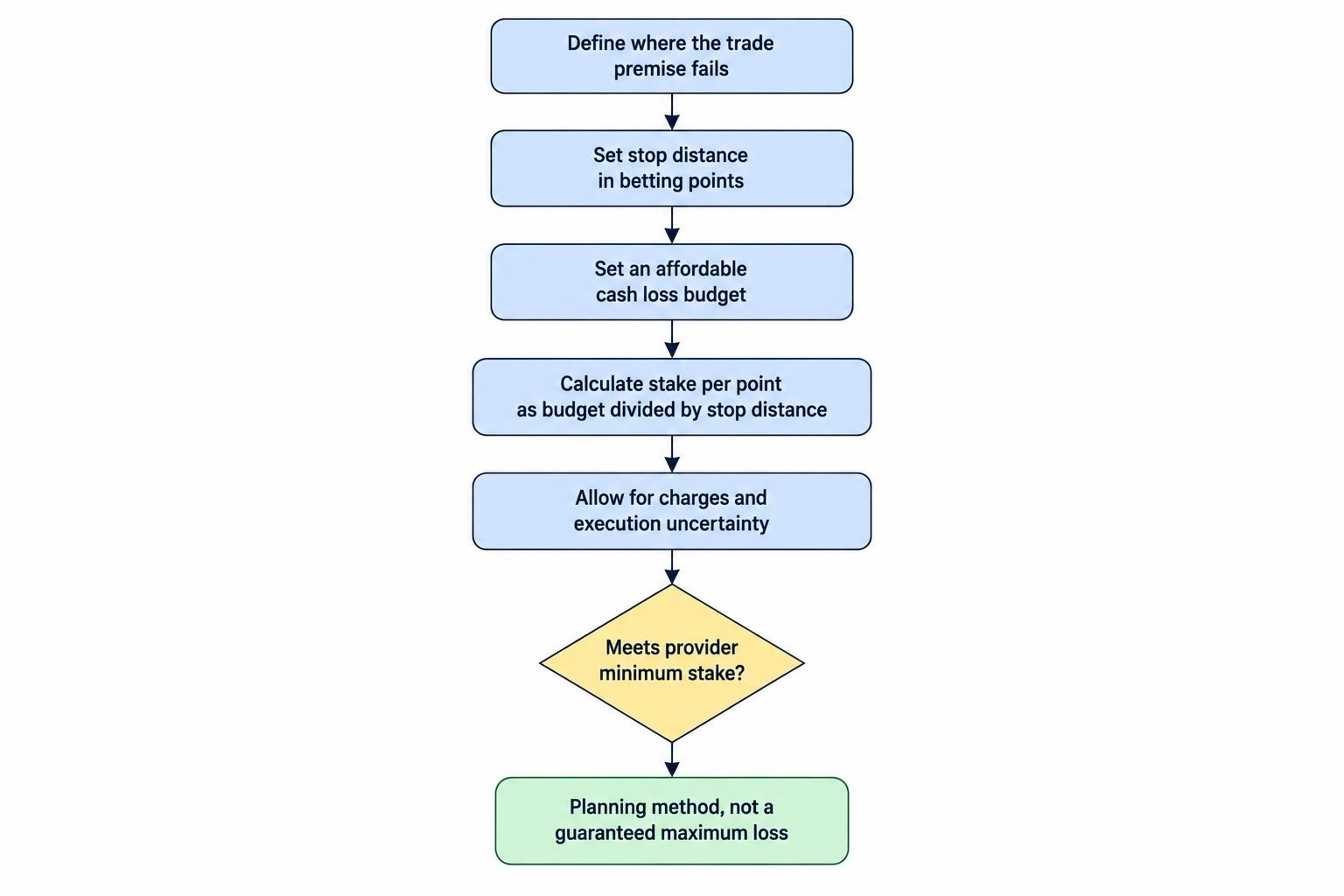
Choose the point at which the trade premise no longer holds before selecting the stake. Then translate that distance into money. Starting with the largest position the account permits reverses the process.
Suppose a hypothetical trade has a £100 planned loss budget and an ordinary stop 40 betting points from entry. Ignoring charges and execution uncertainty, the corresponding stake is £2.50 per point: £100 divided by 40.
That is a planning calculation, not a guaranteed maximum loss. Costs need an allowance, and an ordinary stop may execute beyond its trigger. If the provider’s minimum stake exceeds the amount the plan permits, the trade does not fit the budget.
Widening the stop while retaining the same cash budget requires a smaller stake. Widening it without reducing the stake simply increases the planned loss. A fuller position sizing framework also accounts for other open positions and the account’s capacity to absorb losses.
For gilt trades around announcements, consider whether the stop distance is realistic for that event. A very tight stop can reduce the calculated cash risk without making the intended trade practical.
Costs, Expiry and Holding the Position
Spread and financing
The bid-ask spread creates an immediate trading cost. In the worked example, the four point difference costs £8 at £2 per point if prices remain unchanged. A wider spread requires a larger favourable movement just to reach break-even.
Holding charges depend on the product. Where a rolling or daily funded gilt market is offered, inspect its financing method, charging time and treatment of long and short positions. Do not assume a short trade earns a credit because the underlying asset is a bond. The overnight financing cost guide covers the questions to ask.
Compare costs against the intended holding period. A quote that looks attractive for a short trade may be less suitable for a position held for several weeks.
Dated contracts and rollover
A dated spread bet can have an expiry and a provider-defined last dealing time. Check whether it will close for cash, roll into another contract or require an instruction from you. Do not assume the provider follows the exchange’s final trading deadline exactly.
Different futures months can trade at different prices. A move between contracts is not automatically an economic gain or loss equal to the visible price difference: the closing level, new opening level, stake and adjustments all matter.
Before holding across a roll, review the treatment of open orders, stops and transaction charges. The guide to futures and forward spread bets covers those mechanics without confusing a cash-settled bet with physical bond delivery.
Trading Hours and Execution Risk
Check the provider’s dealing hours for the exact gilt market and contract month. Exchange hours, provider access, holiday arrangements and expiry cut-offs are separate details. An available chart does not prove that you can place or close a trade at that moment.
Execution deserves particular attention around monetary policy announcements, inflation releases and fiscal statements. Quotes can move while an order is being processed, and an ordinary stop is a trigger for execution rather than a promise of its final price.
If a long position’s stop triggers during a sharp fall, the sale may occur below the intended level. The difference between the expected and executed price is slippage. A guaranteed stop, if available for that market, has separate eligibility conditions and possible costs.
Before an event, decide whether to retain the position, reduce it or close it. Making that decision after a sudden move leaves less control over the result. Also check which quote side triggers the stop and whether the platform applies a minimum distance from the market.
Government Debt Does Not Remove Trading Risk
The credit characteristics of UK government debt do not protect a leveraged position from price losses. A gilt can meet its promised payments while its market value falls enough to trigger a trader’s stop or margin close-out.
The distinction was visible on 28 September 2022, when the Bank of England announced temporary purchases of long dated government bonds to restore orderly conditions during gilt market dysfunction. The Bank’s gilt market intervention announcement records the action and its financial stability purpose.
That episode is a reason to assess severe price moves, not a template for predicting the next intervention. A market can move beyond a planned exit between tradable prices. The separate market gap risk guide explains why an ordinary stop cannot eliminate that exposure.
Nor should a gilt position be treated as an automatic hedge for shares. Whether it offsets another holding depends on the shock, the maturity exposure, the direction and the stake. Test the combined loss under adverse scenarios rather than relying on an asset label; portfolio correlation and spread betting risk covers this account-level assessment.
A Practical Check Before Placing a Gilt Bet
The trade ticket should confirm the exposure you intended, not introduce a surprise. Before submitting the order, check:
- Reference: the underlying instrument, maturity area and contract month.
- Units: the cash effect of a 0.01 and a 1.00 price movement at your stake.
- Direction: whether the position expresses a view on rising prices or rising yields.
- Exit: the stop distance, execution conditions and planned cash loss.
- Holding terms: margin, financing, dealing hours, expiry and rollover instructions.
A spread betting demo account can help check the platform’s quote scaling and order controls. It cannot establish that a strategy will be profitable or reproduce every live execution condition.
Common Questions About Gilt Spread Betting
Can you spread bet directly on the ten year gilt yield?
That depends on the product offered. A Long Gilt price contract is not a direct yield quote. If a provider offers a yield-based instrument, check its calculation, point value and direction separately. Do not reuse a bond price calculation without verifying the terms.
Is a gilt spread bet the same as an interest rate spread bet?
No. Gilt prices reflect government bond exposure over their relevant maturities. A short term interest rate contract can reference a different rate and use a different quotation method. The interest rate spread betting guide covers that separate market.
Can you hold a losing gilt bet until the bond matures?
A spread bet does not give you the bondholder’s repayment entitlement. The position remains subject to its own expiry, charges, margin requirements and closure terms. A belief that the underlying government will repay its debt does not solve a leveraged trading loss.
The practical starting point is therefore the contract specification, not the reputation of the underlying asset. Identify the reference, confirm the point value and size the position from an affordable loss plan before taking a view on yields.