A guaranteed stop comparison should answer two questions: will the provider accept the protection your trade needs, and what will that protection cost? A low premium is little use if the minimum stop distance forces you to take more risk than planned.
The comparison below covers pricing, stop distances, cash requirements, trading restrictions and evidence of acceptance. It uses clearly labelled hypothetical offers to show how different terms change the result. It is not a live broker tariff survey, a ranking of named providers or a claim that execution has been tested.
For a provider shortlist, use the separate comparison of spread betting brokers with guaranteed stops. Here, the focus is comparing their terms on an equal basis, rather than treating a tick beside “guaranteed stops available” as the end of the research.
What a Useful Guaranteed Stop Comparison Measures
Start with a defined trade, not a provider’s headline premium. Record the market, contract type, direction, stake, intended entry, stop level and expected holding period. The comparison should also identify the account’s legal entity and client classification. An offer for a different product or account is not evidence that the same terms apply to your spread bet.
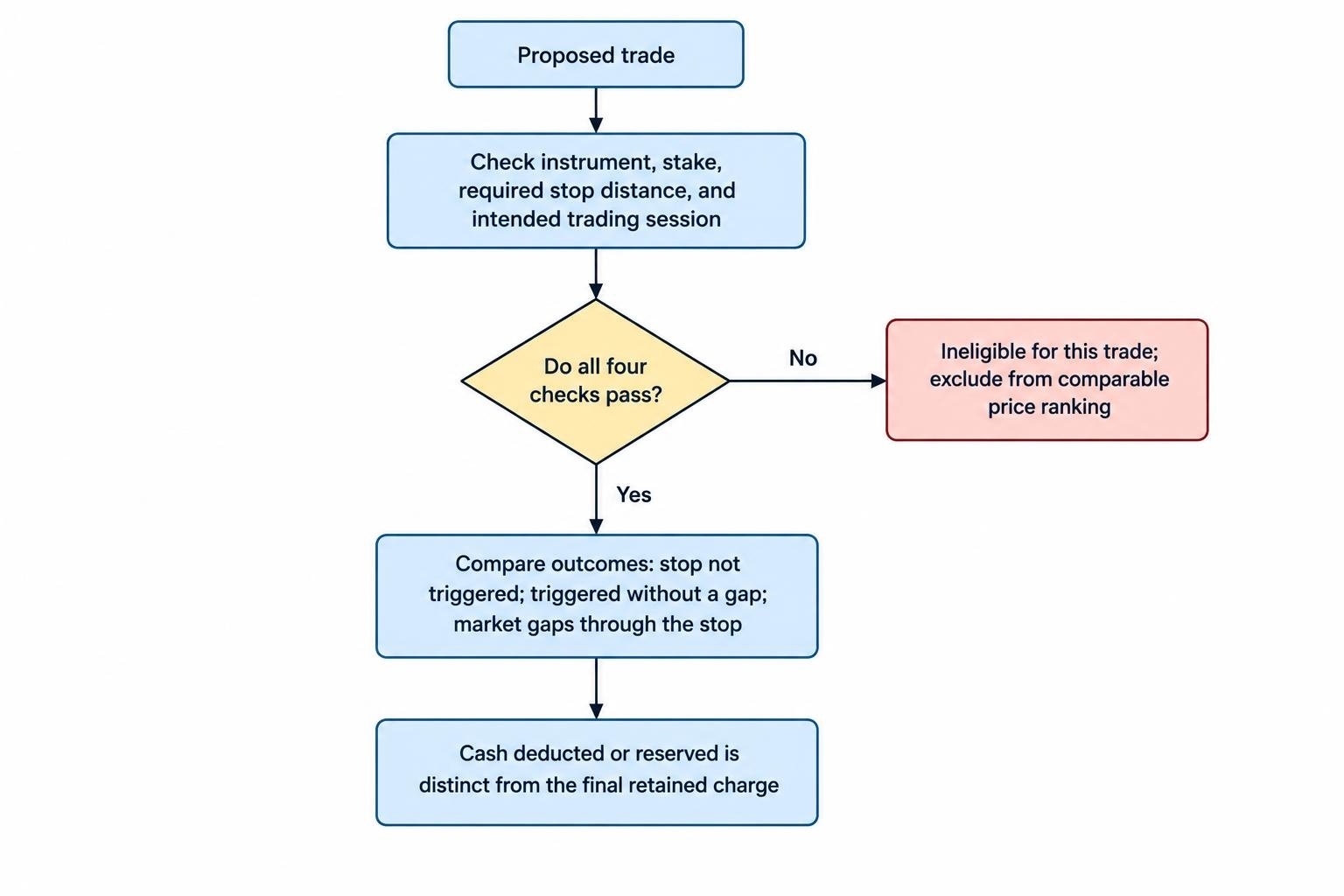
Then separate eligibility from price. Can the guarantee be attached to that instrument, at that stake, at the required distance and during the intended session? An offer that fails one of those checks should not remain in the price ranking as though it were interchangeable with the others.
Among eligible offers, compare three outcomes: the trade closes without triggering the stop, the stop triggers without a gap, and the market moves through the stop level. This reveals both the routine cost and the protection bought for a less orderly exit.
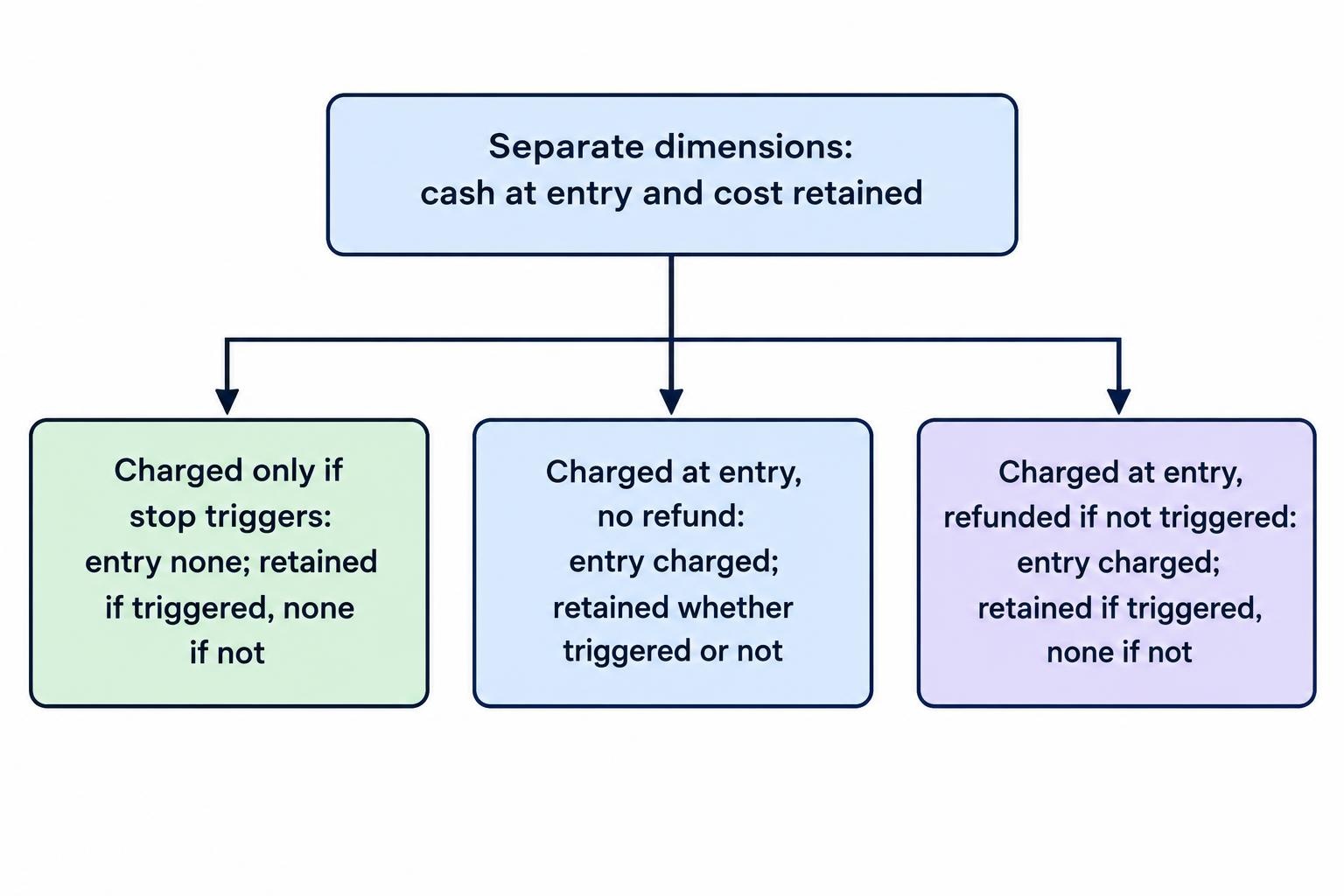
Keep cash requirements separate from retained charges. Money deducted and later refunded can affect available funds without becoming a final trading cost. Conversely, a premium charged only when triggered still belongs in the loss budget, even though nothing was deducted at entry.
Compare the Guarantee, Not Just the Order Label
A guaranteed stop is a contractual commitment to close an eligible position at the agreed stop level when the guarantee applies. It addresses adverse execution beyond that level. It does not promise a profitable trade, free financing or protection for every position in the account.
An ordinary stop does not offer the same price commitment. Rapid price changes and market closures can prevent execution at the intended level, a risk covered in the ESMA and EBA warning on stop orders and execution risk. That distinction matters more than whether both orders appear under the same stop menu.
A trailing stop describes how a stop level moves as the market moves favourably. It does not, by itself, establish a guaranteed execution price. A stop limit order adds a price restriction, but that restriction can leave the position open rather than secure an exit. Compare these as different instructions, not alternative names for the same protection.
The introductory guide to guaranteed stop-loss orders covers the mechanics. For comparison purposes, the evidence to obtain is the contractual price commitment, its eligibility conditions and confirmation that the guarantee has actually been accepted.
Worked Comparison: Three Hypothetical Offers
Consider a proposed long index spread bet with an actual opening execution price of 8,000, a stop at 7,960 and a stake of £5 per point. The entry-to-stop distance is 40 points, producing a £200 price loss if the position closes at the stop.
The following offers are invented for arithmetic only. They do not represent current tariffs, advertised prices or observed terms at any named firm.
| Comparison item | Offer A | Offer B | Offer C |
|---|---|---|---|
| Guarantee premium | 2 points | 0.5 points | 1.2 points |
| Premium at £5 per point | £10 | £2.50 | £6 |
| Payment rule | Charged only if triggered | Charged at entry, with no refund | Charged at entry and refunded if not triggered |
| Minimum permitted distance at entry | 20 points | 60 points | 30 points |
| Accepts the proposed 40-point stop? | Yes | No | Yes |
| Price loss plus premium if the proposed stop triggers | £210 | Not available on these terms | £206 |
Offer B has the smallest premium but cannot provide the proposed stop. Calling it the cheapest protection for this trade would be misleading. It is quoting a different risk arrangement.
Offers A and C both accommodate the intended distance. Under these assumptions, C produces the lower retained premium when triggered. A avoids an entry deduction, whereas C temporarily uses £6 of cash before any refund. Whether that cash difference matters depends on the account’s other funding requirements.
The table excludes financing and other separately charged costs. The £200 price loss uses actual opening and closing execution prices, so the dealing spread should not be added again if it is already reflected in those prices. A comparison built from reference or mid-market prices needs a different treatment.
This is the first useful result: the lowest displayed premium, the lowest cash deduction and the lowest cost for an eligible trade can be three different answers.
Put Every Premium Into the Same Units
Convert each guarantee charge into pounds for the intended stake before comparing it. A point-based premium is straightforward:
Guarantee charge in pounds = premium in points × stake per point.
A 1.5-point premium at £4 per point costs £6. Do not compare that figure directly with “0.3%” until the percentage basis has been identified. It could refer to a stated exposure value or another contractual amount. The denominator matters as much as the rate.
For a separate hypothetical share example, assume a price of 250p, one point equal to 1p, and a £2-per-point stake. The exposure is £500. If the premium is explicitly 0.3% of that exposure, the charge is £1.50, equivalent to 0.75 points at that stake.
That conversion does not make 0.3% and 0.75 points interchangeable across markets. Change the share price, stake convention or percentage basis and the result changes too. Record those assumptions beside the calculation rather than leaving the reader to reverse-engineer them.
The treatment of minimum charges also needs checking. If a hypothetical tariff applies the greater of a calculated premium and a £5 minimum, a £1.50 calculation still produces a £5 bill. The guide to guaranteed stop premiums covers charge structures in more detail; the comparison task is to express the final amount consistently.
Minimum Stop Distance Can Outweigh the Premium
Return to Offer B. Its 60-point minimum would require the example stop to move from 7,960 to 7,940, assuming the minimum is measured from the opening level. At £5 per point, the price loss becomes £300. Add the £2.50 premium and the combined amount is £302.50.
The premium is smaller, the permitted loss is not.
A trader with a £200 budget could instead reduce the stake. Where the premium is proportional to stake and there are no other charges in the calculation:
Maximum stake = loss budget ÷ (entry-to-stop distance + premium expressed in points).
Offer B would allow £200 ÷ 60.5, or about £3.3058 per point. If the hypothetical platform permits penny increments, rounding down to £3.30 produces a combined price loss and premium of £199.65.
That solves the arithmetic, not necessarily the trading problem. A wider stop changes the exit rule and the reduced stake changes exposure. The comparison must state whether it holds stake constant, holds the cash budget constant, or holds both the original stop and stake constant.
For the original 40-point stop, the corresponding budget calculations are about £4.7619 per point for A and £4.8544 for C. Round down to an accepted increment, then leave room for any further costs. The position sizing guide covers that budgeting process.
Also check how distance is measured. A minimum measured from the current executable quote is not automatically the same as a distance measured from the original entry. Record the actual stop price, not just the distance displayed on screen.
Stress Test the Exit Through a Market Gap
A comparison based only on orderly trading misses the event the guarantee is meant to address. Use a separate gap scenario without pretending to know how often it will occur.
Keep the original entry of 8,000, stop of 7,960 and stake of £5 per point. Assume that an ordinary stop would execute at 7,860 after a gap. The ordinary stop then produces a 140-point price loss, or £700. Assume A and C remain valid, have been accepted and close at their guaranteed level.
| Scenario | Ordinary stop | Offer A | Offer C |
|---|---|---|---|
| Exit at 7,960 without slippage | £200 | £210 including premium | £206 including premium |
| Gap: ordinary stop executes at 7,860 | £700 | £210 including premium | £206 including premium |
In the gap scenario, A reduces the illustrated loss by £490 and C by £494 compared with the assumed ordinary execution. Those are scenario differences, not forecasts of savings or evidence that guarantees improve returns over a trading programme.
Offer B is absent because it cannot supply the same 40-point stop. Including its wider stop in this table would break the equal-terms comparison.
Use several adverse exit assumptions if the decision depends on gap exposure. A small overshoot and a severe reopening gap answer different questions. Neither a quiet recent period nor one dramatic example establishes the future distribution of market gap risk.
Compare Charges Across Triggered and Untriggered Trades
A charge paid on every trade needs a different comparison from one retained only when the stop triggers. The important distinction is the payment condition, not whether the advertised number looks small.
For an isolated fee calculation, consider two further hypothetical offers with identical eligibility, stop distances and other terms. One charges 0.5 points on every trade without a refund. The other charges 2 points only when triggered. At £1 per point across 100 trades, the first costs £50.
The second costs £40 if 20 stops trigger, £50 if 25 trigger, and £80 if 40 trigger. The fee-only crossover is therefore a 25% trigger rate under those assumptions.
These counts are illustrations, not observed trading results. A stop-trigger rate also says nothing by itself about profitability. Profitable trades, manually closed losses, holding costs and position sizes still affect the account result.
An upfront charge refunded whenever the stop remains untriggered can have the same retained cost as a trigger-only charge of equal size. Its cash timing is different, though. Compare the amount deducted, the refund condition, when the refund becomes available and what happens after a partial closure or amendment.
Do not estimate future value solely by averaging past slippage. That sample may contain few of the events the protection is intended to cover. Keep expected routine cost and tolerance for an unusually large loss as separate decisions.
Check When Protection Can Be Added or Changed
Availability at account level does not establish availability at the moment you need it. The comparison should distinguish attaching a guarantee at entry, converting an existing ordinary stop, moving an accepted guarantee closer, moving it farther away and removing it.
These are not academic distinctions. A published CFD complaint concerned an attempted conversion to a guaranteed stop outside US market hours. The complaint was not upheld; the record also described restrictions on amendments when markets were closed and when minimum distances increased. The Financial Ombudsman decision on rejected guaranteed stop amendments provides a documented example, not a statement of every provider’s current terms.
For each shortlisted offer, record the permitted dealing session and the permitted amendment session separately. Check whether an instruction can be submitted while the relevant market is closed, and whether submission means acceptance or only a request awaiting processing.
Compare any event-related restrictions before entering the trade. If the plan depends on adding a guarantee shortly before an announcement, obtain confirmation that the intended action is permitted. Do not treat the presence of a button as a contractual answer.
The general spread betting trading hours guide helps distinguish trading sessions. For this comparison, the important record is when the guarantee can be created or changed on the exact contract being considered.
Keep Margin and Account Protections Separate
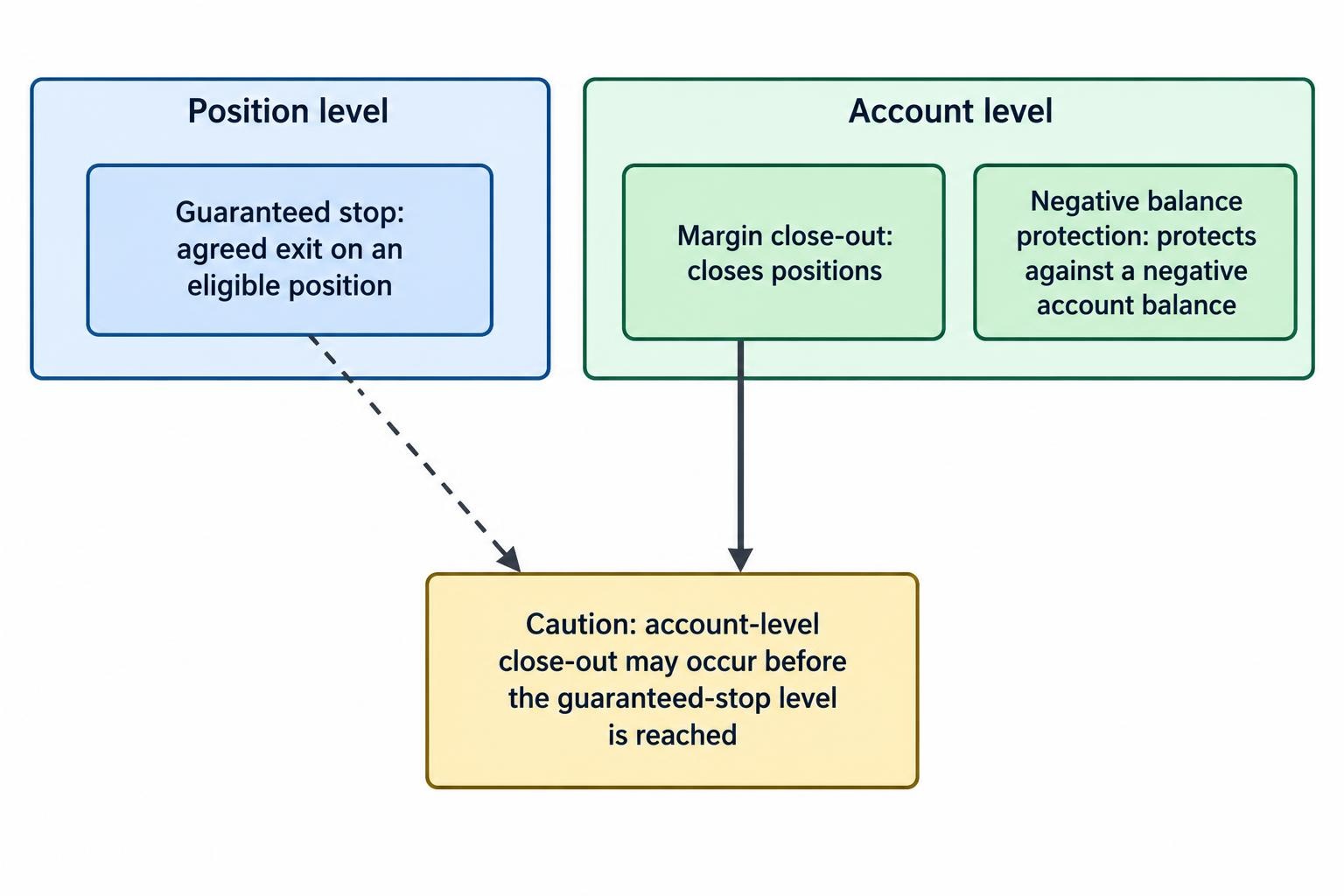
A guaranteed stop’s planned loss is not the same measure as required margin. UK retail rules set minimum opening margin by asset class, require close-out when account net equity falls below 50% of the relevant margin requirement as soon as market conditions allow, and cap liability for the covered investments at funds in the account. These are distinct protections under FCA COBS 22.5 margin and negative balance rules.
For example, at an index level of 8,000, a £5-per-point position represents £40,000 of exposure. If it falls within the rule’s major stock market index category, the 5% regulatory minimum opening margin is £2,000. A calculated £206 stop loss including premium is not evidence that £206 will be enough to open that position.
Account close-out can also occur before a guaranteed stop level is reached. ESMA’s technical guidance expressly identifies that interaction between account-level margin close-out and position-level guarantees. The ESMA answer on guaranteed stops and margin close-out explains why an agreed stop is not a promise to keep the position open until that level.
Compare the provider’s stated margin calculation and close-out process alongside the guarantee terms. Ask how other open positions affect the account, how a premium deduction affects available funds and what happens if equity deteriorates elsewhere. The separate guide to the margin close-out rule covers the account mechanism.
Negative balance protection addresses an account-level liability boundary. A guaranteed stop addresses an agreed exit on an eligible position. Neither should receive credit in a comparison for a protection supplied by the other.
Compare the Whole Trade Cost, Not the Premium Alone
For otherwise comparable offers, build a total cost estimate for the same holding period. Include the guarantee charge under the relevant outcome, dealing spread and any applicable financing or other separately charged amounts. Show refundable deductions separately rather than treating them as permanently spent.
This is not a reason to bury a cheap guarantee beneath vague statements about “value”. It is a reason to calculate the trade. A hypothetical £4 premium advantage disappears if the same position incurs £8 more in other charges over the planned holding period.
The FCA’s review published on 15 October 2026 found continuing concerns about cost disclosure and considerable variation in overnight funding fees across firms and assets. Its findings on CFD pricing and fair value support checking funding charges rather than assuming the stop premium represents the full cost difference.
Use separate estimates for intraday and multi-day trades. Do not apply one holding-period result to every strategy. The total spread betting cost comparison provides the broader framework; here, the guarantee remains one line within it.
Verify Acceptance and Keep the Evidence
A written comparison can establish what an offer says. It cannot prove that a particular stop was attached successfully. Before treating a position as protected, check the accepted order type, stop price, covered stake and any charge or reserved amount shown in the position record.
A spread betting demo account can help you locate the controls and practise reading confirmations. It should not be treated as evidence of live acceptance during a volatile session or proof of execution through a future gap.
A historical dispute following the June 2016 referendum illustrates why records matter. The ombudsman found, on the balance of probabilities, that guaranteed stops had not been requested on two disputed positions. The absence of an expected premium formed part of the evidence considered in the decision concerning disputed guaranteed stop instructions.
Do not turn that case into a universal rule that no charge means no guarantee. A trigger-only tariff may show no entry deduction. Instead, reconcile the confirmation with the payment model and preserve the record that identifies the stop as guaranteed.
Useful records include the order identifier, acceptance time, stop level, protected size, applicable terms and amendment history. After closure, reconcile the exit and retained premium against the spread betting account statement. Flag an unexplained difference rather than adjusting the comparison until the figures happen to fit.
How to Build a Defensible Comparison
Use an eligibility-first method. Establish which offers can accommodate the intended trade, then compare their cash requirements and costs under the same scenarios. Avoid awarding a high score for a low premium to an offer that cannot accept the required stop.
For each observation, preserve a compact record:
- The legal entity, account type, instrument and contract being compared.
- The date, time, session, direction and intended stake.
- The entry quote, stop price, permitted distance and premium basis.
- The payment, refund and amendment conditions.
- Whether the information came from written terms, a displayed quote or an accepted live instruction.
Distinguish those evidence levels in the published result. Written terms establish the stated arrangement. A deal ticket adds a dated quote. An accepted instruction confirms that position’s order status. A completed trade adds an observed outcome. None of these alone establishes how frequently future gaps will occur.
Do not call a desk review an execution test. A test would need a declared method, comparable observations and records supporting the reported outcomes. Questions about observed fills belong within a separate assessment of broker execution quality, rather than being inferred from the word “guaranteed”.
The analysis here establishes how alternative terms change eligibility, cash use and illustrated losses. It does not establish a cheapest named provider, a measured failure rate or a return advantage. That boundary keeps it consistent with the wider spread betting research: calculations should be reproducible, and claims should not outrun their evidence.
Choosing Between Eligible Offers
Reject arrangements that cannot deliver the intended protection before comparing small differences in premium. Then compare accepted stop distance, combined loss and charge, cash timing, amendment rules and total holding cost.
For the worked trade, A and C can supply the proposed 40-point stop; B cannot. C has the lower illustrated triggered cost, while A avoids the initial premium deduction. Those are narrow findings under stated assumptions, not a universal ranking.
If no offer fits the loss budget and exit plan, reducing the stake, changing the trade or declining it are valid outcomes. Moving the stop farther away simply to obtain a cheaper guarantee changes the decision rather than improving it.
The practical use of guaranteed stops in risk management begins with that discipline. Buy the protection the position needs, confirm it has been accepted, and keep enough room in the account for the obligations the guarantee does not replace.