Margin risk in spread betting is the risk that your account cannot support its open positions, forcing you to add money, reduce exposure or accept a broker closing trades. A position can fit the opening margin requirement and still leave too little room for an ordinary adverse move.
The problem is not just how much you might lose. It is whether you can keep control of the exit. A trade that later recovers offers little comfort if a funding shortfall closes it first. Managing margin risk means sizing positions around available capital, testing the account under stress and acting before the broker’s close-out process takes over.
Margin Is Security, Not a Loss Budget
Opening margin is the money required to support a position. It is not a fee, and it does not set the maximum loss on that trade. Your stake per point determines how quickly market movements change your profit or loss; the margin requirement determines how much account funding the position needs.
Suppose a trade requires £800 of margin. That does not mean you have chosen to risk £800, or that the position will close after losing £800. A planned stop might put the intended loss below that amount, while an adverse move without an effective exit could produce a much larger loss. The mechanics are covered separately in how spread betting margin works.
For risk management, distinguish three account figures:
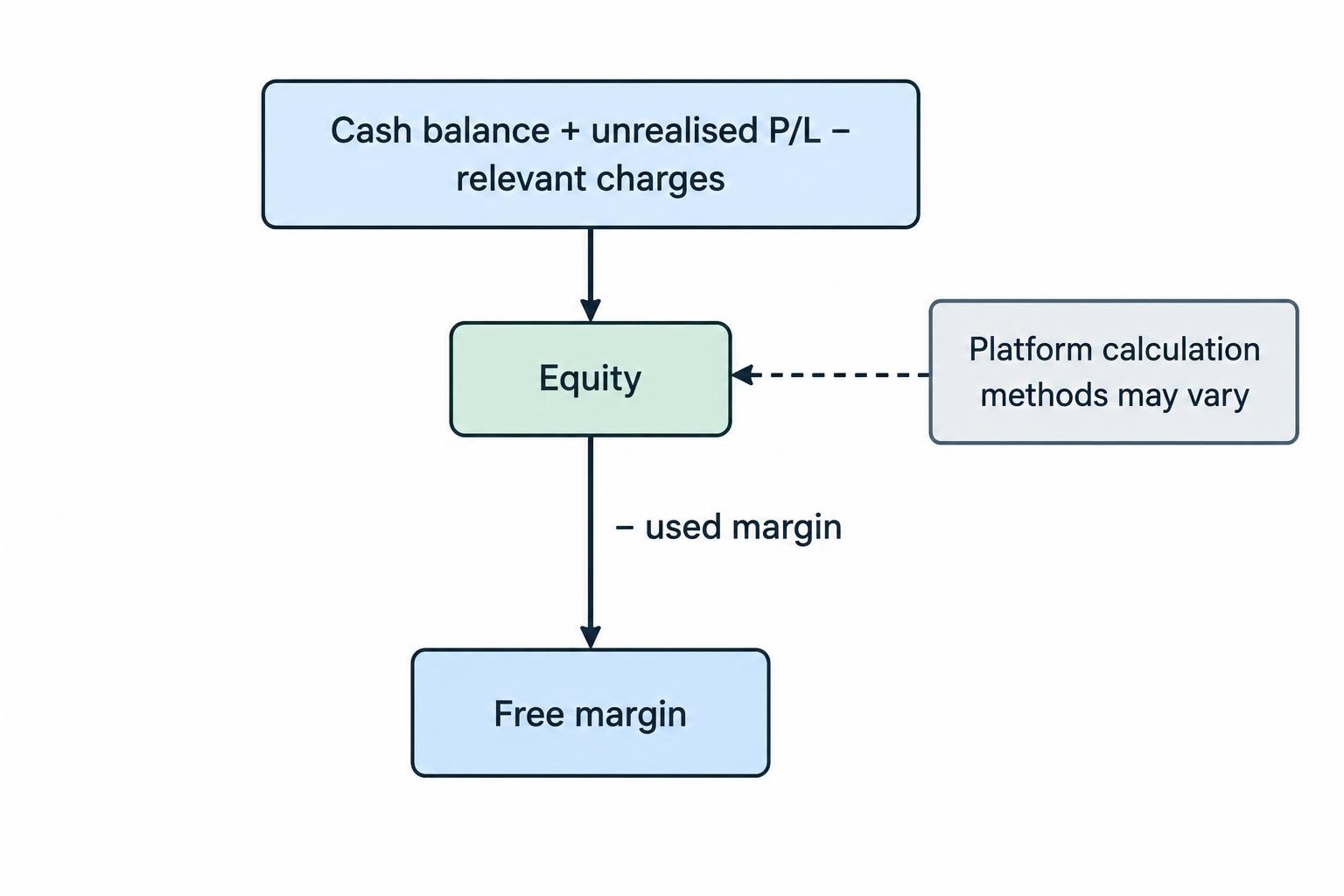
Equity is the account’s cash balance adjusted for unrealised profits, losses and relevant charges. Used margin is the amount committed to supporting open positions. Free margin is commonly equity minus used margin, although platform labels and calculation methods vary.
A positive cash balance can therefore give a misleading impression. If that balance is £5,000 but open positions show a £2,000 loss, the account does not have £5,000 of usable equity. It has approximately £3,000 before other adjustments. Risk decisions need the live equity figure, not the more flattering number.
A Worked Example: Two Stakes, Very Different Pressure
Consider two hypothetical accounts, each with £5,000 of equity. Both buy an index quoted at 8,000, with stakes measured per whole index point. Assume a 5% opening margin requirement.
For clarity, the example excludes spreads, funding and other charges, and holds the margin amount constant after entry. Actual requirements may change under the provider’s calculation method.
| Account measure | £2 per point | £10 per point |
|---|---|---|
| Starting equity | £5,000 | £5,000 |
| Notional exposure at entry | £16,000 | £80,000 |
| Opening margin at 5% | £800 | £4,000 |
| Starting free margin | £4,200 | £1,000 |
| Loss after a 100-point fall | £200 | £1,000 |
| Equity after that fall | £4,800 | £4,000 |
| Free margin after that fall | £4,000 | £0 |
Both trades satisfy the assumed opening requirement. That makes neither equally manageable. The larger position starts with 80% of equity committed as margin and consumes its remaining free margin after a 100-point fall.
The smaller position leaves more room, but spare margin alone does not make a trade sensible. Its possible loss still needs to fit the trading plan. Use position sizing for spread betting to choose the stake from an acceptable loss and a defensible exit, then check that the account can fund it comfortably.
Reversing that order is a common mistake: finding the largest stake the platform accepts, then trying to make the risk look reasonable afterwards.
When Margin Pressure Becomes Forced Closure
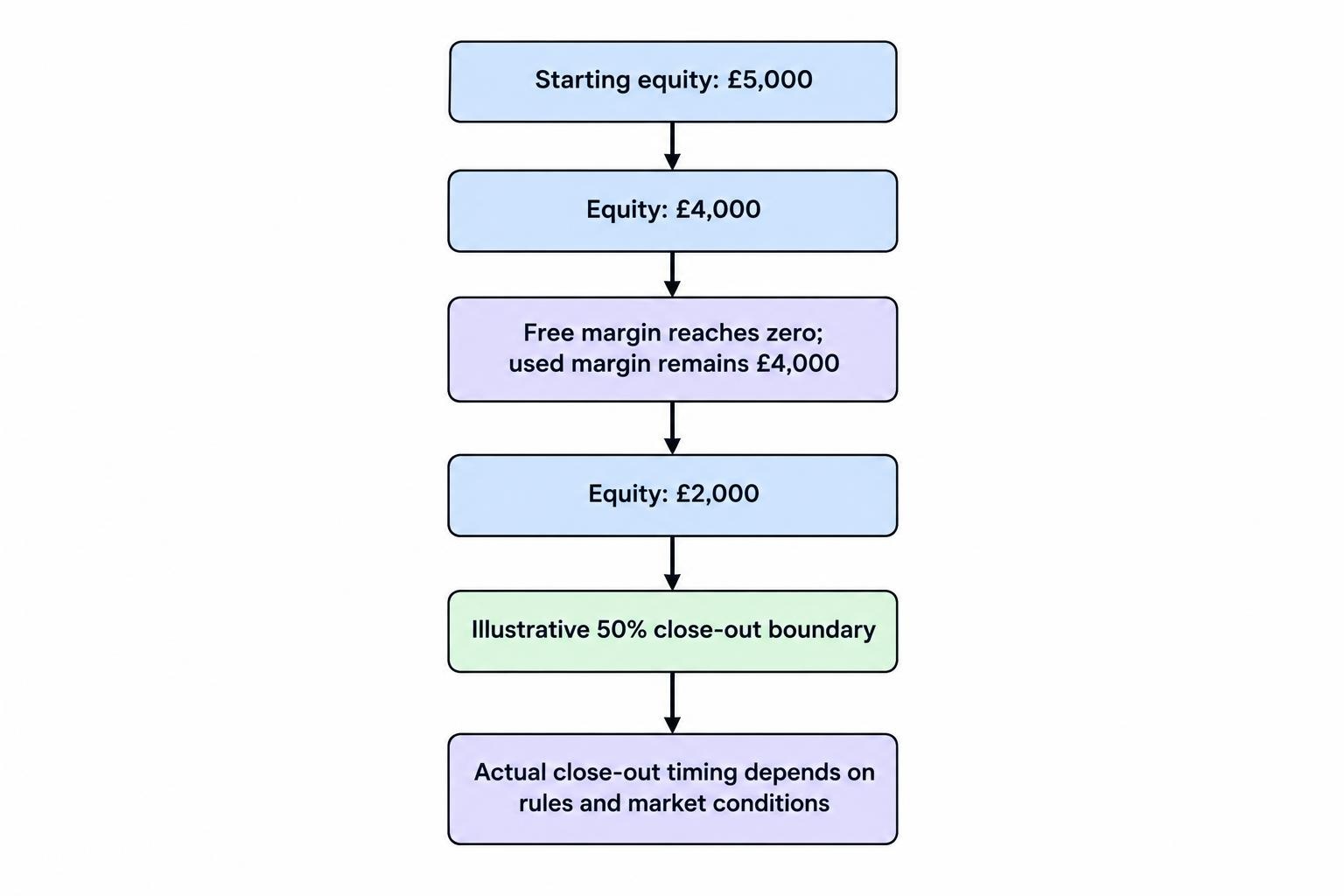
For covered UK retail spread betting accounts, FCA rules require firms to close open positions when account net equity falls below 50% of the margin requirement, as soon as market conditions allow. The test applies across the account rather than treating every trade as a separate pot of money. The FCA’s retail margin and close-out rules also require firms to disclose how their close-out level is calculated and triggered.
Return to the larger example. With equity of £5,000 and an unchanged £4,000 margin requirement, the illustrative 50% threshold is £2,000 of equity. A £3,000 trading loss would bring the account to that boundary: 300 adverse points at £10 per point, before costs.
Notice the distinction. Free margin reaches zero at £4,000 of equity, but the assumed regulatory close-out boundary is lower. Zero free margin and compulsory close-out are not interchangeable terms. Nor does the calculation promise an execution at exactly £2,000 of equity; market conditions may prevent that.
Check the provider’s contractual rights too. Its warning levels, restrictions on new orders and rights to close positions can differ from the regulatory minimum. The detailed treatment belongs in the margin close-out rule guide.
A close-out threshold is a final account safeguard, not a sensible place to set your trading loss budget. Waiting until it is close leaves very little control over timing.
How a Comfortable Margin Buffer Can Disappear
Higher margin requirements
Do not assume the opening margin rate is fixed for the life of a position. Existing positions can face higher requirements under the relevant account terms. A Financial Ombudsman Service decision on increased spread betting margin records a suspended share position whose requirement rose from 25% to 30%, then to 100%.
A higher requirement can create pressure without a fresh trading loss. On £80,000 of unchanged exposure, an increase from 5% to 10% would raise required margin from £4,000 to £8,000. An account with £5,000 of equity would then have a £3,000 shortfall against the full requirement.
That shortfall does not, by itself, explain exactly when positions would close. The applicable terms and close-out calculation matter. Before holding a trade, check whether changes can affect existing positions, how notice is delivered and whether larger exposures attract different margin tiers.
Several positions losing together
Ten positions do not necessarily provide ten separate sources of risk. Long positions in related share indices, technology shares and growth stocks may all respond badly to the same event. Separate tickets can still represent one large directional bet.
Suppose three positions each require £1,000 of margin. Together they use £3,000, while their gains and losses feed into the same account equity. If all three lose £500, equity falls by £1,500. Assessing each trade in isolation misses the pressure on their shared funding.
Use portfolio correlation and spread betting risk to examine overlapping exposures. For margin planning, ask what happens if related trades move against you together, not whether each looked affordable when opened.
Gaps and wider spreads
A price gap can move equity straight past a warning level. There may be no opportunity to reduce the position at the prices between the last quote and the next available one.
Spreads matter too. Positions are valued using the relevant prices available to close them. If those prices move further apart, the account’s marked profit or loss can deteriorate even without an equivalent change in the market’s midpoint. This is particularly uncomfortable when the account already has little spare funding.
Allow for discontinuous moves rather than assuming every loss develops gradually. The separate guide to market gap risk covers why a planned exit price may not be available.
Charges and withdrawals
Margin headroom can also shrink through account debits. A position that barely moves may still consume equity through funding and other applicable costs. Over a longer holding period, those deductions can become relevant to an already tight account.
Include expected overnight financing costs in the funding plan rather than treating them as a separate accounting issue. They reduce the same equity that supports your trades.
Withdrawals have a more immediate effect. Taking £1,000 out reduces equity by £1,000 without reducing open exposure. Recalculate the account after a proposed withdrawal, including an adverse move, before assuming the money is spare.
How Much Free Margin Should You Keep?
There is no universally safe percentage. The same free margin can support very different risks depending on stake sizes, market volatility, correlated positions, holding periods and possible changes to margin requirements.
A more useful approach is to test the account against a plausible adverse scenario. Estimate the combined loss on open positions, deduct expected charges, then apply any margin increase you want the account to withstand. Compare stressed equity with stressed required margin.
For example, take an account with £10,000 of equity and £2,000 of used margin. Assume a scenario in which positions lose £1,500 and required margin rises by 50% to £3,000. Ignoring other charges, stressed equity becomes £8,500 and stressed free margin becomes £5,500.
Those figures describe that scenario, not a guarantee. A larger gap or a more severe margin increase could produce a different result. The exercise is useful because it makes the assumptions visible.
Set a personal intervention level comfortably before compulsory closure could become relevant. That might mean reducing exposure when stressed free margin falls below a chosen cash reserve, or declining a new trade because it would leave the account dependent on unrealised profits.
Be careful with margin percentages shown on dashboards. “Margin level” commonly means equity divided by used margin, multiplied by 100. “Margin utilisation” may express the reverse relationship. A rising number can therefore mean improving safety on one display and increasing pressure on another. Check the definition before setting an alert.
What to Do When Margin Headroom Falls
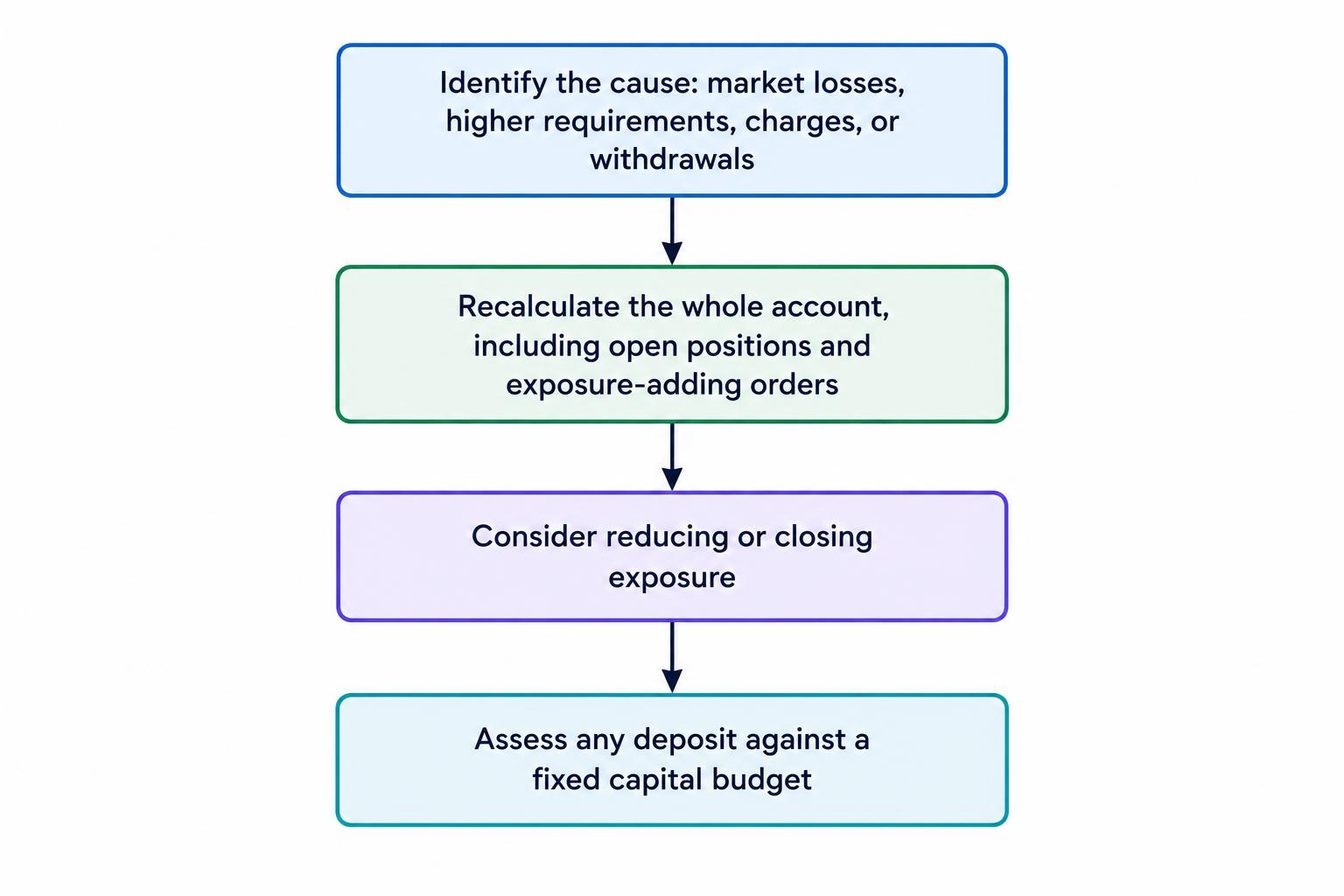
The useful response is to restore control, not automatically defend every open trade. Reassess the position against the original plan and the account’s current condition. A margin call or account warning should prompt action, but the plan should not depend on receiving a phone call or having a long response window.
- Identify the cause. Separate market losses, higher requirements, charges and withdrawals. Each affects the decision differently.
- Recalculate the whole account. Include all open positions and any orders that could add exposure if triggered.
- Consider reducing or closing exposure. Prioritise the account risk, rather than keeping a trade simply because closing it would make the loss feel final.
- Assess any deposit against a fixed capital budget. Do not let repeated top-ups turn a planned loss into an open-ended commitment.
Why closing a losing trade can release margin
Closing a losing position does not normally subtract its unrealised loss from equity a second time. That loss is already reflected in live equity. At an unchanged execution price, closure mainly converts the unrealised result into a realised one and releases the margin supporting the position, subject to costs and account adjustments.
This matters because traders sometimes avoid reducing exposure on the assumption that realising a loss will cause an equivalent fresh fall in equity. The economic loss has already happened; keeping the ticket open does not remove it.
A partial reduction can lower required margin and slow future losses per point. It does not recover the loss already incurred.
Why adding cash is not the same as reducing risk
A deposit increases equity and funding headroom, but it does not change the position’s stake per point. If the market continues against a £10-per-point position, every further adverse point still costs £10.
Adding money may keep the position open longer while increasing the capital exposed to loss. If the original trade no longer meets the plan, more funding does not repair that decision. Money reserved for bills, emergencies or other commitments should not become an improvised margin reserve.
Stops Help, but Do Not Replace Account Funding
A stop-loss order and a margin buffer address different problems. The stop provides an exit instruction for a position. The buffer helps the account support its positions before those exits occur.
An ordinary stop can execute at a worse price during a gap or fast market. A guaranteed stop, where available and subject to its terms, addresses execution-price risk differently. Neither justifies ignoring the funding needs of other trades. The role and conditions of that protection are covered in managing risk with guaranteed stops.
Test whether the account can remain adequately funded if several positions approach their stops together. A stop sitting beyond a likely account intervention point may not get the chance to perform its intended role.
Retail protections are not substitutes for this planning either. Covered UK retail accounts have negative balance protection, but it does not preserve the money already committed to trading. Professional classification or an overseas contracting entity can change the protections available; the FCA’s guidance on spread betting and retail client protections warns against giving them up without considering the consequences.
Build Margin Checks Into the Trading Plan
Before opening a position, record the expected margin requirement, the account’s remaining free margin and the effect of a realistic combined loss. Repeat the check before adding exposure, withdrawing money or holding through an event that could produce a sharp move.
Keep the loss budget separate from the funding budget. A trade needs both an acceptable potential loss and enough account headroom to support its planned management. Passing only one test is not enough.
Margin risk belongs within the wider spread betting risk management plan. The objective is not to use every pound the platform makes available. It is to keep position size, account funding and exit decisions consistent, so that a funding shortage does not become the person making the trade.