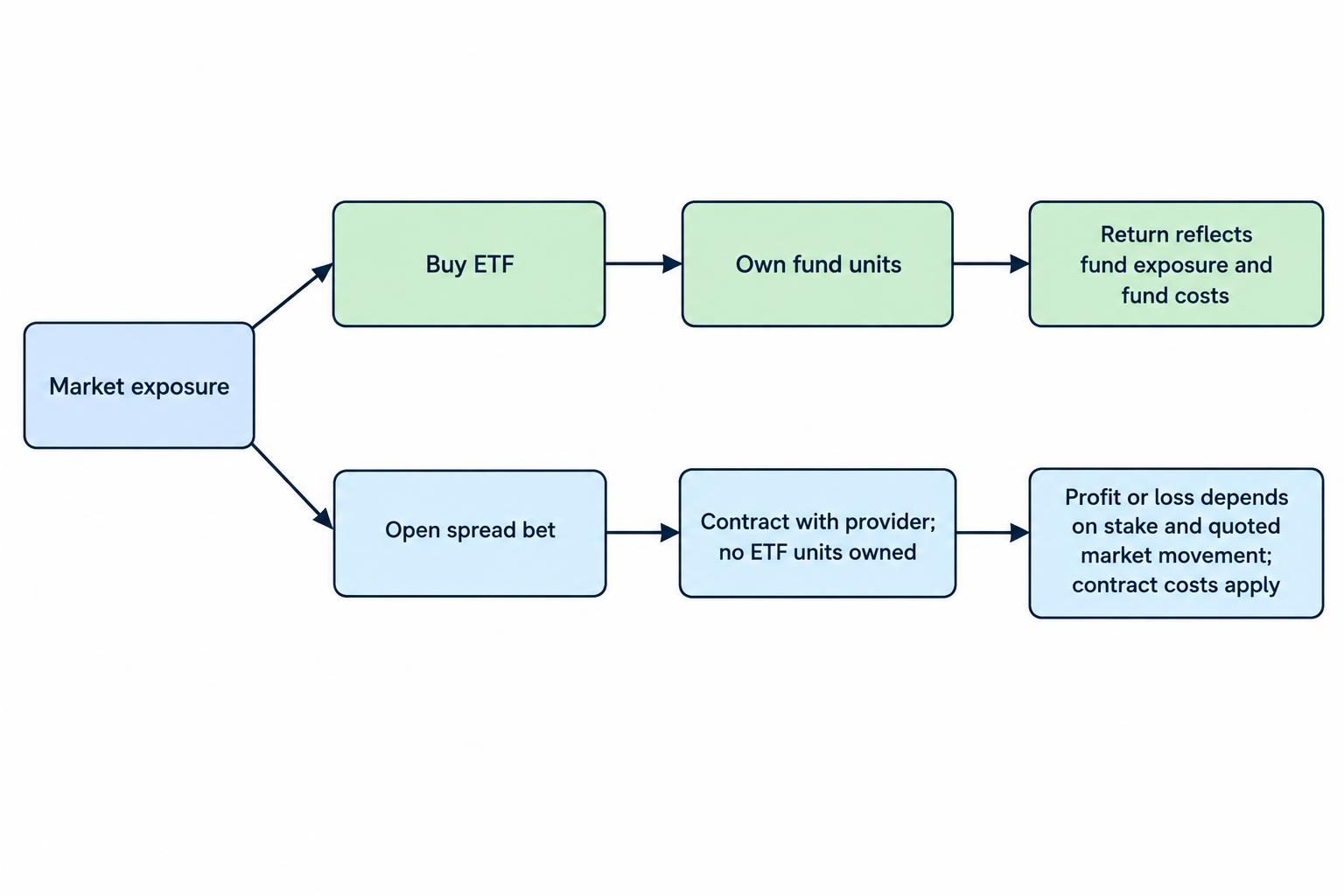
Spread betting and exchange traded funds can provide exposure to the same stock market index, but they serve different purposes. A spread bet is a contract with a provider: you gain or lose a cash amount for each point the quoted market moves. Buying an ETF gives you shares or units in an investment fund.
For building a portfolio over several years, an ordinary ETF bought without borrowing is usually the more straightforward fit. Spread betting offers convenient short positions and adjustable exposure, but introduces margin requirements, financing costs and the possibility of forced closure.
The useful comparison is not the deposit needed to open each position. It is the market exposure, cost of holding it and loss you could withstand.
Spread betting vs ETFs: the main differences
This comparison focuses on UK retail spread betting accounts and conventional, unleveraged ETFs purchased outright. Leveraged and inverse exchange traded products need separate treatment.
| Feature | Spread betting | Buying an ETF |
|---|---|---|
| What you hold | A contract linked to price movements | Shares or units in a fund |
| Position size | Stake per point multiplied by the market level | Number of shares multiplied by their price |
| Initial funding | A margin deposit, plus cash to absorb losses | The purchase price and dealing costs |
| Falling markets | You can open a short bet where available | A conventional long ETF falls with its underlying exposure |
| Holding costs | Spread, financing or expiry related costs, depending on the contract | Fund charges, dealing spread and any platform fees |
| Cash income | Contractual adjustments rather than fund distributions | Income can be distributed or retained within the fund |
| Typical purpose | Active trading or a temporary hedge | Portfolio investment, though ETFs can also be traded actively |
Ownership changes what you are buying
A spread bet does not give you ownership of the index constituents, company shares or fund it references. Your position is against the spread betting provider under its contract terms. A long position benefits from a rise in the relevant quote; a short position benefits from a fall. The mechanics are covered in how spread betting works.
An ETF pools investors’ money in a fund. Its shares trade on an exchange, and the fund may follow an index or use an active investment strategy. Your investment is in the fund, not a direct personal holding in every company within its portfolio. These ownership and trading features are covered in the SEC investor bulletin on ETFs.
That distinction matters even if both positions reference the FTSE 100. An ETF investor has chosen a fund, its investment policy and its charging structure. A spread bettor has chosen a provider, a contract and a stake. Matching the market name does not make those arrangements interchangeable.
Nor does “ETF” tell you everything about the investment. Before comparing it with a spread bet, establish whether the fund follows the same benchmark and whether the comparison includes income, currency movements and charges.
Leverage and margin: compare exposure, not deposits
A small margin deposit can support a much larger spread betting position. This changes the relationship between a market move and the percentage gain or loss on the cash committed. It does not make the underlying exposure cheaper.
For UK retail clients covered by the rules, a major stock market index spread bet requires opening margin of at least 5% of exposure. Providers can require more. Account positions must be closed as soon as market conditions allow if net equity falls below 50% of the required margin. Negative balance protection restricts liability to the funds in the relevant account. These requirements sit within the FCA rules on retail speculative investments.
Those protections do not turn the opening margin into a maximum loss per trade. Money elsewhere in the same trading account can also be at risk. A fully paid ETF has no equivalent margin requirement arising solely from its market price falling, provided you have not bought it with borrowing or pledged it as collateral.
Worked example: £10,000 of exposure through either route
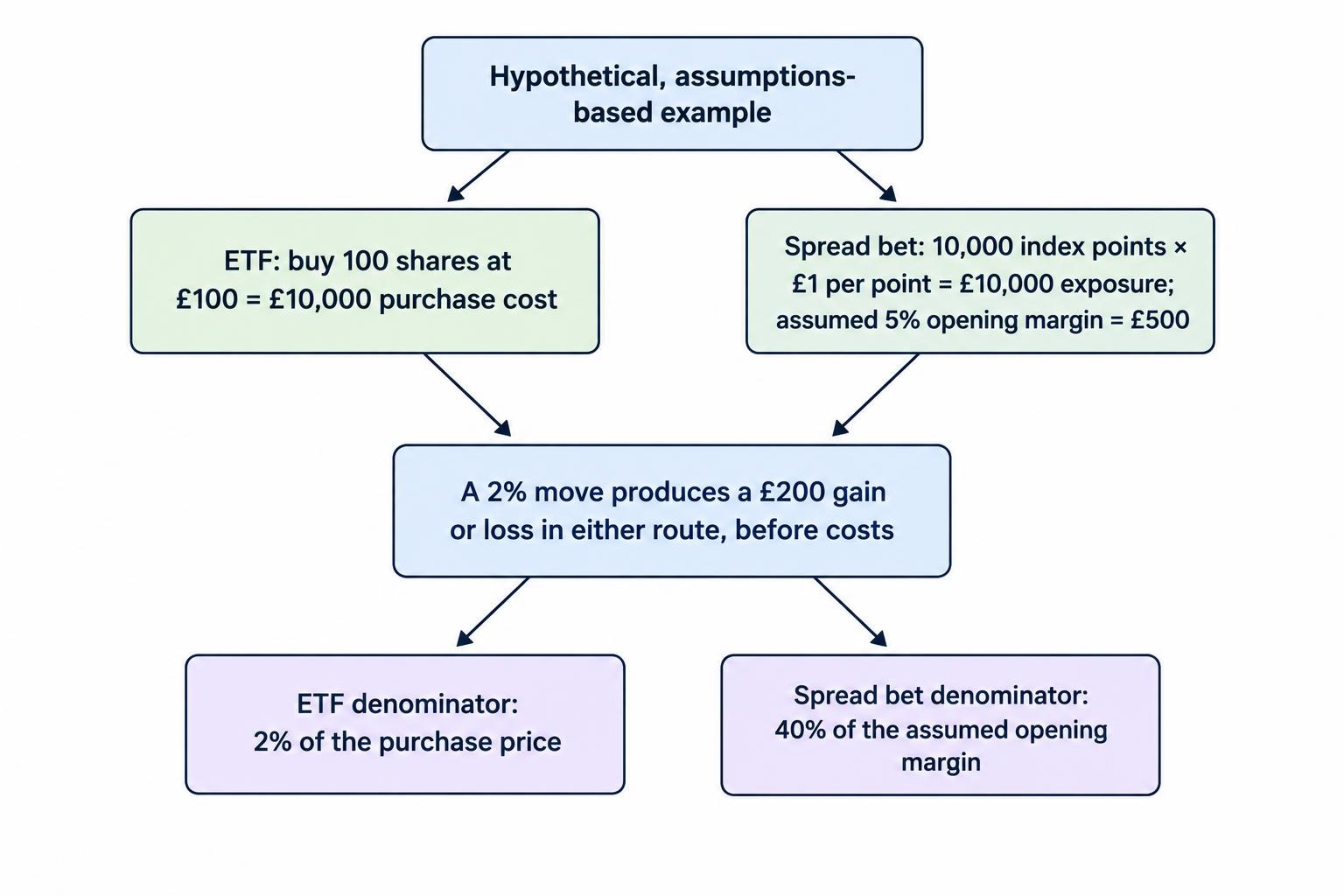
Assume a hypothetical index stands at 10,000 and an ETF following it trades at £100. Ignore spreads, charges, distributions, currency effects and tracking differences for this illustration.
Buying 100 ETF shares costs £10,000. Opening an index spread bet at £1 per point also creates £10,000 of exposure: 10,000 points multiplied by £1. At an assumed 5% margin requirement, the bet needs £500 of opening margin.
If both prices rise by 2%, the ETF position gains £200 and the spread bet gains £200. That is a 2% return on the ETF purchase price but 40% of the spread bet’s opening margin. A 2% fall produces the same £200 loss through either route, before costs.
The apparent performance gap comes from the denominator. The spread bet did not earn more pounds from the same exposure. It used less opening cash and exposed that cash to a much larger percentage swing.
You could hold £10,000 in cash against the £1 per point bet rather than operate close to minimum margin. That reduces effective account leverage, but it does not remove the contract’s charges. Use position sizing for spread betting to work backwards from an affordable loss, rather than forwards from the largest position the platform permits.
Costs depend heavily on how long you hold
A product that looks economical for an afternoon may be expensive for a year. Compare costs over your intended holding period, using equal exposure. Comparing a £500 margin deposit with a £10,000 ETF purchase tells you very little about either product’s running cost.
Spread betting costs
The dealing spread creates an initial hurdle: the market must move far enough in your favour to cover the difference between the buying and selling quotes. Repeatedly opening and closing positions means repeatedly paying that hurdle.
A daily funded bet can also incur financing when held past the provider’s funding cut-off. The calculation generally relates to the position’s exposure, not just the margin deposited. Check the benchmark, provider adjustment, calculation basis and weekend treatment in the contract terms. The separate guide to overnight financing costs covers those calculations.
Short positions do not automatically generate a financing credit. Their treatment depends on the market and contract, and bets linked to individual shares may carry borrowing related charges.
Expiry dated bets use a different pricing structure. Financing can be reflected in the quote rather than appearing as the same daily debit, and keeping exposure beyond expiry may require a rollover. The comparison between daily funded bets and futures bets matters before treating either as a long holding substitute.
ETF costs
An ETF normally deducts ongoing fund expenses from its assets. Your investment return reflects those deductions even though you do not receive a separate bill. Dealing commissions and other transaction costs may sit outside the fund’s headline charge. An ETF’s market price can also differ from its net asset value. The SEC bulletin on fund expenses and ETF transaction costs separates these costs.
Check your platform’s custody fee, dealing tariff and currency conversion charges too. A low fund charge cannot rescue an unsuitable account tariff, particularly if you make small, frequent purchases. “Commission free” is not the same as cost free.
An illustrative holding cost comparison
Suppose a £10,000 long spread bet incurs an assumed annual financing rate of 6%. Holding constant exposure for a year would create approximately £600 of financing costs.
Suppose an ETF with the same exposure has an assumed annual fund charge of 0.20%. That charge would be approximately £20 over a year if the investment value stayed constant.
These are invented rates for arithmetic, not market averages or provider quotes. Both examples exclude other costs and investment returns. Their purpose is to show why the holding period matters: a narrow dealing spread can be overwhelmed by financing if a supposedly temporary trade becomes a permanent resident.
UK tax: an ISA changes the comparison
Spread betting’s tax treatment can be attractive, but it should not decide the product choice on its own. A tax advantage does not compensate for an oversized position or years of unnecessary financing.
For an individual’s financial spread bets, no assets are acquired or disposed of and no chargeable gains or allowable losses arise under the treatment set out in HMRC’s financial spread betting guidance. The loss point matters: a losing bet does not create an allowable capital loss to offset against other chargeable gains.
Do not extend that into a blanket promise covering every contract, business arrangement or country of residence. Check the circumstances addressed in whether spread betting is tax free, and obtain advice where the amounts or arrangements justify it.
For eligible ETFs, a stocks and shares ISA offers a different route. Investment income and capital gains within an ISA are exempt from UK tax, subject to the account rules. The current contribution allowance and permitted investment categories appear in the government’s ISA rules.
The fair comparison may therefore be a spread bet against an ETF held inside an ISA, not an ETF held in an ordinary investment account. Tax treatment depends on personal circumstances and can change.
Income, diversification and currency exposure
A distributing ETF pays out fund income; an accumulating share class retains it within the fund. The benchmark also determines how broad the exposure is. A wide equity index and a narrow sector index are different portfolio choices, even though both can be packaged as ETFs. These distinctions form part of Deutsche Börse’s ETF selection criteria.
A spread bet may receive or pay dividend related adjustments under its terms. Those adjustments are not fund distributions or extra money detached from the price move. When comparing results, include them alongside financing and price changes. Comparing an ETF’s total return with a spread bet’s price profit alone can give a misleading answer.
Currency needs the same care. Buying a sterling trading line of an ETF holding foreign assets does not, by itself, remove currency exposure. Trading currency, fund reporting currency and the currencies of the underlying investments have different roles. Currency hedged share classes attempt to reduce certain exchange rate effects; the distinction is covered in Deutsche Börse’s explanation of ETF currency hedging.
A sterling stake on an overseas index is not automatically an economic match for an unhedged overseas equity ETF. Match the currency exposure before assuming their returns should agree.
Trading hours and execution affect the result
ETF shares trade during the relevant exchange session. A spread betting provider may quote an associated index beyond that session, but availability depends on the product. Wider access is useful only if the price and execution terms are acceptable. Check the distinction between underlying market sessions and provider quotes in spread betting trading hours.
Do not compare execution using the headline spread alone. Consider the size you want to trade, the live quote, available liquidity and what happens during a fast move. A price visible on a screen is not a promise that any quantity will trade there.
With either product, a limit order controls the worst acceptable execution price but may remain unfilled. A market order prioritises execution rather than price certainty. Ordinary stop orders can suffer slippage when prices jump.
Some spread betting contracts offer a guaranteed exit level subject to terms and charges. That is a different arrangement from placing an ordinary stop on ETF shares. Check how guaranteed stop-loss orders work before assuming the two provide equivalent protection.
Short positions and temporary hedges
Spread betting offers a direct way to express a bearish view: sell the quoted market to open a short position. You do not first need to own the referenced asset. That can suit a temporary hedge, but a rising market produces losses on the short bet.
Consider an investor who holds a broad equity ETF and wants to reduce market exposure for two weeks. A short index bet could offset part of a market fall without selling the ETF. However, the ETF and index may not move together, the hedge incurs costs, and the short position needs sufficient cash if markets rise.
That last point can create an awkward cash flow problem. The ETF may gain value while the spread betting account loses cash and approaches a margin threshold. A sound portfolio idea can still fail operationally. The guide to hedging with financial spread bets examines this separation between investment exposure and trading account funding.
Inverse and leveraged exchange traded products offer another route, but they are not substitutes for ordinary ETFs. Many reset exposure daily, so returns over several days can differ from the simple inverse or multiple of the benchmark’s return over that period. The risks are addressed in the FCA review of complex exchange traded products.
A label such as “2×” should never be read as a promise of twice the benchmark’s return over whatever holding period you choose.
Spread betting on an ETF is still spread betting
Some providers offer bets linked to ETF prices. This creates a third arrangement: rather than buying the fund or betting directly on an index, you place a spread bet referencing the fund’s quoted price.
You still do not own ETF shares. Margin, financing, available trading hours and any adjustments follow the betting contract. The ETF’s own expenses already affect the price being referenced, so the absence of a separate fund charge on your betting statement does not mean those expenses have vanished.
This arrangement can combine fund related costs with derivative related costs. Establish why you need it rather than assuming an ETF reference makes the position suitable for passive investing. The market mechanics are covered in ETF spread betting.
Which approach fits the job?
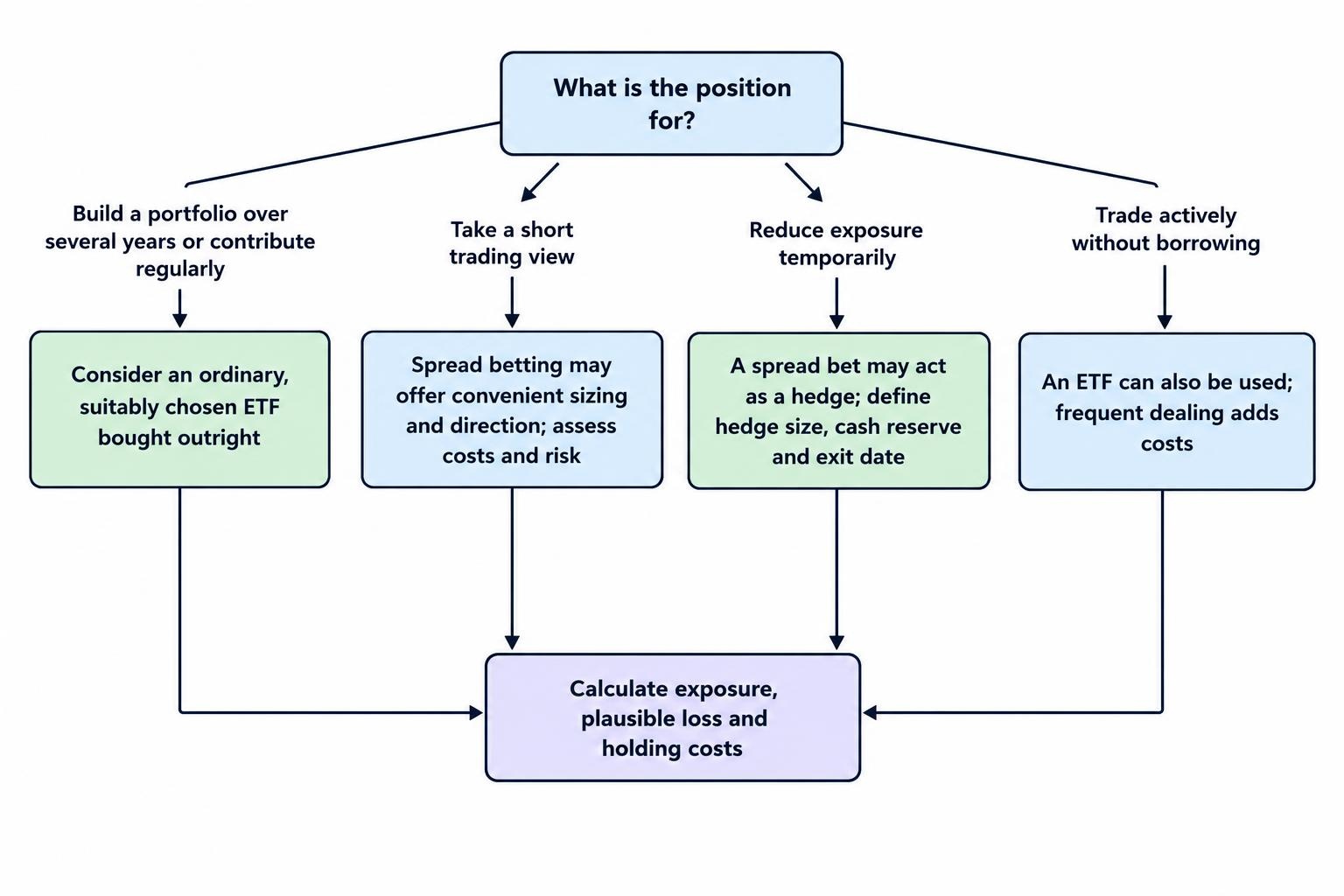
Start with the purpose of the position, not the platform’s minimum deposit.
- Building a portfolio through regular contributions: an ordinary, suitably chosen ETF bought outright generally fits more naturally than a continuously financed spread bet.
- Taking a short trading view: spread betting can offer convenient sizing and direction, provided the risk and costs fit the plan.
- Reducing exposure temporarily: a spread bet may serve as a hedge, but only with a clear hedge size, cash reserve and exit date.
- Trading actively without borrowing: ETFs can still be used, although frequent dealing adds costs and does not remove market risk.
Neither product repairs a weak decision. An ETF concentrating on one volatile sector can be an unsuitable investment. A spread bet can be modestly sized and well funded. The important distinction is that the spread betting contract gives you more ways to create exposure than the cash deposit alone suggests.
Before committing money, calculate the exposure, the loss from a plausible adverse move and the cost of holding for longer than intended. For a spread bet, also calculate how much spare equity remains after that loss. A spread betting demo account can help you practise the mechanics, though simulated results do not establish that a strategy will work with real money.
For a long investment horizon, ownership without borrowing removes financing and margin management from the investor’s daily workload. For a short trading horizon, spread betting’s flexibility may be useful. Choose the structure that fits the task, then size it so a wrong view remains affordable.