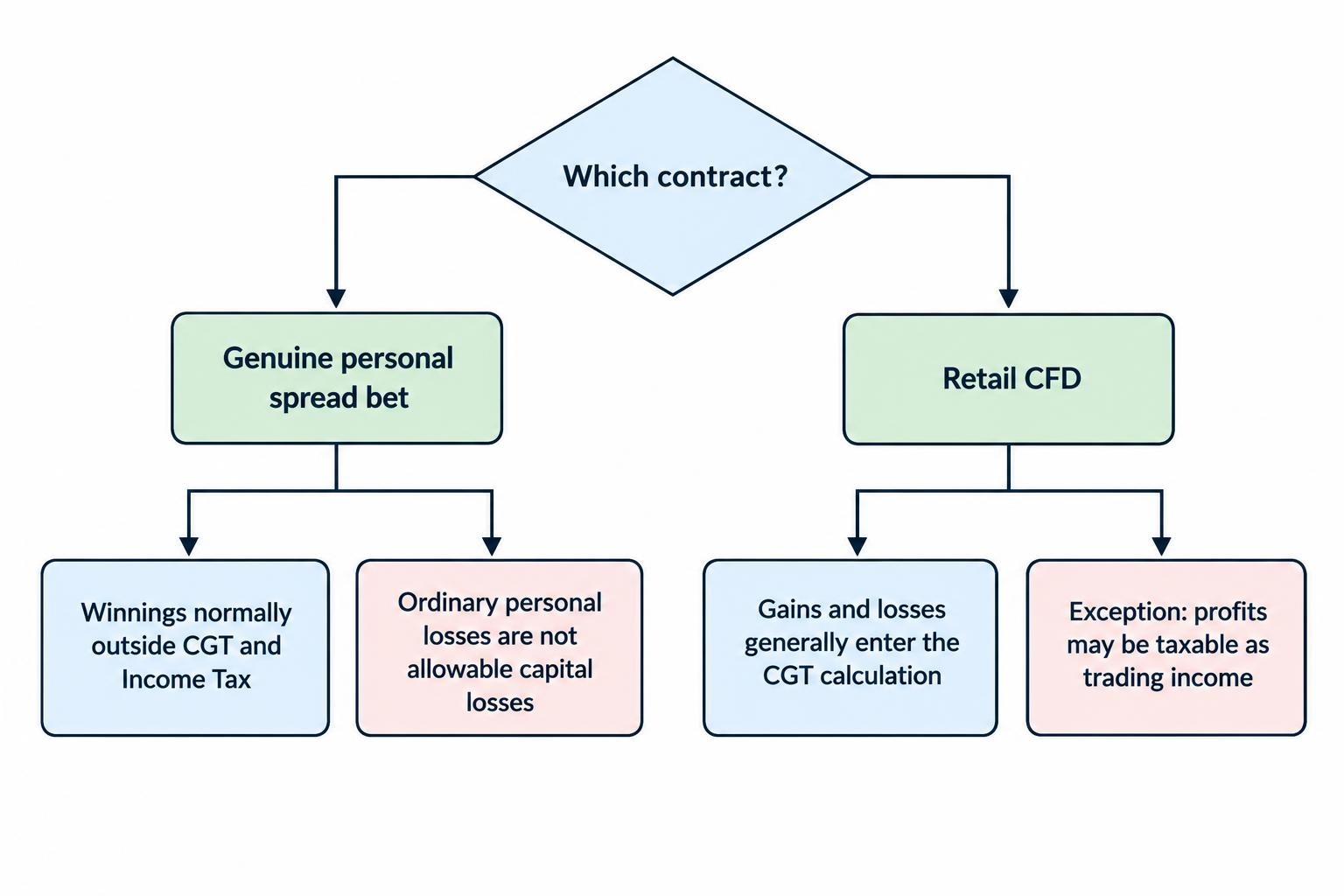
Spread betting and contracts for difference can produce similar market exposure, but their UK tax treatment differs. For individuals placing genuine personal wagers, spread betting winnings are normally outside Capital Gains Tax and Income Tax. Retail CFD gains normally enter the capital gains calculation, unless they are taxable as trading income.
The other side of that difference is loss relief. A tax exemption on winnings does not come with a deduction for losing bets. CFD losses, by contrast, can generally reduce chargeable capital gains.
This guide covers UK resident individuals, with separate notes on commercial hedging and companies. The wider spread betting versus CFD comparison covers how the products work beyond tax. Neither product becomes a sound trade simply because its tax treatment looks attractive.
The Main Tax Differences
Start by identifying the contract you actually hold. The market being traded does not settle the tax question: a spread bet and a CFD tracking the same index can have different outcomes for tax purposes.
| Tax issue | Financial spread betting | Retail CFDs |
|---|---|---|
| Profits | Genuine personal betting winnings are normally outside CGT and Income Tax. | Gains normally fall within CGT, unless taxable as trading income. |
| Losing positions | No allowable capital loss from an ordinary personal spread bet. | Losses generally qualify as allowable capital losses under the usual capital treatment. |
| Annual CGT exemption | Not needed to shelter exempt betting winnings. | May shelter gains, depending on the individual’s other gains and circumstances. |
| Contract charges | Reduce the amount retained, without creating a separate capital loss deduction. | Contract commission, financing equivalents and dividend adjustments enter the net gain or loss calculation. |
| Company accounts | The usual personal betting treatment should not be assumed. | The corporation tax derivative contracts rules generally apply. |
These are starting positions, not a choice of tax labels. You cannot make an ordinary CFD gain exempt by describing the trade as a bet. Nor can you turn an exempt spread betting loss into a capital loss by putting it in an investment spreadsheet.
Why Spread Betting Winnings Are Normally Exempt
The statutory basis for the capital gains exemption is section 51 of the Taxation of Chargeable Gains Act 1992, which excludes betting winnings from chargeable gains. A genuine personal financial spread bet falls within that betting framework rather than being treated like a purchase and sale of the underlying shares or index assets.
That distinction matters even when the trading screen looks familiar. Charts, order tickets and profit figures do not determine the legal nature of the contract.
Suppose you make £8,000 from personal spread bets and £8,000 from selling investments that are subject to CGT. The exempt betting winnings are not added to those investment gains to calculate a larger chargeable gain. They belong in separate categories, even if both activities use the same market research.
The exemption is also not a special allowance that runs out after a certain level of winnings. However, the personal wagering position should not be stretched to cover commercial arrangements without examining their purpose. Our guide to whether spread betting is tax free covers that broader distinction.
How CFD Gains and Losses Are Calculated
Retail CFDs normally fall within the capital gains framework for financial futures. Section 143 of the Taxation of Chargeable Gains Act 1992 provides the statutory treatment of relevant futures transactions, including closing out contracts and payments that settle contractual obligations.
For a standard retail CFD, the tax calculation is not simply the headline movement between the opening and closing prices. Contract charges and adjustments also matter. HMRC’s rules for retail CFD computations bring commission and amounts equivalent to interest and dividends into the net chargeable gain or allowable loss when the contract closes.
A CFD Calculation Including Charges
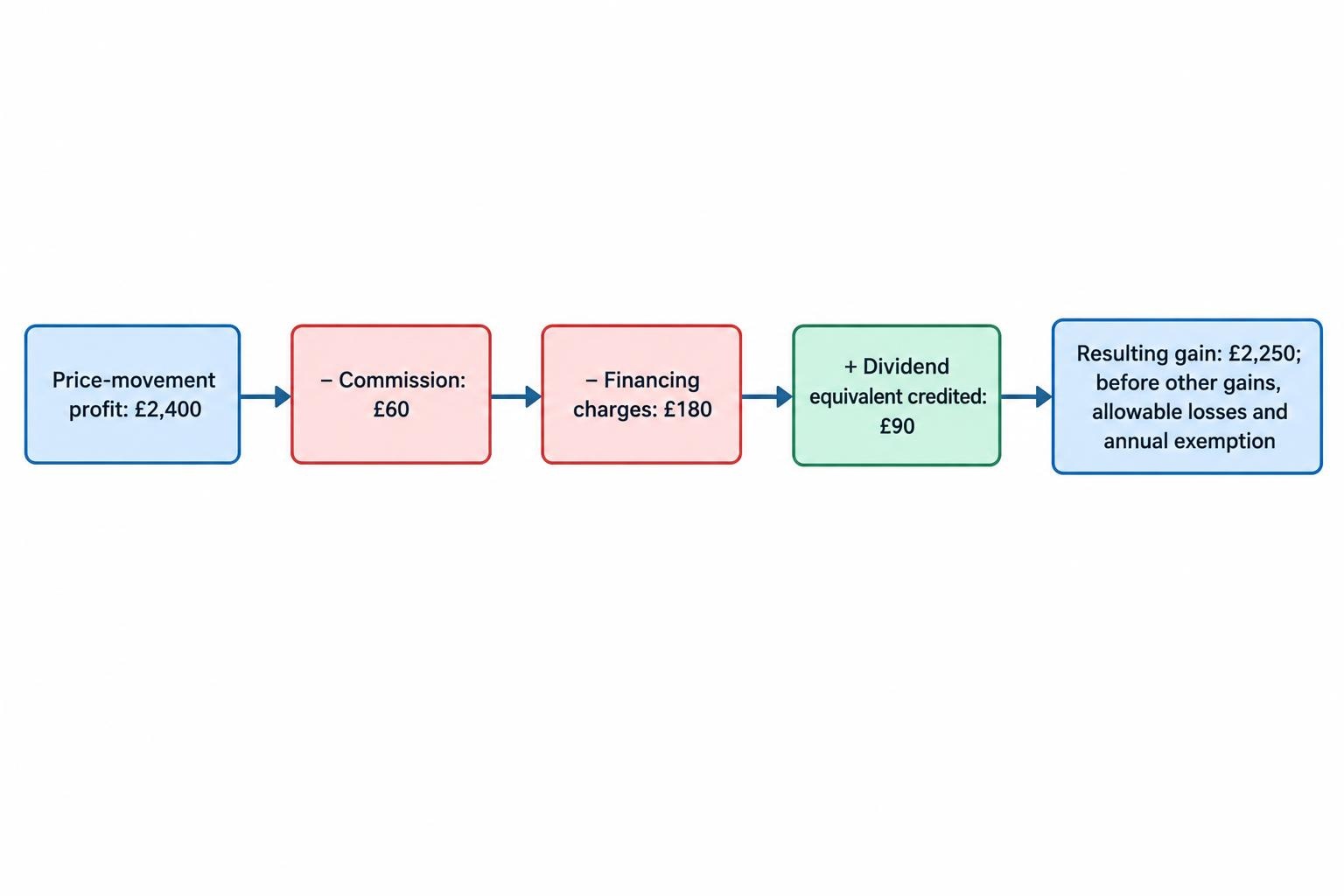
Consider a hypothetical long share CFD with the following results:
- Profit from the price movement: £2,400.
- Commission paid: £60.
- Contract financing charges: £180.
- Dividend equivalent credited: £90.
The resulting gain is £2,400 − £60 − £180 + £90 = £2,250, before considering other gains, allowable losses and the annual exemption.
Do not deduct commission twice if the platform’s realised profit figure already includes it. Equally, do not use a price profit figure that excludes financing and assume it represents the completed tax calculation. Read the statement headings, not just the largest green number.
A CFD dividend adjustment is not an actual company dividend. Under the normal capital treatment, it belongs in the contract calculation rather than being moved into the dividend income section of a return. The same distinction applies to contractual financing equivalents and genuine interest earned separately on cash.
For the commercial effect of holding positions open, see overnight financing costs. A charge can reduce a taxable gain and still leave you worse off financially. Tax relief does not refund the whole expense.
Withdrawals Are Not the Deciding Event
Do not treat a withdrawal to your bank account as the event that determines a CFD gain. Closing or settling the contractual position matters; leaving the proceeds with the provider does not turn the gain back into an unrealised position.
For example, closing a profitable CFD on 2 April and withdrawing the proceeds on 10 April does not, by itself, shift the contract result into the later tax year. Contracts involving interim settlements need attention to their own terms rather than a blanket assumption that an open position has no tax consequences.
CFD Tax Rates, Allowances and Loss Relief
For the 2026/27 tax year, running from 6 April 2026 to 5 April 2027, the annual CGT exemption for most individuals is £3,000. Ordinary gains are generally taxed at 18% to the extent that they fit within the unused basic rate band, and 24% above it. These rates, the exemption, loss relief and reporting rules appear in GOV.UK’s complete Capital Gains Tax guidance.
The exemption applies across your chargeable gains, not separately to each provider or product. Having three CFD accounts does not produce three annual exemptions. Gains from other taxable investments can use the same allowance.
Likewise, being a basic rate Income Tax payer does not guarantee that every pound of a large CFD gain will be taxed at 18%. The size of the gain and the remaining basic rate band both matter.
Example: The Same £10,000 Profit
Assume an individual makes £10,000 after product charges, has no other chargeable gains or allowable losses, and has the full £3,000 exemption available. Also assume all taxable gains fall at the 24% rate.
For CFDs, the calculation is:
£10,000 − £3,000 = £7,000 taxable gain.
£7,000 × 24% = £1,680 CGT.
The individual retains £8,320 after CGT. If the same £10,000 result arose from genuine personal spread betting, it would normally remain £10,000 after tax on those winnings.
The £1,680 difference follows from the assumptions. It is not a promise that the products will produce identical results before tax. Differences in spreads, financing and execution could change the starting figures.
Example: A Profit Below the Available Exemption
Now reduce the gain to £2,500, keeping the other assumptions unchanged. The CFD gain is covered by the available £3,000 exemption, so there is no CGT to pay. The personal spread betting winnings are also normally exempt.
In that example, spread betting creates no immediate tax saving over CFDs. The distinction becomes relevant if other gains use the exemption or the year’s total grows. A useful comparison therefore starts with your expected tax position across all investments, not an isolated winning trade.
The separate guide to spread betting and Capital Gains Tax explains how exempt winnings sit alongside taxable investments.
How Allowable CFD Losses Work
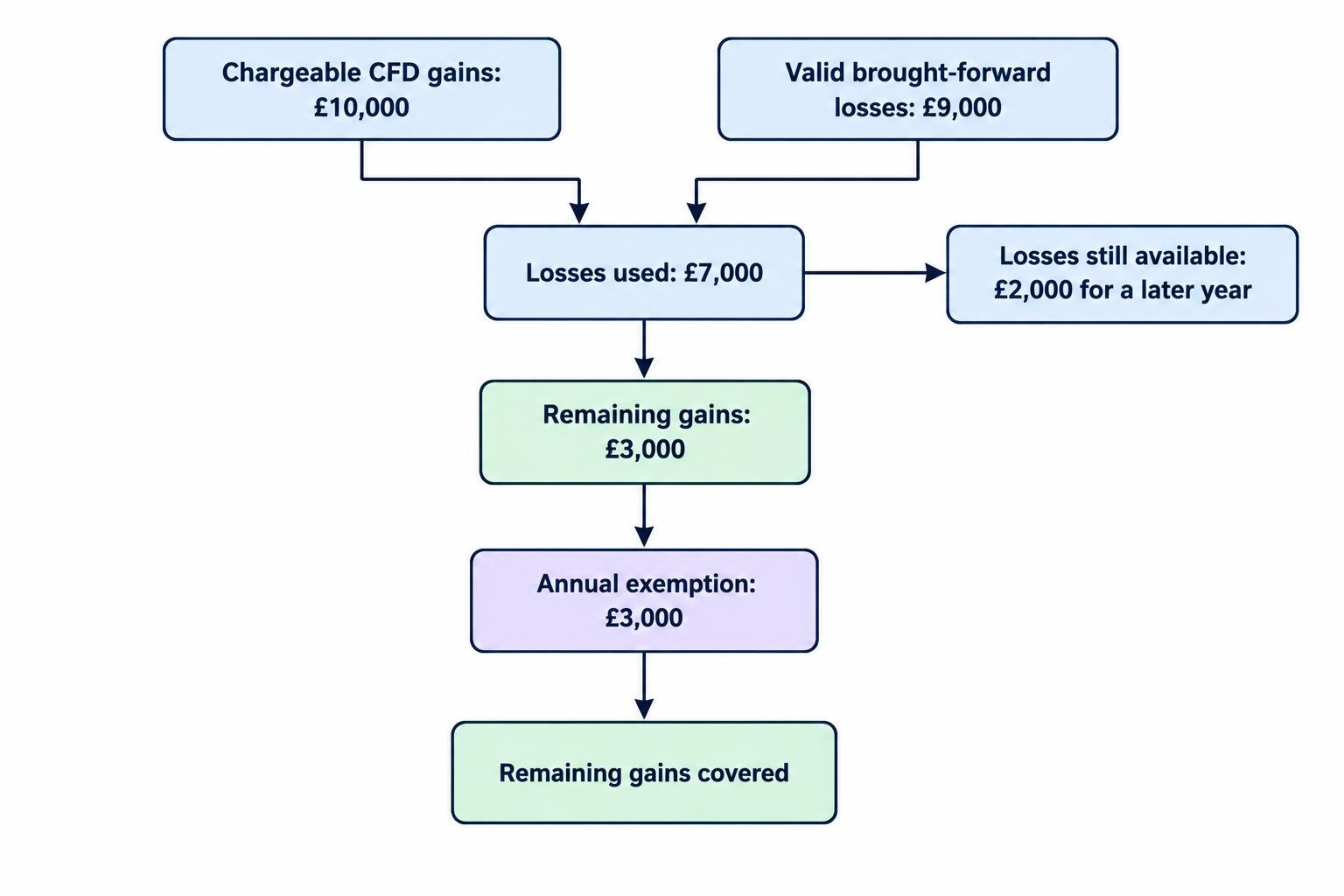
Allowable capital losses from the current tax year reduce that year’s chargeable gains. Unused losses can generally be carried forward once properly claimed. Brought forward losses are normally used only as far as needed to reduce remaining gains to the annual exemption; any balance can remain available.
This order matters. Current year losses and brought forward losses are not interchangeable pots that you can always use in whichever order produces the preferred answer. A loss claim normally has a four year deadline measured from the end of the tax year in which the loss arose.
Suppose you have £10,000 of chargeable CFD gains and £9,000 of valid brought forward capital losses, with the full £3,000 exemption available. Using £7,000 of those losses reduces the gains to £3,000. The exemption then covers that amount, leaving £2,000 of losses available for a later year.
The value is conditional: losses need gains against which they can be used. An unused loss is not cash sitting with HMRC waiting to be withdrawn.
Why Spread Betting Losses Cannot Offset Investment Gains
The usual personal spread betting exemption has a matching restriction on losses. Section 16 of the Taxation of Chargeable Gains Act 1992 applies the distinction between chargeable and exempt gains to allowable and non-allowable losses. An ordinary personal spread betting loss does not become an allowable capital loss.
That can produce different tax bills even where two portfolios finish with the same economic result.
Example: A Derivative Loss Alongside Share Gains
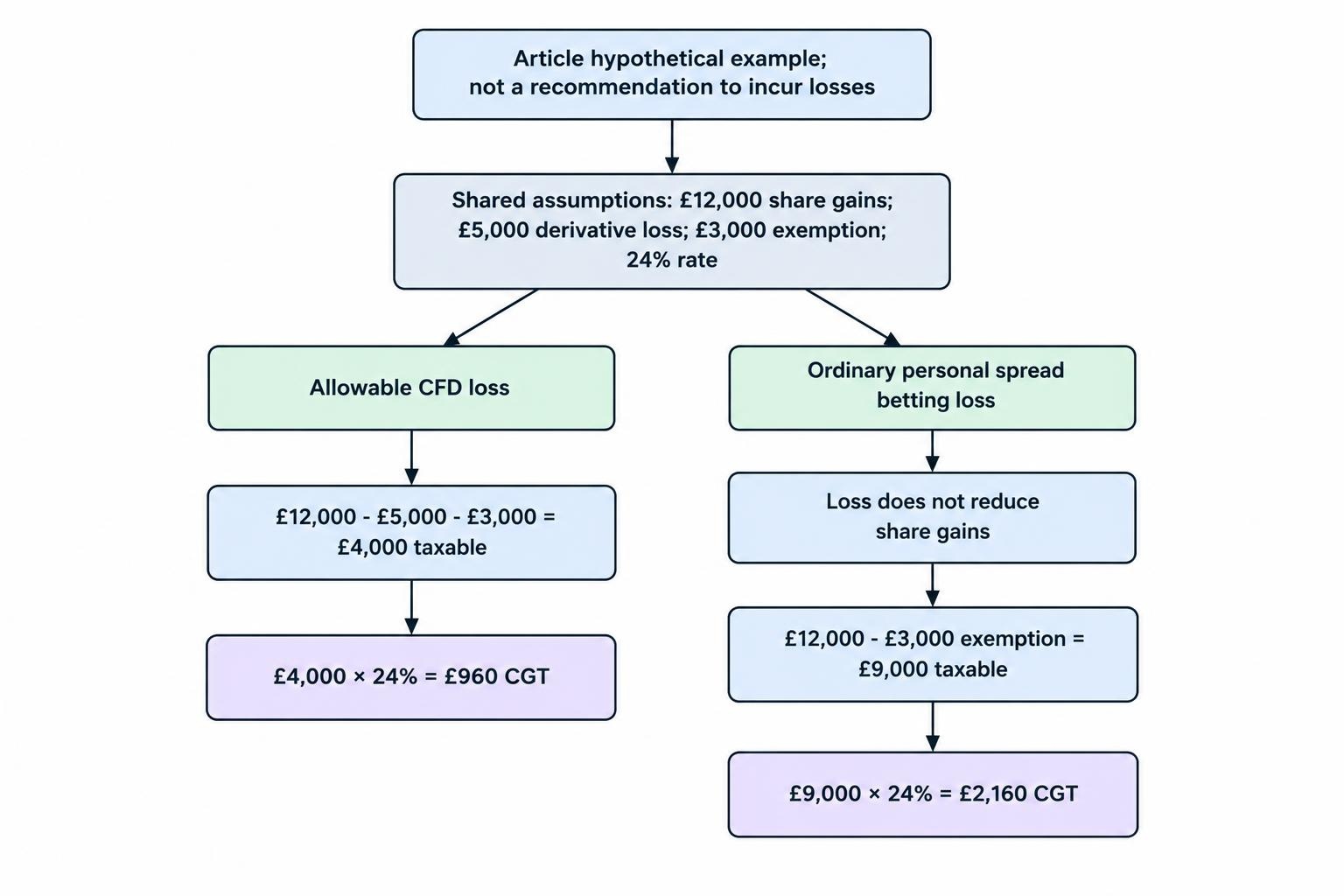
Assume an individual realises £12,000 of chargeable share gains and loses £5,000 on derivatives in the same tax year. The full £3,000 exemption is available, and all taxable gains fall at 24%.
If the £5,000 is an allowable CFD loss, the calculation is £12,000 − £5,000 − £3,000 = £4,000. CGT is £960.
If it is an ordinary personal spread betting loss, it does not reduce the share gains. The calculation is £12,000 − £3,000 = £9,000. CGT is £2,160.
Both portfolios made £7,000 before tax when the share and derivative results are combined. Yet the CFD portfolio retains £6,040 after CGT, compared with £4,840 for the portfolio containing the spread betting loss.
This illustrates why loss treatment belongs in the comparison. It does not make losing trades desirable. In the example, the tax saving from the CFD loss is £1,200, not £5,000. Most of the loss remains an economic cost.
Nor should an ordinary CFD capital loss be treated as a deduction from salary simply because the trading account lost money. The comparison here concerns relief against capital gains. Our guide to the tax treatment of spread betting losses covers the boundaries in more detail.
Does Trading Full Time Change the Answer?
Earning a living from personal betting does not automatically create a taxable trade. Having a system, applying expertise or being sufficiently successful to support yourself through gambling is not enough on its own. This distinction is set out in HMRC’s guidance on professional gamblers.
That prevents a common mistake: assuming that spread betting winnings become taxable the moment they replace a salary. There is no simple salary replacement test in that guidance.
However, separate commercial income needs separate consideration. Someone who places personal bets and also receives payment for providing services should not assume that the service income shares the treatment of their winnings.
The CFD position also needs care. The normal capital gains treatment has an exception where profits are taxable as trading income. You cannot settle that question by choosing whichever treatment gives the smaller bill, or by calling yourself a day trader.
If your circumstances go beyond straightforward personal speculation, obtain advice on the facts. The guide to spread betting tax for professional traders examines these distinctions without treating every active account as a business.
Commercial Hedging and Company Accounts
Personal wagering is not the right starting assumption for every spread bet. A contract used for a commercial purpose, such as hedging a trade exposure, can fall outside the usual personal betting treatment. Companies also generally fall within the corporation tax derivative contracts regime for CFDs and financial spread bets. Both points appear in HMRC’s guidance on CFDs, spread bets and commercial use.
Hedging a Business Exposure
Consider a sole trader expecting a foreign currency receipt who enters a derivative to protect its sterling value. The contract should not be assessed in isolation from the business transaction it protects.
Before entering that arrangement, document the exposure, the purpose of the hedge and how its size relates to the expected receipt. An adviser needs those facts, not just a screenshot showing a currency position.
Do not assume that a private investment hedge and a hedge of business receipts are the same tax problem. The guide to hedging with spread bets and tax addresses that question separately.
Trading Through a Company
A company account is not a larger version of a personal tax exempt betting account. Incorporating solely because personal spread betting winnings are usually exempt starts from the wrong premise.
Review the company’s contract treatment, accounting and tax position before moving an activity into it. The guide to spread betting through a company covers that separate ownership structure.
Stamp Duty Is Usually Not the Deciding Difference
Opening or closing an ordinary CFD does not involve buying the underlying security, so it does not create Stamp Duty or Stamp Duty Reserve Tax liability. This is confirmed in HMRC’s stamp tax rules for CFDs. An ordinary cash settled spread bet likewise does not transfer the underlying shares to the bettor.
Do not frame the comparison as “spread betting avoids stamp duty, CFDs do not”. That confuses derivative exposure with direct share ownership.
Stamp taxes become a more relevant comparison when considering buying shares outright. The dedicated guide to spread betting and stamp duty covers that distinction without mixing it into the CGT calculation.
Records and Reporting: Keep the Products Separate
CFD gains can create a reporting and payment obligation, while losses need a valid claim if you want relief. A nil tax bill does not always remove reporting requirements. Check the rules for the relevant year rather than assuming that no payment means no paperwork.
Maintain separate records for spread bets and CFDs, even if both sit under one provider login. A combined account performance figure can be useful for measuring returns but unsuitable as a tax computation.
For each completed CFD, keep the contract details, relevant dates, price result, commission, financing adjustments and dividend equivalents. Record deposits and withdrawals separately so they are not mistaken for gains or losses.
For spread bets, retain enough documentation to establish the contract type and reconcile the account result. Exempt does not mean undocumented. A clear record also helps explain where funds came from if questions arise later.
Download statements regularly rather than waiting until filing season. Our guide to spread betting record keeping provides a practical framework.
Compare the Result After Costs and Tax
Spread betting’s exemption can be valuable when an individual has taxable gains above available exemptions and reliefs. CFD loss relief can also have value, but only where the losses qualify and can be used. Neither point makes one product universally preferable.
Build the comparison from realistic figures: expected contract charges, available capital losses, other investment gains and the likely tax rate. Compare a profitable year, a flat year and a losing year rather than modelling only the outcome you hope to achieve.
Use a total trading cost comparison alongside the tax calculation. A tax exempt result can still disappoint after financing and dealing costs, while a taxable result may leave more money in your account.
Keep the scope of the UK rules clear. If you have tax obligations in another country, obtain advice there before relying on a UK exemption. For either product, decide the amount you can afford to risk before considering how a gain might be taxed.