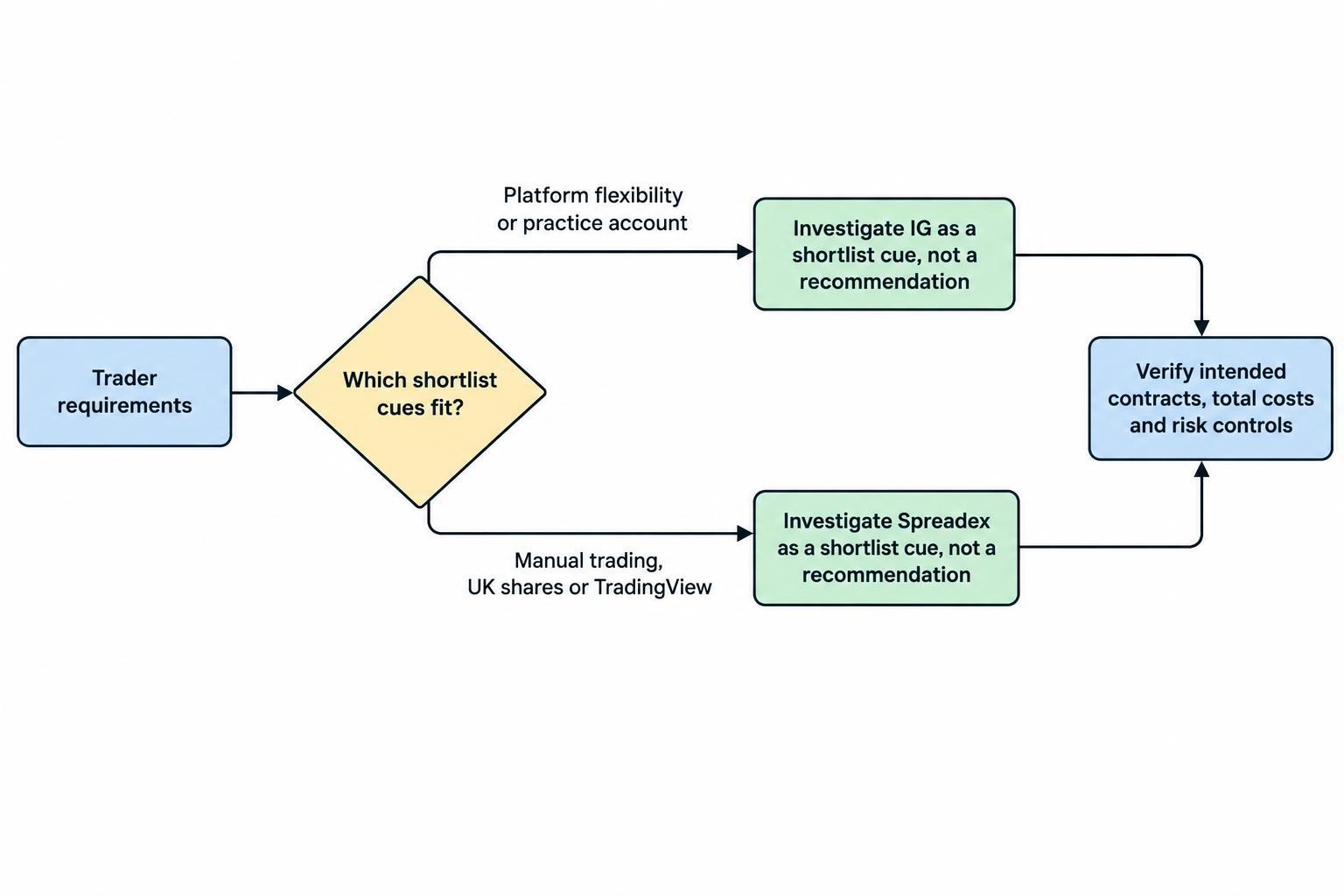
IG and Spreadex suit different approaches to financial spread betting. IG is the stronger starting point if you want several platform options or need room to develop a more technical trading setup. Spreadex deserves a closer look if you trade manually, focus on UK shares, or want to place spread bets through TradingView.
Neither deserves an automatic “cheapest broker” label. The answer changes with the market, stake, trading session and holding period. A narrow opening spread can lose its appeal once financing, subscriptions or a poor exit enter the calculation.
This comparison focuses on UK retail financial spread betting, rather than overseas CFD accounts, share dealing or sports betting. The calculations are illustrations, not measured execution results from either broker. Before opening an account, confirm the current terms for the contracts and platform you intend to use.
IG vs Spreadex: the practical verdict
Start with IG if platform choice matters. Its attraction is the ability to choose between different ways of analysing markets and placing trades. That matters if you already use specialist charting software, want to retain an existing workflow, or expect your requirements to change.
Consider Spreadex if your needs are more focused. Its UK share coverage, native trading interface and TradingView connection make it a credible candidate for discretionary traders. It also has no inactivity fee, although that says nothing about the cost of keeping an individual position open. The Spreadex account and platform assessment also identifies the absence of a native demo account, an important difference from IG.
The better choice should follow your trading requirements, not precede them. Someone trading one index for an hour each morning has a different comparison to make from someone holding several share positions across company results.
| Comparison | IG | Spreadex |
|---|---|---|
| Main platform proposition | Several platform routes, including its own interface, MT4 and ProRealTime | Native web and mobile trading, alongside TradingView |
| TradingView connection | Available; check supported account types, symbols and orders | Spread betting integration available; check the required symbols and orders |
| Practice account | Demo available | No native broker demo currently identified |
| Strong reason to investigate | Platform flexibility and a practice environment | Manual trading and UK share coverage |
| Cost decision | Compare the chosen contract and holding period | Compare the chosen contract and holding period |
| Main caution | Do not assume every platform provides the same markets and controls | Do not treat TradingView paper trading as a replica of a live Spreadex account |
Spreads and trading costs: compare the trade, not the headline
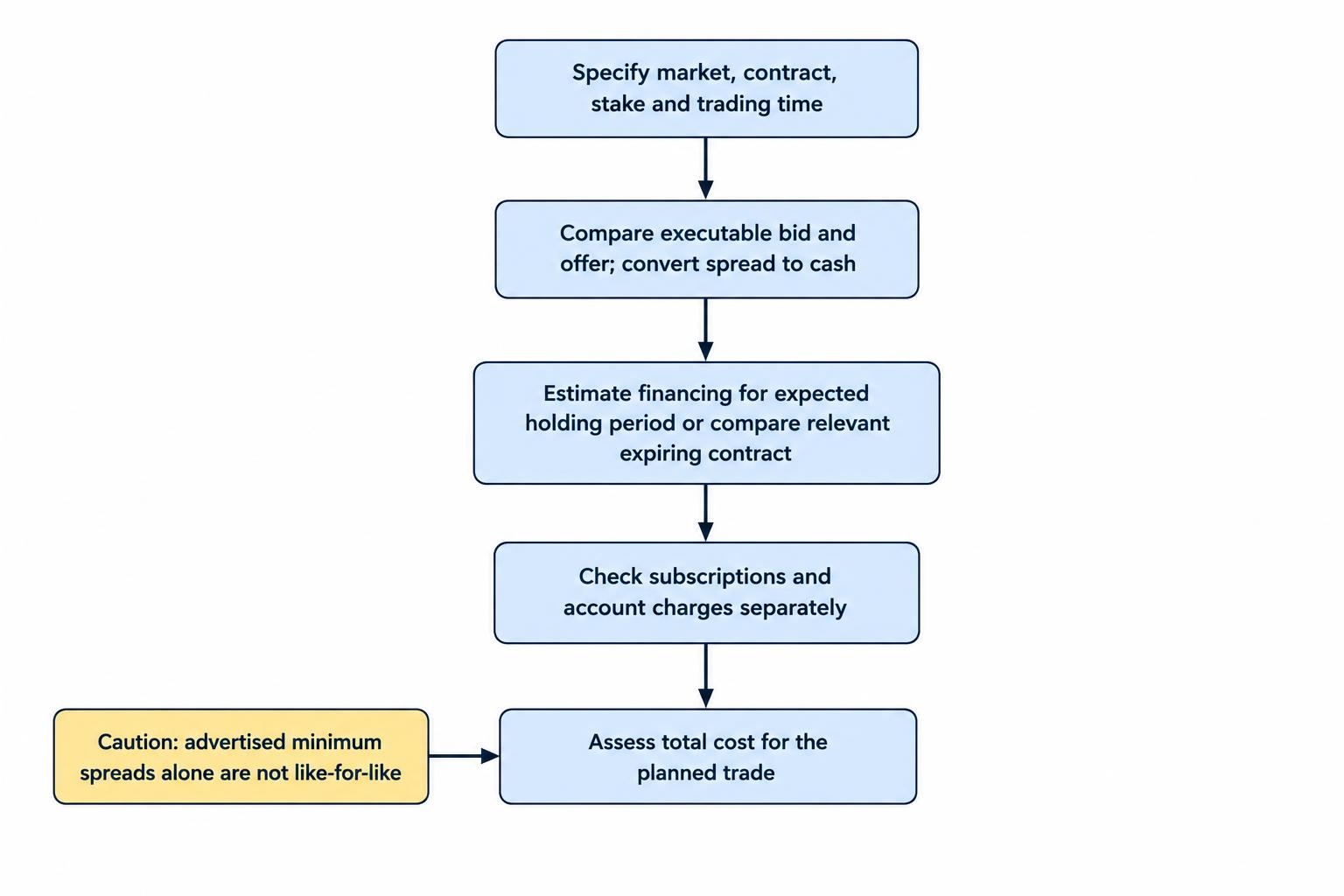
A useful IG vs Spreadex cost comparison begins with an executable quote for the same exposure. Looking at two advertised minimum spreads is not enough. Those figures may apply during different sessions, to different contract versions, or only under favourable market conditions.
Write down the exact market, contract, stake and time you expect to trade. Then compare the bid and offer at each broker. For an index position, distinguish a daily funded contract from an expiring contract. For shares, check that both tickets refer to the same underlying security and use the same definition of a point.
This is also where comparisons can go wrong without anyone noticing. A broker can look cheaper because its quoted point represents a different price increment. Compare the cash effect of the spread, not just the number printed beside it.
What a small spread difference means in pounds
Suppose two hypothetical index contracts have spreads of 1 point and 1.4 points. At £5 per point, their spread costs are £5 and £7 respectively, assuming an immediate opening and closing transaction with an unchanged midpoint.
The difference is £2 per completed trade. Across 50 otherwise identical trades, that becomes £100. These are not IG or Spreadex quotes; they show why a seemingly small difference can matter to an active trader.
Do not charge yourself the full spread twice in the calculation. With an unchanged market and spread, buying at the offer and closing at the bid produces a loss equal to one full spread. If the market or spread changes between entry and exit, the actual result changes too.
A wider spread does not automatically mean a worse completed trade. Execution price, rejected orders and the ability to exit at your intended size also matter. A proper comparison of total spread betting costs keeps those items separate rather than burying them inside a single “low fees” claim.
Overnight funding can change the result
For a position held over several nights, compare the financing formula for that product. An index funding schedule is not interchangeable with a forex schedule. Long and short positions can also receive different adjustments.
Separate the reference rate from the broker’s charge. A published percentage may describe only the broker’s addition, not the entire annual financing rate. Check the charging time, day count and treatment of weekends and holidays before estimating a holding cost.
As an illustration, a two percentage point annual financing difference on £10,000 of constant exposure is about £16.44 over 30 days using a 365 day basis. That can outweigh a modest saving on the opening spread. The rates and exposure in this example are hypothetical.
For either IG or Spreadex, calculate the likely cash adjustment for your position rather than assuming one broker is cheaper across every asset class. The guide to overnight financing costs covers the calculation in more detail.
Daily funded and expiring contracts need separate comparisons
If your strategy holds positions for weeks, compare the available daily funded and expiring versions at each broker. An expiring contract may incorporate carrying costs in its price rather than present them as the same daily funding debit.
That does not make the position free to hold. Expiry, rollover terms and the difference between contract prices still matter. Use the same expected holding period when assessing daily funded bets versus futures style spread bets.
Keep account charges separate from position charges too. An account with no inactivity fee can still be expensive for a particular strategy, while a subscription can be reasonable if you genuinely need the software. Neither point can be settled by the opening spread alone.
Platforms: IG offers more routes, but check what each route supports
IG’s platform and demo account features include its own trading interface, MetaTrader 4 and ProRealTime. That makes it the more natural candidate here if you want to compare several trading environments before committing to one.
More choice has value only when it solves a problem. A trader with an established MT4 workflow has a clear reason to investigate compatibility. Someone who needs only a watchlist, chart and order ticket may find the native interface sufficient.
Check the account and contract behind the software. A platform listed in a broker’s wider product range does not prove that every spread betting market, order type or account feature is available through it. “Supports the platform” and “supports my setup” are different statements.
MT4 and ProRealTime users
If you already depend on MT4, establish whether the spread betting account supports the instruments, position sizes and order behaviour your strategy needs. Do not assume a system built around another broker’s symbols will work unchanged.
Price increments, stake conventions, trading breaks and minimum stop distances can alter results. Before moving an existing setup, compare the practical requirements in the guide to MetaTrader 4 spread betting brokers.
For ProRealTime, include any software charge and its waiver conditions in the comparison. Do not place extra trades simply to avoid a subscription. Paying a known software bill is preferable to manufacturing trading risk to escape it.
TradingView is relevant to both brokers
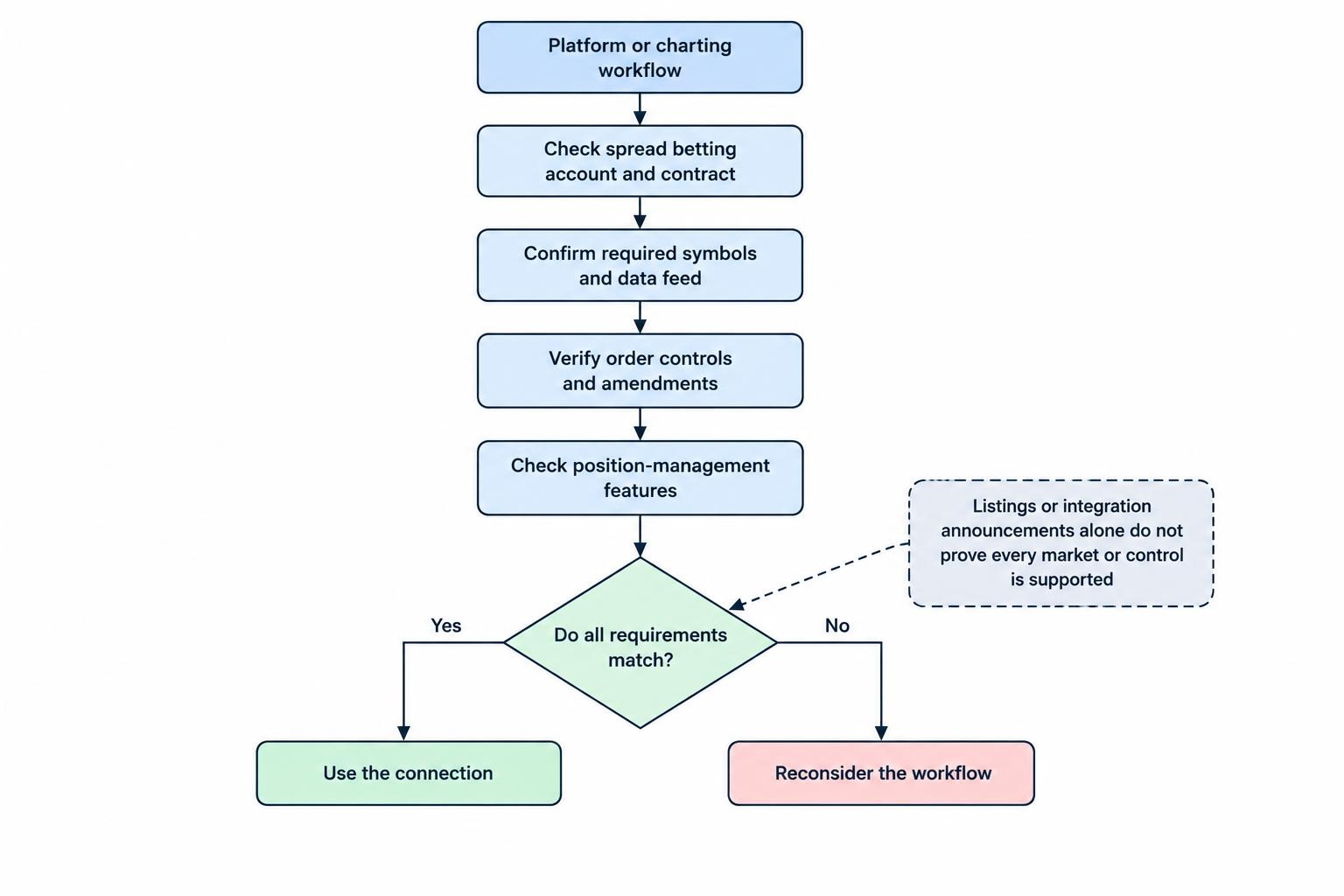
TradingView’s IG integration announcement confirms the broker connection. Before choosing it for a UK spread betting workflow, check the live account options, available symbols and order controls rather than relying on a general platform listing.
Spreadex’s spread betting connection is confirmed in TradingView’s Spreadex spread betting integration announcement. The announcement identifies the SPREADEXSB symbol prefix, which helps distinguish those instruments from other data feeds and contract types.
The chart you analyse and the instrument you trade must match closely enough for your method. An exchange index, a futures contract and a broker’s daily index quote need not display identical prices. A stop drawn against one feed can therefore be misleading if the order is attached to another.
Before making TradingView the deciding factor, compare symbol availability, live data, order amendments and position management. The TradingView spread betting broker guide provides a wider checklist without assuming every integration works in the same way.
Market coverage: build a shortlist of instruments first
Do not choose between IG and Spreadex by counting every market mentioned across their businesses. A total can combine different products, account types and contract versions. It also tells you little about the five instruments you actually intend to trade.
Build a short working list instead. Include your regular index or currency pair, any shares you follow, and the contracts you might use during less common opportunities. Check each one for opening availability, minimum stake, margin and trading hours.
Spreadex merits attention for UK share trading, including AIM coverage. But access to a smaller company is not the same as an attractive trading opportunity. A share can be available while carrying a wide spread, a high margin requirement or restrictions on new positions.
For both brokers, check the exact company rather than assuming a broad “UK shares” category settles the question. The guide to spread betting on UK shares explains the contract details that deserve attention.
Short trades need an extra check. Ask whether the position can be opened at the intended size, whether a borrowing charge applies and what could cause the broker to restrict it. Do not build a strategy around a short position that exists only in a market search result.
For index traders, the choice may be simpler. If both brokers offer the contract you need, the decision moves back to price, platform and risk controls. An extra thousand unrelated markets will not improve that particular trade.
Demo accounts and small balances: IG has a practical advantage
IG’s demo availability gives it an advantage for someone who wants to practise using the platform before funding a live account. Spreadex’s lack of a native demo makes that comparison less convenient, even if its other features suit the trader.
A practice account is useful for learning order entry, amendments and position management. It does not prove how a live order will execute during a fast market. Keep those two purposes separate: platform familiarity is achievable in simulation; live execution quality requires different evidence.
TradingView paper trading should not be treated as a substitute for a broker’s own account environment. It can help rehearse a method, but it does not establish the broker’s actual margin treatment, funding adjustments or fill behaviour. The comparison of spread betting demo accounts covers that distinction.
Minimum deposit is not a sensible trading budget
For a small account, the minimum stake on your chosen contract matters more than a headline deposit threshold. You need enough room to size the trade sensibly and maintain a margin buffer. Being allowed to fund an account does not mean the intended trade fits it.
Consider a hypothetical £2,000 account with a planned price loss of £20 on one trade. If the strategy requires a 50 point stop, the stake would be £0.40 per point before allowing for slippage and other charges.
If a contract’s minimum stake exceeds that figure, the trade does not fit the plan. Moving the stop closer just to satisfy the ticket changes the strategy, not the arithmetic. At either broker, compare minimum stakes against your intended position sizing method.
This produces a more useful decision than asking which broker accepts the smallest deposit. The relevant question is whether the account can support the trades you intend to place without stretching the risk budget.
Stops and execution: inspect the contract and the order ticket
Risk controls should be checked on the platform you will actually use. A feature available in a broker’s native interface may not be presented in the same way through another connection. Check what can be attached when opening a position and what can be amended afterwards.
For an ordinary stop, distinguish the trigger level from the eventual execution price. The order tells the broker when to act; it does not promise that the next available price will equal your chosen level.
If a guaranteed stop is part of your plan, confirm its availability for the exact contract and platform. Compare the minimum distance, premium, amendment restrictions and the point at which the charge becomes payable. A broker level “yes” is only the start of that check.
The premium should be converted into pounds at your intended stake. A charge expressed in points can look small until it is multiplied by the position size. The guide to managing risk with guaranteed stops explains how that protection differs from an ordinary stop.
A stop example without a broker ranking
Suppose a hypothetical long position is opened at 8,000 at £2 per point, with an ordinary stop at 7,960. Execution at that stop would produce an £80 price loss.
If the first available execution price after a gap were 7,900, the price loss would instead be £200. That example excludes financing and other charges. It shows the risk of assuming a trigger level is a guaranteed exit, not how either IG or Spreadex would fill a particular order.
Published execution claims also need careful reading. A speed figure may cover only part of the order process, while a favourable average can conceal very different conditions across markets. Without comparable measurements, there is no sound basis for naming a universal execution winner.
If execution becomes a deciding factor, record the requested price, fill price, order type, time and market conditions. The explanation of slippage in spread betting helps separate execution differences from ordinary price movement.
Regulation and protection: verify the account, not just the brand
For either provider, check the contracting legal entity before transferring money. IG Index Limited and Spreadex Limited are the relevant names to examine for this comparison, but the documents supplied during the application should settle who will hold your account.
Match the firm’s name, permissions and contact details rather than relying on a copied registration number. Follow the steps for checking a broker on the FCA Register, especially if an approach began through an advert, messaging service or unsolicited call.
UK retail protections for these products include leverage restrictions, account based margin close out requirements and negative balance protection. The FCA’s retail product intervention policy sets out the framework, including the 50% margin close out threshold and protection against losing more than the funds in the trading account.
These protections do not turn the account balance into a protected trading budget. You can still lose the funds in the account. Margin close out is also not a personal stop loss plan, and a broker can apply more cautious contractual requirements.
Be careful about changing client classification just to obtain greater market exposure. The protections available to a professional client differ from those available to a retail client. Assess the consequences through the guide to retail and professional client classification before treating a higher trading limit as an improvement.
FSCS protection does not reimburse losing trades
Eligible investment claims can receive compensation of up to £85,000 per person, per firm, subject to the scheme’s requirements. The FSCS investment protection rules distinguish a firm’s failure and a potential client money shortfall from poor investment performance, which is not covered.
Do not confuse that investment compensation limit with bank deposit protection, or assume every product under a familiar group name receives identical treatment. Ask which protection applies to the actual account and activity.
Fraud is a separate risk. The FCA warning about a Spreadex impersonation scam demonstrates why recognising the brand is not enough. Use independently verified contact details, not those supplied by the person asking for a deposit.
Support, withdrawals and everyday account management
Neither a feature list nor a customer rating tells you how support will handle your particular account problem. Before funding IG or Spreadex, ask a question that matters to your intended trading: perhaps a stop restriction, a share’s opening availability or the handling of an expiring contract.
Look for a direct answer that identifies the relevant terms. A quick response is welcome, but speed does not compensate for an answer that avoids the question.
For withdrawals, check the permitted destination, verification requirements, minimum amount and expected processing stages. Distinguish the broker’s handling time from the time a bank or payment provider may need afterwards.
Mobile trading deserves its own check if you expect to manage positions away from a desk. Make sure you can identify the right account, amend the intended order and see the remaining margin clearly. A screen that is pleasant for browsing can still be awkward for managing several open positions.
Account statements matter too. You should be able to separate realised trading results, financing and other adjustments without reconstructing the account from memory. That becomes especially useful when comparing the true cost of a month’s activity.
Tax does not decide IG vs Spreadex
For ordinary UK personal spread betting, the broker’s name does not create the tax treatment. HMRC’s guidance on financial spread betting states that no chargeable gains or allowable losses arise from spread betting.
That is not a reason to prefer IG over Spreadex, nor does it make a loss less expensive. The absence of allowable losses is part of the comparison with other products, not a detail to ignore.
Do not transfer a general UK statement to another country, a company account or a different type of transaction. Personal circumstances and the nature of the activity can matter. The guide to whether spread betting is tax free examines those boundaries without turning this broker comparison into a tax manual.
Which broker should you choose?
IG is the more suitable starting point if you want platform flexibility and a broker demo. Those advantages are tangible if you are still deciding how to trade, already depend on specialist software, or want to practise the order workflow before using real money.
Spreadex is worth shortlisting if you trade manually and its UK share coverage or TradingView setup matches your needs. Its narrower platform choice need not matter if you have no use for the alternatives. The absence of a native demo, however, deserves weight rather than a footnote.
Before choosing either, complete four checks:
- Confirm that your intended contracts are available on the platform you will use.
- Calculate the spread and likely holding costs at your intended stake.
- Check minimum stakes, margin and stop conditions against your risk budget.
- Verify the legal entity, withdrawal terms and applicable account protections.
If both brokers pass, choose the one that fits the actual workflow at an acceptable total cost. If neither passes, widen the comparison through the spread betting broker directory rather than forcing a choice between two unsuitable accounts.
The better broker is not necessarily the one with the longest feature list. It is the one that lets you place the intended trade, understand its costs and control the exposure without changing the plan to fit the platform.