A guaranteed stop premium is the charge for a broker’s commitment to close a covered spread bet at an agreed stop level, subject to the accepted terms. It pays for protection against a worse exit price if the market jumps through that level. It does not make the trade profitable or remove its other costs.
The useful figure is the premium in pounds, not just the rate shown on the deal ticket. Before placing the bet, establish how the charge is calculated, when it becomes payable and whether any refund applies if the stop never triggers.
What does a guaranteed stop premium buy?
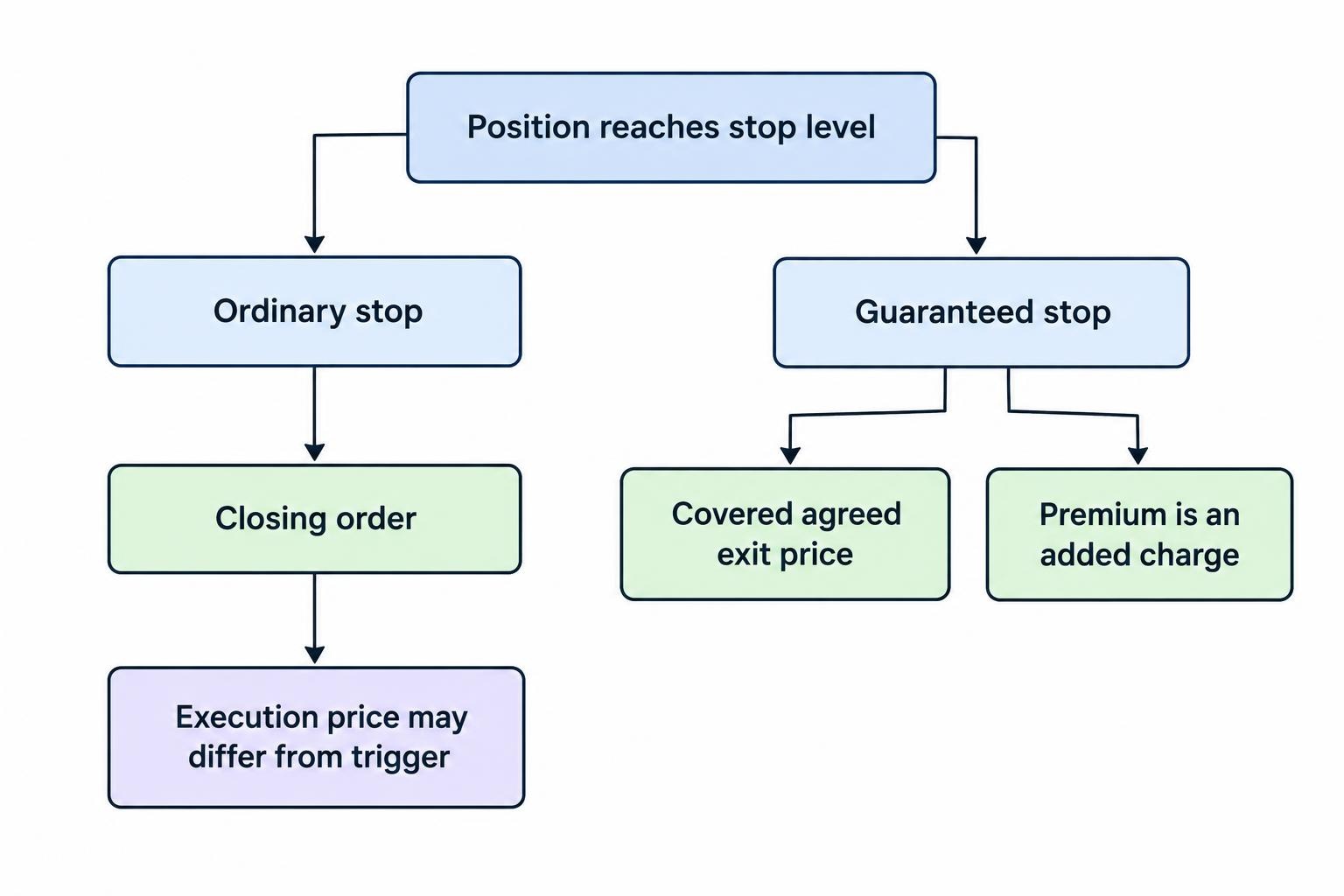
An ordinary stop sets a trigger for closing a position, but its execution price can differ from that trigger. A guaranteed stop adds an agreed execution price to the protection. The distinction between ordinary stops and paid guaranteed protection appears in ASIC’s discussion of stop losses and execution risk.
The premium pays for that price commitment, rather than simply for placing an automatic closing order. If the market moves through your stop without offering a tradable price there, the accepted guarantee protects the covered exit level.
For the order mechanics, see how guaranteed stop-loss orders work. For cost calculations, the distinction is straightforward: the stop controls the covered price loss, while the premium adds to the amount the trade can cost.
How to calculate a guaranteed stop premium
When the fee is quoted in the same points used for your stake, the calculation is:
Premium in pounds = premium in points × stake per point
Suppose an illustrative premium is two points and your stake is £3 per point. The charge would be £6. At £10 per point, the same two-point rate would cost £20. A small-looking rate can become a substantial cash charge as the stake increases.
Keep the premium rate separate from the stop distance. A stop 50 points from entry does not mean you pay a 50-point premium. The distance determines the price loss at the stop; the premium determines the extra charge for guaranteeing that exit.
Check the units before multiplying. A point, pip or fractional price movement must match the unit used for the stake. The stake per point calculation should produce the same cash amount as the platform’s order preview.
If the fee is expressed as a percentage instead, establish what value the percentage applies to. Do not assume the calculation uses your margin deposit. Use the stated calculation base and confirm the final charge in your account currency.
When is the premium charged?
Do not assume “premium” means “pay only if stopped out”. A charge can be collected when guaranteed protection is accepted; cTrader’s guaranteed stop charging specification includes that arrangement. Your account’s fee schedule determines what you owe and when.
Check whether the premium becomes payable when you attach the stop or only when it triggers. If money is taken upfront, check whether closing the position manually, reaching a profit target or removing the protection qualifies for a refund. These are separate questions. An upfront debit does not establish whether the final cost is refundable.
Under a trigger-only arrangement, the charge may become payable whenever the guaranteed stop executes, even if the market reaches the level smoothly. The guarantee protects against adverse execution; the fee need not depend on the broker having to absorb a gap on that particular trade.
Also distinguish money charged from money reserved. A displayed amount might reduce available funds without yet becoming a completed fee. Read the order preview and account entries carefully rather than treating every reduction in available cash as an expense.
Worked example: premium versus gap loss
Consider a hypothetical index spread bet bought at 8,250 for £3 per point, with a stop at 8,200. The entry-to-stop distance is 50 points, giving a price loss of £150 if the position closes there.
Assume the guaranteed stop premium is two points, payable if the stop triggers. Its cash cost is £6. These figures illustrate the calculation and are not current broker quotes.
Now suppose the market gaps lower and the ordinary stop can only execute at 8,130. The outcomes would be:
| Exit scenario | Closing level | Price loss | Premium | Total loss |
|---|---|---|---|---|
| Ordinary stop, no slippage | 8,200 | £150 | £0 | £150 |
| Ordinary stop, assumed gap execution | 8,130 | £360 | £0 | £360 |
| Guaranteed stop, same gap | 8,200 | £150 | £6 | £156 |
In this example, the guarantee avoids £210 of adverse execution for a £6 premium, leaving the guaranteed-stop outcome £204 better than the assumed ordinary-stop outcome. Without slippage, the ordinary stop would cost less.
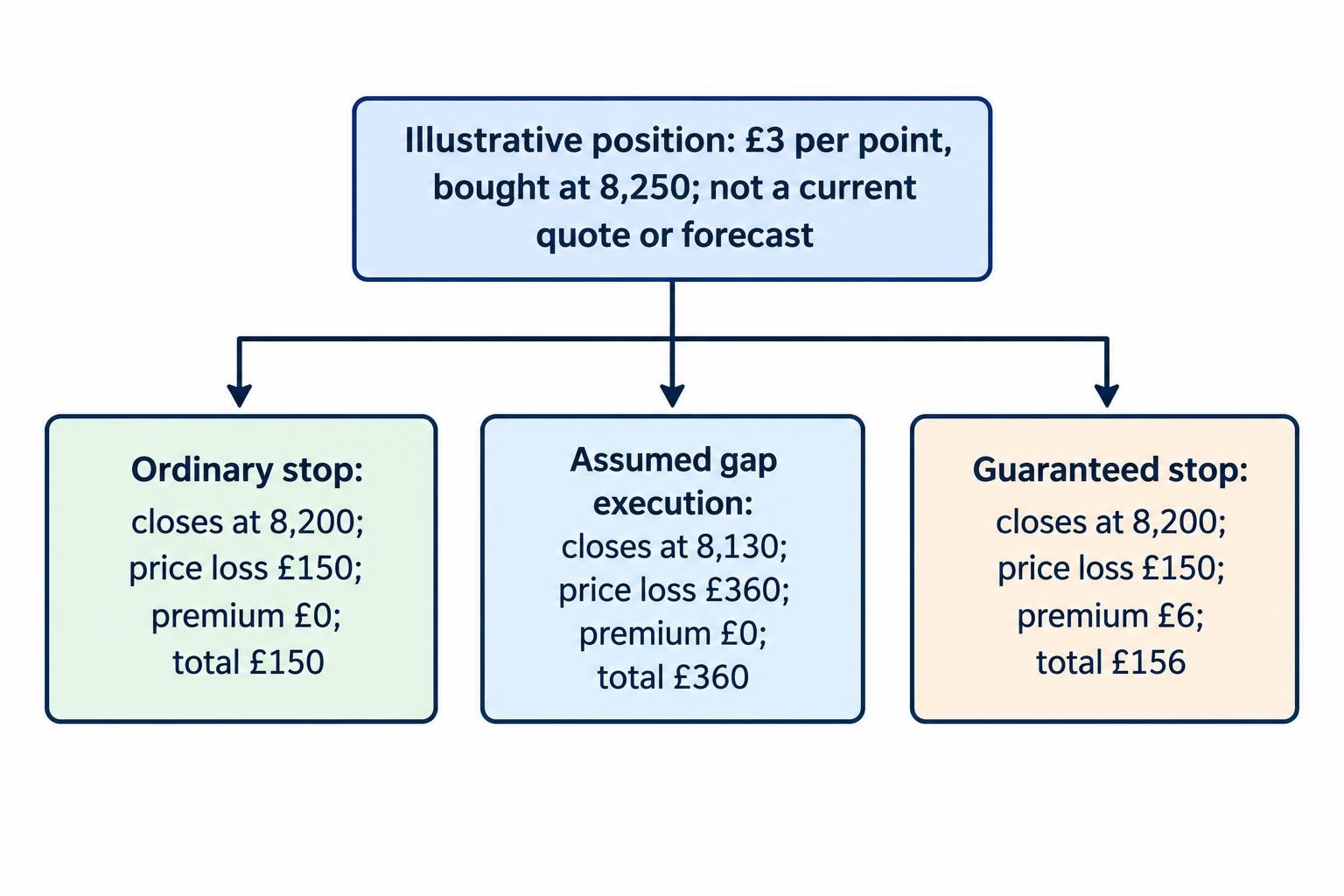
The example assumes a valid guarantee covering the whole position and no earlier account close-out. It excludes financing and other separate adjustments. The entry and closing levels are executable prices, so do not add the spread again if it is already reflected in those prices.
The comparison illustrates the cash cost of slippage, not the expected saving from buying guarantees across a trading strategy. One favourable gap example cannot establish whether the premiums will pay for themselves over time.
Include the premium in your trade budget
If you calculate stake using only the stop distance, the premium sits outside your planned loss. That can leave the trade costing more than the figure you intended to risk.
For a premium quoted in points and payable on a stopped trade:
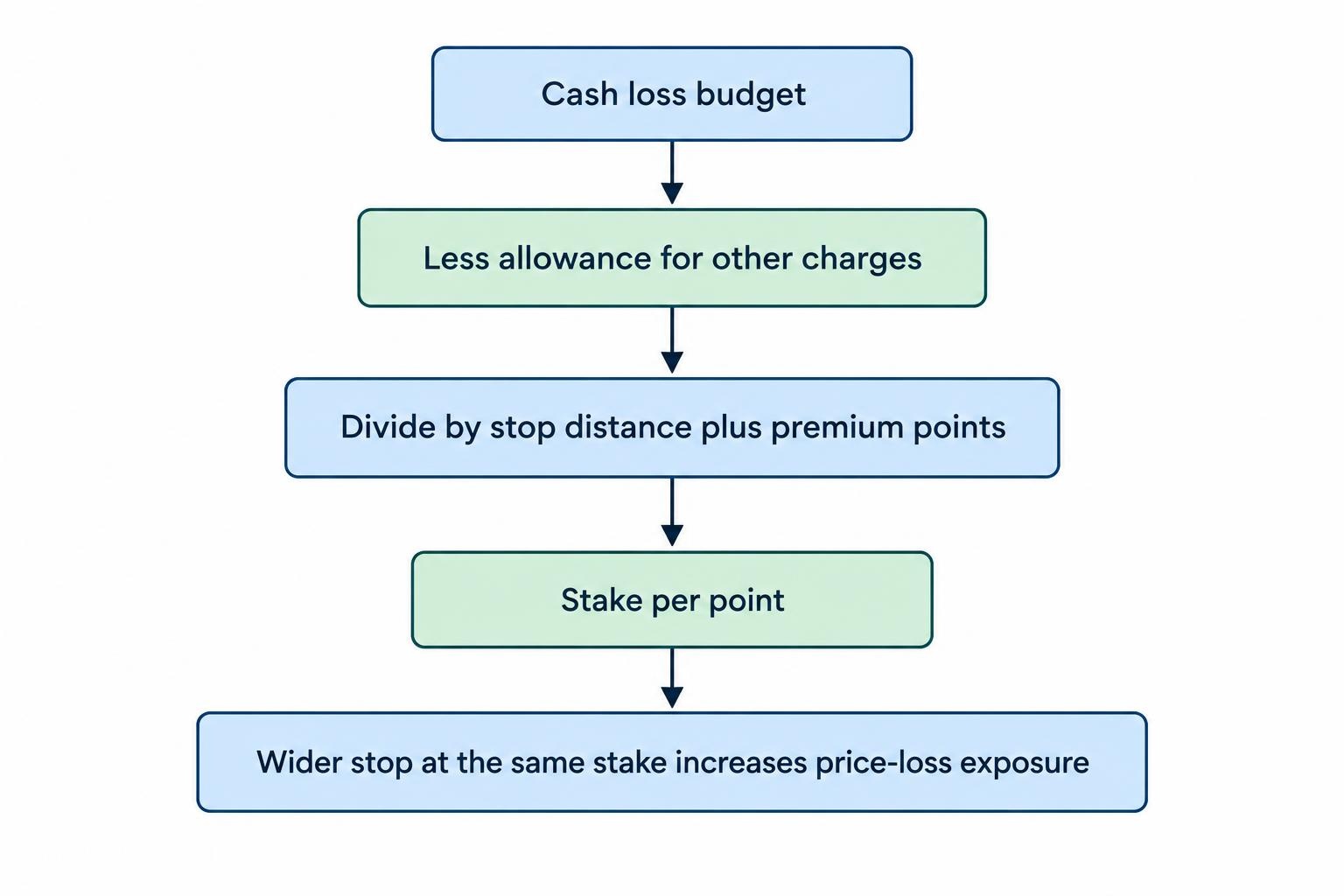
Stake per point = (cash loss budget − allowance for other charges) ÷ (stop distance + premium in points)
Using a £130 budget, a 50-point stop and a two-point premium gives a stake of £2.50 per point, assuming no other charges. The price loss would be £125 and the premium £5, bringing the total to £130.
This is a budgeting calculation, not a suggested risk amount. Round down to an available stake increment if rounding up would exceed your budget. The broader process belongs in position sizing for spread betting.
Minimum stop distances also deserve attention. If the accepted guarantee requires a wider stop than your original plan, keeping the same stake increases the price loss at that stop. A cheap premium attached to a much wider stop may produce a larger cash exposure than expected. Recalculate the stake rather than judging the charge in isolation.
What the premium does not cover
The guarantee concerns the covered exit price. It does not automatically absorb the spread, financing, currency conversion or other account charges. For a position held across funding cut-offs, budget separately for overnight financing costs. A fixed stop level does not freeze every expense associated with keeping the bet open.
Nor does paying a premium promise that the position will remain open until the stop is reached. Account-level margin close-out can close a guaranteed-stop position earlier. That interaction is addressed in ESMA’s Q&A on guaranteed stops and margin close-out. Keep the premium, the margin requirement and available account funds separate in your calculations.
For UK retail accounts covered by the rules, negative balance protection caps liability for the relevant speculative investments at the funds in the account under FCA COBS 22.5.17R. That account-level protection is different from guaranteeing the exit price of one position. Neither makes spread betting a safe product.
How to compare premiums before placing a bet
Compare the cash charge for an equivalent position, not two headline point rates. The same stake, stop distance and intended holding period give a more useful starting point. If the permitted stop distances differ, compare the resulting cash loss budgets too.
Before submitting the order, check:
- Calculation: What is the premium in pounds for the full position?
- Timing: Is it charged on acceptance or only on execution?
- Refunds: What happens if the position closes without triggering the stop?
- Restrictions: What minimum distance, amendment or cancellation conditions apply?
- Confirmation: Does the accepted order record show guaranteed protection for the intended size?
Retain the order confirmation and check the eventual charge against it. If a refund is due under the terms, reconcile that credit as well. A correct calculation on the opening ticket is only half the accounting.
Is a guaranteed stop premium worth paying?
The decision is whether the accepted exit-price protection is worth its cash cost for that position. Consider the consequences of a gap, the required stop distance and the size of the loss you could tolerate without the guarantee. Closing the trade or reducing the stake are alternatives worth considering, not afterthoughts.
A trigger-only fee and a non-refundable upfront fee should not be treated as equivalent, even when their quoted amounts match. Their cost across a series of trades depends on different events.
Use the premium as one part of a total spread betting cost comparison. The cheapest guarantee is not necessarily the cheapest trade. Calculate the covered price loss, add the premium and other expected charges, then decide whether that total fits the trade budget before committing funds.