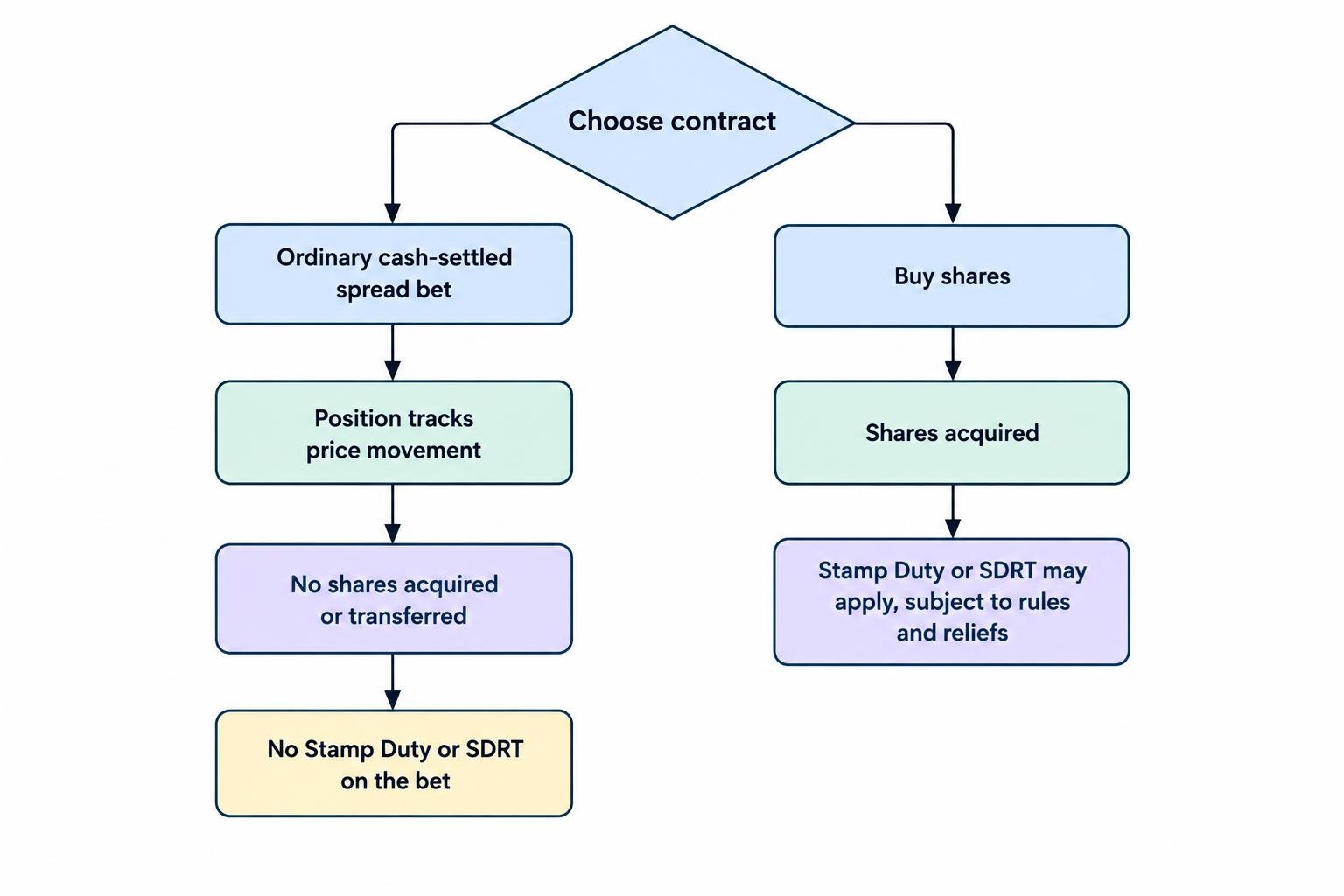
UK financial spread betting does not normally attract Stamp Duty or Stamp Duty Reserve Tax (SDRT). The reason is straightforward: you take a position on a price movement rather than purchase the underlying shares. HMRC’s guidance on financial spread betting confirms that no assets are acquired or disposed of through the bet.
That can remove an entry cost compared with buying chargeable UK shares. It does not make spread betting cheaper in every case, and it certainly does not make the position safer. The useful comparison is between equivalent market exposure, total costs and the risks you accept.
Why Spread Bets Fall Outside Share Transfer Taxes
A share spread bet is a contract with your provider. Your profit or loss depends on the movement between your opening and closing prices, multiplied by your stake per point. You do not receive the shares when you open the position or deliver them when you close it.
The distinction matters because the principal SDRT charge applies to agreements to transfer chargeable securities for money or money’s worth. An ordinary cash settled spread bet contains no such agreement. Its reference to a UK share price does not turn it into a purchase of that share.
This also explains why buying and selling mean different things on the two account types. Clicking “buy” on a spread betting ticket opens a position expecting a price rise; it does not make you a shareholder. Our comparison of spread betting and share dealing covers the broader differences between the contracts.
Stamp Duty and SDRT: What Share Buyers Usually Pay
“Stamp duty” is often used as shorthand for both share transaction taxes, but they are separate charges. Electronic share purchases generally attract SDRT. Purchases using a stock transfer form generally attract Stamp Duty when the transaction exceeds £1,000. The usual rate is 0.5%, subject to exemptions and reliefs; these distinctions appear in HMRC’s guidance on tax when buying shares.
The £1,000 threshold for transactions using a stock transfer form is not a general allowance for electronic purchases. A small electronic share purchase can still attract SDRT.
Nor does every share purchase carry the charge. Examples outside the usual charge include subscribing to newly issued shares, while purchases of foreign shares outside the UK do not normally attract UK Stamp Duty or SDRT. A comparison should therefore start with the actual investment you would otherwise buy, not assume every alternative costs an extra 0.5%.
Worked Example: £10,000 of UK Share Exposure
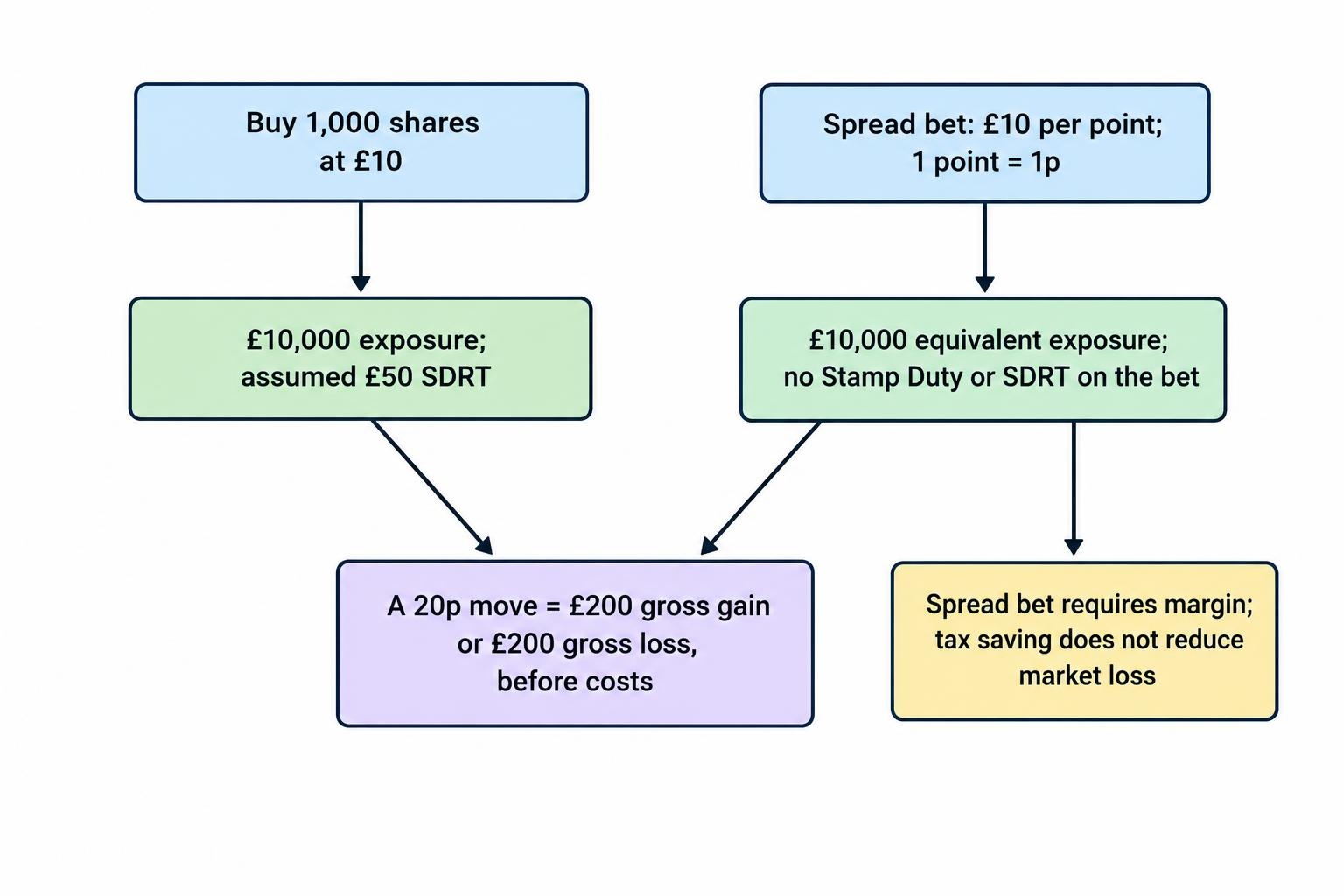
Suppose an existing UK company share trades at 1,000p, or £10. You want exposure equivalent to 1,000 shares. Assume an electronic share purchase attracts the standard 0.5% SDRT charge, with no exemption or relief.
| Position | Exposure at opening | Share transaction tax |
|---|---|---|
| Purchase 1,000 shares at £10 | £10,000 purchase value | £50 SDRT |
| Open a share spread bet at £10 per point, where one point equals 1p | £10,000 equivalent exposure | No Stamp Duty or SDRT on the bet |
The spread betting stake matches the share exposure because a 1p movement changes the value of 1,000 shares by £10. On either position, a 20p favourable movement produces a £200 gross gain before costs. A 20p adverse movement produces a £200 gross loss.
For the share purchase, the £50 SDRT is an acquisition cost. It is not calculated on your eventual profit. For the spread bet, there is no corresponding share transfer charge, but the spread and any other applicable charges still affect the result.
This illustration excludes differences between quoted prices, financing and execution. It also does not assume equal cash deposits: a spread bet requires margin rather than payment of the full equivalent share value. Matching the exposure is what makes the comparison useful. Matching only the initial cash outlay could produce very different risks.
The absence of a £50 tax charge does nothing to reduce the £200 market loss in the adverse scenario. Position size and available account funds remain central to managing the risk of exposure larger than your deposit.
No Stamp Duty Does Not Mean No Trading Costs
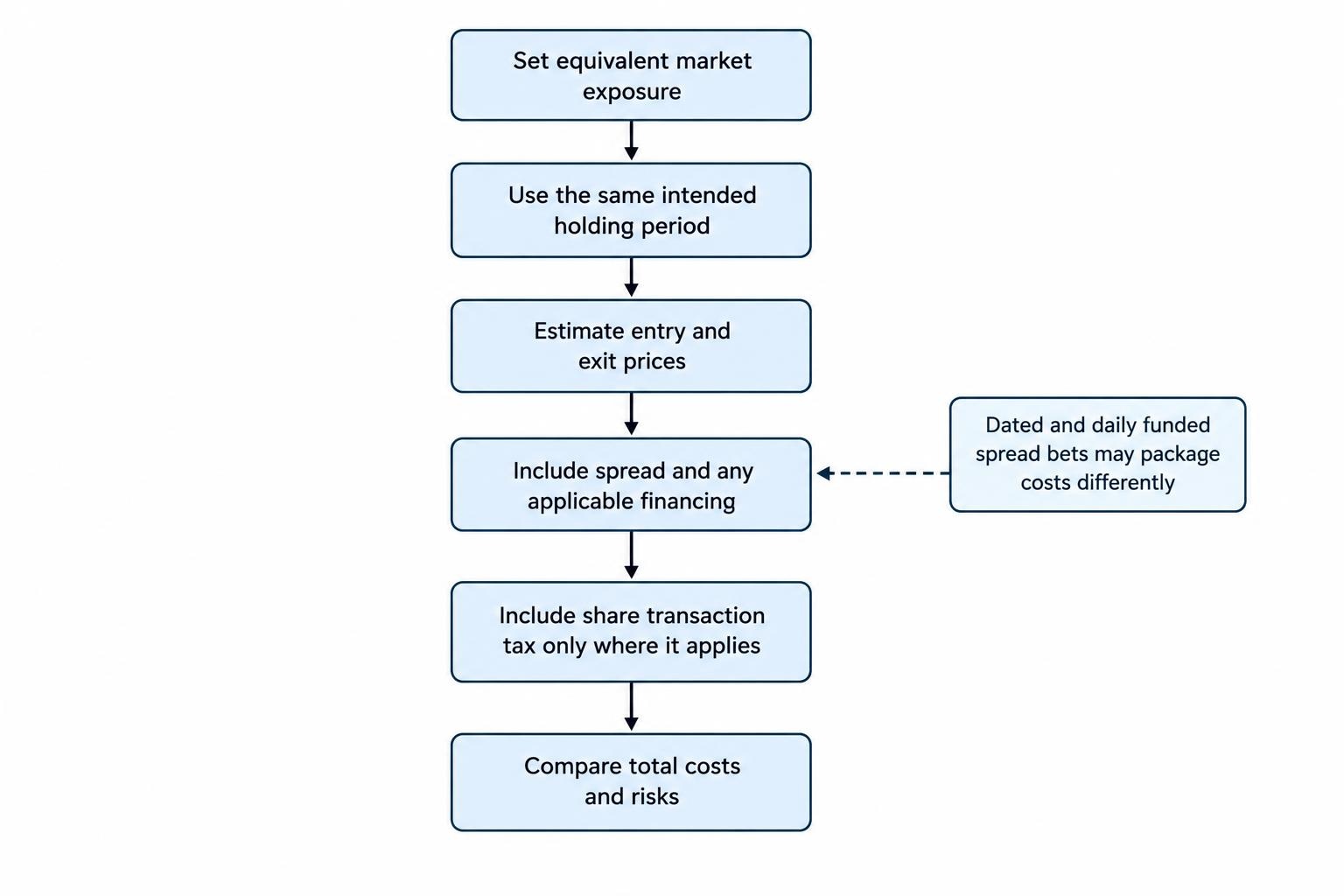
Avoiding a share transaction charge can help a short holding period, but it is only one line in the calculation. Spread bets have a difference between the buying and selling prices. Depending on the contract, holding a position overnight may also generate financing charges.
For a position held over a longer period, financing can outweigh the entry tax avoided. A small apparent saving at opening is not much comfort if recurring charges steadily consume it. Compare the expected holding period, not just the first day.
Contract choice matters too. A daily funded bet and a dated contract can package their costs differently. Check whether a quoted price includes a wider spread, whether separate financing applies, and what happens at expiry or rollover. The guide to comparing total spread betting costs provides a framework for that calculation.
Use equivalent exposure, the same intended holding period and realistic entry and exit assumptions. Otherwise, a comparison can make one product look cheaper simply because it represents a smaller position.
Keep Stamp Duty Separate From Other Tax Questions
Stamp Duty and SDRT concern share transactions. They do not, by themselves, answer how profits, losses or business arrangements should be treated for other taxes. “No stamp duty” is therefore a narrower statement than “no tax consequences of any kind.”
If your question concerns income, capital gains, hedging or trading through a company, address that question separately. The UK spread betting tax guide separates those topics rather than treating them as one blanket exemption.
The scope here is UK share transaction taxes on ordinary financial spread bets. Do not assume the same treatment applies under another country’s tax rules or to a different product sold through the same trading platform.
What to Check on Your Account
Confirm that the trade confirmation identifies a spread bet, not a share purchase. A provider may offer several account types, and the company name or trading app alone does not establish which contract you entered.
If an unexpected charge appears, ask the provider to identify it and explain its contractual basis. A financing adjustment, dealing charge or dividend adjustment should not be treated as Stamp Duty simply because it reduces your account balance.
Keep confirmations and statements showing the account type, market, stake, opening and closing prices, and charges. Clear spread betting records help separate bets from investments held elsewhere and make discrepancies easier to investigate.
Choose the product for the exposure, costs and ownership rights you actually want. The absence of Stamp Duty is a useful distinction, not a reason on its own to replace a shareholding with a margined bet.