Spread betting gives you a contract linked to a market’s price movements. Investing usually means buying and holding assets, such as shares, bonds or fund units, with the aim of building wealth or receiving income. You can gain exposure to the same market through either route, but the funding, costs and risks differ.
For building a portfolio over many years, fully paid investments are generally a better structural fit than leveraged spread bets. Spread betting serves a different purpose: taking a trading position, including a view that prices will fall, without buying the underlying asset.
The useful comparison is not simply which can produce the bigger return. It is how much exposure you take, what keeping it costs, and whether you can stay in the position when prices move against you.
How spread betting and investing differ
This comparison treats investing as buying ordinary shares, bonds or mainstream funds without borrowing. Investing through a margin account, leveraged fund or other complex product changes the risk calculation.
| Feature | Spread betting | Fully paid investing |
|---|---|---|
| What you hold | A contract with a provider linked to an underlying market | Shares, bonds, fund units or another investment asset |
| Money committed | Margin supports a larger market exposure | You pay the purchase price of the investment |
| Return calculation | Points moved multiplied by your stake per point, less costs and adjustments | Change in asset value plus income received, less costs |
| Market direction | You can open a long or short position | Ordinary purchases generally benefit from rising prices and income |
| Holding period | Depends on the contract, financing and available margin | Usually determined by your investment plan and the asset’s terms |
| Ongoing demands | Monitor exposure, margin, funding costs and exit orders | Review asset selection, allocation, charges and changing needs |
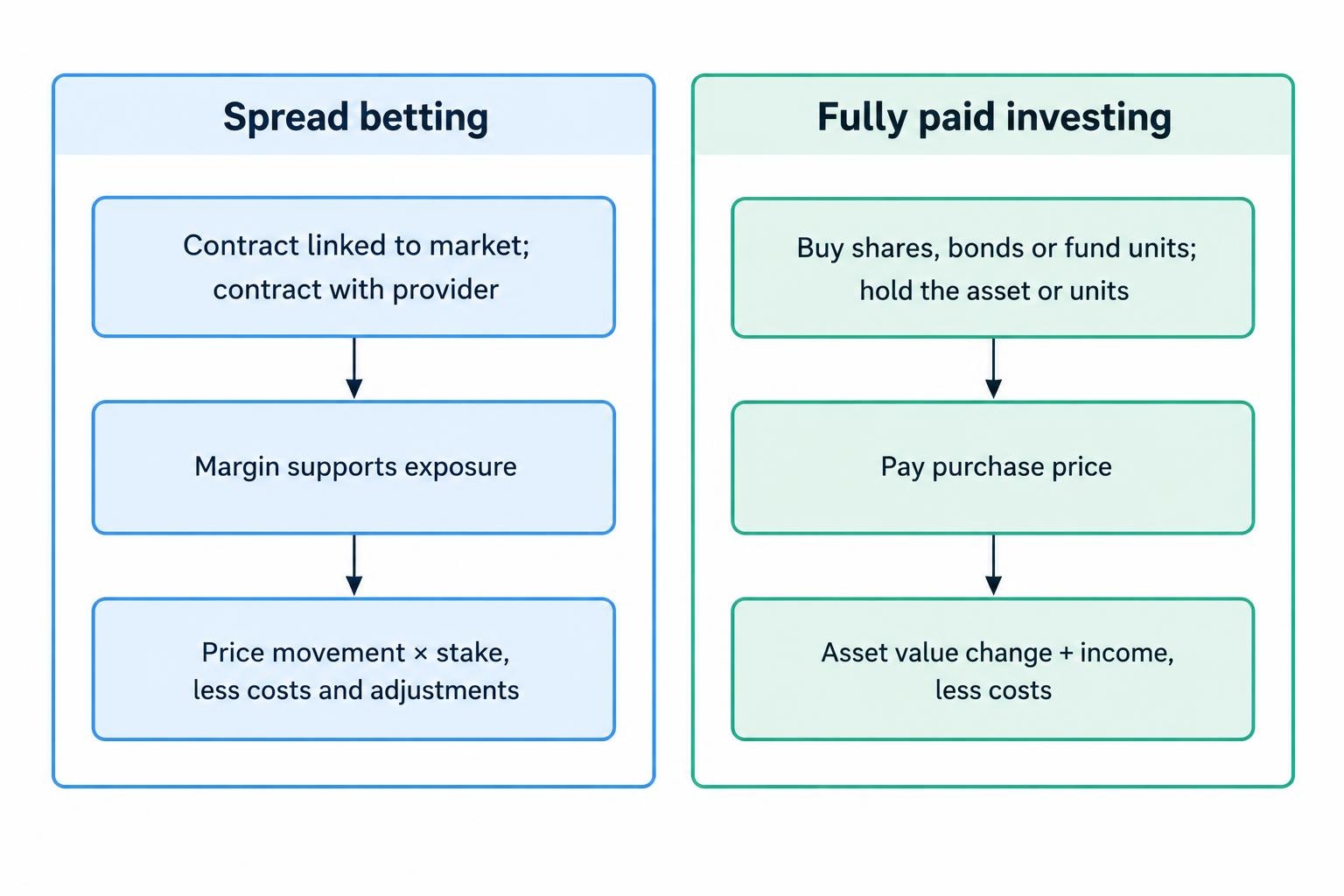
The mechanics of how spread betting works matter more than the label on the account. A small opening deposit can support a large position. It does not mean that position carries a small financial risk.
Ownership, dividends and investment income
Buying a company’s shares gives you an ownership interest. Depending on the share class and holding arrangements, that can include dividend entitlements and voting rights. Neither dividends nor a rising share price are guaranteed; the SEC’s explanation of stock ownership and returns sets out that distinction.
A spread bet on the same company does not make you a shareholder. You have a contract with the provider, not an ownership interest in the business. A share spread bet may receive or incur a dividend adjustment under its terms, but that adjustment is not the same as owning shares and receiving a shareholder distribution.
Funds introduce another distinction. When you buy a fund, you own units or shares in that fund rather than personally holding every asset in its portfolio. A broad investment fund can provide exposure to many companies through one holding. Spread betting on an index also provides exposure to a basket of companies, but through a trading contract rather than a fund investment.
That difference affects more than paperwork. It changes the holding costs, account requirements and way you receive returns. The separate comparison of spread betting and ETFs covers the choice between index exposure through a bet and ownership of an exchange traded fund.
Compare equal market exposure, not equal deposits
The easiest way to make spread betting look unusually profitable is to compare a leveraged position with a much smaller investment. A fair comparison starts with the same exposure, then examines how each position is funded.
A £10,000 exposure example
Assume a fictional company’s shares trade at 500p, or £5. Buying 2,000 shares creates a £10,000 investment.
For the spread betting example, assume one point equals 1p. A stake of £20 per point produces the same initial price sensitivity as those 2,000 shares: every 1p movement changes the position’s value by £20. The provider requires a hypothetical 20% margin, so £2,000 supports the £10,000 exposure.
If the share price rises from 500p to 525p, the investment gains £500. The spread bet also gains £500 before costs and adjustments: 25 points multiplied by £20.
If the price falls to 475p, each position instead loses £500 before costs. The market exposure, rather than the opening deposit, determines that pound loss.
The percentage figures look different. A £500 gain is 5% of the £10,000 purchase price, but 25% of the spread bet’s £2,000 margin. A £500 loss produces the same percentages in reverse. The smaller deposit is not a discount.
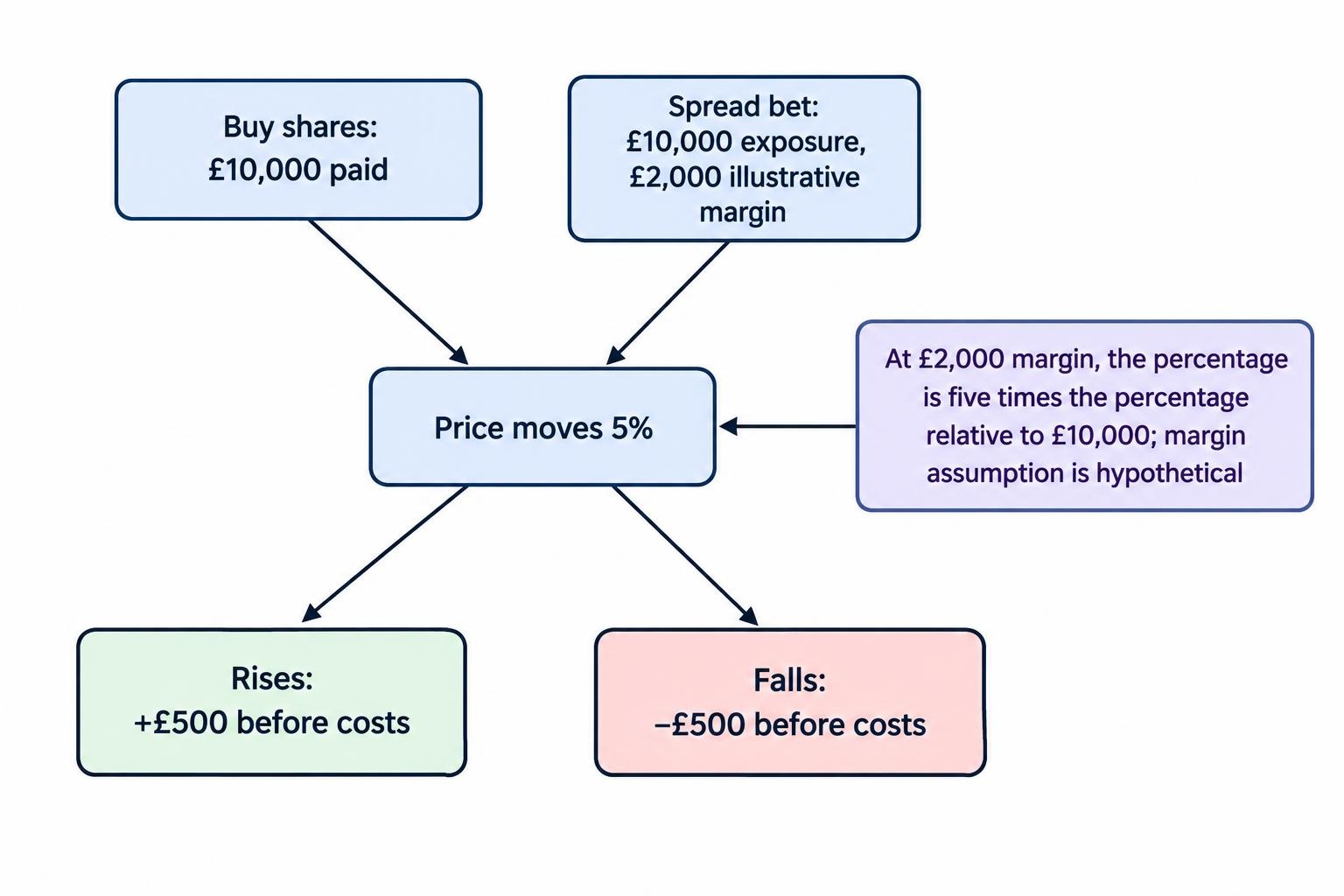
These figures deliberately ignore spreads, financing, dividends, taxes and execution differences to isolate the effect of funding. The assumed margin is illustrative, not a promise about any provider’s requirements. Check the market’s point definition before using stake per point to calculate exposure.
What if you only have £2,000?
At £5 per share, £2,000 buys 400 shares. A 5% price rise produces a £100 gain before costs. Using that £2,000 to support the larger spread bet produces a £500 gain from the same move, but also a £500 loss if the move goes the other way.
Those are not equivalent positions. One has five times the initial market exposure of the other.
A spread bettor could choose a smaller stake and keep more cash available. Leverage permits larger exposure; it does not require you to use the maximum. The sensible starting point is the pound loss you can afford, not the largest trade the platform will accept.
Risk differs in both size and timing
Both approaches can lose money. An individual company can fail, a bond issuer can default, and a fund can suffer a prolonged decline. Buying an asset outright does not make the asset safe.
Spread betting adds a funding constraint. Losses reduce the equity available to support open positions. You may need to reduce exposure or add money, and the provider can close positions under the account terms. Having the right long term view is no help if the position cannot survive the intervening losses.
For UK retail accounts covered by the rules, FCA requirements include minimum opening margin, account-level margin close-out and negative balance protection. Firms must close positions as soon as market conditions allow when account equity falls below 50% of the required margin. Liability for the covered speculative investments is restricted to the funds dedicated to that trading account under the FCA’s retail speculative investment rules.
Negative balance protection is not a cap at the margin assigned to one trade. You can lose more than that trade’s opening margin, and other money in the trading account may be at risk. It also does not prevent you from losing the account’s entire trading balance.
By contrast, a fully paid holding that is not pledged against borrowing has no trading margin requirement. A price decline alone does not create a margin shortfall. You can still face a painful loss, but you do not need extra collateral simply to keep holding it.
This distinction is central to spread betting margin risk. The question is not just how far a market might fall. It is whether your account can support the position before you choose to exit.
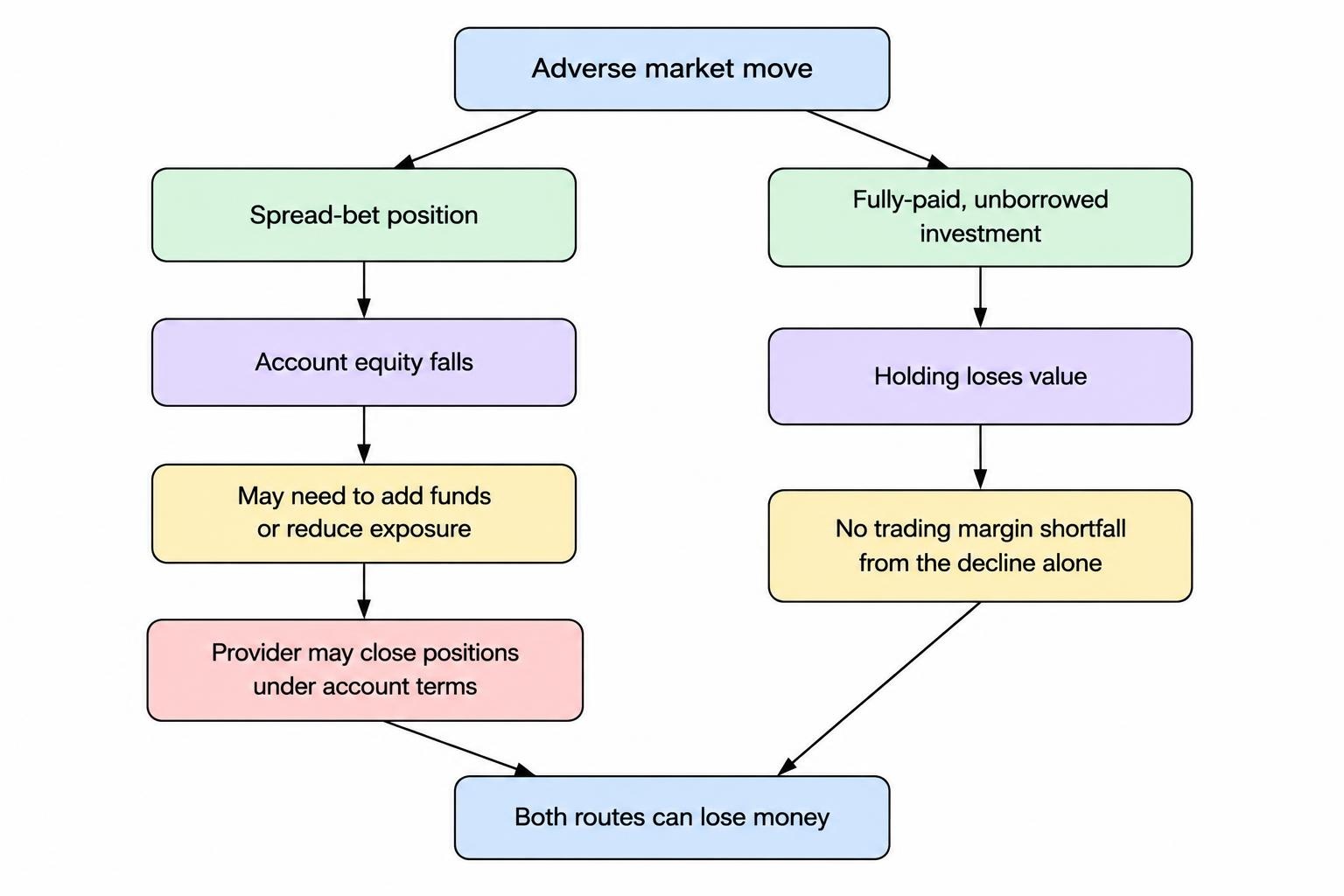
Stop losses help define a trading exit, but an ordinary stop does not guarantee its execution price. A market gap can produce a worse result than planned. Using stop losses within a risk plan requires an allowance for that possibility, rather than treating the displayed stop level as a guaranteed maximum loss.
Holding period changes the cost comparison
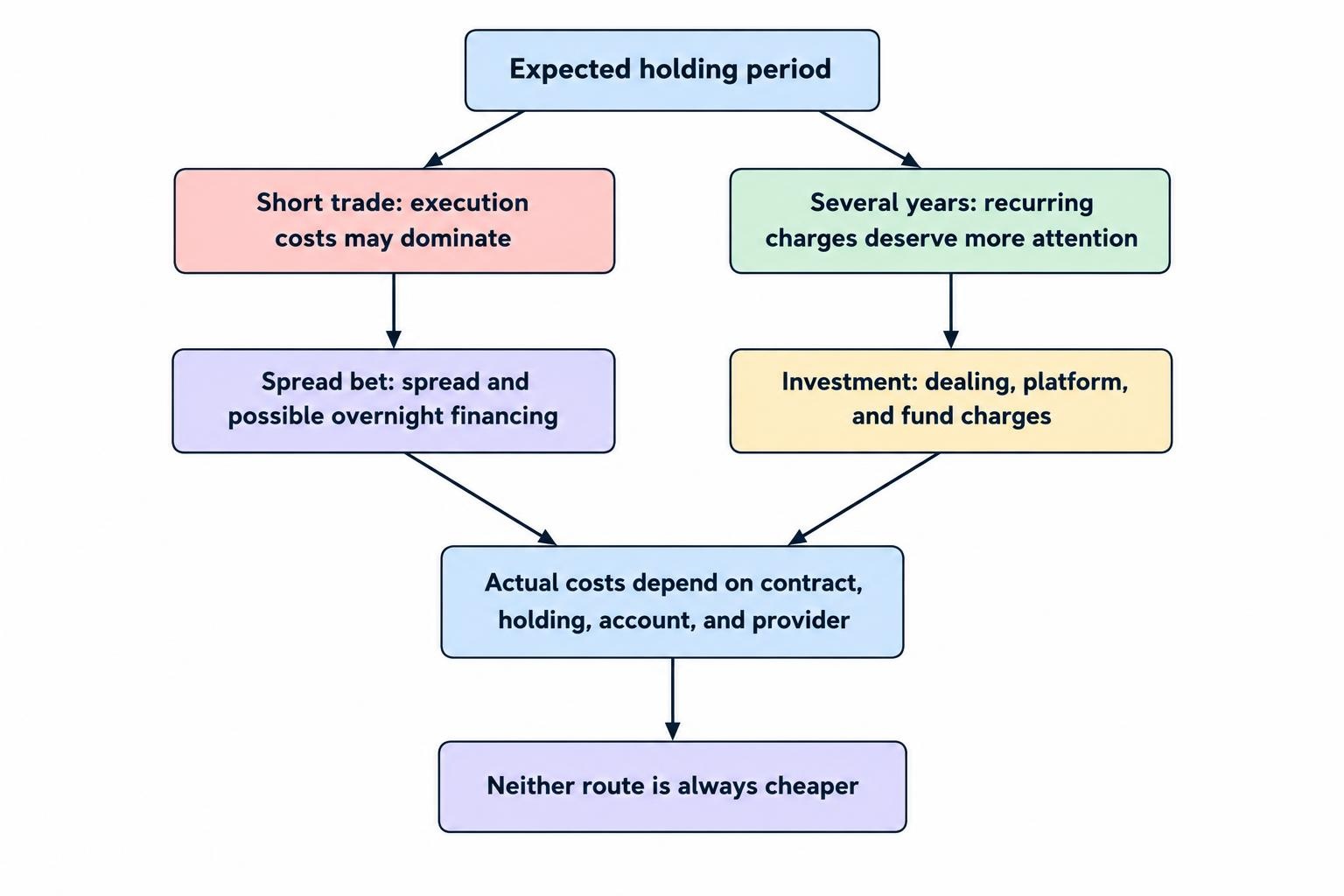
A position that makes sense for an afternoon may be expensive to maintain for a year. That is one reason spread betting and investing should not be treated as interchangeable ways to hold the same market indefinitely.
Spread betting costs
The spread creates an entry and exit hurdle: buying and immediately selling at unchanged quotes produces a loss. Wider spreads increase that hurdle, while frequent trading repeats it.
Daily funded bets can also incur overnight financing. The calculation generally relates to the position’s market exposure, not just the margin paid to open it. In the example above, a financing charge would not necessarily be calculated on only the £2,000 deposit.
A simple hypothetical shows why this matters. If a £10,000 long position carried an unchanged annual financing charge of 8%, the annualised cost would be about £800. That is 8% of the exposure but 40% of a £2,000 opening margin. Actual charges depend on the contract, rate, holding days and provider’s method; this is a cost illustration, not a quoted rate.
Short positions do not automatically avoid holding costs. Financing terms, reference rates and any borrowing charges can affect the result. Review the overnight financing calculation for the actual market rather than assuming a short trade earns interest.
Futures-style spread bets usually handle the cost of carrying exposure differently, with pricing reflected in the contract rather than a separate daily financing debit. That does not make the exposure free to hold. Expiry, spreads and rolling the position can all matter, as the comparison of daily funded bets and futures explains.
Investment costs
Fully paid investments avoid the financing charge associated with maintaining a daily funded spread bet. They still have costs. Depending on the holding and account, these can include dealing charges, platform fees, fund charges, currency conversion and applicable transaction taxes.
Fund charges reduce the return available to investors over time. A low dealing fee does not compensate automatically for expensive ongoing administration, just as a narrow spread does not settle the cost of a leveraged trade held for months.
Compare the total expected cost over your intended holding period. For a short trade, execution costs may dominate. For a holding intended to last several years, recurring charges deserve much more attention.
Long term investing and compounding
Investing can combine changes in asset value with income and regular contributions. Reinvested dividends or fund distributions buy additional holdings, which then participate in future gains, losses and distributions.
Compounding does not require a smooth annual return. It means later returns apply to a balance already changed by earlier results. Losses compound too: after a 20% fall, a holding needs a 25% gain to return to its starting value, before costs.
A longer holding period gives investments more opportunity to ride out short term fluctuations, but it does not guarantee recovery. Spreading money across companies, asset types and regions also reduces reliance on any one holding. These principles sit alongside a suggested timeframe of at least five years in the FCA’s long term investing guidance.
Spread betting profits can also be retained in an account. However, increasing stakes after gains increases exposure; it does not turn a trading strategy into a dependable compounding plan. The result still depends on the strategy’s performance after spreads, financing and losses.
A rising market is not enough to settle the comparison either. A fully paid investor and a spread bettor may both benefit from the rise, yet achieve different net returns because their costs, position sizes and exit points differ.
For someone making monthly contributions over many years, the practical advantage of conventional investing is the ability to add to owned holdings without continually maintaining trading margin. That is a structural difference, not a promise of superior returns in every period.
UK tax: compare accounts, not slogans
For an individual placing ordinary personal financial spread bets, no chargeable capital gains or allowable capital losses arise from those bets. This treatment is set out in HMRC’s guidance on financial spread betting. The absence of allowable losses matters: a losing bet does not provide a capital loss to offset against taxable investment gains.
That does not make spread betting the only route to tax-efficient market exposure. Eligible investments held in a stocks and shares ISA can generate income and capital gains free of UK tax within the wrapper, subject to the ISA rules. The government’s explanation of ISA tax treatment covers that alternative.
Compare the account you would actually use, not a spread betting account against an assumed fully taxable investment account. An ISA does not remove investment risk or charges, but it can change the tax comparison substantially.
Tax treatment depends on circumstances and can change. Company activity and business arrangements need separate consideration. The broader guide to whether spread betting is tax-free covers the qualifications beyond this capital gains comparison.
Tax should influence the choice after you have assessed suitability, exposure and costs. An exemption does not rescue a position whose losses or holding charges you cannot afford.
Short positions and hedging serve different goals
Ordinary investing usually starts with buying an asset you want to own. Spread betting also lets you open a short position, aiming to profit if the quoted market falls. That makes it useful for expressing a bearish trading view without first owning the asset.
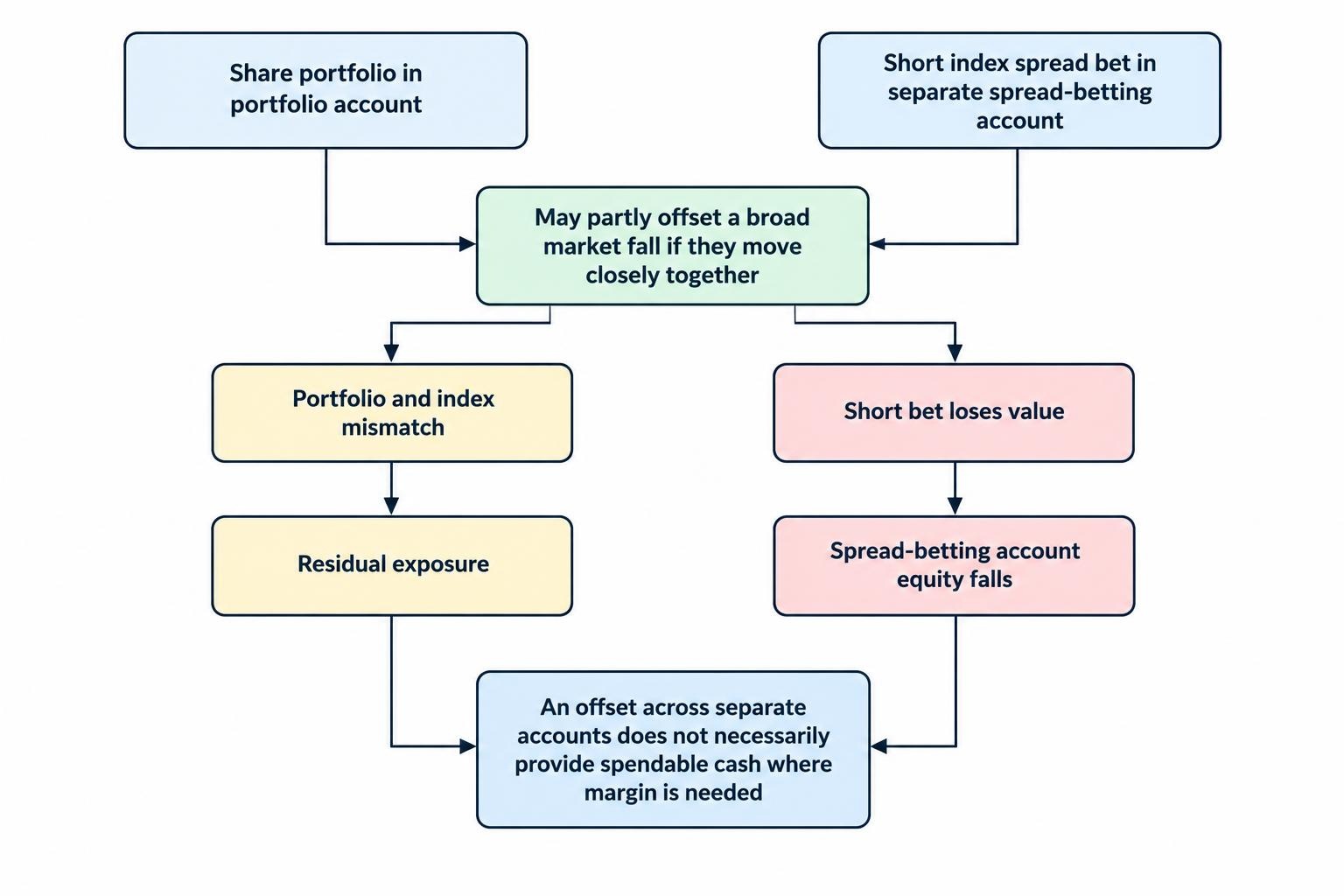
It can also support a temporary hedge. Consider an investor who holds a portfolio of shares but wants to reduce exposure to a broad market decline for a short period. A short index spread bet could offset part of a fall if the portfolio and index move together closely enough.
The match will rarely be exact. The portfolio may contain different companies, sectors or currency exposures. If shares rise, the short hedge loses money and offsets some of the portfolio’s gains. Financing and execution costs reduce the result further.
There is also a cash-flow problem. The investment portfolio might rise while losses on the short position reduce the spread betting account’s available equity. An economic offset across two accounts does not necessarily provide spendable cash in the account that needs margin.
For those reasons, hedging with financial spread bets requires a sizing and funding plan. Opening a short position because the news feels worrying is not, by itself, a hedge calculation.
Which approach fits your objective?
Start with the job you want the money to do. Building a portfolio for a distant goal, receiving investment income and trading a short term price move are different objectives. They should not share an account choice by default.
Fully paid investing is generally the closer fit when you want to hold assets for years, make regular contributions and avoid maintaining leveraged trading positions. You still need suitable holdings, manageable charges and the financial capacity to withstand losses.
Spread betting may fit a defined trading or hedging task when you understand the contract and can fund the exposure. The relevant questions are practical:
- Exposure: What pound gain or loss would a realistic market move produce?
- Funding: How much cash would remain available after an adverse move?
- Duration: What would the position cost if it stayed open longer than expected?
- Exit: What closes the trade, and what happens if execution is worse than planned?
If you cannot calculate those figures, placing the trade is premature. A spread betting demo account can help you practise stake calculations and order handling, although simulated results do not establish that a strategy will succeed with real money.
Someone interested only in exposure to individual companies may find the narrower comparison of spread betting and share dealing more useful when assessing ownership and account mechanics.
Using both approaches is possible, but keep their purposes and budgets separate. A trading loss should not automatically become a reason to withdraw money from a long term investment plan. Nor should a failed short term trade become a “long term investment” simply because closing it would realise a loss.
Choose the structure that fits the intended holding period and the loss you can afford. For long term asset accumulation, ownership without borrowing removes several funding pressures. For a trading position, spread betting offers flexible exposure, but that flexibility comes with obligations that the opening margin does not fully describe.