Spread betting promotions can make opening an account look straightforward. A few taps, a small starting deposit and access to familiar markets. The harder questions concern what the advert leaves you expecting: how much you could lose, what trading will cost and who will hold your account.
A promotion should help you assess an offer, not replace that assessment. A polished video, recognisable sponsor or convincing profit screenshot is no substitute for checking the firm, reading the terms and calculating the risk.
This guide covers UK financial promotion rules and the practical checks to make before responding to an advert. The wider framework is covered in our guide to UK spread betting regulation.
What counts as a spread betting financial promotion?
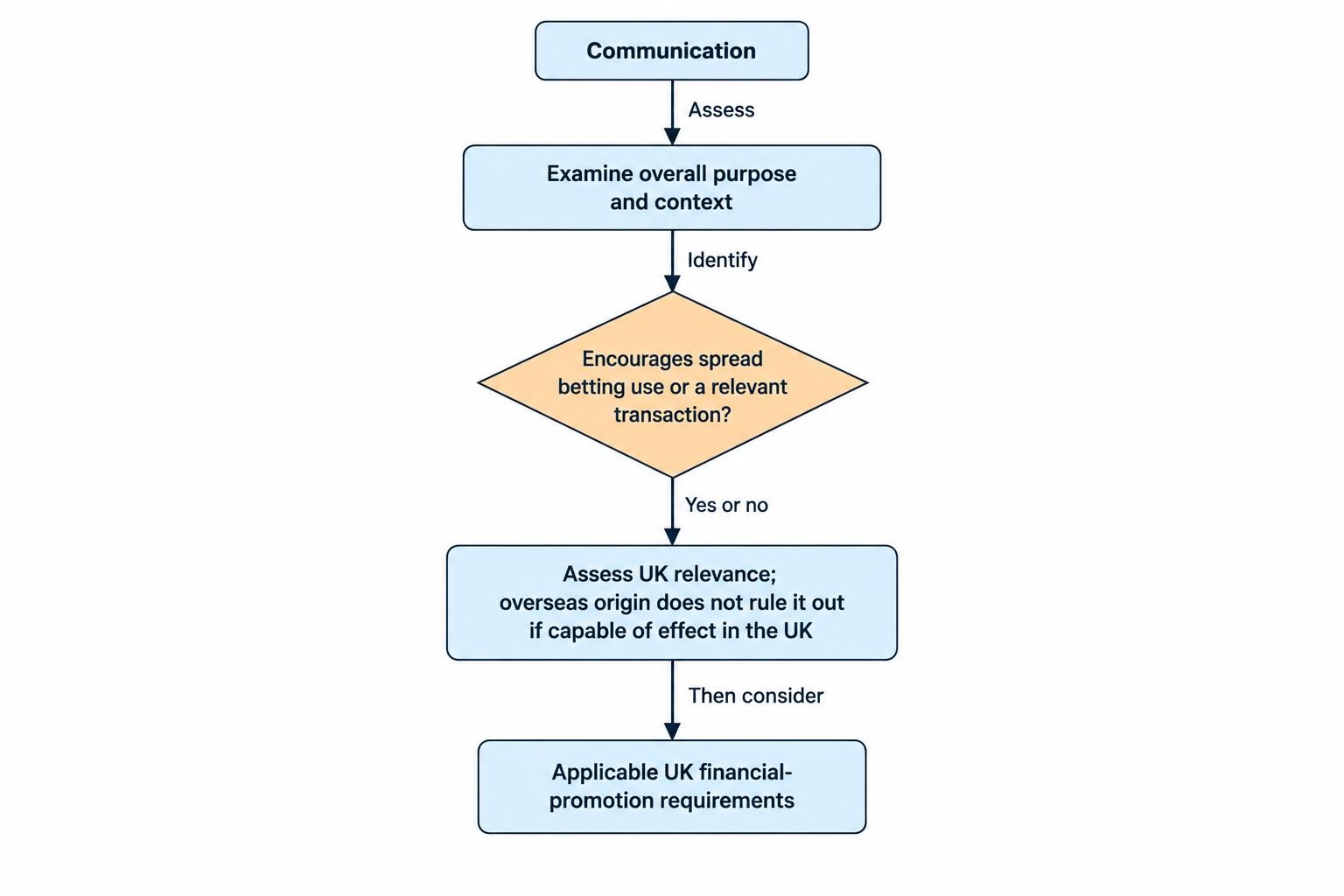
The legal starting point is an invitation or inducement to engage in investment activity, communicated in the course of business. That restriction appears in section 21 of the Financial Services and Markets Act 2000. For spread betting, the question is whether a communication encourages someone to use a trading service or enter into relevant transactions, rather than what the publisher calls it.
A banner inviting readers to open a spread betting account is an obvious example. A comparison article, sponsored market commentary or account-opening email can also contain promotional material. The format alone does not settle the question.
Consider two hypothetical passages. One describes how a £2 per point position produces a £100 loss after a 50-point adverse move. The other uses the same calculation to encourage readers to open an account with a named provider. The arithmetic has not changed, but the purpose and surrounding message have.
Look at the communication as a whole. What does the headline promise? Which benefits receive attention? Where does the button lead? Does the content help readers evaluate spread betting, or push them towards an account before they have considered the risks?
A useful reading habit is to identify the requested action before assessing the sales pitch. Opening an account, depositing money, joining a trading group and placing a trade are different decisions. Do not let an advert bundle them into one apparently harmless click.
Overseas origin is not an automatic escape from the restriction. Section 21 can apply to a communication originating outside the UK if it is capable of having an effect in the UK. A foreign address in the footer is therefore not enough to establish that UK promotion rules are irrelevant.
Who can lawfully communicate a financial promotion?
Broadly, a financial promotion must be communicated by an authorised person, approved by an authorised person lawfully able to approve it, or covered by an applicable exemption. These are different legal routes, not interchangeable badges. The FCA requirements for approving financial promotions set out the distinction.
Since 7 February 2024, firms generally need permission to approve promotions for unauthorised persons, unless an exemption from that permission requirement applies. Being an authorised financial services firm does not, by itself, establish unrestricted permission to approve other businesses’ promotions.
For a reader, this creates two separate questions. Who provides the trading account, and who takes responsibility for the promotional communication? A publisher or influencer may not be the business that will receive your deposit or execute your trades.
If an advert says its content has been approved, check the identity of the approving firm rather than accepting an unexplained statement. Equally, do not confuse approval of promotional content with a recommendation that you should trade.
Exemptions require careful analysis of their conditions. A publisher should not assume that a disclaimer, an audience label or a claim that readers are experienced settles the matter. Anyone producing commercial spread betting content should establish the applicable route before publication, not after a campaign has attracted customers.
From the customer’s side, vague responsibility is a reason to pause. You should be able to identify the advertiser, the account provider and the legal entity named in the account documents without having to piece them together from several unrelated pages.
What “fair, clear and not misleading” means in practice
The central standard is that communications and financial promotions must be fair, clear and not misleading. FCA guidance also addresses clear disclosure of capital risk, complex charging structures and the use of terms such as “guaranteed”, “protected” or “secure”. These requirements sit within COBS 4.2 on fair, clear and not misleading communications.
For readers, a useful test is whether the message leaves a balanced impression. Does the apparent opportunity remain attractive only because the potential loss, trading costs or conditions have been pushed out of view?
Take an advert built around a low starting deposit. Before treating that as evidence of affordability, calculate a plausible loss at the stake you intend to use. The amount needed to open an account answers a different question from the amount a position could lose.
The same applies to price claims. “No commission” is not the same statement as “no trading costs”. Ask what you would pay through the spread, financing, currency conversion and any optional services relevant to your account. Our guide to spread betting costs separates those charges.
A narrow headline spread also needs context. Which market does it cover, during which hours, and under what conditions? Compare the advertised figure with the terms for the markets and holding periods you actually expect to use.
Consider a hypothetical index position at £2 per point. A 40-point move against it produces an £80 trading loss before other charges. That calculation remains the same whether the opening margin feels large or small. The mechanics of spread betting leverage explain why the deposit and exposure should not be confused.
Good questions are often less exciting than good headlines. They are also more useful. “What would this cost over three nights?” tells you more than an unexplained claim that an account offers excellent value.
The retail risk warning and loss percentage
FCA rules for retail spread betting include prescribed risk warnings and restrictions on incentives. The warning normally includes the provider’s loss percentage, recalculated every three months over the preceding 12 months and including costs. The rules also prescribe prominence, including a bordered warning fixed at the top of relevant websites or apps. The governing provisions are in COBS 22.5 on retail marketing of CFDs and similar speculative investments.
The prescribed framework covers leveraged spread bets even though its wording refers to CFDs. There are different warning formats for different circumstances, including provisions for certain character limits and providers without relevant trading history. Publishers should use the applicable prescribed wording, not turn this explanation into their own warning template.
What the percentage tells you
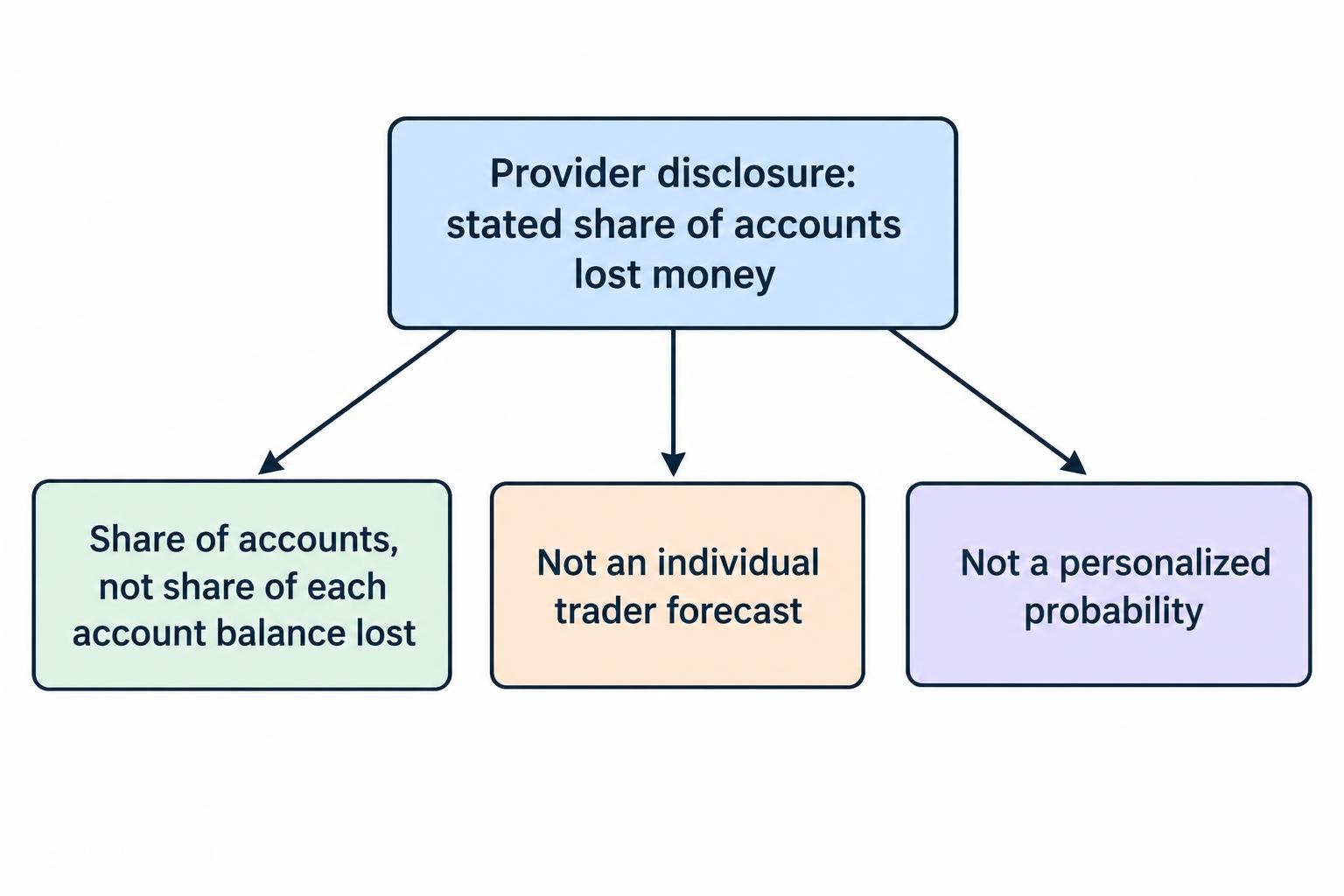
The loss figure concerns accounts, not the percentage of money lost. To illustrate the distinction, suppose a hypothetical disclosure says 70% of accounts lost money. That does not mean each account lost 70% of its balance. It also does not tell you whether the remaining accounts made large profits, small profits or broke even.
Nor is the figure your personal forecast. It cannot assess your proposed stake, trading frequency, strategy or response to losses. Treat it as evidence about the provider’s account outcomes, not a personalised probability calculator.
When comparing percentages, check that you are looking at the intended provider and a current disclosure. Do not treat a small difference between two figures as proof that one platform will make you a better trader. Our guide to retail client loss rates considers how to interpret these disclosures.
Read the warning before the account-opening form
Turn the warning into a practical question: can you describe the financial consequences of the position you intend to place? Write down the stake, an adverse price move, expected charges and your planned exit. If those numbers are unclear, completing the application is premature.
A warning is not a ceremonial hurdle to click past. It should change how you evaluate the offer, particularly when the rest of the promotion makes trading look effortless.
Bonuses, cashback and other incentives
The same retail rules prohibit monetary and non-monetary incentives when marketing, distributing or selling these products. Examples include account-opening bonuses and fee rebates, including volume-based rebates. Lower fees offered to all retail clients and information or research tools are treated differently under the accompanying guidance.
For a prospective customer, an offer to reward deposits or trading volume deserves scrutiny. Ask why the reward is there and what behaviour you must adopt to obtain it. A reward that requires extra transactions can distract from whether those transactions belong in your trading plan.
Compare two hypothetical offers. One publishes a lower charge available to every retail customer. Another promises a payment after a customer completes a set number of trades. Both may be presented as savings, but their conditions and incentives are very different.
Do not use promotional credit as the basis for deciding how much trading you can afford. Build the calculation around your own money and the loss you are prepared to bear.
A spread betting demo account can provide a separate setting for learning the controls. Use it to practise order entry and inspect the platform, rather than treating a virtual profit as evidence that funding a live account will produce the same result.
Social media, influencers and affiliate promotions
The FCA’s FG24/1 guidance on financial promotions on social media, published on 26 March 2024, applies the promotion framework across social channels. It covers standalone compliance, affiliate oversight and commercial communications through private groups. Unauthorised influencers communicating promotions without appropriate approval or an exemption may commit a criminal offence.
Each promotion needs to comply when considered individually. A link can provide supporting detail, but it does not cure a misleading initial message. A commercial interest can also exist without a direct payment for the individual post. Firms using affiliates are expected to take proactive responsibility for their promotional communications.
For a reader, the practical issue is what appears before you follow the link. A video might show a profitable position, describe trading as a convenient extra income and direct viewers to an account-opening page. Ask whether the video itself gives you a balanced basis for that next step.
The creator’s personality is not evidence about the account’s costs or suitability. Neither is the number of followers. Separate the entertainment value of a post from the financial decision it asks you to make.
Private groups are not a substitute for verification
An invitation-only chat can feel more personal than an advert. Keep the same checks. Who operates the group? What commercial relationship exists with the provider? Does joining commit you to anything, and why are you being encouraged to open an account through a particular link?
If someone asks you to leave the original platform and continue through private messages, retain the earlier conversation. Do not let the change of channel interrupt your checks on the business receiving your information or money.
A practical approach for publishers
Before publishing, review the finished communication in the format readers will actually see. Check the headline, thumbnail, caption, spoken claims, warning and destination page. A suitable paragraph in an editing document is not enough if the mobile layout crops it out.
As a practical control, keep an inventory of live promotional assets and their approved versions. Include affiliate posts and reused clips. Plan how to update or remove material when its price claims, warning figures or account terms change.
How to challenge common advertising claims
Some phrases need qualification rather than automatic rejection. The table below turns common marketing language into questions you can use while comparing an offer. These are assessment prompts, not findings that any named advertiser has broken a rule.
| Promotional claim | What to check |
|---|---|
| “Start with a small deposit” | What stake would you use, and what would an adverse move cost? Separate the account’s funding requirement from the loss on a position. |
| “Trade commission-free” | Which other charges apply to your intended markets and holding period? Request a complete cost example rather than relying on one absent fee. |
| “Tax-free profits” | What treatment applies to your circumstances, and how are losses treated? Check the qualifications in our guide to whether spread betting is tax-free. |
| “Earn a regular income” | What evidence supports the claim? Look for the period measured, losing periods, capital committed and charges, rather than a selected profitable day. |
| “Control your risk with stops” | Which order type is offered, with what conditions and charges? Read the terms for guaranteed stop-loss orders rather than assuming every stop has the same protection. |
Put numbers beside any claimed benefit. Suppose an advert shows a hypothetical £200 gain. Ask what stake produced it and how far the price moved. At £5 per point, a favourable 40-point move produces £200 before costs; an adverse 40-point move produces a £200 loss before costs.
The profit figure alone does not reveal the exposure. It also leaves out the route taken: a position might have moved against the trader before recovering. That matters if you are trying to judge whether you could tolerate the same trade.
Performance screenshots deserve the same discipline. Ask whether they show a live or demonstration account, one trade or the whole account, and results before or after charges. If those details are absent, you do not have enough information to assess the claim.
A testimonial can raise useful questions, but it cannot answer the questions about your own proposed account. Replace “this worked for someone else” with “what are the terms, costs and possible losses for the transaction I am considering?”
Checks to make before responding to an advert
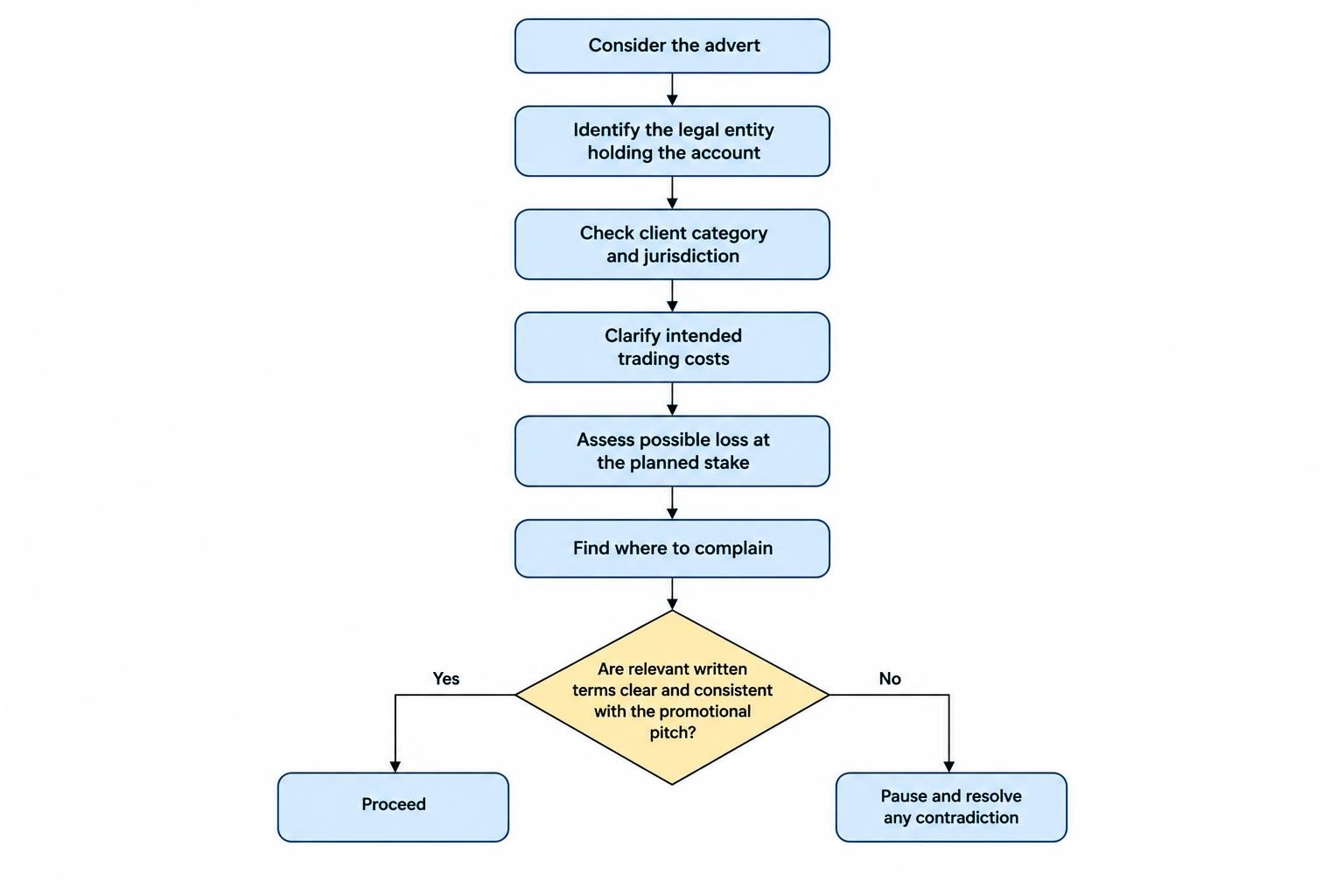
Start with the legal entity, not the brand’s appearance. Compare the business named in the promotion with the name in the account agreement. Use the process in our guide to checking a broker on the FCA Register to examine its status, permissions and contact details.
Write down the entity name before continuing. This simple step makes it easier to spot an unexplained change between an advert, application page and account agreement. Ask for an explanation rather than assuming similarly named businesses are interchangeable.
Next, check the client category offered. If a sales conversation encourages you to become a professional client, assess that decision separately from the advertised trading opportunity. Our guide to retail and professional client classification covers the distinctions to examine.
Do the same when an application leads to an overseas entity. Compare the agreement you are being offered with the one you expected from the promotion. Questions about jurisdiction, complaints and protections belong before the deposit, not after a dispute. See our guide to offshore spread betting brokers for that separate assessment.
Before proceeding, you should have clear answers to five questions:
- Which legal entity will hold my account?
- What client category and jurisdiction will apply?
- What will my intended trading cost?
- What loss could my planned stake produce?
- Where can I raise a complaint about the account or promotion?
If an answer depends on a verbal assurance, request the relevant written terms. If the written terms contradict the pitch, stop and resolve the contradiction. There is no benefit in completing an application quickly if the account is not the one you thought you were opening.
Reporting a misleading spread betting promotion
You can use the FCA process for reporting misleading financial promotions to raise concerns about an advert. The page distinguishes promotions connected with authorised firms from suspected scams or unauthorised businesses. It also makes clear that the FCA authorises businesses rather than endorsing products.
Preserve the evidence before contacting the advertiser. Save the complete advert, its web address or account handle, the date you saw it and the destination page. For a video, note the relevant timestamps and retain the caption where possible.
Explain the concern precisely. “The headline describes trading as risk-free, but the account terms describe possible losses” is more useful than “this advert looks wrong”. Identify the wording, the impression it creates and any contradictory information you found.
If you have already opened an account and believe the promotion contributed to a loss, keep your application documents, messages, statements and complaint correspondence. Separate the promotional claim from the later account events so the sequence is clear.
A regulatory report and a request for personal redress are different steps. Do not assume that reporting an advert automatically resolves an individual dispute. Our guide to spread betting complaints and the Financial Ombudsman covers the complaint route in more detail.
Where identity or payment instructions are in doubt, pause further transfers while you verify the business independently. Our guide to spread betting scams addresses those warning signs.
The soundest response to a promotion is a slower decision. Identify the offer, check the firm, calculate the exposure and read the conditions. An advert can introduce a service. It should not do your due diligence for you.