The spread betting appropriateness test checks whether you have the knowledge and experience to understand the risks of the product. It is not a trading qualification, a profit forecast or confirmation that spread betting is right for your finances. For non-advised investment services covered by MiFID, the assessment sits within the FCA’s COBS 10A appropriateness rules.
The useful question is not “Which answers will get my account approved?” It is “Could I explain what happens to my money when this trade goes wrong?” Account access matters rather less if the first loss comes as a surprise.
What does the broker assess?
The assessment focuses on relevant knowledge and experience, rather than enthusiasm for trading. The information collected can include:
- Product familiarity: the investments and services you know, particularly those relevant to the proposed trading account.
- Previous transactions: their nature, size and frequency, and how long you have been carrying them out.
- Relevant background: your education, occupation or former occupation, where these help establish your knowledge.
Prior trading experience is not an automatic pass. Nor does a lack of live trades automatically settle the assessment against you: FCA guidance allows knowledge alone to be sufficient in some circumstances.
Answer questions about your history accurately. Holding a share portfolio does not demonstrate that you understand a leveraged short position. If a form asks about actual transactions, do not substitute trades you watched, considered or placed using virtual money.
This assessment is one part of UK spread betting regulation, not a replacement for reviewing the account terms and product risks.
Appropriateness is not the same as suitability
Appropriateness asks whether you understand the risks. Suitability is a broader assessment associated with investment advice and portfolio management. It considers knowledge and experience, but also your financial situation, ability to bear losses, investment objectives and risk tolerance. These duties appear in the FCA’s suitability requirements.
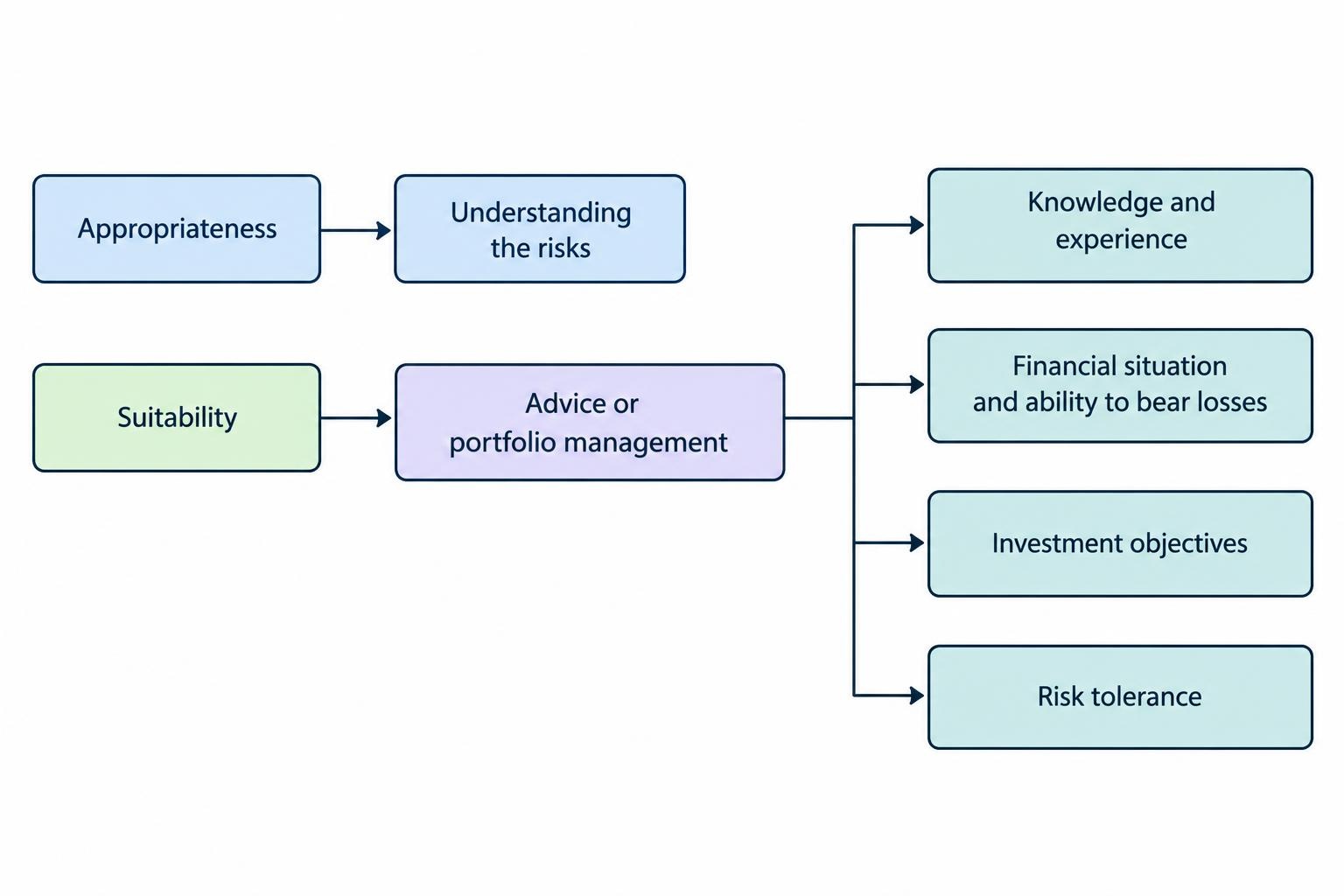
That distinction matters. You could understand every calculation in an application and still be planning to trade with money needed for rent. Knowledge does not make that money expendable. Treat a successful assessment as neither investment advice nor permission to disregard your household budget.
Financial questions can still form part of account opening. In its 15 October 2026 feedback on CFD firms’ practices, the FCA reported that several firms had changed their onboarding processes. Changes included income thresholds below which consumers were rejected or received greater scrutiny at the appropriateness stage. This describes firms’ measures, not a universal FCA minimum salary for spread betting.
Concepts you should be able to explain
The following are learning prompts, not a copy of a provider’s questionnaire or an answer sheet. Work through the reasoning rather than memorising a phrase. If you cannot explain an outcome without looking it up, spend more time on that topic before applying.
| Concept | What you should be able to explain |
|---|---|
| Stake per point | How a price movement translates into a cash profit or loss, including the effect of increasing the stake. |
| Margin | Why the opening margin is collateral for exposure, rather than the purchase price or a fixed maximum loss. |
| Long and short positions | Which price direction creates a loss, and which side of the quote applies when opening and closing. |
| Stops and execution | Why an ordinary stop does not guarantee its requested execution price during a gap or rapid move. |
| Trading costs | How the spread and any applicable financing or other charges affect the result. |
Check the cash calculation
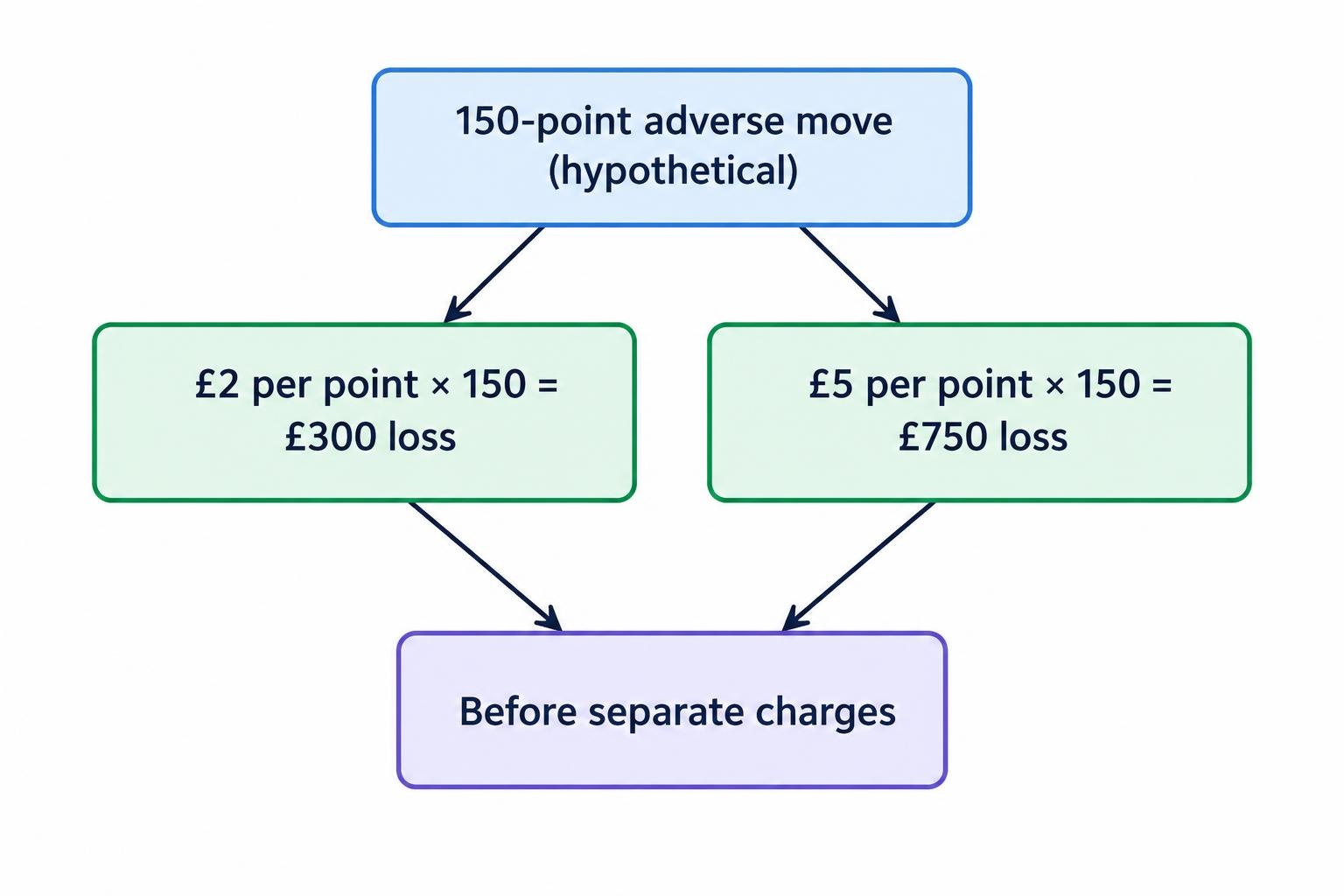
Suppose you buy an index spread bet at £2 per point. You later close it at an executable selling price 150 points below your entry. The trading loss is £300, before any separate charges: 150 multiplied by £2.
Now change only the stake to £5 per point. The same movement produces a £750 loss. A forecast about the index has not changed, but the damage to the account has. Being confident about direction tells you nothing about whether the position is sensibly sized.
Separate margin from money at risk
Suppose a hypothetical position requires £500 of opening margin. That figure does not tell you its maximum possible trading loss. Losses follow the position’s price exposure and stake, not a promise that the opening margin will contain them.
Before trading, practise explaining what happens when losses reduce account equity and available funds. The guide to spread betting margin covers the mechanics without treating the deposit requirement as a risk budget.
Know what a stop can and cannot do
A planned stop distance helps estimate a loss, but an ordinary stop can execute at a worse price. That changes the cash result. “I have a stop” is therefore an incomplete answer to “How much could this trade lose?”
Review the distinction between ordinary and guaranteed execution when learning about stop-loss orders. Check the actual order terms rather than assuming every order carrying the word “stop” offers the same protection.
What happens if the assessment is unsuccessful?
Two outcomes need separating. A provider may conclude that the product is not appropriate based on your answers. Alternatively, it may lack enough information to reach a conclusion. Both situations require a warning, but the warning addresses a different problem in each case.
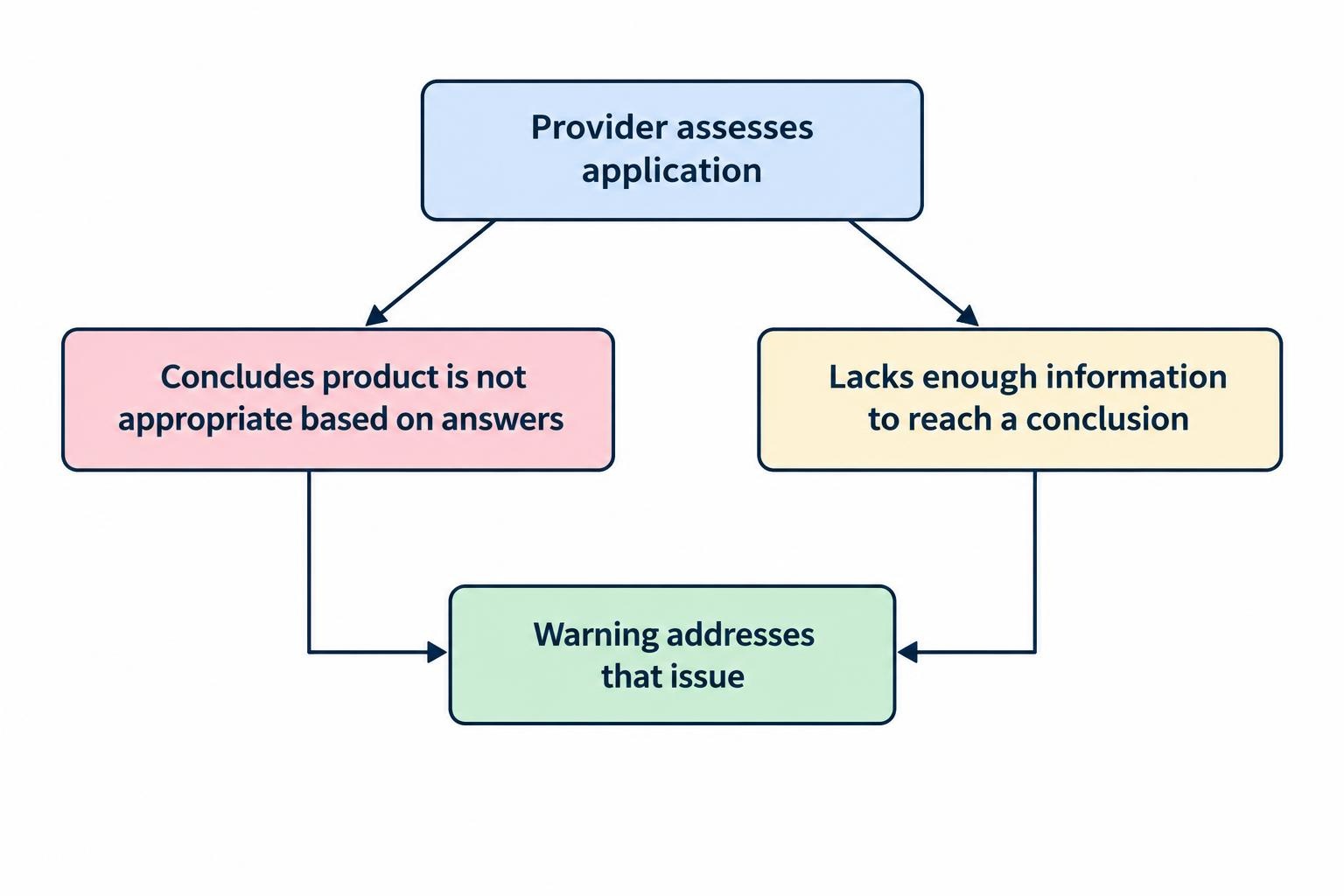
A warning does not create an automatic right to trade after clicking an acknowledgement. If you ask to proceed despite it, the firm must consider the circumstances when deciding whether to do so. These distinctions are set out in COBS 10A.3 on client warnings.
In its 2017 review of CFD appropriateness assessments, the FCA criticised processes that allowed applicants to override warnings without meaningful consideration. It also warned against placing undue weight on course attendance or demo account use. The message remains useful for applicants: completing an educational activity is not the same as demonstrating that you understand the risk.
If your application does not proceed, ask whether the issue concerns knowledge, experience, missing information or a separate account eligibility requirement. The response may help identify what needs attention, without turning the assessment into a hunt for a different answer.
Can you retake the appropriateness test?
Ask the provider whether reassessment is available, what conditions apply and whether you need to supply further information. Do not assume a question count, pass mark or waiting period mentioned elsewhere applies to your application.
A sensible reassessment follows genuine learning or correction of an error. Repeatedly changing truthful answers until access appears is a different exercise. It undermines the assessment and leaves the underlying knowledge gap untouched.
If a question is ambiguous, request clarification rather than guessing what the provider wants. Keep the distinction between correcting inaccurate information and rewriting your history. Reading about options yesterday does not turn into years of derivatives experience today.
How to prepare without gaming the assessment
Start with the product terms and practise calculating losses, not just profits. Choose a hypothetical entry, stake, adverse movement and exit price. Then add a wider spread, a worse stop execution and any applicable holding charges. Can you explain why each change affects the result?
A spread betting demo account can help you rehearse those mechanics without committing trading funds. Use it to locate order controls and inspect the cash effect of changing a stake. Treat it as practice, not evidence that you will react the same way when real money is at risk.
Before applying, you should also be comfortable explaining why adding funds does not repair a losing trade, why a short position loses when the market rises, and why several positions can suffer together. None of these explanations needs impressive terminology. Plain English and correct arithmetic do the job.
What passing the test does not establish
A successful assessment does not validate your strategy, predict your returns or establish an affordable stake. It also does not replace checking the provider, reading the agreement or reviewing the protections attached to a retail account.
Keep a copy of the information you submit and any warnings or messages you receive. If something is wrong, ask for it to be corrected. If you believe the process was handled improperly, raise the issue through the provider’s complaints procedure; the guide to spread betting complaints and the Financial Ombudsman covers the separate complaints route.
The assessment should prompt a practical decision: do you understand the exposure well enough to choose whether to take it? Passing is not an instruction to place a trade. Choosing not to trade remains a perfectly valid result.