Slippage in spread betting is the difference between the price you expected an order to execute at and the price you actually received. It can affect an opening trade, a manual close or an ordinary stop loss. A worse price increases your loss or reduces your profit; a better price does the reverse.
The practical issue is simple: a planned entry or exit price is not always an executable price. Unless an order carries a contractual price guarantee, your risk calculation needs to allow for that difference.
How Slippage Works in Spread Betting
Suppose an index has a buy quote of 8,000 when you submit an order. Before the order executes, the available buy price moves to 8,003. Your trade opens three points higher than expected. That is three points of negative slippage.
If the order instead executes at 7,998, you receive two points of positive slippage, also called price improvement. Slippage is not automatically a cost, although adverse execution tends to attract more attention than a pleasant surprise.
Whether a price change helps or hurts depends on whether the order buys or sells, not simply whether you hold a long or short position. Closing a short bet requires buying; closing a long bet requires selling.
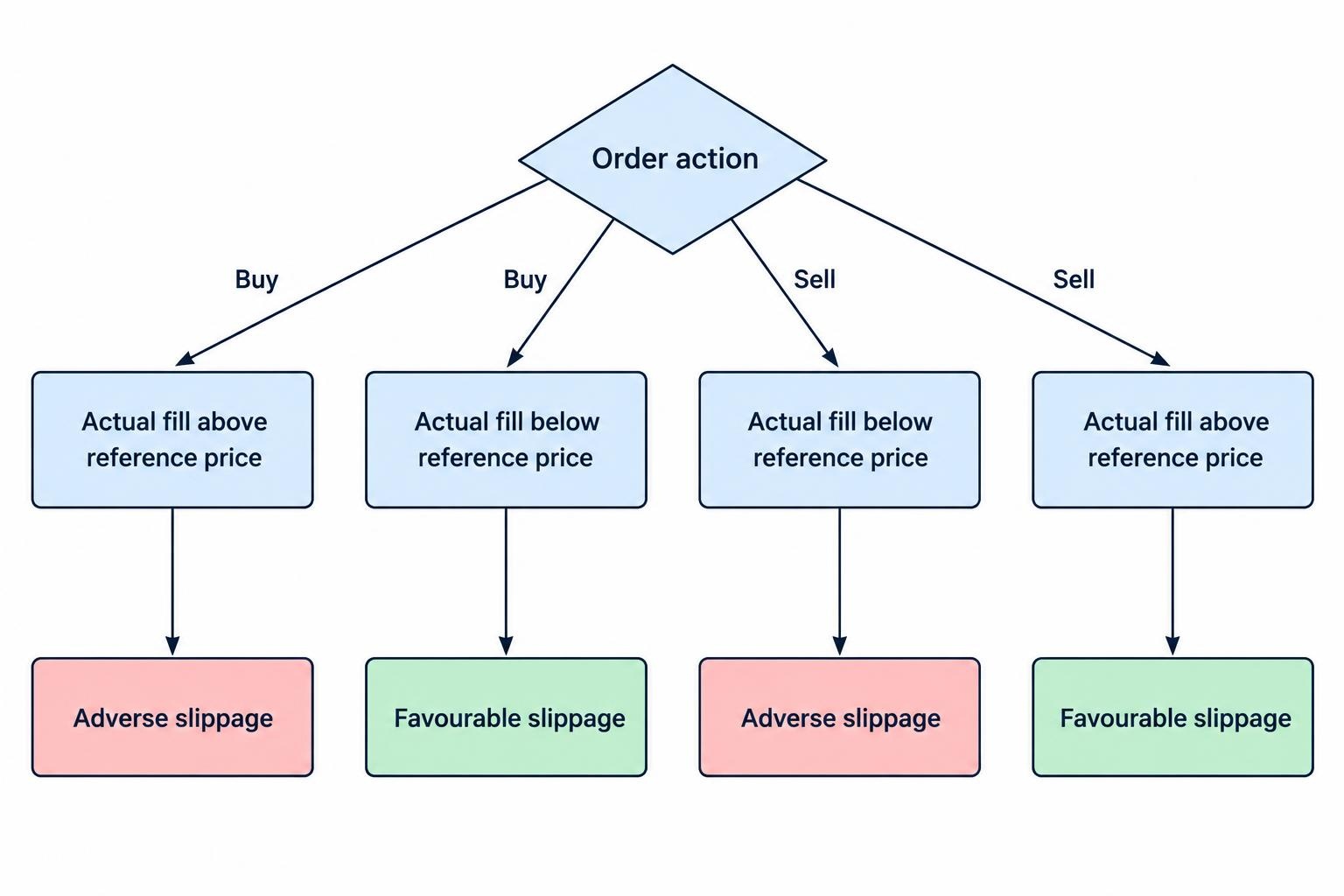
| Order action | Actual execution | Slippage | Effect versus expected price |
|---|---|---|---|
| Buy | 8,003 | 3 points adverse | £6 worse |
| Buy | 7,998 | 2 points favourable | £4 better |
| Sell | 7,997 | 3 points adverse | £6 worse |
| Sell | 8,002 | 2 points favourable | £4 better |
These figures isolate the effect of execution. They are not the profit or loss on a complete trade, and they exclude separate charges.
How to Calculate Slippage
To calculate the cash effect, multiply the price difference in the instrument’s betting points by your stake per point. Check the contract’s point definition rather than assuming every decimal place on the screen represents one betting point.
Adverse slippage cost = adverse price difference in points × stake per point.
For a buy order, an execution above the reference price is adverse. For a sell order, an execution below it is adverse. Use the executable quote when you submitted the order as the reference for an immediate trade, or the trigger level when reviewing an ordinary stop.
A Stop Loss Example
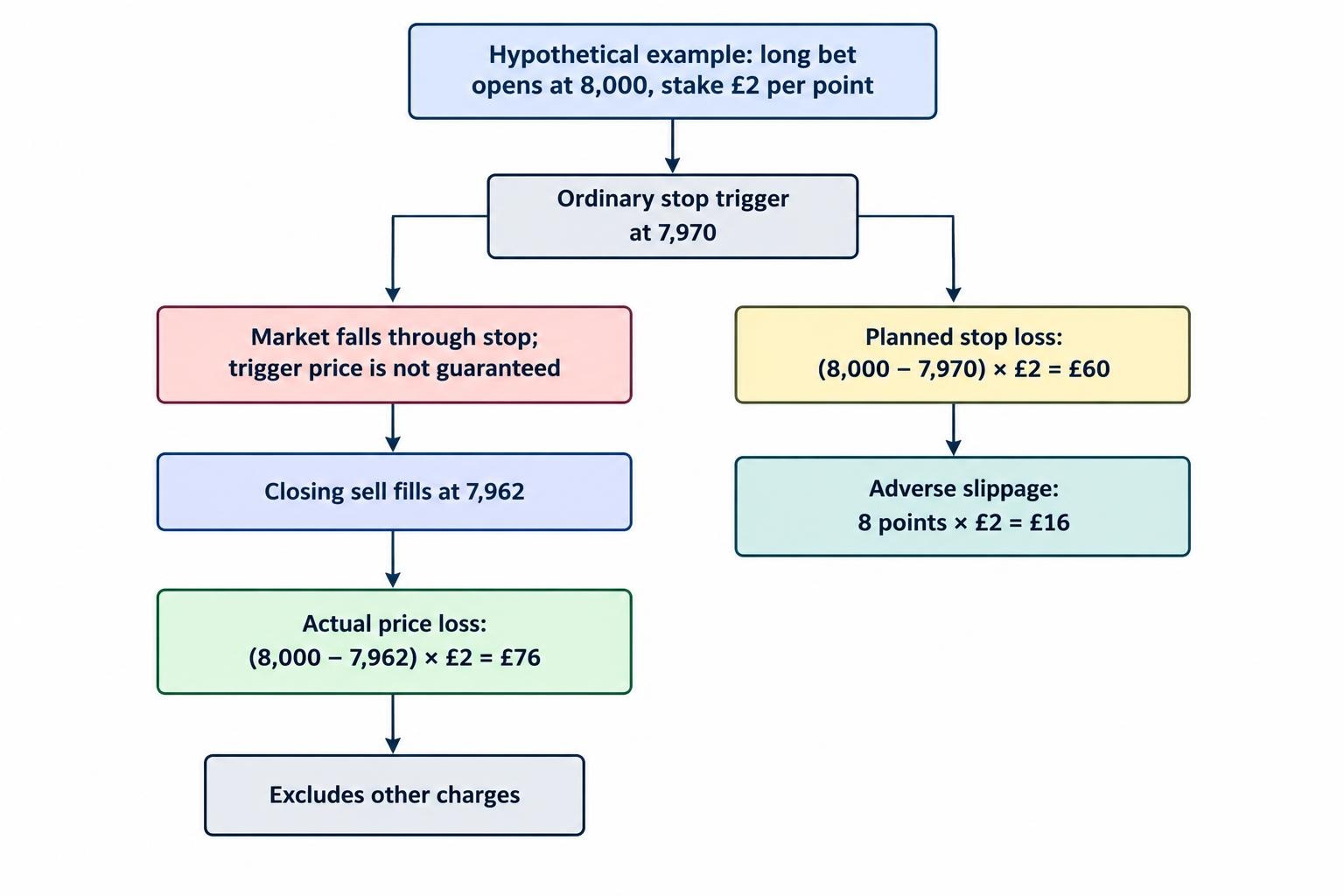
You open a hypothetical long index bet at 8,000 for £2 per point and place an ordinary stop loss at 7,970. Your planned price loss is 30 points, or £60.
The market falls through the stop, and the closing sell order executes at 7,962. The actual price loss is 38 points:
(8,000 − 7,962) × £2 = £76.
The eight points of adverse slippage add £16 to the planned loss. This assumes the opening trade filled at 8,000 and excludes financing or other charges.
The stop still acted as an instruction to exit, but it did not fix the loss at £60. That distinction matters more than the label on the order ticket.
Why Slippage Happens
Prices Move Before Execution
Submitting an order and receiving a fill are separate events. If the available price changes between them, an order without price protection may execute at a different level. Fast movement leaves less time for the price you saw to remain available.
A market can also have plenty of trading activity without offering much liquidity at your intended price. Liquidity means the amount available to trade at a price, not simply how busy the market looks.
News Can Change Available Prices Abruptly
Economic announcements, company results and unexpected headlines can cause prices to change sharply. Orders may arrive while quotes are being updated, and the price available for one order may no longer be available for the next.
This is particularly relevant to entries triggered by a sudden move. A stop entry can activate at the intended level but open beyond it, leaving a worse entry price and a different distance to the planned exit.
Your Broker’s Quote Is the Relevant Quote
A spread bet is linked to an underlying market, but the provider usually sets the prices displayed to its customers. An exchange chart or another platform’s quote is therefore not automatically the price your order could have received. The Financial Ombudsman’s spread betting pricing guidance addresses this distinction when assessing execution disputes.
A delayed screen or connection can also leave you reacting to an outdated quote. A reliable connection helps avoid acting on stale information; it cannot keep a market price available after that price has changed.
Slippage Is Not the Same as the Spread or a Market Gap
The spread is the difference between the sell and buy prices quoted at the same moment. Slippage is the difference between your execution reference and the actual fill. You can pay the spread without experiencing any slippage.
Suppose the quote is 7,999–8,001 and you buy at 8,001. An immediate valuation against the sell price starts two points lower. That is the effect of the spread, not evidence that the order slipped. If the buy order instead executes at 8,004, the additional three points are adverse slippage against the original buy quote.
A market gap is a jump between price levels without available trading at the intervening levels. It can cause slippage when an order executes beyond its trigger, but the two terms describe different things: the gap describes the price movement; slippage describes the execution difference.
Slippage can occur during continuous trading too. It does not require a weekend reopening or a visible hole in a chart. The separate guide to market gaps covers how those price jumps arise.
How Order Type Changes Slippage Risk
Market Orders Prioritise Execution
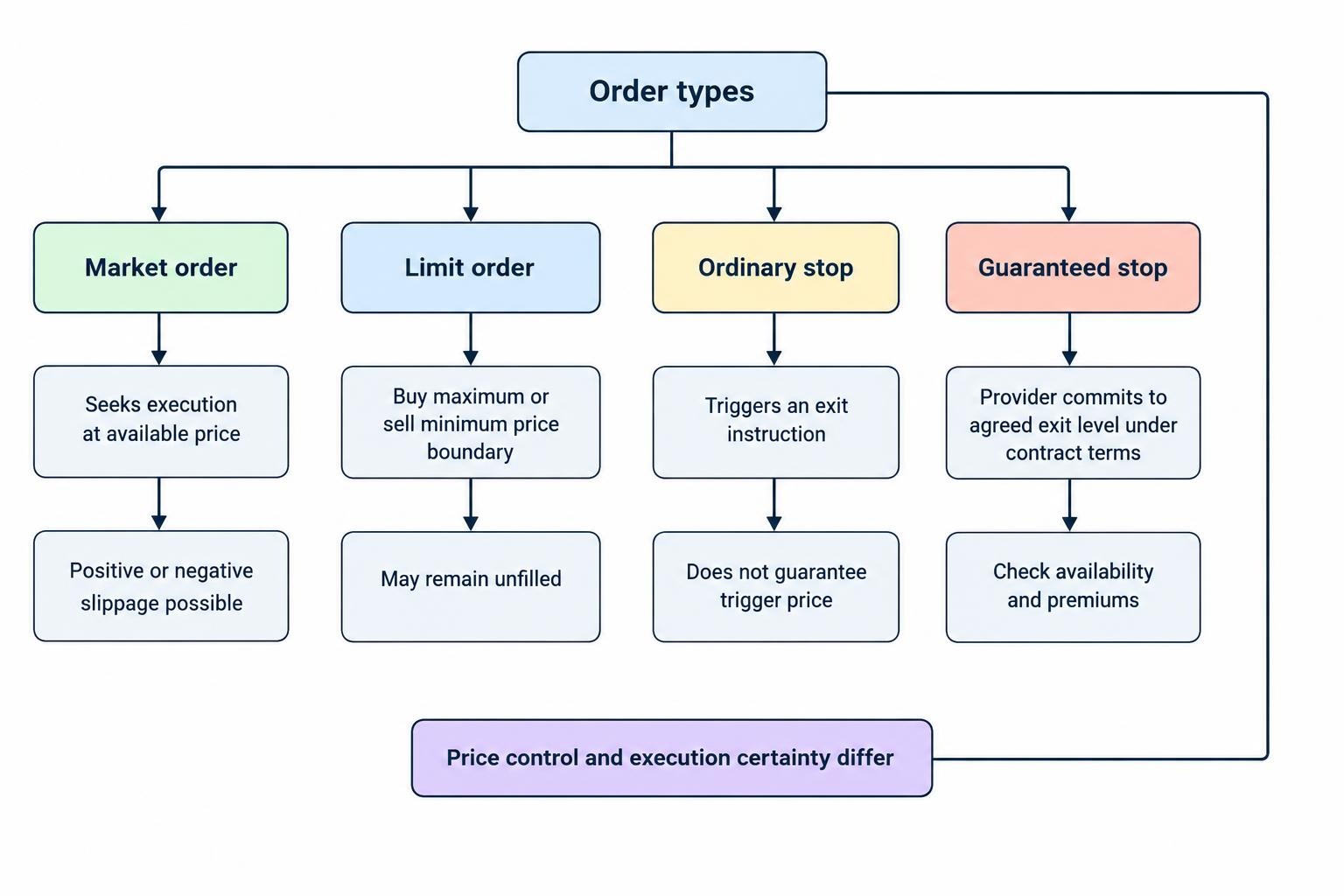
A market order requests execution at the available price rather than setting a firm price boundary. It can receive positive or negative slippage. Clicking a manual close button does not necessarily protect the exit price either; check how the platform handles that instruction.
Some platforms offer a price tolerance or maximum deviation setting. Where available, this may reject an order if the price moves outside the permitted range. A rejected close leaves the position open, so price control and execution certainty are not the same thing.
Ordinary Stops Do Not Guarantee the Trigger Price
An ordinary stop generally activates an instruction to trade once its trigger condition is met. It does not reserve liquidity at the stop level. A trailing stop changes the trigger as the market moves in your favour, but it does not become guaranteed simply because it trails.
For a long position, the closing transaction is a sell; for a short position, it is a buy. Check the provider’s trigger rules and whether your chart displays the bid, offer or midpoint. Comparing a buy fill with a bid chart can make normal spread mechanics look like an execution error.
Limit Orders Set a Price Boundary
A buy limit specifies a maximum purchase price, and a sell limit specifies a minimum selling price. Correctly executed, it fills at that price or better, rather than accepting adverse slippage beyond the limit.
The trade-off is non-execution. A limit order may remain unfilled if the required price is unavailable. A stop limit, where offered, has the same issue after activation: it can protect the execution price while leaving you exposed through an open position.
Guaranteed Stops Protect the Agreed Exit Level
A guaranteed stop commits the provider to the agreed stop price under the contract’s terms, even if the market does not offer that price. The distinction between a market price and a provider’s guarantee is addressed in Financial Ombudsman decision DRN-3970117 on ordinary and guaranteed stops.
Check availability, premiums, minimum distances and amendment rules before relying on that protection. A guaranteed stop loss protects the covered exit level; it does not turn a poor entry into a good trade or remove other trading costs.
How to Reduce the Impact of Slippage
You cannot remove every execution risk while insisting that every order fills. You can, however, make choices that reduce exposure or reduce the cash damage when an order slips.
- Choose the execution trade-off deliberately. Use a limit when the entry price matters more than getting filled. Do not treat a missed trade as an order malfunction.
- Plan around event risk. Before a scheduled announcement, decide whether to keep the position, reduce it, use available guaranteed protection or avoid opening it.
- Keep the stake proportionate. A smaller stake reduces the pounds lost per point of adverse execution. It does not guarantee fewer points of slippage.
- Check the actual ticket. Confirm the contract, quote side, stake, stop type and any execution tolerance before submitting the order.
A slippage allowance can improve position sizing, provided you treat it as a planning assumption rather than a maximum loss. If you model a 30-point stop plus five points of adverse execution, your assumed exposure is 35 points times the stake. The eventual fill could still be worse.
Moving an ordinary stop further away does not solve slippage. It changes the exit level and may increase the intended loss. If the strategy needs a wider stop, reassess the stake rather than keeping the cash risk unchanged only on paper.
How to Check Whether a Fill Was Fair
One adverse fill does not prove misconduct. Start with the evidence: the order reference, submission and execution times, requested or trigger price, actual fill, stake, order type and relevant bid or offer prices. Save the execution confirmation and any screenshots, including the chart’s price setting.
UK best execution duties require firms to take sufficient steps to obtain the best possible result, considering factors including price, costs, speed and likelihood of execution. For retail orders, price and execution costs form the total consideration. These obligations appear in the FCA’s COBS 11.2A best execution rules; they are not a promise that every order will fill at the price first displayed.
Ask the provider which quote triggered the order, when the order became executable and how the fill followed its execution policy. Compare like with like: the same contract, timestamp and quote side.
Unfair treatment of price improvement is a separate concern from ordinary market movement. In its 24 February 2014 final notice on asymmetric slippage, the FCA took action over favourable price movements being retained while adverse movements were passed to customers in rolling spot forex trading. That does not mean positive and negative slippage must occur equally often in your account.
Record Slippage Separately from Your Trading Result
Keep a consistent execution log rather than judging slippage from whichever trade hurt most. Record favourable, adverse and unchanged fills, then group comparable orders by market, order type and trading period.
A profitable trade can have poor execution, and a losing trade can receive price improvement. Separating the strategy result from the cash effect of slippage helps identify whether the problem lies with the trading decision, the execution conditions or both.
Build the plan around the order you actually use. An ordinary stop provides an exit instruction, a limit provides a price boundary, and a guaranteed stop provides contractual price protection. Confusing those promises is where a tidy risk calculation can come unstuck.