Index spread betting lets you take a position on a stock market benchmark without buying its constituent shares. You choose a stake per point, buy if you expect the quoted price to rise, or sell if you expect it to fall. Your result depends on the distance between your opening and closing prices, multiplied by that stake, with costs and adjustments included.
The attraction is straightforward: one position can express a view on a basket of companies. The risk is just as straightforward. A small margin deposit can support a much larger exposure, so an ordinary market move can produce a substantial account loss.
Trading an index also requires more than recognising its name. The benchmark, contract type, point value and trading session all affect what you are trading and how much it costs.
How index spread betting works
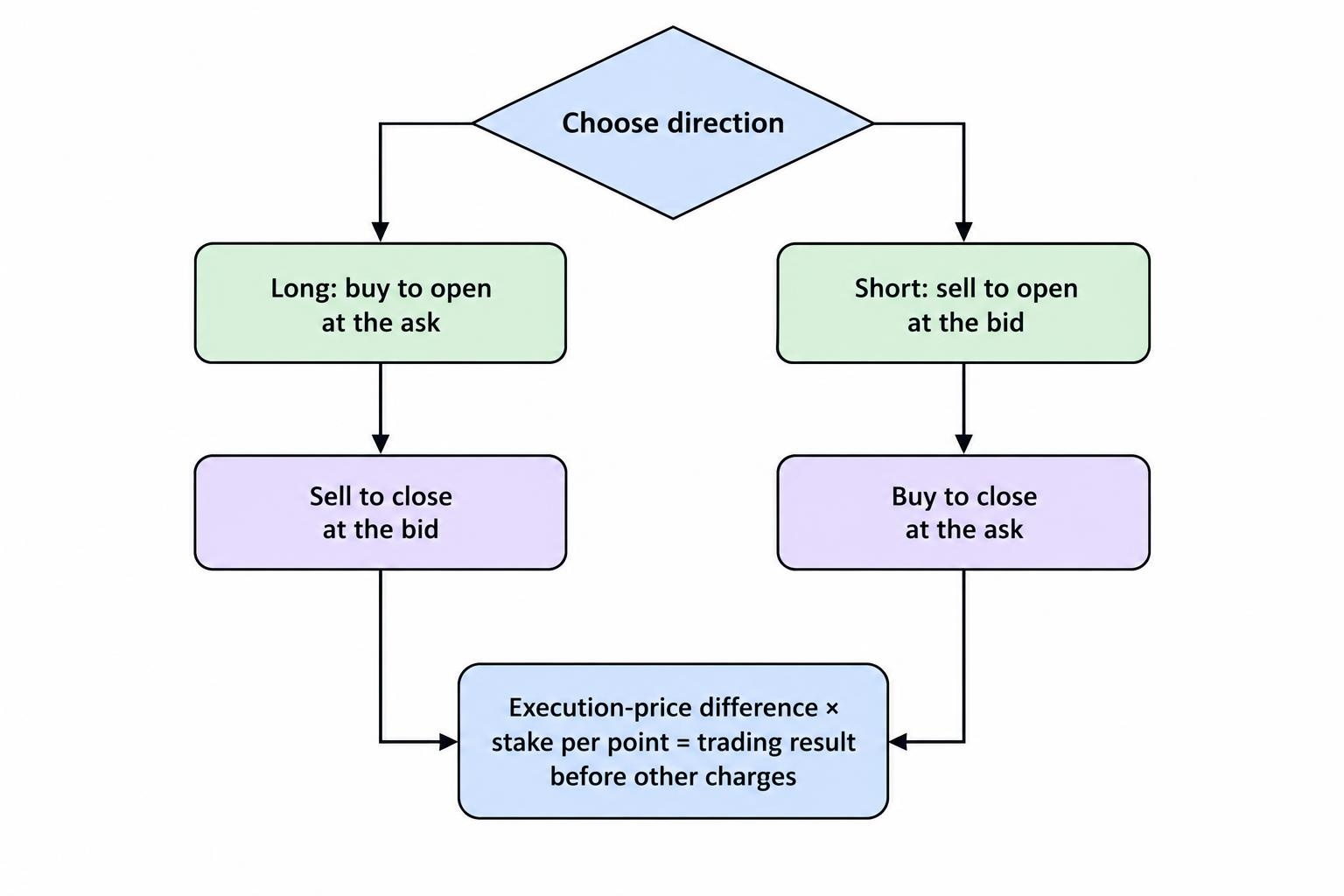
A provider quotes two prices for an index contract: a sell price, or bid, and a buy price, or ask. You open a long position at the buy price and close it at the sell price. A short position works in reverse: sell to open, then buy to close.
The gap between those prices is the spread. If the quote remains unchanged immediately after entry, closing the position produces a loss equal to the spread multiplied by your stake. The market must move far enough in your favour to cover that opening disadvantage before the trade becomes profitable.
Your stake determines the cash effect of each point. At £2 per point, a favourable 30-point move between execution prices produces £60 before other charges. The same move against you loses £60. Check the contract’s point definition rather than assuming every digit on the screen represents a full point; the guide to stake per point covers this distinction.
The contract is with the spread betting provider, not an ownership interest in the index constituents. You do not receive shareholder voting rights. Any dividend adjustment is part of the contract’s accounting, rather than a dividend paid to you as a shareholder.
For a contract denominated in pounds per point, the stake already expresses the cash sensitivity in pounds, even when the underlying benchmark tracks overseas shares. Other account or contract charges may still involve currency conversion, so check the terms rather than assuming there are none.
Index spread betting example
Suppose an illustrative index contract has a sell price of 8,000 and a buy price of 8,002. You trade at £2 per point. These are hypothetical prices, not current market quotes.
| Position | Opening execution | Closing execution | Result |
|---|---|---|---|
| Long, market rises | Buy at 8,002 | Sell at 8,062 | 60 points gained: £120 profit |
| Long, market falls | Buy at 8,002 | Sell at 7,942 | 60 points lost: £120 loss |
| Short, market falls | Sell at 8,000 | Buy at 7,940 | 60 points gained: £120 profit |
| Short, market rises | Sell at 8,000 | Buy at 8,060 | 60 points lost: £120 loss |
For a long position, subtract the opening buy price from the closing sell price. For a short position, subtract the closing buy price from the opening sell price. Multiply the resulting points by the stake.
These calculations already include the spread because they use executable buy and sell prices. Do not deduct it again. If you bought at 8,002 and immediately sold at 8,000, the two-point difference would produce a £4 loss.
A chart may display a midpoint, bid or another reference price. That display is not necessarily the price available for closing your position. Use the appropriate execution side when checking a profit target or estimating a loss.
Which stock indices can you spread bet on?
Market availability varies by provider. Before choosing a contract, establish which benchmark it follows and how that benchmark weights its companies. Five familiar indices illustrate why the distinction matters.
FTSE 100
The FTSE 100 benchmark comprises 100 large UK companies, selected by full market capitalisation before investability adjustments. It is reviewed quarterly. The number of companies alone does not tell you how evenly exposure is distributed.
Before trading, check the current constituent weights and identify the companies that could have the greatest effect on the index. Do not treat a UK index label as proof that every business depends only on British customers. The dedicated FTSE 100 spread betting guide covers this market in more detail.
S&P 500 and Dow Jones Industrial Average
The S&P 500 uses float-adjusted market capitalisation weighting, so larger companies by that measure have greater influence. The Dow Jones Industrial Average contains 30 companies and uses share-price weighting instead. A higher-priced Dow constituent therefore carries more weight than a lower-priced one, regardless of their relative company values. These differences are set out in the S&P and Dow index construction comparison.
An S&P 500 spread bet expresses a view on a broader collection of large US companies than the Dow. However, a large constituent count does not guarantee balanced exposure. Check how much influence the largest companies have before treating the position as evenly spread.
The Dow requires a different reading of constituent influence because of its weighting method. Its headline point changes also need context: a 100-point move means different things at different index levels. The Dow Jones spread betting guide addresses that market separately.
Nasdaq 100
The Nasdaq 100 tracks 100 of the largest non-financial companies listed on Nasdaq and uses modified market capitalisation weighting. It is not the Nasdaq Composite, and it is not an index consisting solely of technology companies. The Nasdaq 100 benchmark description details its construction and sector coverage.
Its membership creates a different exposure from a broad US equity benchmark. Before opening a position, check the influence of its largest companies and whether they have earnings announcements approaching. The dedicated Nasdaq 100 spread betting guide covers the practical considerations.
DAX
The DAX tracks 40 large companies listed on the Frankfurt Stock Exchange’s regulated market that meet its eligibility requirements. Its familiar performance version takes dividends into account within the index calculation. That makes the distinction between price and performance indices particularly relevant; see the STOXX DAX benchmark factsheet.
Do not assume a DAX contract handles dividends exactly like a contract based on a price index. Verify the referenced version, point value and adjustment policy before trading. The DAX spread betting guide examines those details without treating every German index contract as interchangeable.
Cash index bets versus futures and forward bets
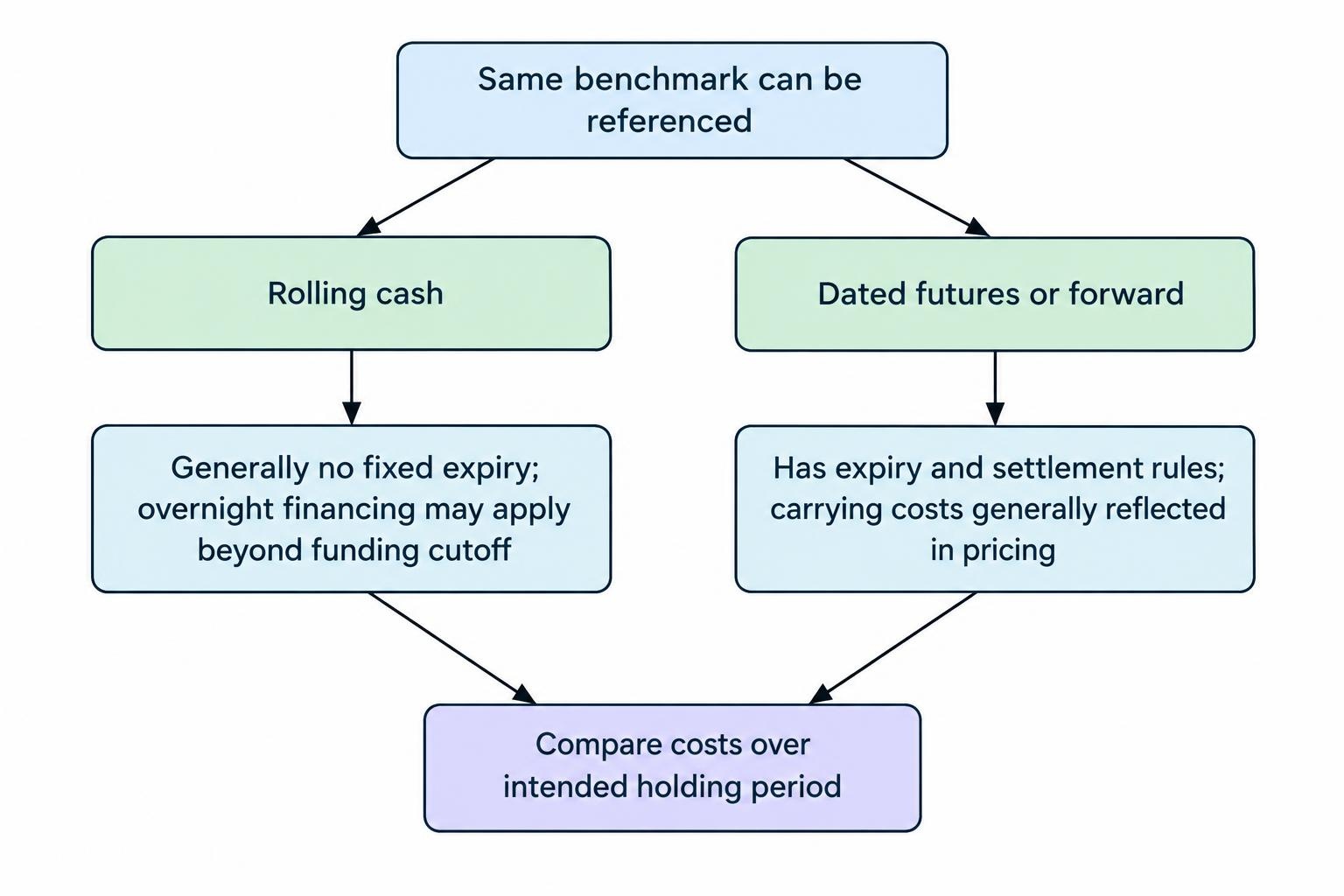
An index name identifies the market, but not necessarily the contract. Providers may offer a rolling cash contract, often called a daily funded bet, alongside dated futures or forward contracts. Both can reference the same benchmark while showing different prices and charging structures.
Rolling cash contracts
A rolling cash contract generally has no fixed expiry and remains open until you close it or the provider closes it under its terms. Positions held beyond the funding cutoff normally receive an overnight financing adjustment. The applicable rate, calculation method and treatment of non-business days depend on the contract.
This structure makes the holding period part of the cost calculation. A spread that looks attractive for a short intraday trade may matter less than accumulated funding charges on a position held for several weeks. Check the funding cutoff too: crossing it can matter even if you have held the trade for only a short time.
Dated contracts
A futures or forward spread bet has an expiry date and settlement rules. Its pricing generally incorporates the cost of carrying exposure to that date, rather than applying the same daily funding arrangement as a rolling cash bet. A futures-based spread bet remains a contract with your provider; it is not the same as holding an exchange-traded futures contract directly.
Cash and futures prices need not match. Index futures fair value depends on the cash index, interest rates, expected dividends and time to expiry, while actual prices can move around that theoretical value. The CME equity index fair-value calculation shows the relationship.
Compare contracts over your intended holding period, including their spreads, funding treatment and any expiry or rollover costs. The difference between their quoted levels is not automatically a trading opportunity. The comparison of daily funded bets and futures covers the choice in greater detail.
The costs of index spread betting
The spread is the most visible cost. At £3 per point, a two-point spread creates a £6 opening disadvantage if prices do not change. A five-point spread creates a £15 disadvantage at the same stake. A small difference in the quote becomes more noticeable when the stake or trading frequency increases.
Compare the spread available during the session you intend to trade, not just an advertised minimum. Also check whether the quoted spread is fixed or variable and whether different schedules apply outside the main underlying market session.
Overnight financing can become the larger expense on rolling positions. Calculate it over a plausible holding period rather than looking only at one day’s charge. The broader guide to spread betting costs explains how to compare the complete bill.
For cash contracts based on price indices, constituent shares going ex dividend can lead to contractual adjustments, commonly a credit to longs and a debit to shorts. The amount and timing depend on the product. A credit is not free profit: the related price effect must also be considered. The guide to spread betting dividend adjustments explains the accounting.
Other possible costs include guaranteed stop premiums and charges associated with rolling dated positions. Slippage is different: it is the difference between an expected execution price and the price actually obtained. Even without a separate fee, it changes the trade’s result.
Margin and account exposure
For UK retail clients covered by the FCA rules, the minimum opening margin is 5% of exposure for major stock market indices and 10% for minor stock market indices. These correspond to maximum leverage of 20:1 and 10:1 respectively. The classifications are regulatory categories, not informal descriptions of an index’s popularity. The requirements appear in FCA COBS 22.5 margin rules.
Those percentages are minimum requirements, not a promise that every contract will be available at that margin. Check the provider’s actual requirement, including any position-size tiers.
Consider an illustrative index level of 8,000 and a stake of £2 per full index point. The approximate exposure is £16,000. At a 5% margin rate, the opening requirement would be about £800.
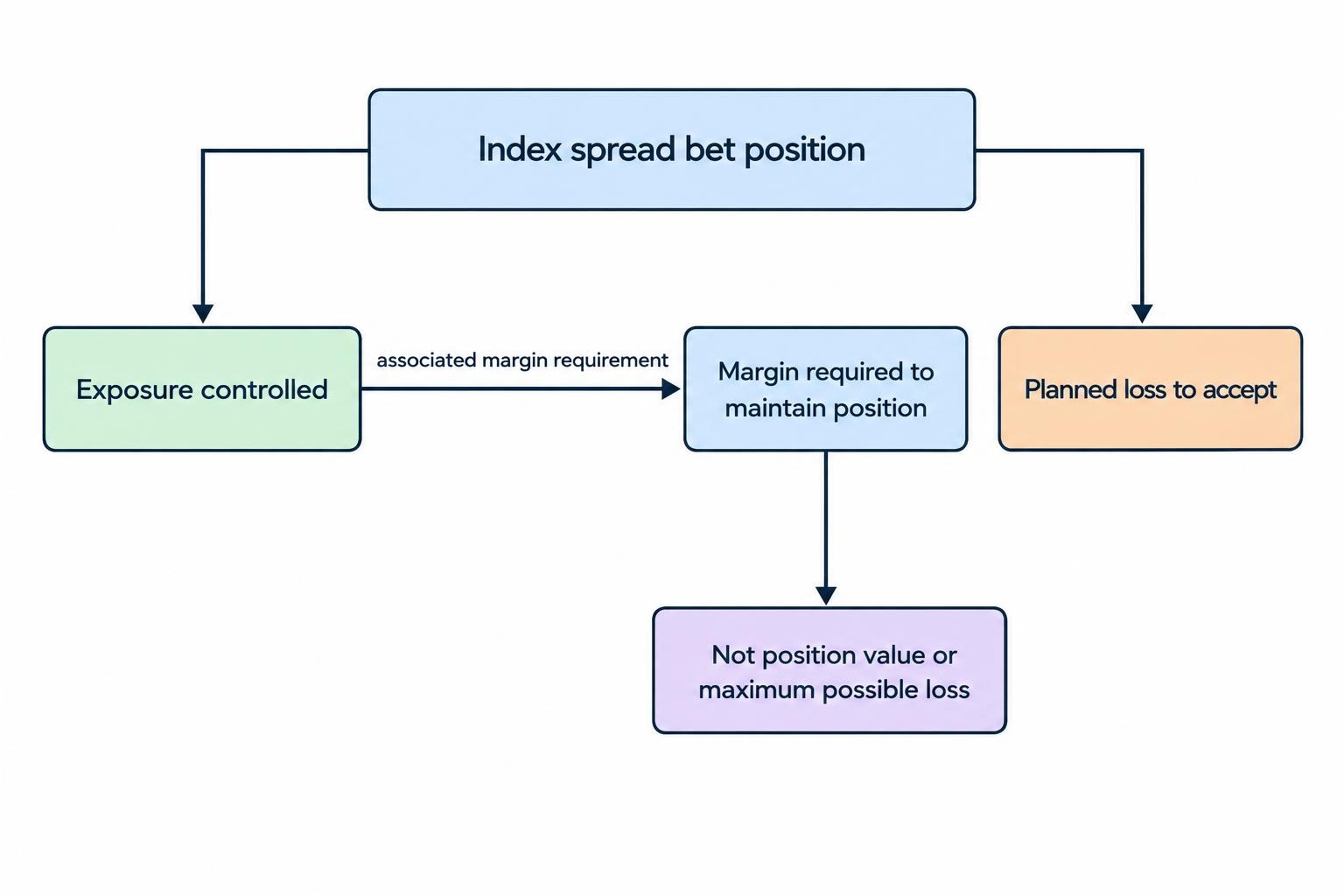
An adverse 1% index move is 80 points, producing a £160 trading loss before costs. That is 1% of the exposure but 20% of the illustrative margin deposit. The £800 deposit is therefore neither the position’s value nor its maximum possible loss.
UK retail protections also include an account-level margin closeout rule when net equity falls below 50% of the required margin, and negative balance protection covering funds dedicated to the trading account. The FCA retail CFD protection policy summarises these safeguards.
These protections do not prevent you losing the account balance. They are also not substitutes for planning an exit: closeout can affect positions you intended to keep open, and execution still depends on market conditions.
Keep three amounts separate: the exposure you control, the margin needed to maintain it, and the loss you intend to accept. Confusing them makes a position look affordable when it may simply be easy to open.
What moves a stock index?
An index responds to changes in its constituent share prices, with each company’s influence determined by the benchmark’s weighting method. Broad changes in profit expectations, interest rates and investor risk appetite can affect many constituents at once. A major company announcement can also matter when that company carries a large weight.
The useful question is not simply whether an announcement sounds positive or negative. It is how the announcement differs from expectations, which companies it affects and how those companies contribute to the index. Good economic news can produce an awkward market reaction if traders interpret it as a reason for higher interest rates.
Build a calendar around the chosen market. Include relevant central bank decisions, inflation and employment releases, and earnings from heavily weighted constituents. Treat these as possible changes in trading conditions, not automatic buy or sell signals.
Trading hours and prices outside the main session
The hours shown for a spread betting contract may extend beyond the main trading session of its constituent shares. Distinguish between the underlying stock exchange session, related futures trading hours and the provider’s own dealing schedule.
When constituent shares are not trading, a provider’s index quote can reflect related futures and other pricing inputs rather than a live calculation from every underlying share. Check its pricing policy before comparing that quote with a cash index shown on a news page.
Contract breaks, holidays and daylight saving changes can also affect availability. A schedule copied from an old screenshot is not much of a trading plan. The index trading hours guide explains how to distinguish the sessions.
Before carrying a position through a closure, establish when you can next trade it and whether your orders remain active. A stop cannot create an executable price during a period when the contract is closed.
Managing risk on index positions
Set the trade’s invalidation level before choosing the stake. If an illustrative trade has a £120 planned loss allowance and a stop 60 points from entry, the arithmetic gives £2 per point before allowing for charges and possible execution beyond the stop. This is a sizing example, not a recommended risk budget.
A wider stop requires a smaller stake if the cash risk allowance stays unchanged. Keeping the stake and widening the stop increases the intended loss. The guide to position sizing for spread betting develops that calculation.
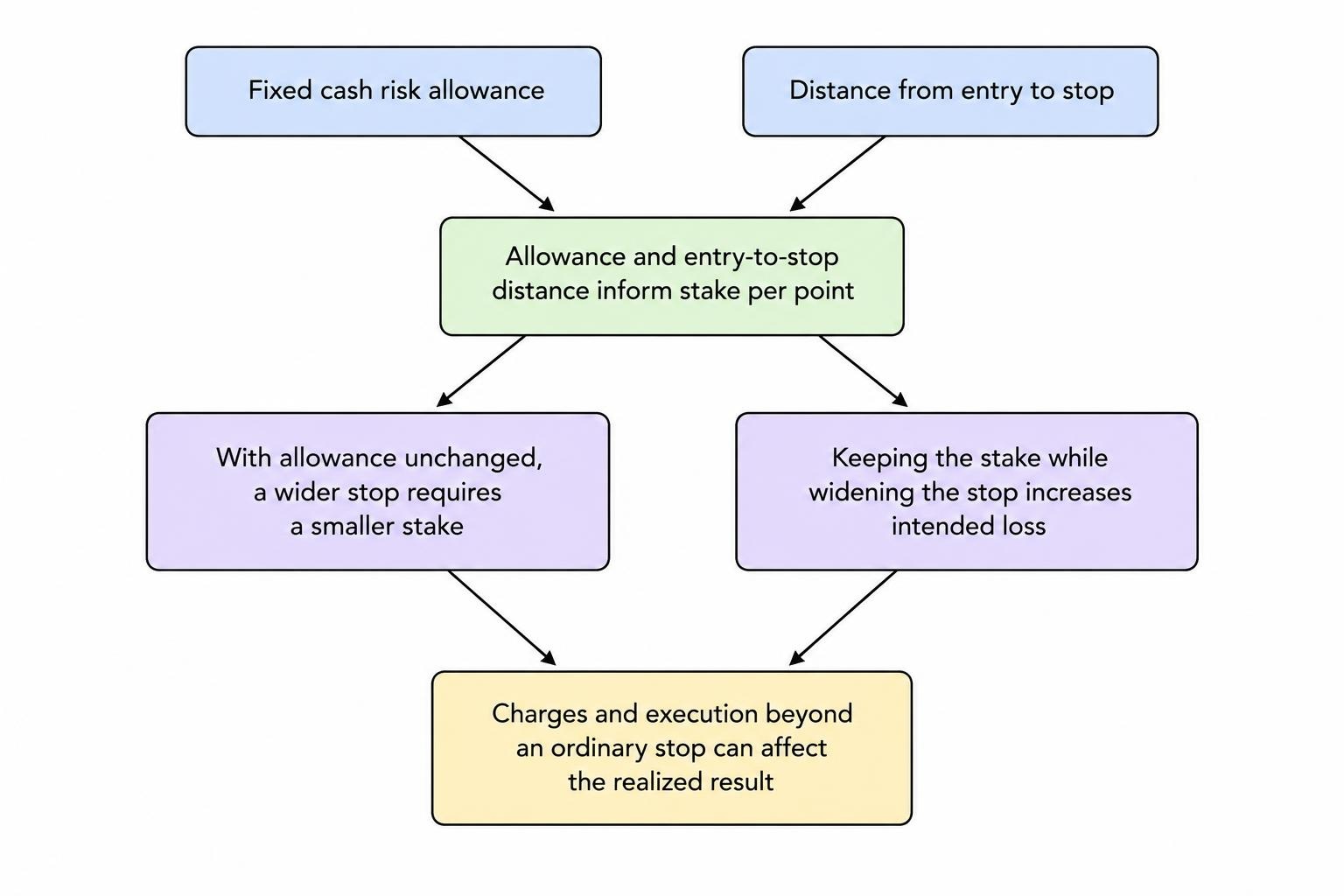
An ordinary stop loss is a trigger, not a guaranteed execution price. Fast moves and gaps can produce a worse fill. Where a guaranteed stop is available, check its premium, permitted distance and other conditions rather than assuming it works identically across contracts.
Measure exposure across the account as well as trade by trade. Buying several equity indices does not automatically create several independent risks. Positions can share constituent companies or respond to the same economic event. The guide to portfolio correlation and spread betting risk explains how overlapping exposures can accumulate.
Compare percentage moves and cash sensitivity, not just points. A 100-point move at an index level of 5,000 represents 2%; at 20,000 it represents 0.5%. At £1 per point, both moves change the trading result by £100, but they represent different market moves. Equal stakes do not make different indices equally risky.
Choosing an index spread betting contract
Start with the market and holding period you can assess, then examine the contract. There is no universally best index for beginners or experienced traders. Familiarity helps with preparation, but a familiar name does not make an oversized position safer.
Before placing an order, confirm:
- Benchmark: the exact index and whether the contract references a cash, performance or dated futures version.
- Point value: the quote scale, minimum stake and cash effect of a realistic move.
- Costs: the spread during your trading session, funding treatment and any stop or rollover charges.
- Availability: dealing hours, scheduled breaks, expiry and settlement terms.
- Risk: margin requirements, stop conditions and the effect on your other open positions.
Provider comparisons should use those same criteria. The guide to index spread betting brokers focuses on contract coverage and trading conditions rather than assuming the longest market list is the best choice.
A suitable contract is one whose exposure, costs and exit conditions you can calculate before entry. If the minimum stake makes a sensible stop too expensive for your risk allowance, the position is too large. A smaller margin requirement does not fix that problem.