A trailing stop is a stop-loss order that moves when a spread bet’s price moves in your favour. It tightens the exit level automatically but does not move back when the price turns against you. The aim is to reduce open risk and, after a sufficient favourable move, protect part of an unrealised profit.
The trade-off is straightforward: a close trailing stop can exit during an ordinary pullback, while a wider stop gives back more profit before triggering. An ordinary trailing stop also does not guarantee its execution price. It changes how a stop-loss order moves, not whether the market can jump past it.
How a trailing stop works
For a long spread bet, the trailing stop sits below the relevant market price. As that price reaches new highs, the stop moves upwards. If the price falls, the stop stays at its latest level. A sufficient reversal triggers the exit.
For a short spread bet, the direction reverses. The stop sits above the relevant price and moves down as the market falls. It stays put when the market rises.
This one-way adjustment is the defining feature of a trailing stop. The general mechanism also applies to securities orders covered by the SEC bulletin on stop and trailing stop orders. For a spread bet, check the provider’s contract for the reference price, adjustment rules and execution terms rather than assuming exchange order rules apply.
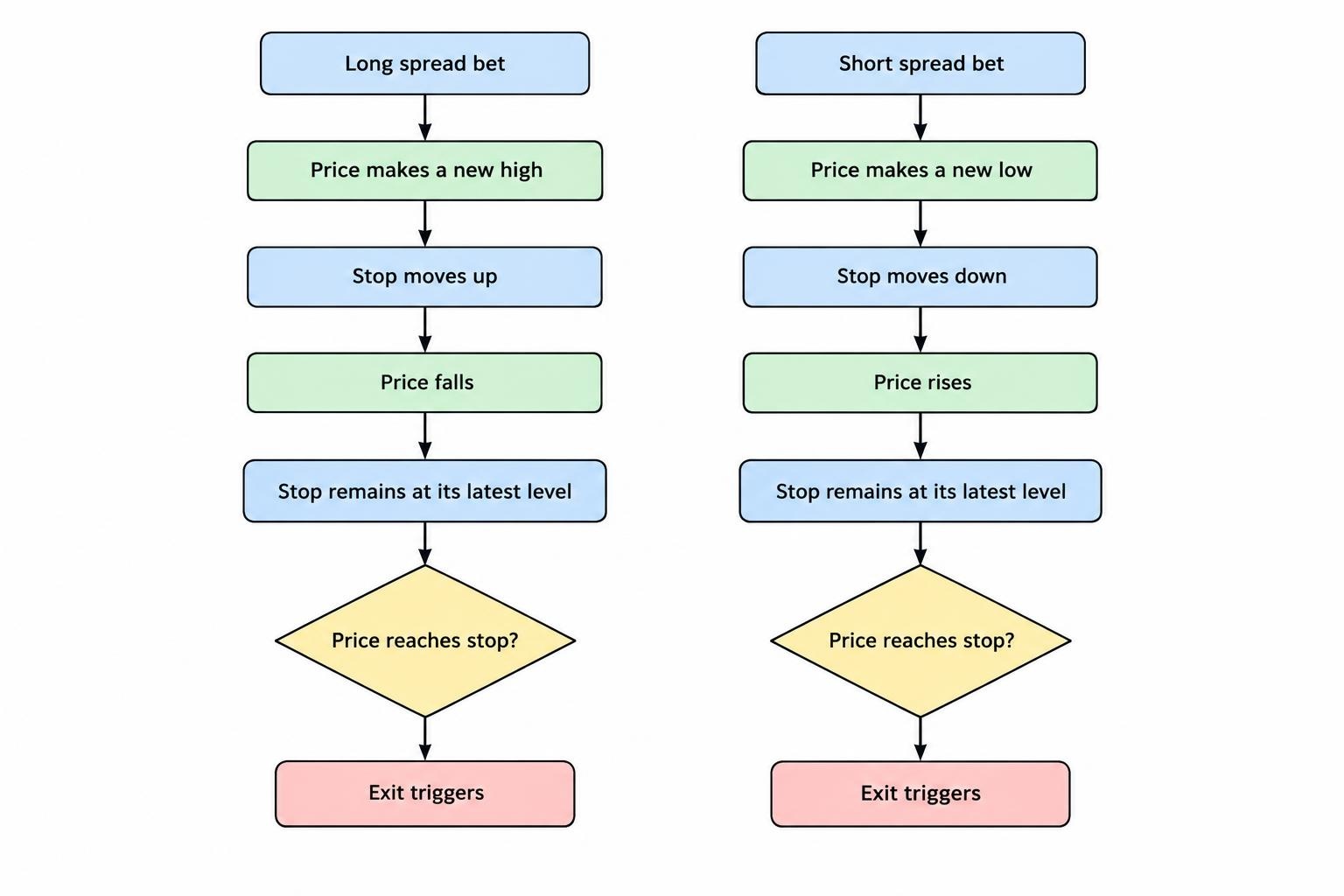
A trailing stop does not identify the end of a trend. It follows a rule you choose, including when the eventual exit turns out to be inconvenient.
Trailing distance and trailing step
The trailing distance is the gap between the relevant reference price and the stop. A 40-point distance on a long position places the stop 40 points below that reference, subject to the platform’s adjustment rules.
The trailing step, where available, controls how far the market must move favourably before the stop adjusts again. Distance and step are not interchangeable. A 40-point distance with a 10-point step does not place the stop 10 points from the market.
Under a simple stepped arrangement, a long position might have a reference price of 8,000 and a stop at 7,960. If the reference reaches 8,010, the stop advances to 7,970. A move to 8,006 would not yet complete that 10-point step. Confirm how the platform anchors and calculates each adjustment.
Also check whether the distance is entered in points, pips or a percentage. A price point and a pound of account risk are different measurements; your stake connects the two.
Worked example: a trailing stop on a long spread bet
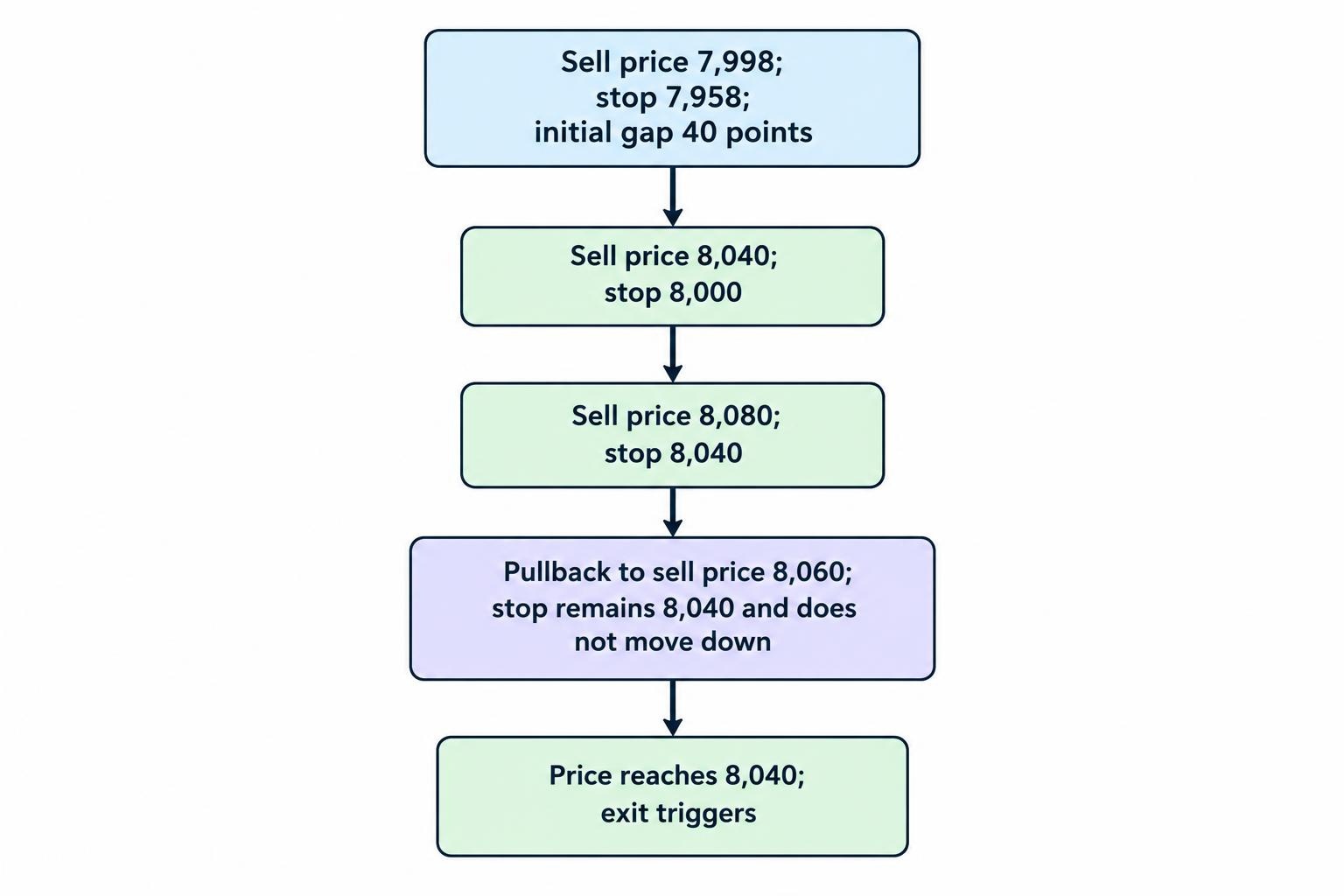
Suppose an index is quoted at 7,998–8,000. You buy at 8,000 for £2 per point and attach a trailing stop 40 points below the sell price. For this hypothetical example, the sell price controls both trailing adjustments and triggering, and there is no trailing step.
| Stage | Sell price | Stop level | What happens |
|---|---|---|---|
| Position opens | 7,998 | 7,958 | The initial stop sits 40 points below the sell price. |
| Market rises | 8,040 | 8,000 | The stop advances to the entry price. |
| Market reaches a new high | 8,080 | 8,040 | The stop advances another 40 points. |
| Market pulls back | 8,060 | 8,040 | The stop remains unchanged. |
| Price reaches the stop | 8,040 | 8,040 | The exit triggers. |
If execution occurs at 8,040, the price profit is (8,040 − 8,000) × £2 = £80, before financing or other applicable charges. A worse execution price would reduce that result.
Notice the initial risk calculation. The stop starts 40 points below the sell quote, but 42 points below your purchase price. Execution at 7,958 would therefore produce an £84 price loss, not £80. The opening spread accounts for the difference.
At the highest sell quote, the unrealised price profit was £160. The eventual £80 result gives back half of that peak profit. A trailing stop aims to retain part of a move, not sell at its highest point. The calculation follows the same principles covered in calculating spread betting profit and loss.
How the same mechanism works on a short position
Suppose you sell another market at 6,000 for £3 per point. The buy quote is initially 6,002, and your trailing stop follows that quote at a distance of 30 points. Its initial level is therefore 6,032.
If the buy quote falls to 5,920, the stop moves down to 5,950. A rebound leaves it there. If the stop then triggers and executes at 5,950, the price profit is (6,000 − 5,950) × £3 = £150, before other applicable charges. Again, this assumes no trailing step and execution at the stop level.
Choosing a trailing distance
There is no universally correct trailing distance. The setting needs to reflect the market, the trading timeframe and the amount of movement your trade is intended to capture.
A tight distance reduces the reversal you tolerate, but ordinary price movement may repeatedly trigger it. A wider distance gives the position more room, at the cost of a larger potential loss or a greater surrender of open profit.
One approach is to compare the proposed distance with recent volatility. A stop that sits inside routine price swings may conflict with a plan to hold through those swings. Average True Range can provide a reference for recent trading ranges, although it cannot predict the next move or guarantee that a chosen distance will hold.
Do not choose the stop solely because the resulting cash loss looks comfortable. Start with a defensible exit distance, then check whether the stake makes that risk affordable. If it does not, reducing the stake or declining the trade is more coherent than squeezing the stop into normal market movement.
For example, an illustrative £150 risk allowance and a 60-point distance between entry and the initial stop imply £2.50 per point before allowing for charges and adverse execution. If that entry-to-stop distance becomes 100 points, the same allowance implies £1.50 per point. Position sizing for spread betting covers that relationship in more detail.
Trailing stops versus fixed and guaranteed stops
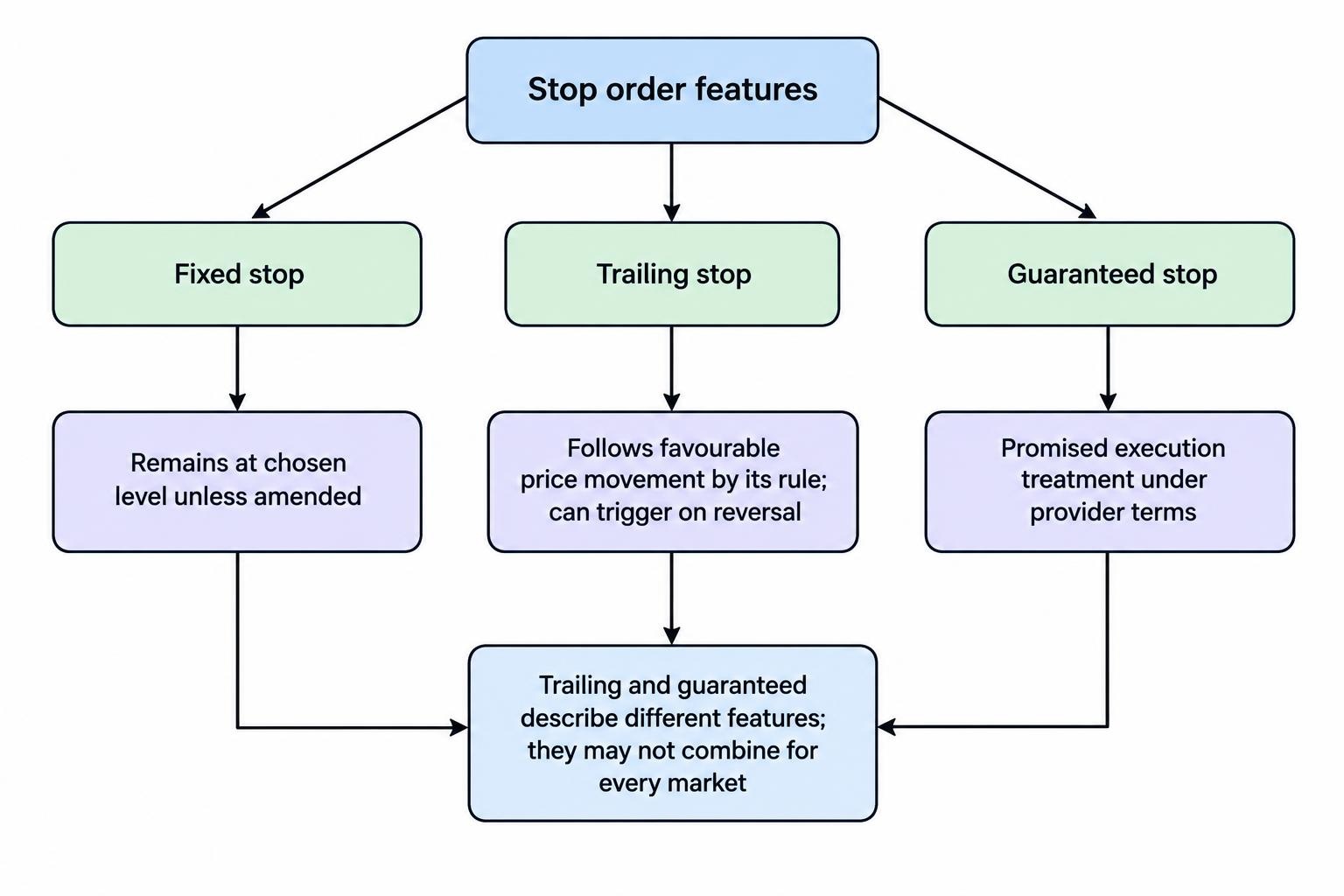
A fixed stop stays at its chosen level unless you amend it. That can suit a trade whose exit depends on a particular price level rather than a constant distance from the market. A trailing stop replaces those manual adjustments with a predefined rule.
Neither approach is automatically better. A fixed stop can leave more profit exposed after a favourable move. A trailing stop can close a position during a pullback that a fixed stop would have survived. Compare complete trading results, not just whether the trailing version occasionally captures a satisfying exit.
A guaranteed stop-loss order addresses a different question: execution protection under the provider’s terms. “Trailing” describes movement of the stop level; “guaranteed” describes the promised execution treatment. Do not assume an ordinary trailing stop includes that protection, or that both features can be combined on your chosen market.
A profit target is different again. It seeks an exit at a chosen favourable level, whereas a trailing stop waits for a reversal from the best reference price reached after activation.
Trigger prices, gaps and execution risk
The price shown on a chart is not necessarily the price used to trigger your stop. Before placing the order, establish which quote controls it. Closing a long spread bet involves selling; closing a short involves buying. A chart displaying a midpoint or the opposite side of the spread may not show the trigger clearly.
Spread changes matter too. If the sell quote falls or the buy quote rises as the spread widens, that movement may bring the relevant quote to a stop even when the chart’s midpoint moves less. Use the provider’s trigger definition when reviewing an exit.
A non-guaranteed stop level is not a promised fill price. Rapid movement can produce a worse execution, and a brief price spike can trigger an exit before the market recovers. These general stop-order risks also feature in FINRA’s notice on stop orders during volatile markets, which concerns US securities rather than UK spread betting contracts.
For the long example above, a stop at 8,040 might execute at 8,025 if the next available execution price is lower. At £2 per point, the price profit would then be £50 rather than £80. This difference is slippage.
Gaps between trading sessions create a related problem: the market may reopen beyond the stop without trading at its level. Moving the stop automatically does not remove that risk.
What to check before activating a trailing stop
Read the order ticket and relevant dealing terms before relying on the feature. The useful checks are practical rather than cosmetic:
- Availability: confirm that trailing stops are supported for the exact market and contract.
- Distance and step: check the units, minimum settings and adjustment method.
- Activation: establish when trailing begins and which price controls it.
- Operation: check whether trailing runs on the provider’s servers or requires your platform or device to remain connected.
- Order changes: confirm what happens after a partial closure, position amendment or contract expiry.
After submitting the instruction, verify that the position shows an accepted trailing stop, its current level and the intended settings. An unsubmitted change in an order ticket is not an active instruction.
A spread betting demo account can help you learn the controls and observe adjustment behaviour. It should not be treated as proof that live execution will match a simulation, especially during fast markets.
When a trailing stop fits the trade
A trailing stop can suit a plan that aims to hold a favourable move without setting a fixed profit target. It is less suited to a plan that deliberately tolerates repeated pullbacks larger than the selected trailing distance. The order and the strategy need to agree.
It also does not make the underlying product low risk. Financial spread betting sits within the high-risk CFD products covered by the FCA’s CFD risk information; automating an exit does not change that classification.
Choose the exit rule before the trade, size the stake around the initial risk, and accept that retaining some profit means surrendering some of the peak. If that trade-off does not fit the position, consider another of the available spread betting order types rather than repeatedly changing the trailing distance after every uncomfortable price move.