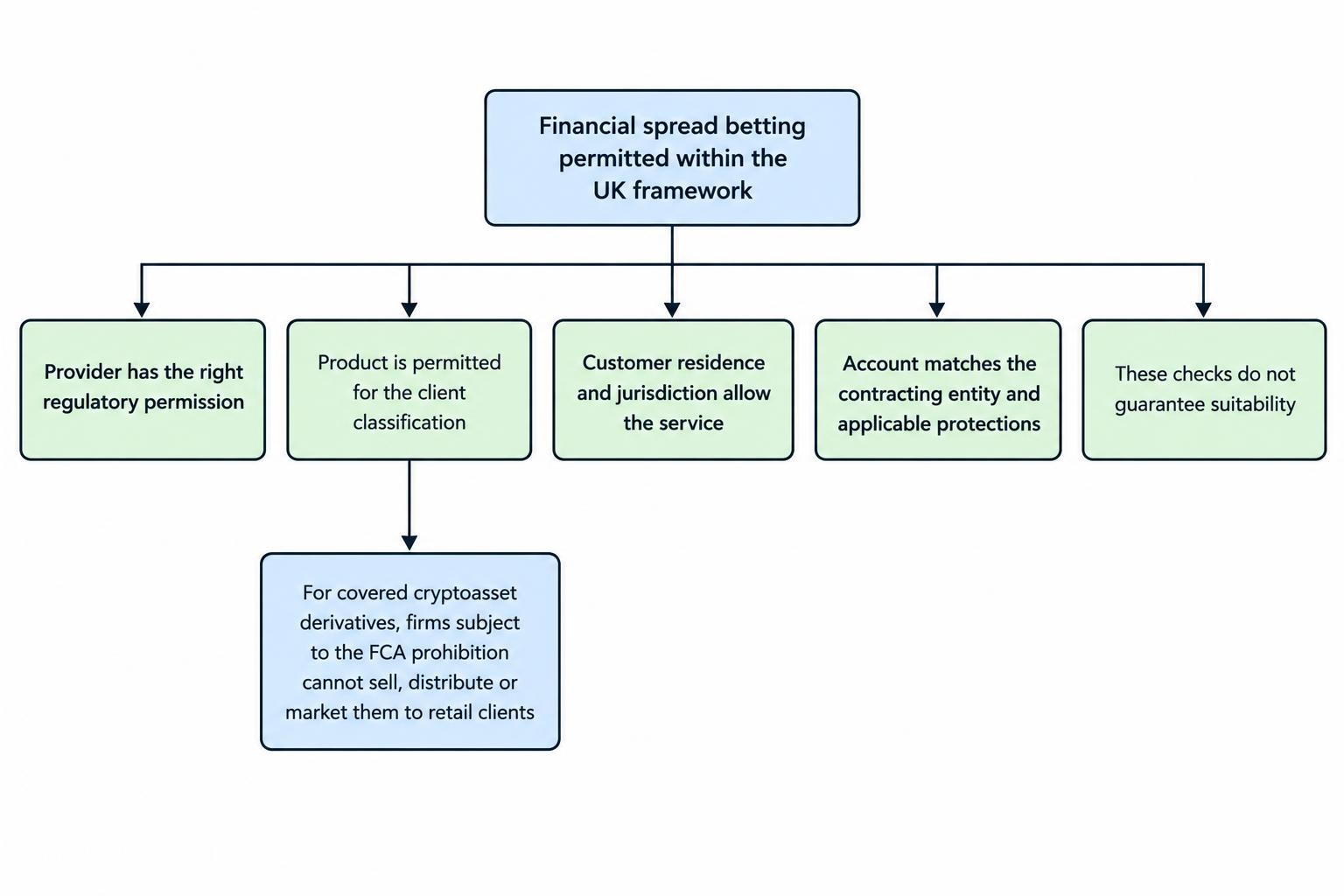
Financial spread betting is legal in the UK, but that does not make every provider, product or account arrangement lawful. The firm needs the right regulatory permission, the product must be permitted for the client concerned, and the account must operate within the applicable rules.
For a retail customer, the practical question is therefore not simply whether spread betting is legal. It is whether the company named in the account agreement can lawfully offer that particular service to you. Your residence and client classification matter too, especially where an overseas company sits behind a familiar trading brand.
The Legal Position in the UK
UK law permits regulated financial services rather than giving providers unrestricted freedom to offer them. Section 19 of the Financial Services and Markets Act 2000 prohibits a person from carrying on a regulated activity in the UK, or purporting to do so, unless authorised or exempt.
That distinction separates the legality of the product from the conduct of the provider. Financial spread betting can be a lawful service while a company offering it without the required authorisation operates unlawfully. A functioning platform and a successful deposit do not settle either question.
The word “betting” can also cause confusion. Financial spread betting falls within the FCA’s regulatory remit, rather than becoming an ordinary gambling service because of its name. The Gambling Commission’s explanation of activities outside its remit identifies spread betting on stocks and shares as FCA regulated.
For a customer trading their own account, focus on the provider’s permission, the product restrictions and the account terms. Running a brokerage or offering services to other people raises separate questions. Our guide to UK spread betting regulation covers the wider framework.
Does Legal Availability Mean Anyone Can Open an Account?
No. A lawful product is not an entitlement to an account. Separate the country’s legal position from the provider’s acceptance criteria, and check both before applying. Review the provider’s minimum age, residence requirements and account restrictions rather than assuming that access to its application form establishes eligibility.
Regulatory checks also go beyond confirming that an applicant exists. For relevant services offered without advice, firms must obtain information about the client’s knowledge and experience to assess whether the product is appropriate. The FCA’s appropriateness rules in COBS 10A require warnings where a product is considered inappropriate or the firm lacks enough information to assess it.
Answer those questions accurately. Knowing which box might get an application through is not the same as knowing how a leveraged trade can lose money. Account approval should not be treated as a recommendation to trade.
The spread betting appropriateness test guide explains that assessment in more detail. Keep it separate from your own decision about whether the potential loss is affordable.
How to Check Whether a Provider Can Lawfully Serve You
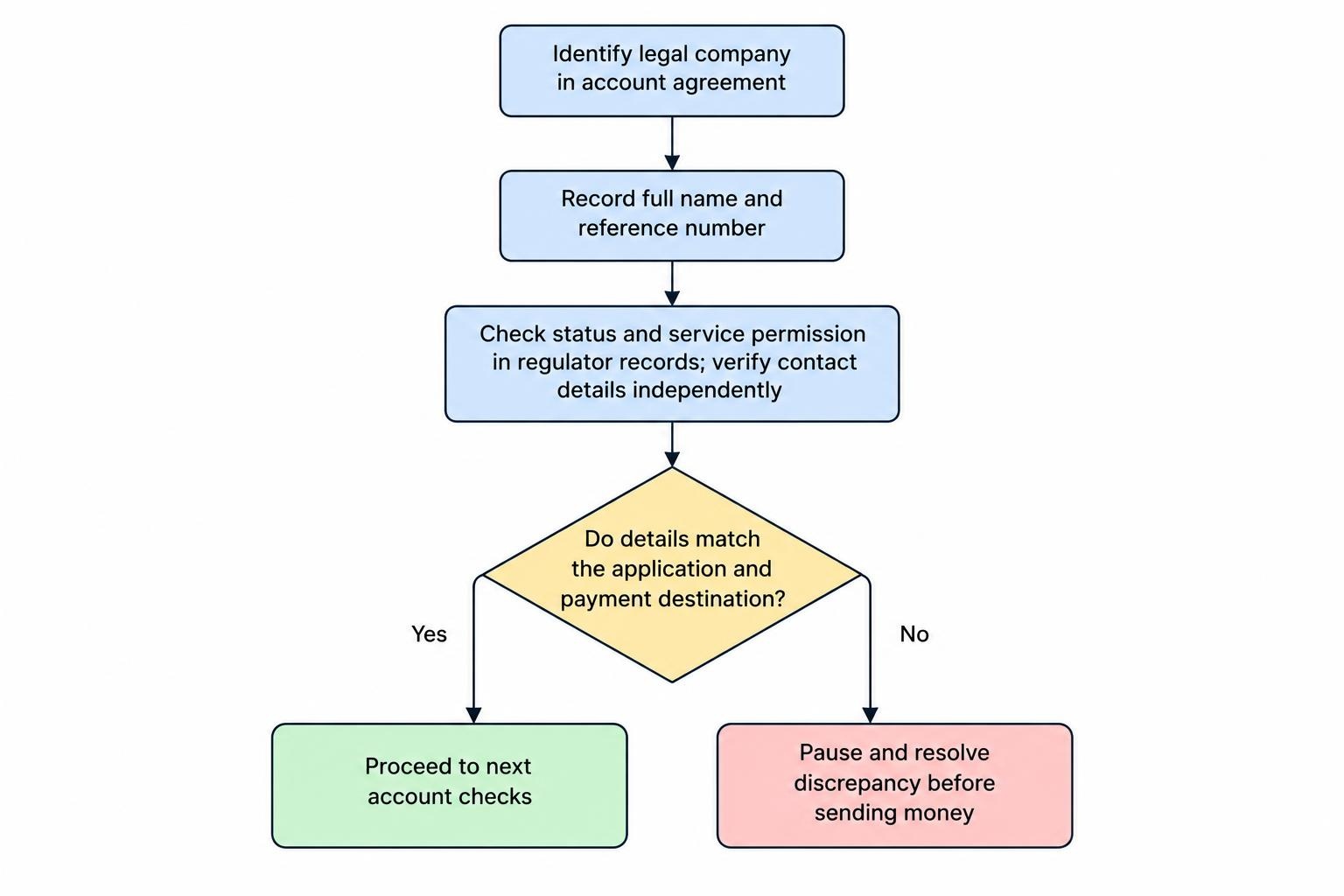
Start with the legal company named in the account agreement, not just the brand displayed above the login button. Record its full name and firm reference number, then compare those details with the regulator’s records. Where the application and agreement name different companies, resolve that difference before sending money.
The FCA’s guidance on checking authorisation distinguishes authorisation from registration and explains how to check whether a firm has permission for the service offered. Finding a company’s name somewhere in the regulatory records is not enough; its status and permissions must match the proposed service.
Check contact details as well. Clone firms can copy the name and reference number of a genuine business while using another domain, telephone number or payment destination. Use the independently checked contact details to resolve discrepancies, rather than asking the person who approached you to confirm their own legitimacy.
Our guide to checking a broker on the FCA Register covers the record check step by step.
Keep a copy of the agreement and the company details you checked. This gives you a clear record of who was supposed to provide the service. A polished app is not a regulatory permission, and a familiar logo does not tell you who holds your account.
Rules That Apply to Retail Spread Betting
Legal availability comes with restrictions. The FCA’s COBS 22 rules for restricted speculative investments set conditions for retail spread betting, including margin requirements, account protections, warnings and restrictions on incentives.
| Requirement | Practical effect |
|---|---|
| Leverage restrictions | Maximum leverage depends on the underlying market, including 30:1 for major currency pairs and 5:1 for individual shares. |
| Margin close-out | If account net equity falls below 50% of the required margin, positions must be closed as soon as market conditions allow. |
| Negative balance protection | Retail liability is capped at the funds dedicated to trading these products in the account. |
| Risk warnings | Providers must display prescribed warnings about the risk of losses. |
| Incentive restrictions | Firms cannot offer prohibited monetary or non-monetary incentives to encourage trading. |
These protections do not prevent the loss of your trading funds. Negative balance protection is an account liability safeguard, not a promise that each position will lose only its opening margin.
Nor should the maximum permitted leverage become your target. The legal ceiling answers how much exposure may be offered, not how much exposure makes sense for your finances. The guide to retail client protections examines those safeguards without treating them as insurance against poor trading decisions.
Are Cryptocurrency Spread Bets Legal for Retail Customers?
The general legality of financial spread betting does not mean that every underlying market is available. Cryptoasset derivatives are an important exception: firms subject to the FCA’s prohibition cannot sell, distribute or market the covered derivatives to retail clients.
Retail access to certain crypto exchange traded notes changed on 8 October 2025. That change did not reopen retail access to cryptoasset derivatives. The FCA’s announcement on retail crypto ETNs expressly preserved the derivatives ban.
A crypto ETN and a spread bet are not interchangeable simply because both track a cryptoasset’s price. Do not treat a headline about one product as permission to trade another. Check the contract being offered, not just the market name on the screen.
The cryptocurrency spread betting rules cover this exception in more detail. An offer presented as a way around a retail restriction deserves scrutiny, not a hurried deposit.
Professional Accounts and Offshore Providers Need Separate Checks
An offer to switch to professional status or open an account with an overseas group company changes the questions you need to ask. It should not be treated as a routine upgrade to the same account with a larger trading allowance.
The FCA warns that inappropriate professional classification and redirection to overseas providers can deprive retail customers of protections. Its regulatory guidance for CFD and spread betting firms identifies both practices as concerns.
Professional status is a regulatory classification, not a badge for someone who trades frequently. Before requesting it, establish which protections would cease to apply and why the provider considers you eligible. The guide to retail and professional client classification covers that distinction.
For an overseas account, ask which company contracts with you, which regulator supervises the service and how a dispute would be handled. Do not assume that protections advertised for a UK company extend to another company in the same group.
Overseas location alone does not answer whether an arrangement is lawful. Equally, foreign regulation should not be accepted as proof that the firm can offer its products to you. Get the explanation in writing before deciding whether to proceed.
Is Spread Betting Legal Outside the UK?
There is no reliable worldwide yes-or-no answer. A UK provider’s permission does not establish that it can serve residents of every country, and the account terms do not replace the law where you live. Check the product and the provider’s authority in the relevant jurisdiction.
For US residents, FCA authorisation alone is not enough. Foreign entities soliciting US residents to trade are generally required to register with the CFTC where its rules apply, although exemptions exist and other regulators may be relevant depending on the product. The CFTC’s registration and background-check guidance addresses these cross-border checks.
Do not infer lawful access from a platform accepting a US address or allowing a deposit. Ask the firm to identify the legal basis on which it can offer the proposed contract to a resident in your jurisdiction. Where the answer is unclear, obtain local legal advice rather than relying on a sales response.
If you move abroad, review your position before continuing to trade. Tell the provider about the change and confirm whether the existing account can continue under the same entity and terms. A VPN is not a substitute for that check.
Legal Status and Tax Treatment Are Different Questions
A service can be lawful without receiving the tax treatment you expect. Conversely, favourable tax treatment does not establish that a provider is authorised. Keep the regulatory and tax checks separate.
For individuals placing genuine financial spread bets, HMRC’s financial spread betting guidance states that no chargeable gains or allowable losses arise. The loss treatment matters: an unsuccessful bet does not automatically create a capital loss that can be used against investment gains.
That UK guidance should not be treated as a worldwide tax exemption or a complete answer for every business arrangement. Our guide to whether spread betting is tax-free covers the tax question separately. Obtain advice where your residence, business activity or circumstances make the position uncertain.
What to Establish Before Funding an Account
You should be able to identify the contracting company, verify its permission for the service, confirm that the product can be offered to you and establish which client protections apply. Read the agreement alongside the regulatory record, rather than treating either as a box-ticking exercise.
If those checks leave a mismatch, pause the application. Ask for a written answer and verify it independently. There is no benefit in rushing to fund an account whose legal structure remains unclear.
Financial spread betting is legal in the UK within the relevant framework. That is permission for a regulated activity, not a guarantee that a provider is genuine, that every market is available or that trading is suitable for you.