Spread betting brokers with no minimum deposit let you open an account without committing a fixed starting sum. That flexibility can help you compare platforms before deciding whether to fund one. It does not mean you can trade without money, or that a small deposit will support the position you want.
The useful comparison is not simply £0 versus £100. It is the combination of funding rules, minimum stakes, margin and trading costs. Start with the wider choice of spread betting brokers, then check whether each account fits your budget at the trade level.
Which spread betting brokers have no minimum deposit?
CMC Markets and Pepperstone provide two examples of why the wording matters. One account may have no opening deposit requirement, while another accepts bank transfers without a minimum but sets a floor for card payments.
| Broker | Published funding position | Practical qualification |
|---|---|---|
| CMC Markets | No minimum deposit required to open an account. | You still need enough money to cover a position before trading. The CMC Markets account and funding review records its zero minimum deposit. |
| Pepperstone | No minimum for UK domestic or international bank transfers. Cards, Apple Pay and Google Pay have a £10 minimum. | The payment route changes the minimum you can transfer. The Pepperstone funding research by UK entity separates these transaction requirements. |
These examples reflect published terms checked in October 2026, not a ranking or an exhaustive list. Confirm the funding screen and account terms before transferring money. Check that you are applying for the UK spread betting account rather than a CFD account offered elsewhere in the same group.
Neither example establishes which broker is cheapest for your strategy. A £0 opening requirement says nothing about the spread on your chosen market, the smallest permitted stake or the cost of holding a position overnight.
What “no minimum deposit” actually means
There are four separate thresholds to check. Confusing them can leave you with a funded account that cannot place the trade you intended.
- Account-opening minimum
- The amount required to establish or activate an account. A zero requirement can let you open the account without funding it immediately.
- Payment minimum
- The smallest transfer accepted through a particular funding method. This can differ between bank transfers, cards and digital wallets.
- Minimum stake
- The smallest amount you can bet per point on a market. This determines how much each price movement gains or loses.
- Margin requirement
- The funds needed to open and maintain a position. It depends on the market, position size and applicable margin rate.
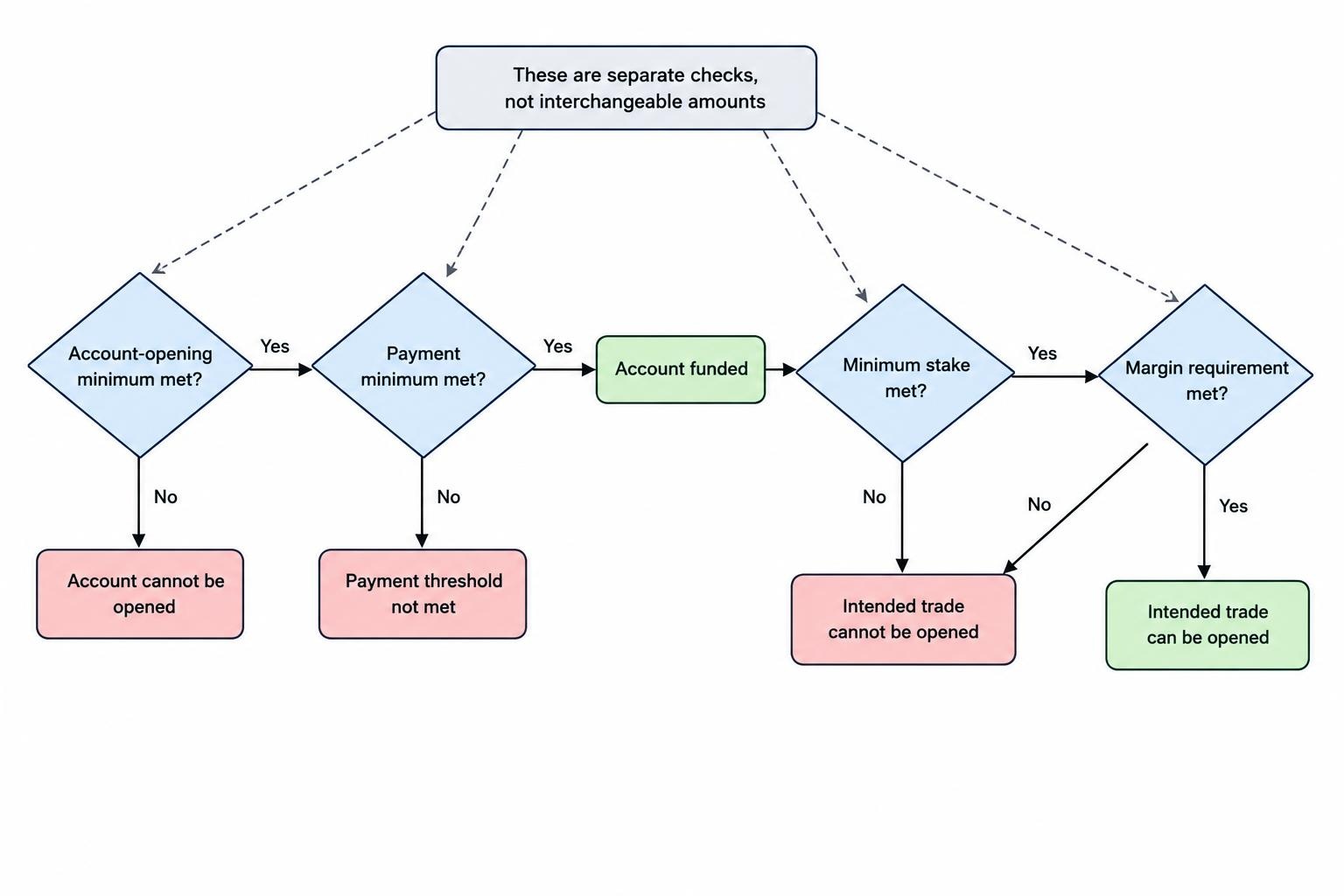
A broker might accept a £10 payment while requiring much more to open your chosen trade. The deposit has cleared; the trading requirement has not. Our explanation of spread betting margin covers that distinction in more detail.
How much money do you need to trade?
Work backwards from the proposed position rather than forwards from the smallest accepted deposit. Calculate its margin requirement, planned loss and likely costs, then decide whether the account can support it.
A hypothetical small-account example
Assume an index is quoted at 8,000, the broker permits a minimum stake of £0.50 per point, and the margin rate is 5%. These figures are illustrative, not a live quote or an offer from either broker above.
The position has a notional exposure of 8,000 × £0.50 = £4,000. At 5%, its opening margin requirement is £200.
A £50 deposit cannot support that position, even if the broker accepted the payment. A £250 account could cover the £200 opening margin, leaving £50 before the initial spread cost and subsequent price movements. That remaining balance is not a promise that the trade can stay open through any particular move.
Now assume the planned stop is 20 points from entry. At £0.50 per point, the intended trading loss is £10 before slippage and other costs. That is 4% of a £250 account.
If your chosen risk budget were 1%, the cash allowance would be £2.50. Dividing £2.50 by the 20-point stop distance gives a stake of £0.125 per point. That falls below the assumed £0.50 minimum, so the proposed trade does not fit the account.
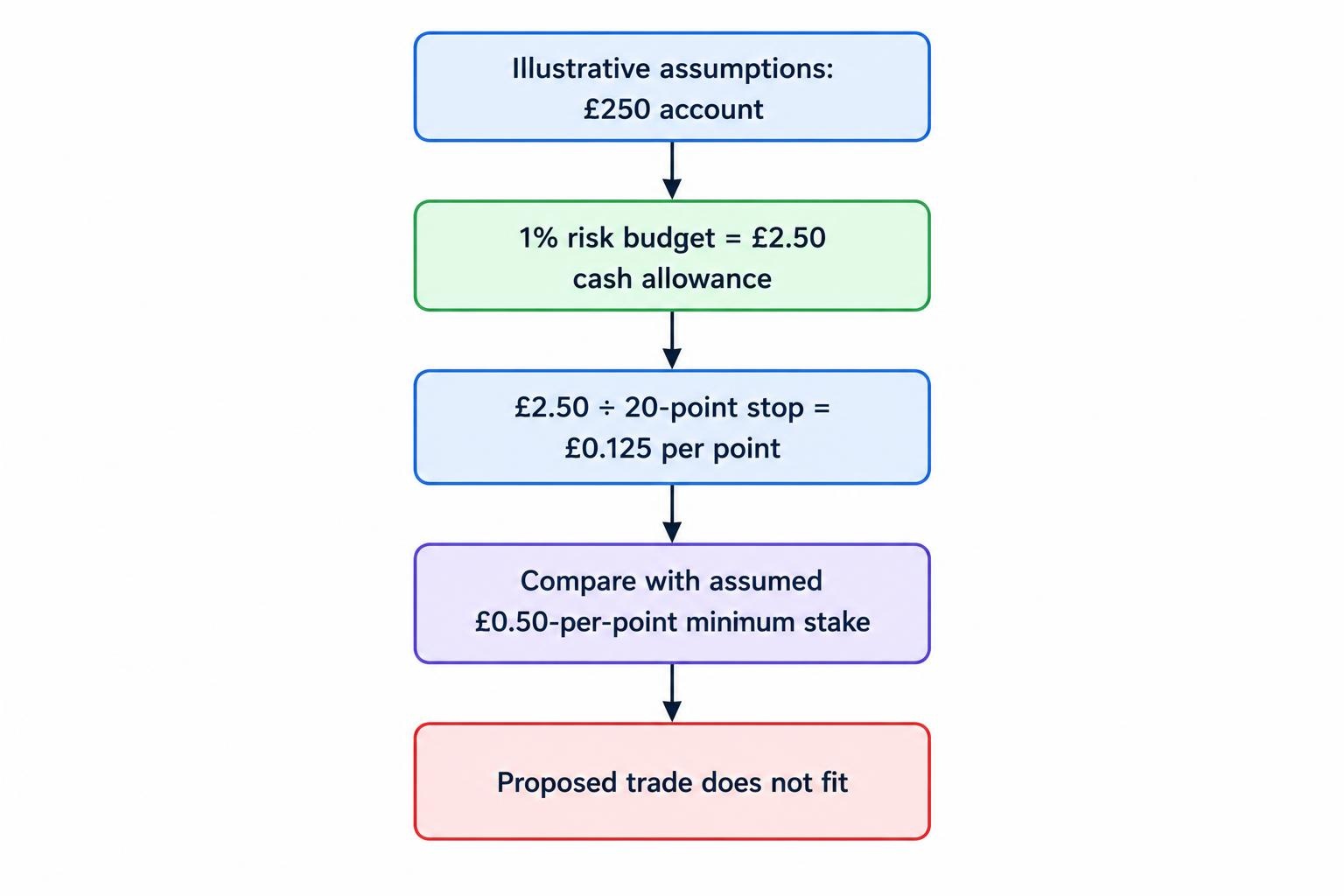
The answer is not to squeeze the stop closer just to make the arithmetic behave. Use position sizing to assess the trade, then reduce the stake where possible, reconsider the market or leave it alone. A deposit requirement is an administrative threshold, not a risk budget.
What to compare beyond the deposit minimum
Minimum stakes on the markets you intend to trade
Inspect the actual order ticket. A platform can accept a small deposit yet require a stake that produces uncomfortable losses during an ordinary price move.
Compare the same instruments across providers rather than relying on an advertised starting stake. Check the point definition too: a point on one product need not represent the same price increment as a point on another. For smaller accounts, brokers offering small stakes may be a more useful shortlist than brokers with the lowest deposit requirement.
Spreads, funding charges and account fees
No minimum deposit does not mean free trading. At £0.50 per point, a two-point spread represents £1 of initial spread cost. That is 1% of a £100 account before the market has moved in your favour or against you.
Compare spreads during the hours you expect to trade. For positions held beyond the trading day, inspect the financing terms, calculation basis and charging times. Also check inactivity fees, payment charges and withdrawal conditions. Use a total trading cost comparison rather than treating the opening deposit as the price of the account.
Stops and order restrictions
Check minimum stop distances, the smallest order size and whether guaranteed stops are available on your intended markets. Where a guaranteed stop carries a premium, include that cost in your cash-risk calculation.
An ordinary stop does not guarantee the requested exit price. Gaps and fast markets can produce a worse execution price, increasing the loss beyond your initial calculation. The Financial Ombudsman’s guidance on stop-order execution addresses this distinction and the disclosures relevant to complaints.
Funding and withdrawals
Before depositing, check the payment minimum, supported currency and any bank or card-provider charges. Read the withdrawal rules at the same time, including minimum amounts, verification requirements and how money is returned.
Do not build a trading plan around an emergency top-up arriving instantly. Choose the position size before opening it, rather than relying on another transfer to keep it running.
Retail protections still matter
For covered UK retail spread betting accounts, the FCA’s rules require firms to close positions as soon as market conditions allow when account net equity falls below 50% of the required margin. Negative balance protection also caps liability for covered positions at the funds in that trading account. Both protections appear in FCA Handbook COBS 22.5.
Those protections do not make a small account safe. You can still lose its entire balance, and margin close-out is not a substitute for a planned exit. Read the broker’s contractual close-out terms before trading.
Check the legal entity holding the account, its permissions and its contact details. A familiar brand name or copied registration number is not enough. Follow the FCA’s authorisation-checking procedure to confirm that you are dealing with the genuine firm.
A practical way to assess an account before funding it
Use a spread betting demo account to practise placing orders and reading the margin display. Set its virtual balance near the amount you might actually allocate. An oversized demo balance can hide the very funding constraints you need to assess.
Before moving to live trading, complete these checks:
- Confirm the UK spread betting account and complete the requested application checks.
- Choose a market and inspect its minimum stake, margin and stop restrictions.
- Calculate the planned cash loss and costs against your account budget.
- Confirm the payment and withdrawal terms before transferring funds.
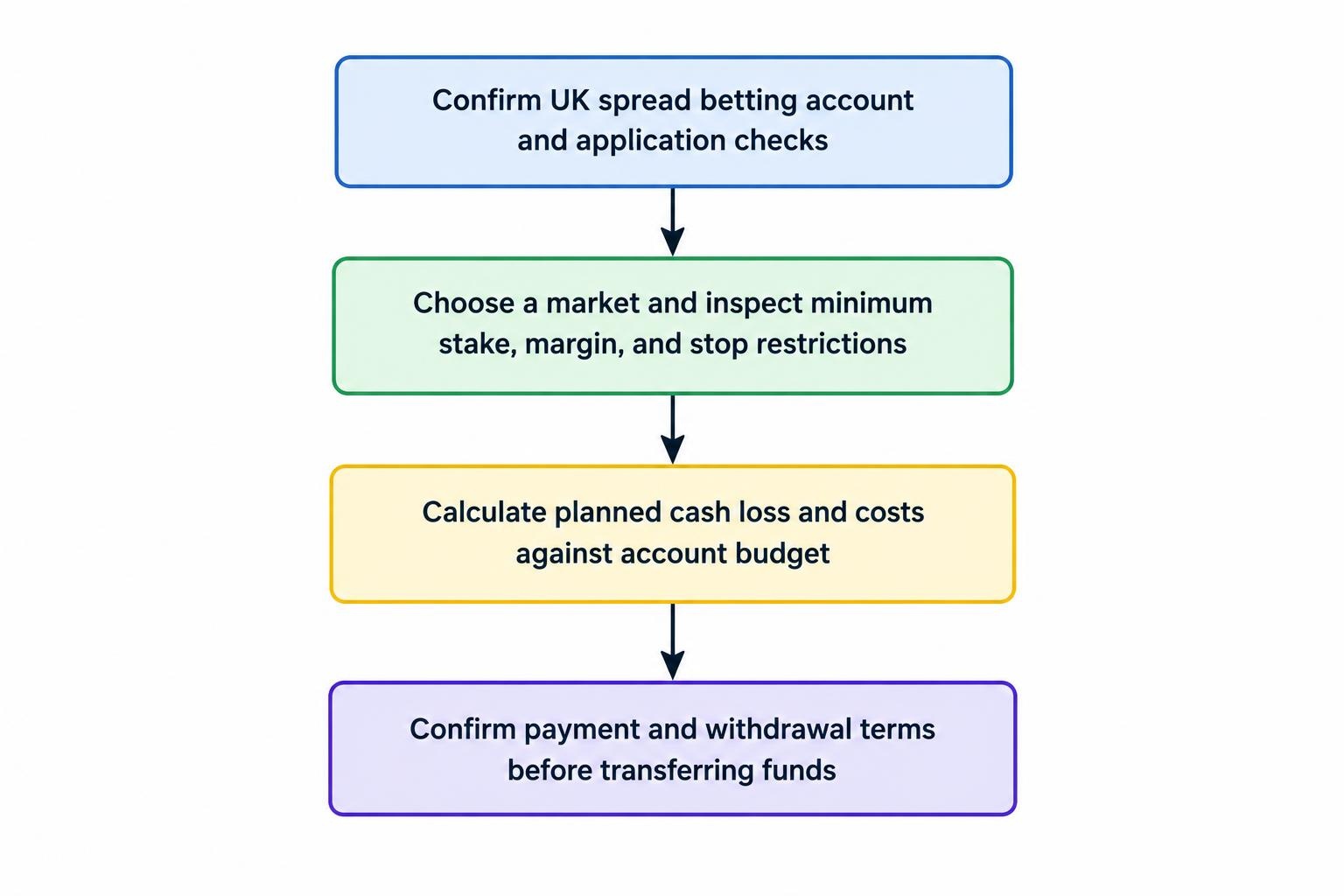
If the smallest available trade exceeds your risk budget, pause. Adding money is not automatically the right answer, particularly if that money belongs in your household budget or emergency savings.
Common questions about no-minimum-deposit accounts
Can you spread bet with £10?
A broker may accept £10, but that does not establish whether you can open a position. The trade must meet its margin requirement, and its minimum stake must fit your risk allowance. An accepted deposit is not evidence of an adequately funded account.
Is no minimum deposit the same as a no-deposit bonus?
No. A zero minimum removes a fixed funding threshold. It does not promise free trading credit or allow you to place live trades without sufficient funds.
Does a larger minimum deposit mean a better broker?
No. The deposit threshold alone cannot establish execution quality, service or value. Compare the account’s trading conditions and regulatory position instead.
Which no-minimum-deposit broker should you choose?
Choose only after checking whether the smallest permitted position fits your budget and whether its costs suit your trading frequency and holding period. The useful account is not simply the one that accepts the smallest transfer. It is one you can use without forcing the trade size, stop distance or household finances to fit.