Share spread betting lets you speculate on an individual company’s share price without buying its shares. You choose whether the price will rise or fall, then set a cash stake for each point of movement. Your profit or loss depends on the distance between your opening and closing prices, multiplied by that stake, with charges and adjustments affecting the final result.
The attraction is straightforward: access to rising and falling share prices through a margin account. The danger is just as straightforward. A small deposit can support a much larger position, and company announcements can move a share past your planned exit price.
This guide covers share spread betting for UK retail clients, including price units, worked examples, margin, costs and company events. The starting point is to separate three numbers that trading platforms place close together: your stake, your market exposure and your potential loss. They are not interchangeable.
How Share Spread Betting Works
A share spread bet is a contract with your provider that references a company’s share price. You do not become a shareholder, receive voting rights or acquire shares that you can transfer into an investment account. You hold a price-based position whose treatment follows the provider’s contract terms.
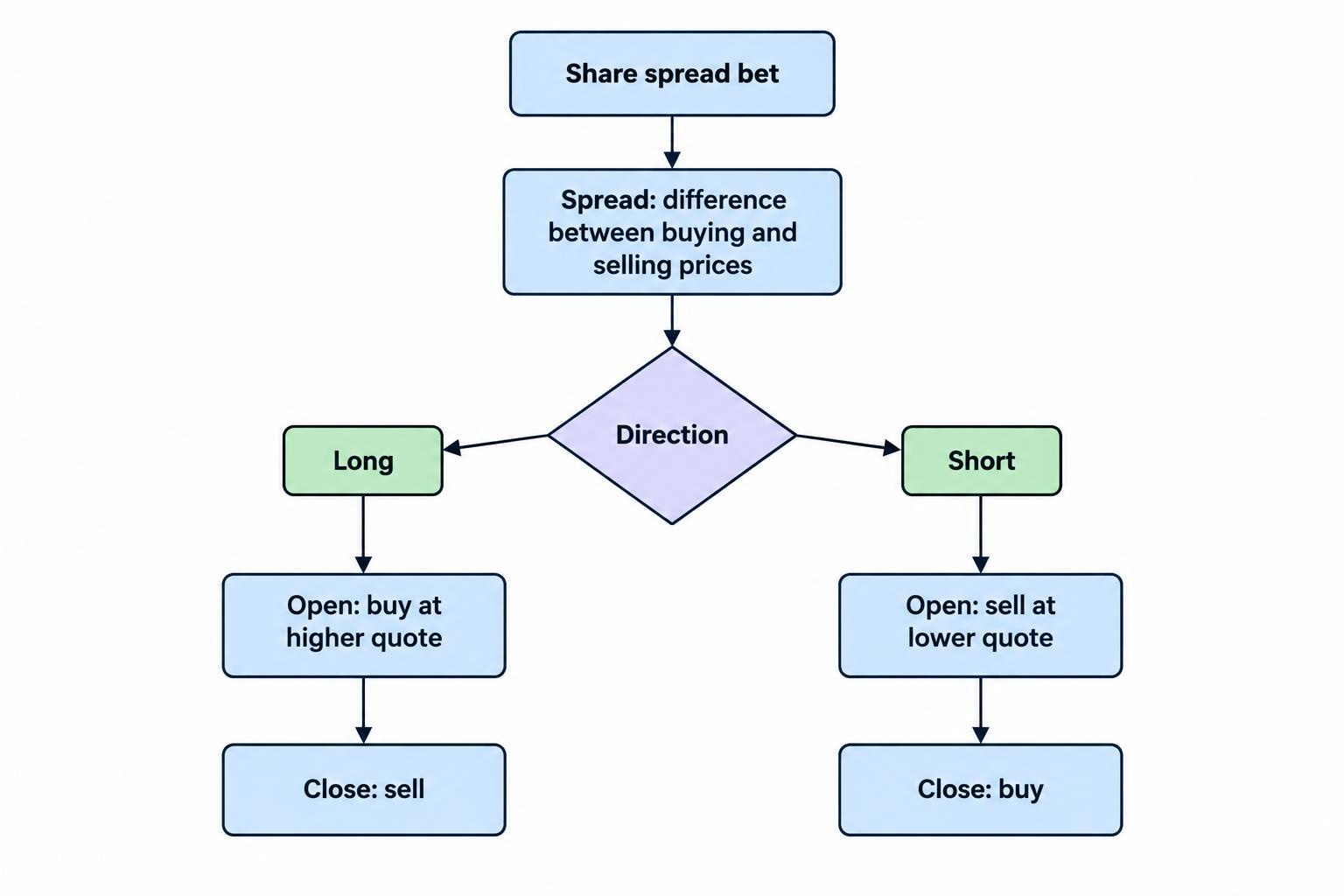
The provider quotes two prices: a lower selling price and a higher buying price. To open a long position, you buy at the higher price and later close by selling. To open a short position, you sell at the lower price and later close by buying. The difference between those quoted prices is the spread.
A share must move far enough in your favour to cover that initial price difference before the position shows a trading profit. A rising company share price does not automatically mean a profitable long trade if the move is smaller than the spread and other costs. The broader mechanics are covered in how spread betting works.
Check What One Point Means
For the examples below, one point equals one penny in a UK share price. A quote of 502 therefore represents 502p, or £5.02. At £2 per point, a movement from 502 to 512 changes the position’s value by £20.
That convention must not become an assumption you carry into every market. A US share may use cents as points, and platform displays can use different scaling. Check the market information and deal ticket before calculating a stake. Decimal places are poor substitutes for contract details.
When one point equals 1p, a £1 stake per point has the same price sensitivity as 100 shares: a 1p movement produces a £1 change. A £2 stake has the price sensitivity of 200 shares. This relationship helps you see the exposure hidden behind a modest-looking stake. The stake per point guide covers the calculation across different quoting conventions.
Going Long or Short
A long share spread bet benefits from a rising price and loses from a falling price. A short position reverses that relationship. You can open a short without already holding the company’s shares, provided the provider permits selling in that market.
Do not assume every listed share is available to short throughout the trading day. Check the instrument’s dealing status and terms, including any borrowing charge or right to close the position. The practical restrictions are covered in short selling shares through spread betting.
A Share Spread Betting Example
Assume a fictional UK company is quoted at 498 to sell and 502 to buy. One point equals 1p, and your stake is £2 per point. These are illustrative prices, not a live quote or a recommendation.
If you expect the share price to rise, you buy at 502. If you expect it to fall, you sell at 498. Each row below represents a separate possible trade.
| Position | Opening price | Closing price | Calculation | Trading result |
|---|---|---|---|---|
| Long, price rises | Buy at 502 | Sell at 550 | (550 − 502) × £2 | £96 profit |
| Long, price falls | Buy at 502 | Sell at 470 | (470 − 502) × £2 | £64 loss |
| Short, price falls | Sell at 498 | Buy at 454 | (498 − 454) × £2 | £88 profit |
| Short, price rises | Sell at 498 | Buy at 540 | (498 − 540) × £2 | £84 loss |
These calculations use the actual dealing side at entry and exit, so the spread is already reflected. Do not subtract it again. Financing, borrowing charges, premiums and account adjustments remain outside these figures.
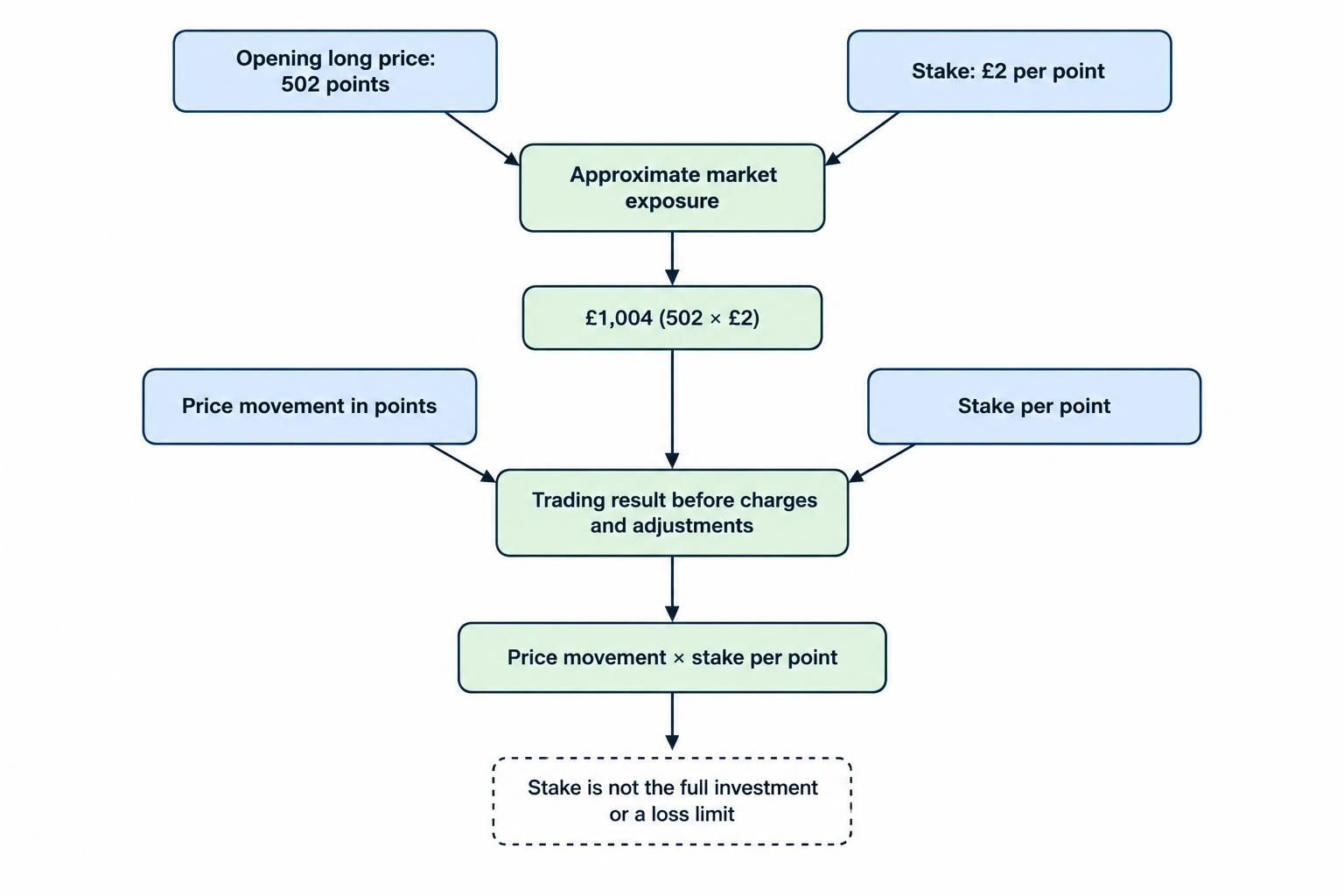
At the long entry price of 502, the £2 stake represents approximately £1,004 of share exposure: 502 points multiplied by £2. The stake is £2, but the position is not a £2 investment. Confusing those figures is an expensive way to learn multiplication.
Margin, Exposure and Retail Protections
UK retail rules require at least 20% initial margin for leveraged exposure to individual shares, equivalent to maximum leverage of 5:1 at that minimum. Providers can require more. The rules also require account-based close-out when net equity falls below 50% of the required margin, as soon as market conditions allow. Negative balance protection caps liability at the funds dedicated to the relevant trading account, not at the deposit allocated to one trade. These protections sit within FCA COBS 22.5 rules for retail speculative investments.
Using the £1,004 example, 20% margin would be £200.80. A 50-point adverse movement at £2 per point still creates a £100 trading loss. Posting only part of the exposure does not reduce the cash effect of each point.
Margin is therefore a funding requirement, not a sensible risk budget. Account close-out is not a substitute for choosing an exit, either. Other positions, unrealised losses and charges can affect how much account equity remains available.
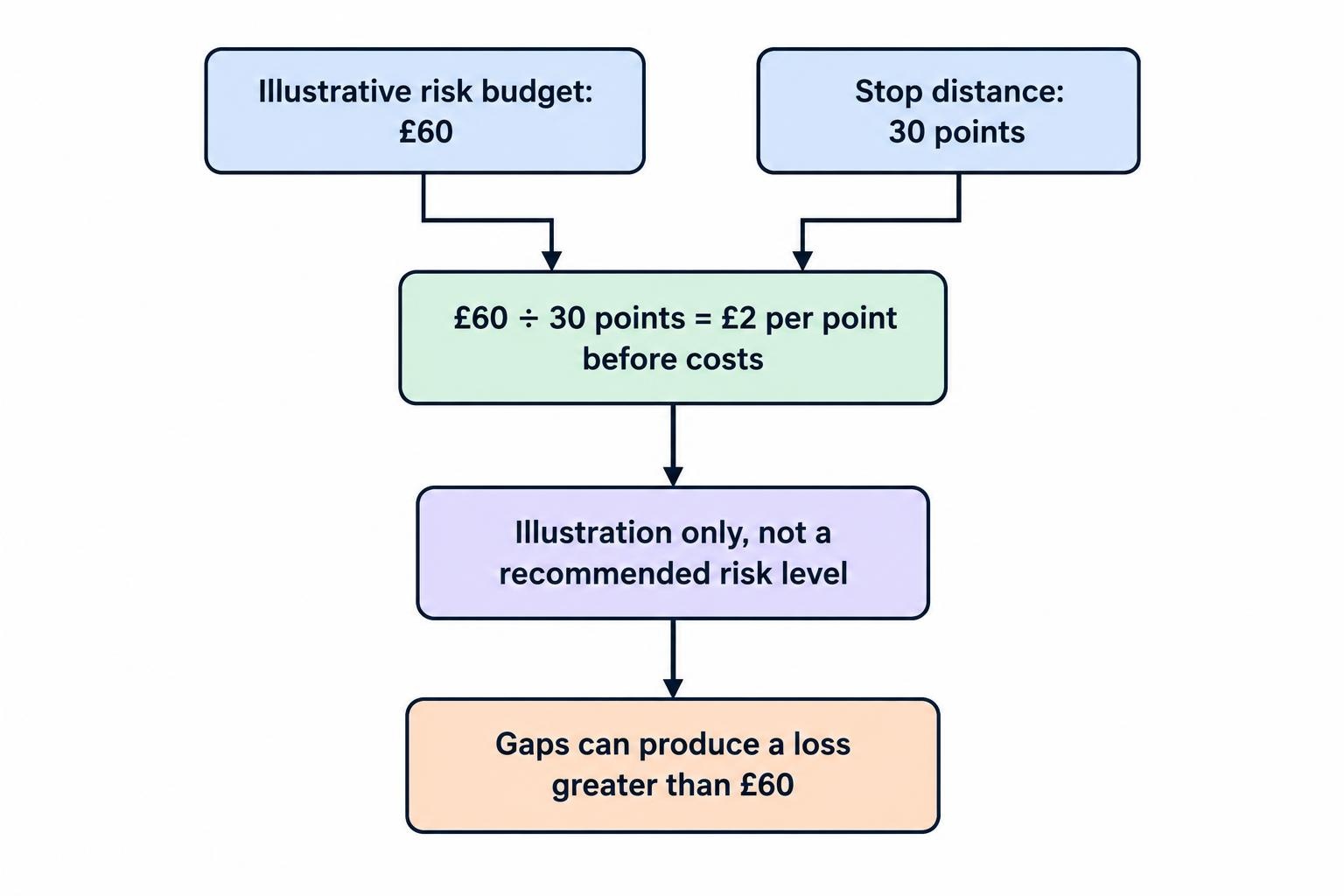
A more useful starting calculation is planned loss divided by stop distance. If you choose a £60 risk budget and a stop 30 points from entry, that gives a £2 stake before allowing for costs. This is an arithmetic example, not a suggested risk level. Use position sizing for spread betting to connect your stake to the loss you intend to tolerate.
Which Shares Can You Spread Bet On?
Available shares depend on the provider, account and current market conditions. Check the actual instrument rather than assuming that every company listed on an exchange appears on the platform. A familiar company name does not settle questions about minimum stake, margin or trading access.
UK Shares
With UK shares, pay close attention to pence versus pounds, company announcement dates and the dealing spread relative to your intended price move. A four-point spread matters much more if your target is ten points than if it is one hundred.
Smaller companies deserve particular scrutiny. Before placing a trade, check whether the displayed quote supports your intended stake and whether a wider spread would make the trade uneconomic. The guide to spread betting on UK shares covers the local market considerations.
US Shares
For US shares, establish the point value, settlement currency and trading session before comparing opportunities. Some providers offer sterling stakes on overseas shares. Check whether trading results, financing and dividend adjustments all settle in sterling, and whether any currency conversion charges remain.
Keep company events in their original time zone until you have checked the conversion. An earnings release scheduled after the US close may arrive well into the UK evening. The US share spread betting guide examines these contract and timing differences.
What Share Spread Betting Costs
The dealing spread is only the opening item in the cost calculation. Your holding period, direction and chosen share can affect what else you pay. Compare the likely total cost of the trade you intend to place, rather than a headline spread on a different instrument.
The Spread and Any Separate Dealing Charge
At £2 per point, a four-point spread creates an £8 difference between the opening price and the immediate closing price, assuming the quote does not change. Increasing the stake increases that hurdle in direct proportion.
Check whether share dealing charges are incorporated into the spread, billed separately or subject to a minimum charge. Do not read “commission-free” as “cost-free”. For a short holding period, the entry and exit cost may be the main obstacle to profitability.
Overnight Funding
A daily funded share position may incur financing when held beyond the provider’s cutoff. Check the reference rate, provider adjustment, day-count method and treatment of weekends and holidays. Where financing uses the full position value, calculating it from the smaller margin deposit understates the charge.
Compare long and short funding separately rather than assuming a short position earns interest. The FCA’s 15 October 2026 findings on CFD and spread betting charges identify wide differences in overnight funding fees and concerns about how firms communicate them.
Borrowing Costs and Other Charges
A short share position may carry a borrowing charge alongside its funding treatment. Read how that charge is calculated, whether it can change and what happens if the provider can no longer maintain the position.
Also check for market data charges, currency conversion and guaranteed stop premiums where applicable. The share spread betting costs guide brings these items together. A trade that looks reasonable for two days may look quite different after two months of charges.
Dividends and Corporate Actions
A share spread bet does not give you a shareholder dividend. Instead, the provider may apply a cash adjustment when the underlying share trades without its dividend entitlement. Long positions are generally credited and short positions debited under the relevant contract terms.
That credit is not a free return. The share price can reflect the loss of dividend entitlement, while ordinary market movements continue at the same time. A strategy based only on collecting the adjustment ignores the price side of the trade.
Check the qualifying time, adjustment rate and treatment of overseas deductions. The credit to a long position need not match the debit to an equivalent short position. These mechanics are covered in dividends and share spread bets.
Stock splits, rights issues, takeovers and demergers can also change the contract. Depending on the event and provider terms, adjustments may affect your opening level, stake, working orders or cash balance, or lead to closure.
Read the provider’s event notice before acting on an apparent price discontinuity. A split does not create profit simply because a chart changes scale. The separate guide to corporate actions and spread bets covers these events without treating them as ordinary price moves.
The Main Risks in Individual Share Trades
Earnings and Unexpected Announcements
A company can release results that look strong on the surface yet disappoint the expectations already reflected in its share price. Revenue, margins, debt, cash flow and management forecasts can point in different directions. “Good company” and “good entry price” are different judgements.
Before entering, identify the next scheduled announcement and decide whether your trade is intended to cross it. An earnings trade requires a different loss assumption from a trade you plan to close before publication. Unscheduled announcements remain a risk in either case.
Gaps and Stop Execution
An ordinary stop is not a guaranteed execution price. If a long position entered at 502 has a stop at 472, the planned distance is 30 points. But if the next executable selling price is 442, the loss at £2 per point would be £120 rather than £60, before other charges.
A guaranteed stop, where offered and valid under its terms, addresses execution at the chosen level in a different way. Check eligibility, minimum distance and premiums rather than assuming every share supports it. The distinction matters most when assessing market gap risk.
Short Positions and Concentrated Exposure
A falling share price has a floor at zero. A rising share price has no equivalent fixed ceiling, so a short position’s adverse price distance can keep expanding. Account protections do not make a heavily sized short trade low risk.
Also assess positions together. Holding several banks, housebuilders or oil producers may create repeated exposure to the same economic driver. Different company names do not necessarily provide different risks. Before adding another trade, ask what event could hurt all the positions at once.
Share Trading Hours and After-Hours Access
The London Stock Exchange’s standard trading hours are 08:00 to 16:30 London time, subject to the exchange calendar and relevant market arrangements. The London Stock Exchange trading hours FAQ provides the standard schedule. Your spread betting provider determines when its own share contract is available.
For US shares, the NYSE core session runs from 09:30 to 16:00 Eastern Time. Check the NYSE session and holiday calendar rather than assuming every weekday has a full session. UK conversions can shift temporarily because British and US daylight saving changes do not always occur together.
Exchange access and spread betting access are not the same thing. A provider may quote selected shares outside their main session without offering the same access across its entire share list.
Before using extended hours, check spreads, order availability and how stops work during that session. Do not assume that a position can be closed whenever news appears. The guide to after-hours share trading covers those distinctions.
Share Spread Betting Versus Buying Shares
Buying shares and opening a share spread bet can produce similar directional exposure, but they serve different purposes. A fully paid shareholding gives ownership without a margin close-out mechanism. A spread bet gives contractual price exposure and may involve ongoing funding, margin requirements and provider adjustments.
For an intended holding period measured in years, compare the cumulative costs and ownership rights before choosing a margin product. Avoid selecting a spread bet solely because its opening cash requirement is smaller. The unfunded portion has not disappeared; the contract still exposes you to the price movement.
For shorter trades, the ability to sell first or use defined cash stakes may be useful, but those features do not establish that the trade is suitable. The fuller comparison of spread betting and share dealing separates product mechanics from investment objectives.
UK Tax Treatment of Share Spread Betting
For individuals, financial spread betting normally produces no chargeable capital gains and no allowable capital losses. A losing spread bet therefore does not ordinarily provide a capital loss to offset against gains elsewhere. This treatment is set out in HMRC’s financial spread betting guidance.
Do not stretch that statement into a promise covering every person, business or jurisdiction. Whether winnings arise from carrying on a trade depends on the contract and economic substance, while companies require separate consideration. HMRC’s guidance on spread betting and trading income addresses that distinction.
Tax treatment should follow the product decision, not replace it. A loss remains a loss even without a tax bill attached. Consult the UK spread betting tax guides and obtain advice where your circumstances fall outside ordinary personal speculation.
Choosing a Provider and Preparing a Trade
Start with the shares and holding periods you actually intend to trade. A provider with an attractive index spread may not offer suitable share pricing, minimum stakes or short availability. Compare the contract rather than the marketing category.
Check the legal entity that will hold your account, its regulatory status and your client classification. Then examine the instrument details: point value, minimum stake, margin rate, funding, borrowing charges, trading hours and stop terms. The share spread betting broker guide provides a framework for that comparison.
Before submitting an order, record:
- The reason for the trade and the next known company event.
- The point value, stake and resulting market exposure.
- The intended exit, planned loss and a worse gap scenario.
- The expected holding period and associated charges.
- The effect of the trade on your other open positions.
Check the order preview against those figures. If the platform’s estimated exposure or cash movement differs from your calculation, resolve the difference before trading. It may reveal a point-value error, a different contract scale or a charge you missed.
Share spread betting is a means of taking price risk, not a shortcut around it. A workable trade needs more than a view on the company: the stake, costs, contract terms and exit assumptions must also make sense. If they do not, reducing the position or leaving it unopened is a valid decision.