Dow Jones spread betting lets you take a position on movements in a major US share index without buying its constituent shares. You choose a cash stake per index point, then buy if you expect the market to rise or sell if you expect it to fall. Your profit or loss depends on the distance between your opening and closing prices.
For UK traders, the practical questions are straightforward: which Dow contract are you trading, what does each point cost, and how much can the position lose? The mechanics match other forms of index spread betting, but the Dow’s weighting method, US trading session and relatively large point movements need attention. A small stake can still create substantial exposure.
What Does a Dow Jones Spread Bet Track?
The Dow Jones Industrial Average, usually shortened to the Dow or DJIA, measures 30 US blue-chip companies. It is a price-weighted index, rather than a ranking of companies by their total market value. The official S&P Dow Jones Indices overview sets out its coverage.
Price weighting matters because a higher-priced share has more influence on the index than a lower-priced share. Consider two hypothetical constituents priced at $400 and $100. A 1% rise adds $4 to the first share and $1 to the second, so the higher-priced share contributes four times as much to the index movement, assuming everything else stays unchanged.
The index calculation uses a divisor, with adjustments for relevant changes rather than simply dividing share prices by 30. Membership changes occur when needed, not through a fixed annual replacement exercise. These arrangements form part of the Dow Jones Averages methodology.
This has a practical consequence: counting how many constituents are rising tells you less than checking which shares are moving and their weights. A few influential constituents can pull the Dow in a different direction from a broader US benchmark. If your trade is based on broad US equity performance, compare the intended exposure with S&P 500 spread betting before choosing the market.
A platform may label its Dow market “Wall Street”, “US 30” or something similar. Treat the label as a starting point, not a contract description. Check the underlying reference, whether the product is cash-based or dated, and what the provider means by one point.
How Dow Spread Betting Prices and Stakes Work
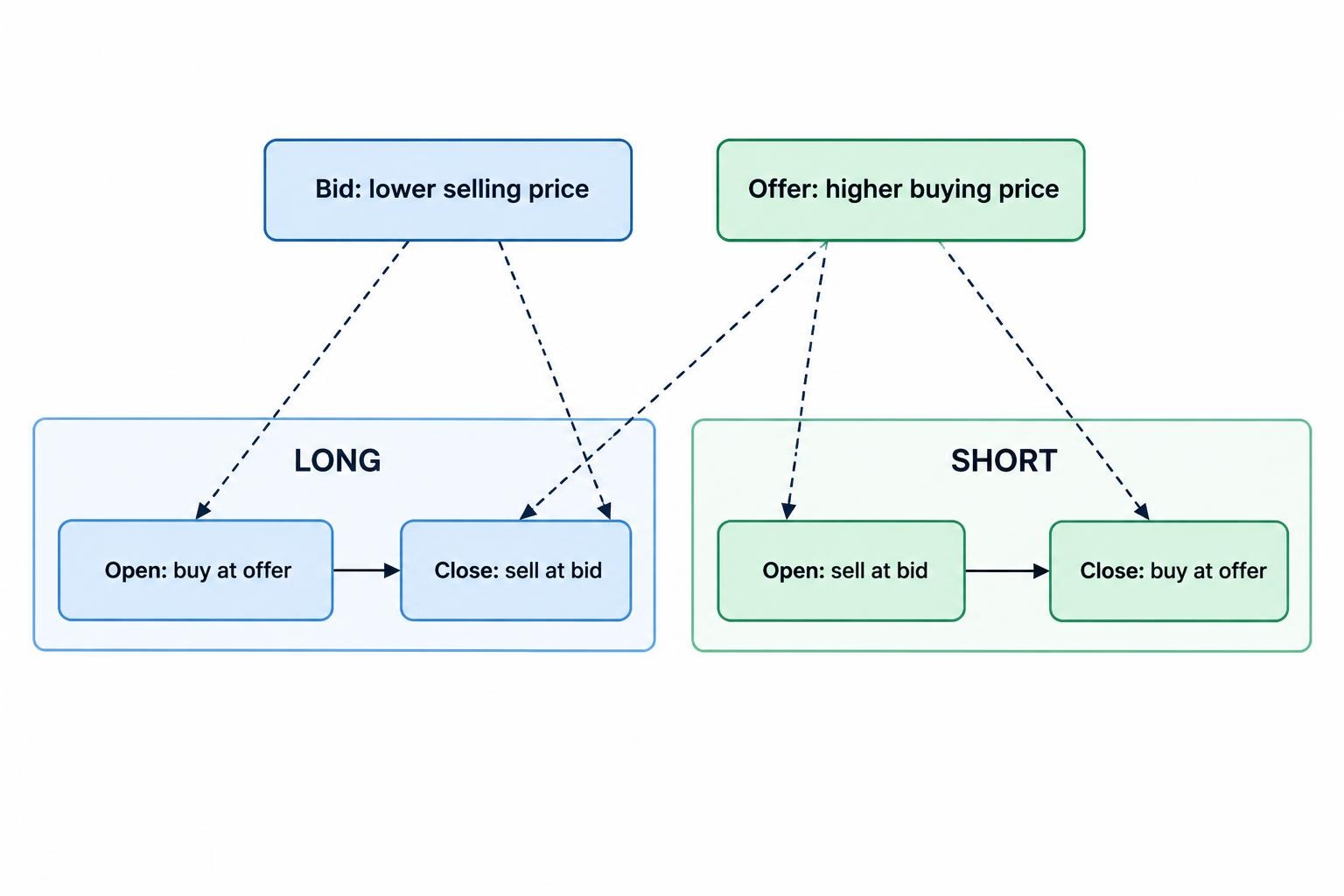
A Dow spread betting quote has two prices: the lower selling price, or bid, and the higher buying price, or offer. You open a long position at the offer and close it at the bid. For a short position, you sell at the bid and later buy back at the offer.
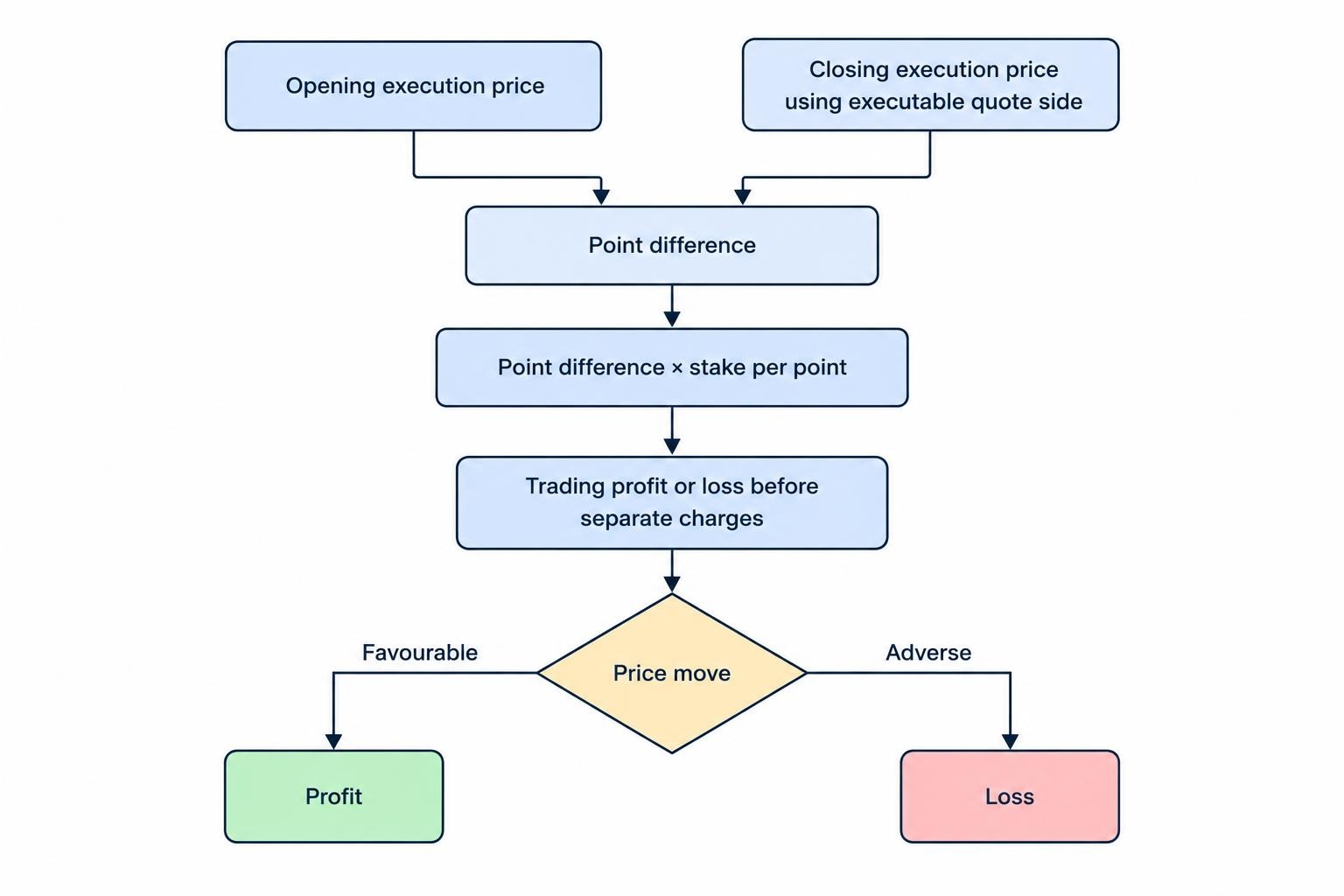
Your stake determines the cash effect of each point. At £1 per point, a 100-point movement between your execution prices produces a £100 profit or loss before separate charges. At £2.50 per point, the same movement produces £250. The stake per point calculation is what connects the chart to your account balance.
Do not confuse a displayed decimal place with a full index point. A move from 42,000.0 to 42,001.0 is one index point, even if the platform displays smaller price increments. Confirm the ticket’s point convention before submitting an order.
Where the contract is denominated in pounds per point, its trading profit or loss is calculated in pounds. You do not automatically convert each result from dollars just because the underlying shares trade in the US. Check the contract currency rather than assuming it from the market name.
A Dow Jones Spread Betting Example
Suppose a provider quotes a hypothetical Dow market at 41,998–42,002. These figures illustrate the calculation; they are not a current market quote.
You expect a rise and buy at 42,002 for £1.50 per point. Two possible outcomes are:
| Outcome | Closing quote | Calculation | Trading result |
|---|---|---|---|
| Market rises | 42,122–42,126 | (42,122 − 42,002) × £1.50 | £180 profit |
| Market falls | 41,902–41,906 | (41,902 − 42,002) × £1.50 | £150 loss |
Both results use the executable closing bid, not the midpoint of the quote. The spread is already reflected in those entry and exit prices, so you should not subtract it again. Financing or other separate charges would still need to be included.
If you immediately closed while the original quote remained unchanged, you would sell at 41,998 after buying at 42,002. That four-point difference would cost £6 at £1.50 per point.
For a short example, sell at the original bid of 41,998. If you later buy back at an offer of 41,898, the 100-point favourable difference produces £150 before separate charges. If the offer rises instead, the short position loses money.
Margin Is Not the Amount You Can Lose
The FCA explicitly includes the Dow Jones Industrial Average in its definition of a major stock market index. That classification matters for UK retail margin requirements.
For covered UK retail accounts, the minimum initial margin for major stock indices is 5% of exposure, equivalent to maximum opening leverage of 20:1. Firms must close positions as soon as market conditions allow when account equity falls below 50% of the required margin. Negative balance protection also restricts liability to funds dedicated to these products in the account. These requirements sit within the FCA rules for retail spread bets and similar investments.
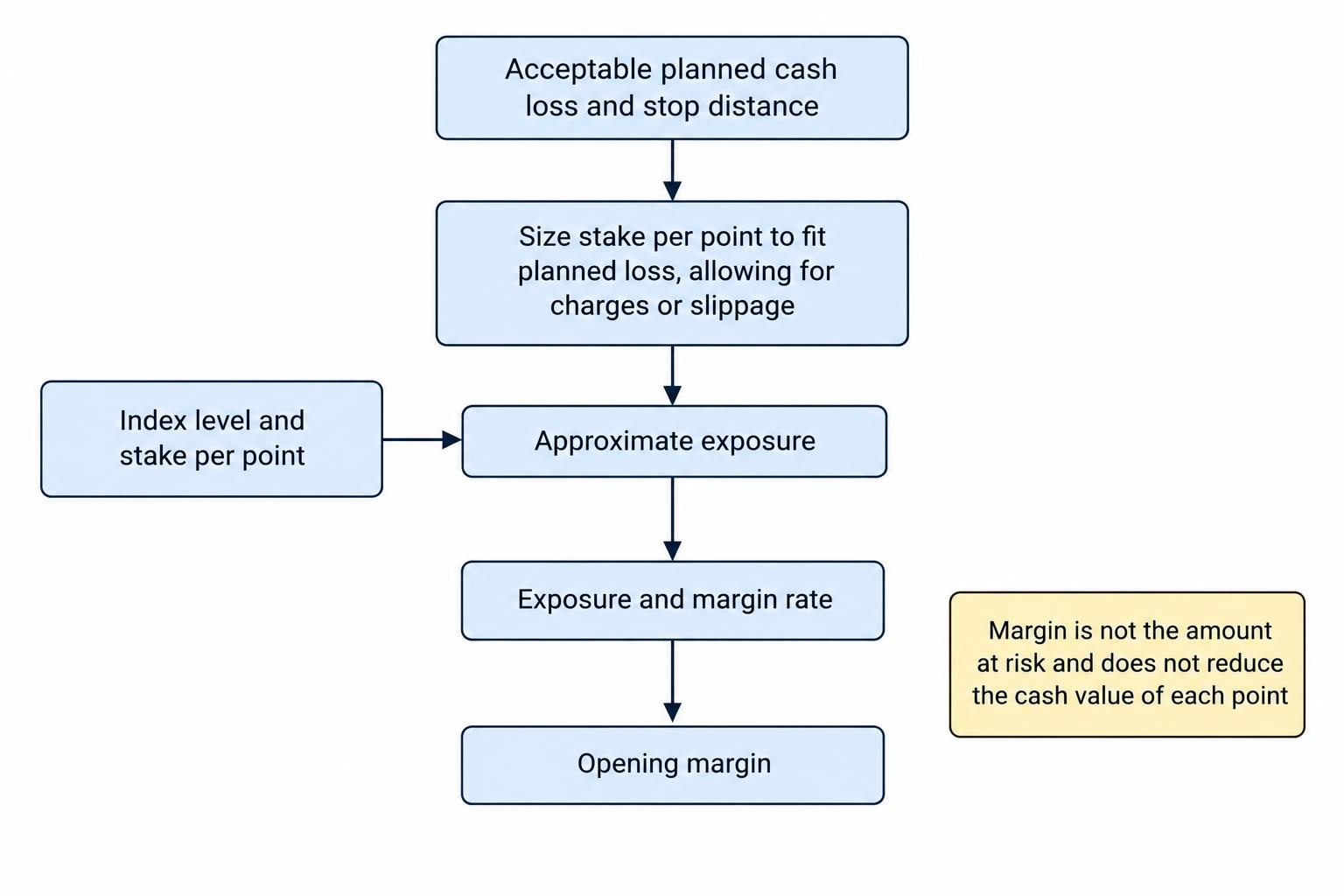
Using a hypothetical index level of 42,000, a £1-per-point position represents approximately £42,000 of exposure. At a 5% margin rate, the opening margin would be £2,100. A 100-point adverse movement would still lose £100 before costs. The margin deposit does not reduce the cash value of each point.
A provider may require more than the regulatory minimum. Keep spare account equity rather than treating every available pound as permission to open another position. Negative balance protection does not protect the money already in the account from trading losses.
Size the trade from an acceptable cash loss and a reasoned exit level. A £75 planned loss divided by a 150-point stop distance gives a stake of £0.50 per point, before allowing for charges or slippage. If the provider’s minimum stake is higher, the trade does not fit that budget. The position sizing guide covers this calculation in more detail.
Dow Trading Hours for UK Spread Bettors
The regular US cash equity session runs from 09:30 to 16:00 Eastern Time, normally 14:30 to 21:00 UK time. US holidays and shortened sessions can alter the schedule, so check the NYSE trading hours and holiday calendar before planning around the opening or closing auction.
The UK conversion is not fixed throughout the year. During the spring and autumn periods when US and UK clock changes do not align, the usual cash session runs from 13:30 to 20:00 UK time. Verify the day’s conversion rather than copying an old calendar entry; the index trading hours guide covers session differences.
Do not confuse cash equity hours with all available Dow-related trading. Exchange-traded Dow futures operate beyond the cash session, including overnight trading, as shown in the CME equity index futures trading specifications.
Your spread betting provider sets its own dealing schedule. Check maintenance breaks, holiday hours, order availability and whether any weekend product is a separate market. A quote outside cash hours is not proof that the constituent shares are all trading normally.
Compare the spread during the session you intend to trade, not just the lowest advertised figure. An overnight setup needs an overnight cost assessment.
Choosing Between Cash and Dated Dow Contracts
Daily funded cash bets
A daily funded Dow bet provides ongoing exposure without choosing a quarterly expiry. Positions held beyond the provider’s funding cut-off can incur financing adjustments. Whether that structure suits a trade depends on its expected holding period, not simply whether the entry spread looks attractive.
For a position intended to close during the same session, focus on the spread, execution and any relevant fees. For a trade that might remain open for several nights, compare the full cost using the daily funded bet versus futures comparison.
Futures and forward bets
A dated contract references a future period and has an expiry or settlement process. Its quoted level can differ from the cash index because pricing reflects factors such as financing and expected dividends. A higher futures quote does not, by itself, mean traders expect an equivalent rise in the cash index.
Dated spread bets commonly price carrying costs into their terms rather than applying the same daily funding structure as cash bets. Check the provider’s documentation for additional charges, settlement prices and rollover treatment. Moving into a later contract is a new transaction, not a free extension.
Costs beyond the opening spread
For cash positions, establish the funding cut-off, calculation basis and treatment of weekends before holding overnight. A daily charge that looks small in isolation can matter across a longer holding period. The overnight financing cost guide explains the calculation.
Also check dividend adjustments, guaranteed stop premiums and execution differences. Cash index products may apply dividend adjustments to account for constituent payments. These are contract adjustments, not dividends from shares you own.
Compare contracts over your intended holding period using the same stake and market movement. Comparing only headline spreads can favour the wrong product.
What Moves the Dow?
Interest rate expectations affect equity valuations and financial conditions. Federal Reserve decisions and communications therefore belong on a Dow trader’s calendar. The relationship includes changes in borrowing costs and the relative attractiveness of shares, rather than a dependable rule that every rate cut lifts the index. The Federal Reserve’s account of monetary policy transmission sets out these channels.
Company earnings, profit guidance and wider economic releases also deserve attention when forming a trade. Because the Dow is price weighted, check the current weights of companies reporting results rather than treating every earnings announcement as equally relevant.
Separate the event from your forecast. A favourable headline can still disappoint expectations, while weak figures can alter expectations for interest rates. Before a scheduled announcement, decide whether your plan allows holding through it, reducing exposure or staying out. Making that choice after the quote starts jumping is harder.
Building a Practical Dow Trading Plan
Use the chart that matches the contract
Mark entry and exit levels on the market you will actually trade. A cash index chart, a dated futures chart and a provider’s continuous chart need not show identical prices. A level copied from the wrong chart can trigger an order earlier or later than intended.
For an opening-range setup, define the range, entry condition and failed-breakout exit before placing the trade. A brief move above a range is not proof that it will continue. The breakout trading guide covers the strategy; the Dow-specific task is matching those rules to your session, contract and dealing spread.
Allow for gaps and stop execution
An ordinary stop order does not guarantee its execution price. If the market moves through the stop level, the exit can occur at a worse price. That matters around announcements, session breaks and weekend reopenings.
Where available, a guaranteed stop can fix the agreed exit level subject to the provider’s terms, premium and minimum distance. Check those terms before relying on it. The distinction between an ordinary stop and risk management with guaranteed stops becomes most relevant when a price gap makes the planned exit unavailable.
Do not widen a stop simply to avoid accepting a loss. If a sound setup needs more room, reduce the stake before entry so the wider distance still fits the cash risk budget.
Measure combined exposure
A long Dow trade alongside long S&P 500 and Nasdaq positions should not automatically be treated as three independent risks. Test what happens to the account if all three move against you together. Different market names do not establish diversification.
Review each position’s planned loss, then consider their combined effect under a shared adverse move. The portfolio correlation guide provides a framework for that assessment. Leave room for execution differences as well as the losses calculated at your intended stop levels.
What to Check Before Placing a Dow Spread Bet
Choose the contract on its dealing terms, not the familiarity of its name. A useful review should answer four questions:
- What exactly am I trading? Confirm the underlying reference, cash or dated structure, point convention, stake currency and any expiry.
- What will it cost during my trading hours? Check the live spread, holding charges and any stop premium rather than relying on an advertised minimum.
- How will my orders behave? Establish whether stops trigger from the bid or offer, which orders operate outside cash hours and what happens during market closures.
- Does the trade fit my account? Check minimum stakes, opening margin, spare equity and the planned cash loss before submitting the order.
When assessing index spread betting providers, use the same proposed Dow trade to compare their terms. This makes differences in stake sizes, spreads, funding and order features easier to evaluate.
A demo account can help you practise selecting the correct contract, entering a stake and attaching an exit order. It cannot establish how a live order will fill during a fast move, so do not treat a smooth demonstration as an execution guarantee.
The final decision is whether the available contract fits the trade. If its minimum stake makes the planned loss too large, its funding makes the holding period uneconomic, or its dealing hours conflict with your exit plan, leave it alone. The Dow does not become a better trade because the order ticket is already open.