Cryptocurrency spread betting remains unavailable to retail clients under the UK’s cryptoasset derivative ban. As at 21 October 2026, firms covered by the restriction must not sell, distribute or market these products to retail clients in or from the UK. The operative prohibition sits in FCA Handbook rule COBS 22.6.
That does not mean every form of cryptocurrency exposure is prohibited. Buying crypto directly, purchasing an eligible crypto exchange traded note and placing a spread bet are different transactions. Headlines about wider retail access to crypto investments should not be read as permission to open a Bitcoin spread bet.
What the UK crypto spread betting ban covers
A cryptocurrency spread bet is a contract based on price movements, rather than a purchase of coins. You choose a stake per point and take a long or short position. Your financial exposure comes from the contract with the provider, not ownership of cryptocurrency in a wallet.
The restriction covers derivatives referencing the cryptoassets within its scope, including Bitcoin and Ether. Changing the settlement currency to pounds, describing the trade as a hedge or offering a smaller stake does not change what the contract references.
Start with the product’s legal description, not the name on its trading screen. A platform’s “crypto” tab might contain direct purchases, derivatives or securities. Those labels are not interchangeable.
The distinction also works in the other direction: a restriction on cryptocurrency derivatives is not a blanket ban on financial spread betting. The broader framework for other markets is covered in our guide to UK spread betting regulation.
When the ban began, and why
The ban took effect on 6 January 2021. Its policy basis included concerns about unreliable valuation, extreme price volatility, market abuse and financial crime affecting the underlying markets. The FCA also rejected a general retail hedging exemption. These decisions appear in the FCA’s final policy statement on crypto investment products.
The concern was not simply that a trader might choose the wrong direction. A derivative can transmit problems in its reference market into the trading account, even though the trader never holds the underlying asset.
Avoiding wallet management therefore answers only one question: who holds the coins? It does not answer whether the contract is suitable, how its price is formed or what happens during a sharp market disruption.
The original policy allowed existing retail holdings to remain until investors chose to exit; it did not require compulsory closure. That historical treatment should not be mistaken for permission to open a new position.
What changed for crypto exchange traded notes in 2025?
On 8 October 2025, the UK reopened retail access to certain crypto exchange traded notes, or cETNs, traded on a UK Recognised Investment Exchange. This was a change for eligible securities, not a reversal of the derivative ban. The FCA announcement opening retail access to crypto ETNs expressly retained the restriction on retail cryptoasset derivatives.
| Product | What the transaction provides | Relationship to the restriction |
|---|---|---|
| Crypto spread bet or CFD | A derivative position based on price movements | Within the retail derivative prohibition where the reference cryptoasset is covered |
| Direct spot crypto purchase | A purchase of the cryptoasset itself | Not prohibited by this derivative ban; separate requirements apply |
| Eligible UK traded crypto ETN | A security providing crypto linked exposure | Retail access permitted subject to the applicable product and distribution requirements |
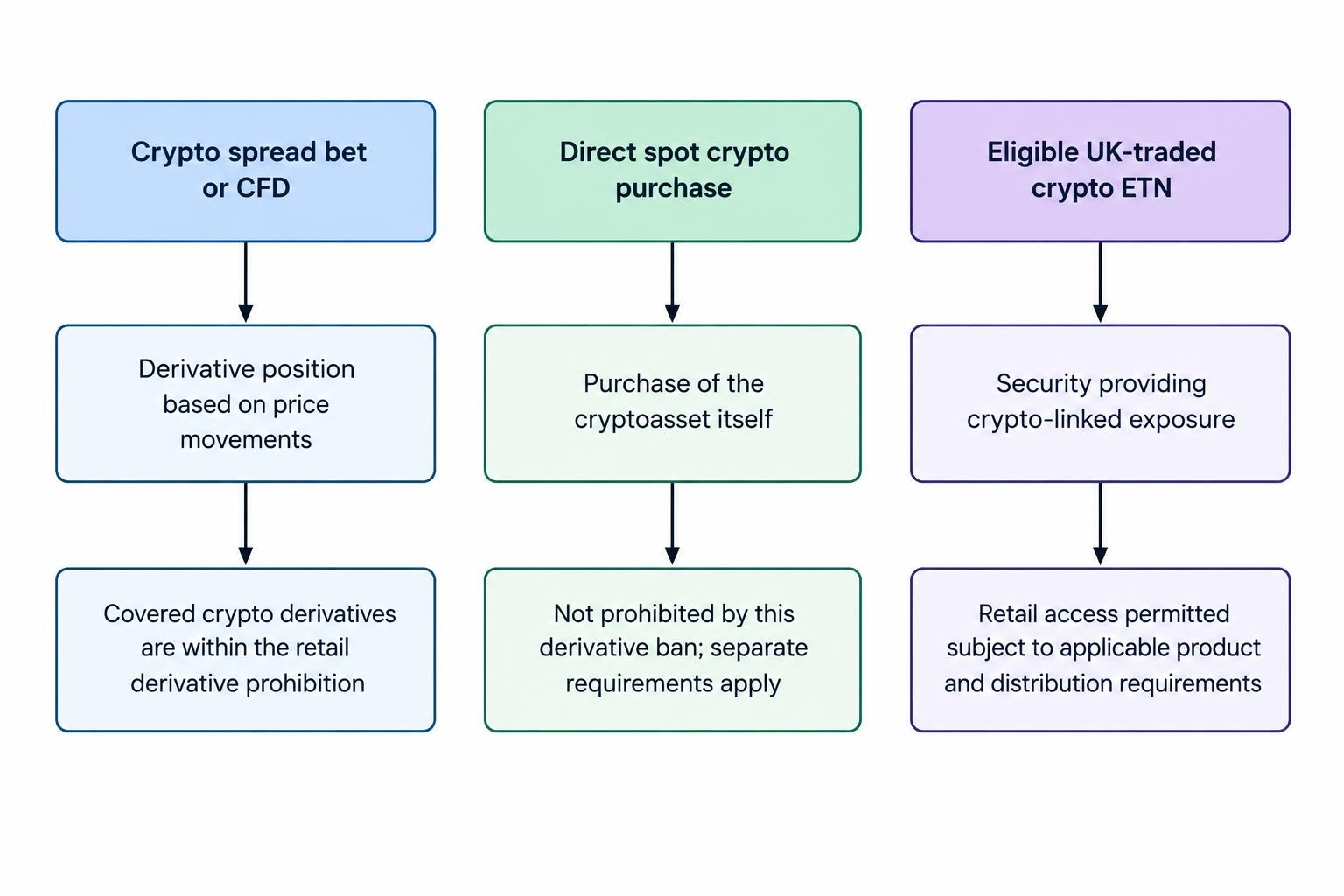
The change did not make cETNs risk free. The FCA stated that the Consumer Duty applies to firms offering them to retail investors, but that FSCS coverage would not apply.
For a prospective buyer, the practical task is to identify the exact security and read its documents. Check what drives its return, what charges apply and when it can be traded. Do not assume that an exchange listing makes a product equivalent to holding coins, or that all crypto linked products now have the same retail access rules.
Small stakes and lower borrowing do not create an exemption
The restriction is a product prohibition, not just a maximum borrowing ratio. An offer of a covered crypto derivative does not become permissible for a retail client simply because the provider asks for a larger deposit.
Keep two questions separate: may the firm offer this product to this client? And, if it may, what margin and trading conditions apply? Our guide to spread betting leverage limits covers the second question for products that can lawfully be offered.
Nor should you treat a low minimum stake as proof of low financial exposure. The stake must be read alongside the contract’s point definition and the possible distance of a price move. A small number beside “£ per point” tells you very little on its own.
Risk controls also come after the access question. Comparing stop distances, deposit requirements and financing charges is premature if the firm cannot properly explain why it is offering the contract to you.
Can professional clients access crypto spread betting?
The retail prohibition is not a blanket prohibition on professional business. However, professional classification is a formal client category, not a subscription upgrade.
Under FCA rules for elective professional clients, the firm must assess the client’s expertise, experience and knowledge. Where the MiFID quantitative test applies, at least two of these conditions must also be met:
- Transactions of substantial size on the relevant market at an average frequency of 10 per quarter over the previous four quarters.
- A financial instrument portfolio, including cash deposits and financial instruments, exceeding €500,000.
- At least one year working in the financial sector in a professional position requiring knowledge of the intended transactions or services.
The process also requires a written request, a clear warning about protections and compensation rights that may be lost, and a separate written acknowledgement of those consequences.
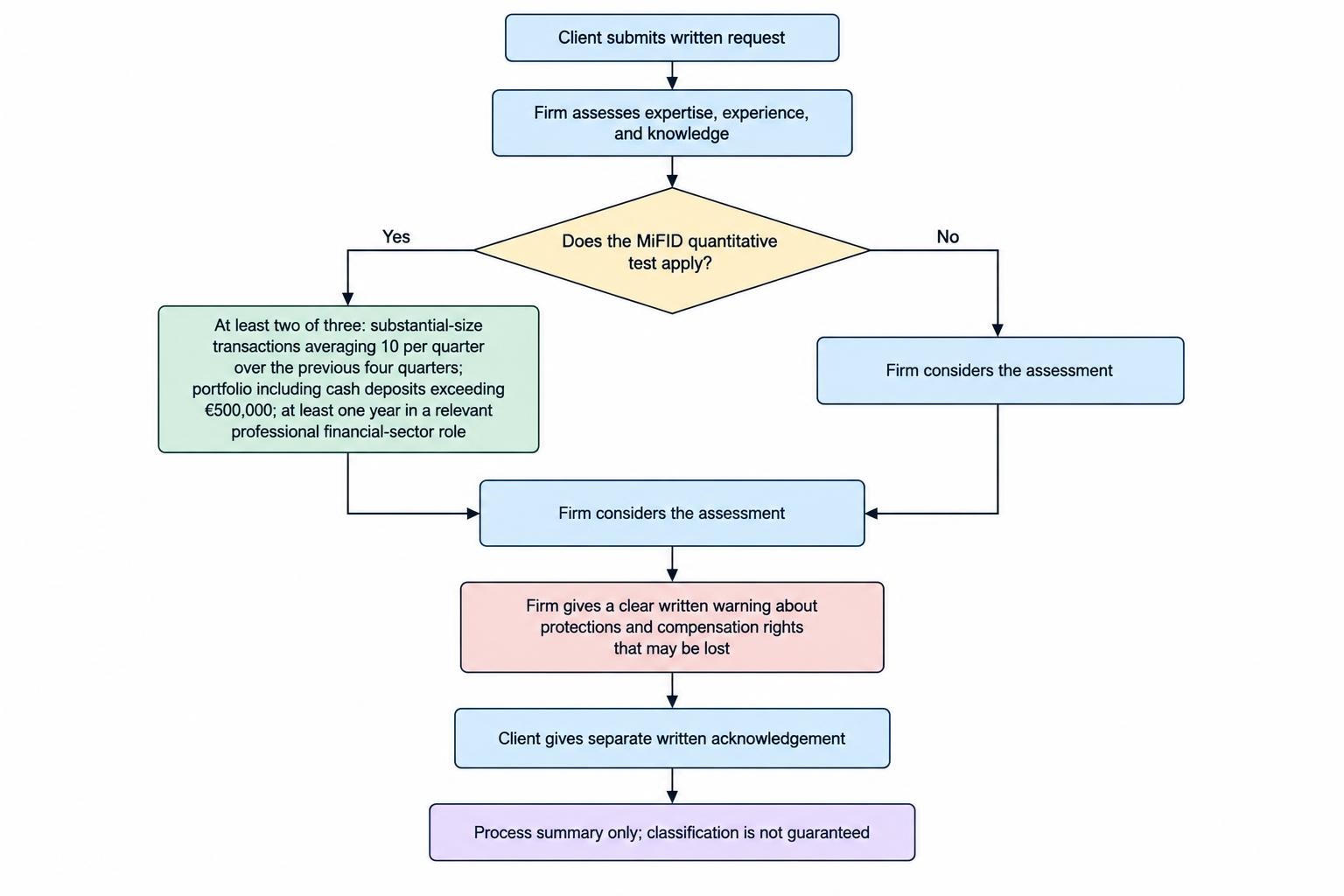
Meeting a wealth threshold alone is therefore not enough. Nor does classification guarantee that a provider will offer cryptocurrency contracts.
Before requesting a change, read the consequences of retail versus professional client classification. Ask the firm to identify the services covered by the classification and explain the account terms in writing. Do not make extra trades simply to build a transaction count: that turns an eligibility question into a reason to take unnecessary risk.
Offshore access is not evidence of UK compliance
An overseas platform may display cryptocurrency derivatives or allow a UK address through its registration process. Neither observation establishes that its offer complies with the requirements applicable to it.
Read the customer agreement before considering the trading conditions. Identify the company that would hold your account, the country in which it operates and the regulator responsible for that entity. A familiar group name is not enough.
Our guide to offshore spread betting brokers examines these entity and jurisdiction questions in more detail.
Be particularly cautious if a sales representative suggests moving to another group company solely to obtain crypto access. Ask for a written explanation of the proposed arrangement rather than relying on a chat message saying that “everyone does it”. That is not a regulatory analysis.
Do not falsify your residence or misstate your experience to pass account checks. Apart from the underlying compliance concerns, inaccurate application details can leave you arguing about your own declarations if a dispute later arises.
For an unusual cross-border arrangement, obtain qualified advice before funding the account. An accessible order ticket is evidence that software works, not that the legal position has been resolved.
“FCA registered” does not mean authorised for every product
Cryptoasset registration under the money laundering regulations has a different purpose from authorisation to conduct regulated investment business. Registration alone does not mean customers receive Financial Ombudsman Service or FSCS protection. The distinction is set out in the FCA’s cryptoasset registration and consumer protection guidance.
When reviewing a firm, check the exact legal name and the activities shown against it. Do not stop at finding a matching brand or firm reference number. Our guide to checking a broker on the FCA Register sets out the process.
Also distinguish the service you are considering from other services the same business provides. A firm’s status for one activity should not be treated as an answer about every product available through its app.
Ask three separate questions: who is contracting with you, what permission supports the service, and what complaint or compensation arrangements apply? Request the answers before depositing money, not after a withdrawal problem.
For a permitted spread betting account, assess FSCS protection and its boundaries separately. Do not treat a compensation scheme as a promise that an investment cannot lose value.
A hypothetical example: why the point definition matters
Consider a hypothetical cryptocurrency spread bet offered to an eligible professional client. This is an illustration of exposure, not a recommendation or a statement that any provider offers these terms.
Suppose the contract defines one point as a $1 movement in the reference price. At £0.50 per point, a 2,000 point adverse move produces a £1,000 trading loss before spreads, financing and other charges. At £2 per point, the same move produces a £4,000 loss.
The calculation is straightforward: price movement in points multiplied by stake per point. The potential mistake is concentrating on the stake while overlooking how many points the price could move.
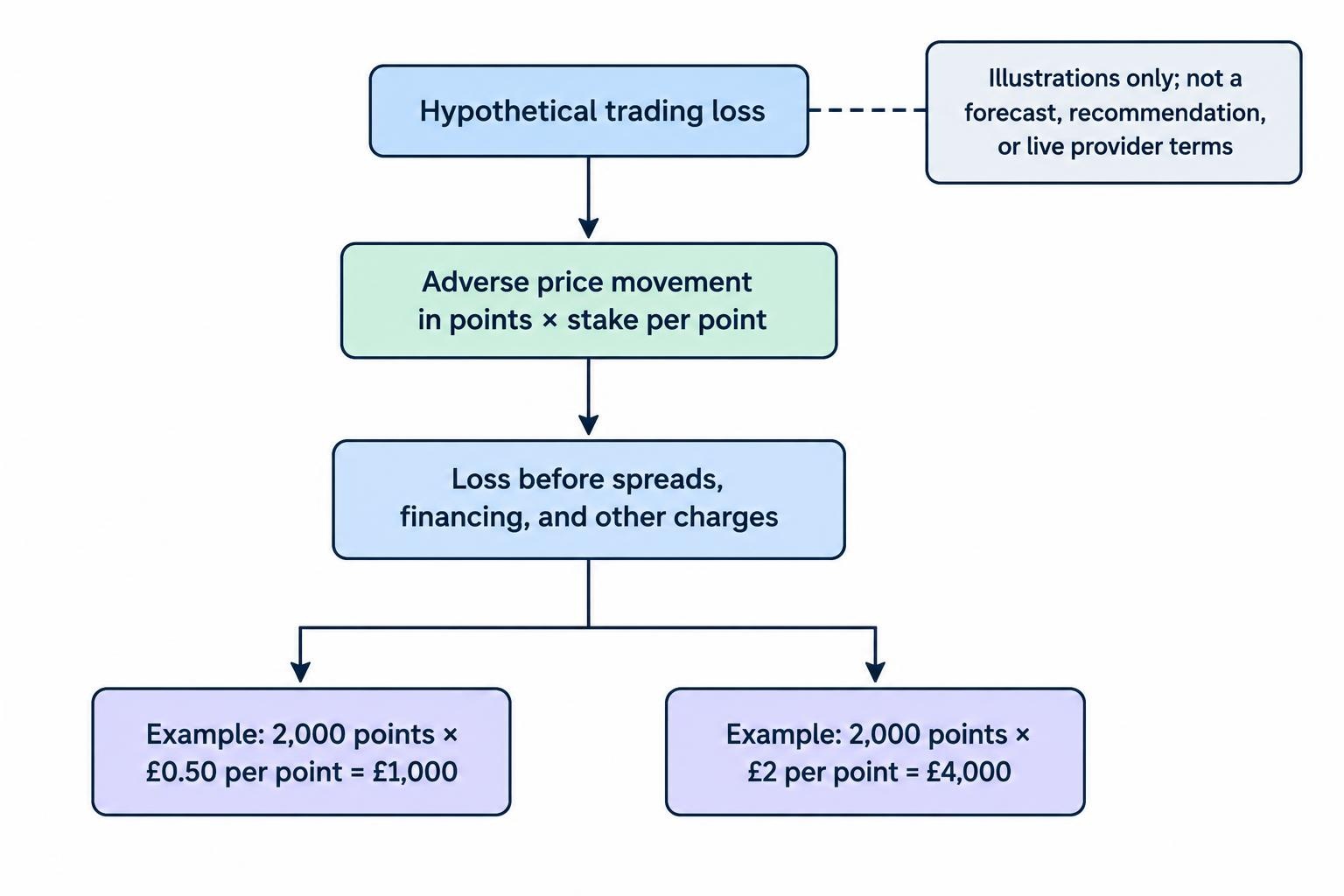
Any assessment of a permitted position should begin with the cash consequences of an adverse move. The guide to position sizing for spread betting develops that calculation without confusing the deposit required to open a trade with its financial exposure.
Then examine the contract’s pricing, execution and closure terms. A favourable eligibility decision does not answer those trading questions.
How to assess a cryptocurrency trading offer
Before transferring money, obtain enough documentation to describe the proposed transaction in plain English. You should be able to identify the product, the contracting company, your client category and the arrangements that would apply if something went wrong.
If the product is presented as an ETN, request the security identifier and product documents. If it is a spread bet or CFD, ask why the firm considers you eligible. If the answer rests on professional classification, check the written classification notice rather than a marketing description.
Pause if the explanation keeps changing. “You own crypto”, “you trade its price” and “you buy a listed security” describe different arrangements. A provider should not switch between them to answer whichever question you ask.
Guaranteed returns, pressure to deposit immediately and requests to misstate your status are reasons to stop and investigate. Our guide to spread betting scams covers checks to make before sending funds.
The practical rule is to verify the contract before comparing its advertised benefits. For a UK retail client, access to an eligible crypto ETN should not be confused with access to cryptocurrency spread betting. The product category, client classification and contracting entity must all be checked on their own terms.