Scalping is a financial spread betting approach that seeks small price movements through trades typically lasting seconds or minutes. The trader opens a position, looks for a narrowly defined opportunity and closes it quickly, sometimes repeating the process during a trading session. Profit or loss depends on the movement between the actual opening and closing prices, multiplied by the stake per point, with any separate charges included. The short holding period does not make the approach low risk. Small targets give spreads, slippage and execution mistakes considerable influence over results. This guide explains how scalping works, who it may suit, its advantages and disadvantages, and how to assess a method through practical examples. All figures are hypothetical and are not performance forecasts.
What is scalping in financial spread betting?
A scalper tries to capture a small part of a market movement rather than hold a position through a longer trend. A trade might follow a brief pullback, a move beyond a nearby price level or a return towards the middle of an established range. There is no universal time limit or required number of trades that defines scalping. What distinguishes it is the relationship between a small intended price move, a short decision window and frequent attention to execution. It is one approach within financial spread betting strategies, not a complete trading system by itself. A usable system still needs rules for market selection, entry, exit, position size, acceptable costs and the conditions in which trading stops.
Financial spread betting provides the mechanism for expressing that view without buying the underlying asset. A trader can buy to speculate on a rise or sell to speculate on a fall, with gains and losses calculated in money per point. The FCA includes financial spread bets within its supervision of contracts for difference and related products, which it describes as high risk. Scalping does not change the underlying product or remove its exposure to rapid losses. It also does not turn a retail spread betting account into an exchange market-making operation. A trader using the provider’s buy and sell quotes normally has to overcome the spread before a favourable market move produces a profit.
Scalping versus day trading and swing trading
Scalping is generally a form of day trading, but day trading covers a much wider range of holding periods and targets. A day trader may take one position based on a morning trend and close it hours later. A scalper might trade several brief movements within that same trend, accepting repeated entry costs in exchange for shorter exposure on each position. Swing trading usually involves holding through several sessions and sometimes longer. These differences change the demands on the trader, not just the chart interval. Scalping puts more weight on immediate execution and concentration, while swing trading requires more attention to overnight events, financing and price gaps between sessions. None of these approaches has an automatic profitability advantage.
| Feature | Scalping | Broader day trading | Swing trading |
|---|---|---|---|
| Typical holding period | Seconds to minutes | Minutes to hours | Several sessions to weeks |
| Intended price movement | Usually small | Often a larger intraday move | Often a move across several sessions |
| Trading frequency | Can be high; no required quota | Often fewer entries | Usually fewer entries over the same period |
| Monitoring requirement | Close attention during positions | Active attention during the session | Planned reviews and event monitoring |
| Main cost concern | Spread and execution relative to small targets | Spread, execution and turnover | Spread, financing and holding duration |
| Overnight exposure | Normally avoided by design | Normally avoided by design | Commonly accepted within the plan |
| Common failure | Costs consume a small apparent edge | Intraday losses exceed the plan | Gaps or holding costs undermine the trade |
How a scalping spread bet works
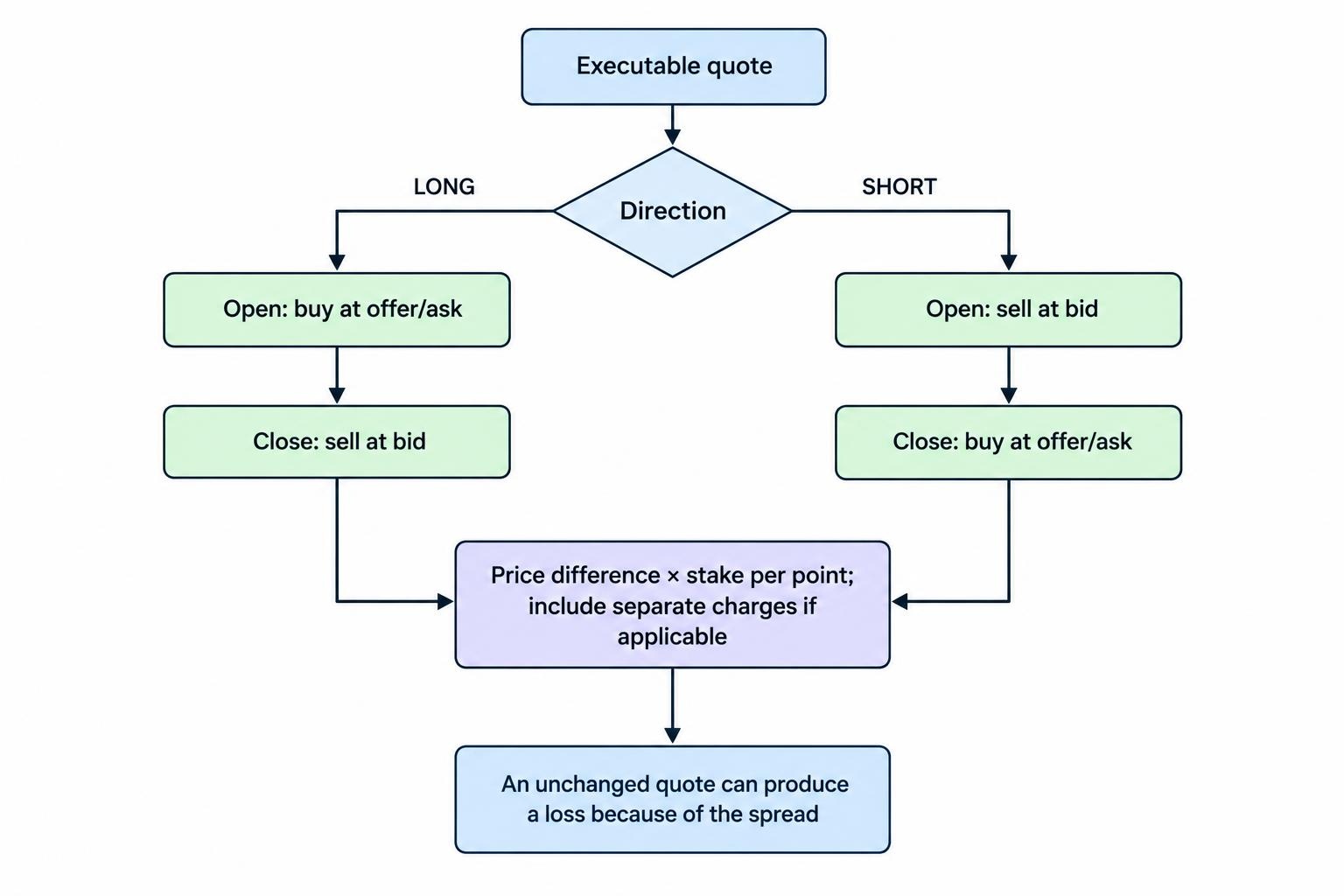
The provider displays a sell price, also called the bid, and a buy price, also called the offer or ask. Suppose an index is quoted at 8,000.0/8,001.0 and the stake is £2 per index point. Buying opens the position at 8,001.0; selling it immediately at the unchanged bid of 8,000.0 would lose £2. To make money, the closing sell price must rise above the opening buy price by enough to cover any additional charges. For a short position, the opening transaction uses the bid and the closing purchase uses the offer. These prices matter more than a chart’s appearance. A midpoint chart can suggest that a target was reached even though the executable price needed to close the position never traded there.
Before placing a trade, establish exactly what the ticket calls a point. An index point, a penny in a share and a pip in a currency pair are different units. Decimal places on the screen can also differ from the unit used to calculate the stake. On some forex tickets a point corresponds to a conventional pip; on others the display needs more careful interpretation. Use the contract specification and the platform’s monetary profit and loss preview rather than guessing. A tenfold sizing error can arise from confusing a pip with a fractional pip. Scalping also requires checking minimum stake sizes and permitted stop distances, because a method that needs a very small stake or very close stop may not fit the available contract.
Who might scalping suit?
Scalping may suit someone who can set aside uninterrupted trading periods, process changing quotes calmly and follow exit rules without negotiating with themselves. The useful skill is consistent decision-making under time pressure, not enthusiasm for pressing buttons. A trader must be comfortable rejecting a setup when the spread widens or the price moves before the order can be placed. They also need enough concentration to recognise order errors, unexpected exposure and changes in market conditions. A practical session might involve watching one market for a defined period and taking no trades if the entry rules are absent. This is a more realistic starting point than assuming that a scalper must produce a steady stream of transactions every morning.
The approach is a poor fit for someone who can only check a phone between other commitments, depends on trading profits to meet immediate bills or struggles to accept several small losses without increasing the stake. Beginners face the added challenge of learning order mechanics while prices are moving quickly. Short trades can feel more manageable than longer positions, but that impression can encourage too much exposure. A person who prefers time to review evidence may find a slower approach easier to assess. There is also a practical opportunity cost: a small positive result after a demanding session may offer little compensation for the time and attention involved. Suitability depends on both trading behaviour and the results after all costs.
Advantages and disadvantages of spread betting scalping
Scalping gives a trader a defined period of market participation and frequent opportunities to observe how a narrowly specified setup behaves. Positions are normally closed during the session, reducing planned exposure to overnight announcements and weekend gaps. When a daily funded contract is closed before the applicable funding cut-off, an overnight financing charge will generally not arise for that position, subject to the product terms. The approach also permits trading in either direction without needing to own the underlying asset. These features can make the process easier to organise around a short trading window. They do not establish that the strategy has an edge, and being flat overnight says nothing about how much could be lost during the session itself.
The disadvantages follow directly from the small intended gains. A slightly wider spread, a late entry or an exit filled beyond the expected price can consume several successful trades. Repeated decisions create room for fatigue, accidental orders and attempts to recover losses through increased stakes. High turnover repeatedly exposes the account to transaction costs, even when individual positions are brief. There is also a temptation to take profits quickly while allowing one losing position to become much larger than planned. That pattern can produce an attractive win rate alongside a falling account balance. Scalping therefore demands assessment of the size and distribution of results, including unusual losses, rather than judging the strategy by how often the screen turns green.
Which markets can be used for scalping?
Market selection should begin with executable prices during the intended trading session. Major currency pairs and widely followed stock indices are common subjects for scalping analysis, but their names alone do not establish suitability. Compare the quoted spread with the size of the movement the strategy tries to capture, then examine price continuity, trading hours and the behaviour around announcements. Gold, oil and individual shares can also move quickly, although the combination of spreads, jumps and contract units may make a narrow target impractical. A market that looks active on a chart may still be expensive to trade through a particular spread betting contract. Begin with one instrument whose pricing and order rules can be documented clearly.
Time of day matters because underlying market activity and the provider’s quote can change throughout the session. A cash index opening, an economic release or a company announcement may create movement while also making entry and exit less predictable. The busiest period is not automatically the best period for a small target. Record the spread and execution conditions during the hours you actually intend to trade instead of relying on an advertised minimum. Check the current exchange or product calendar, relevant time zones and daylight-saving changes when scheduling sessions. A provider may offer prices while the underlying cash market is closed, but those prices need not behave like quotes during the main session. The same setup can have very different economics at different times.
Why the spread matters so much for scalping
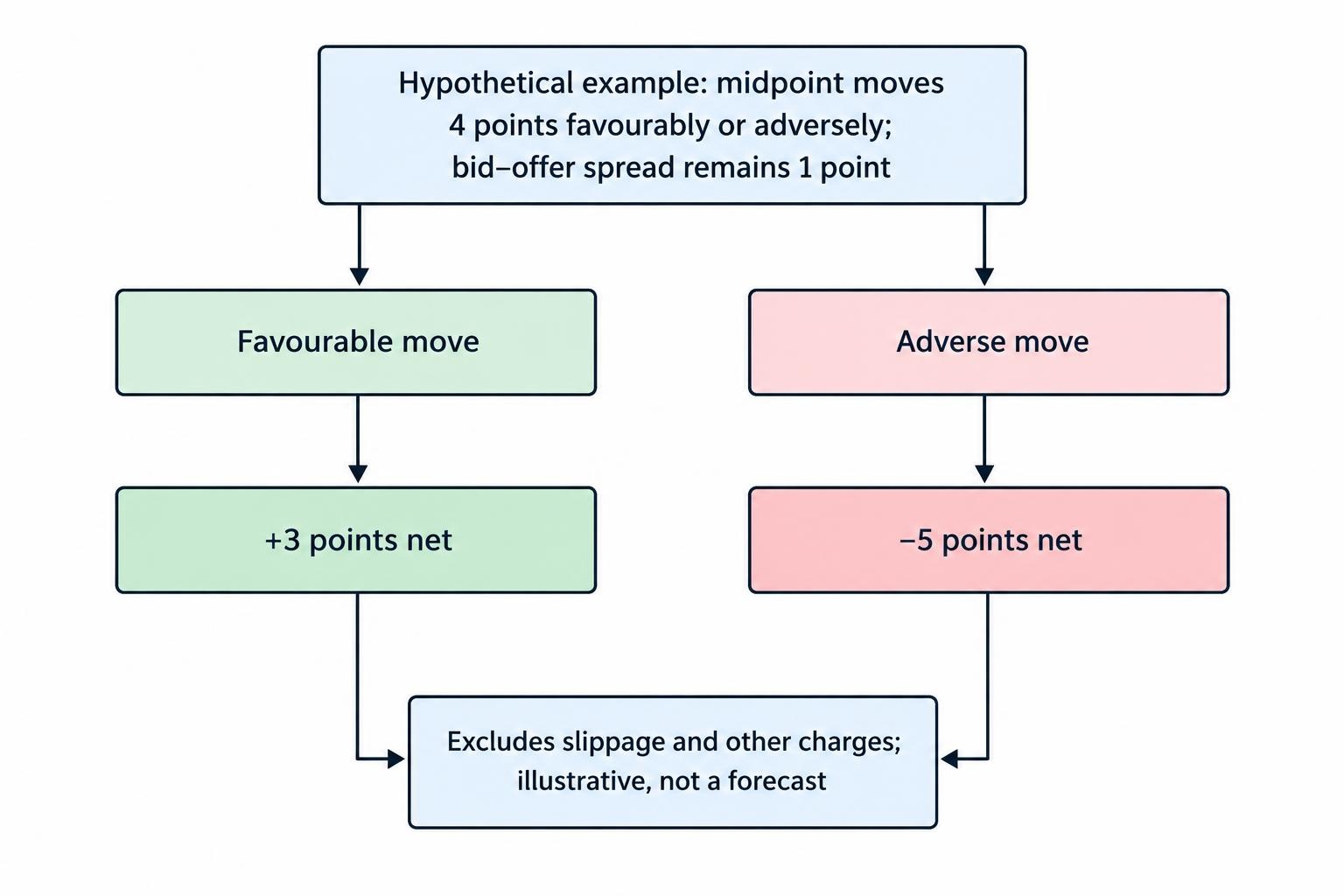
Consider a strategy that aims to capture a four-point move in the market’s midpoint and also accepts a four-point adverse midpoint move. Assume an unchanged one-point bid–offer spread, immediate fills and no other charges. A successful long trade captures only three points between its actual buy and sell prices, while an unsuccessful one loses five points. The spread has reduced the winner and increased the loser relative to the midpoint model. At £1 per point, 36 winners and 24 losers would produce £108 minus £120: a £12 loss despite a 60% win rate. This is an illustration of trading costs, not a forecast. If targets and stops are already measured from executable entry and exit prices, do not subtract the spread again.
| Constant quoted spread | Net winner from a four-point favourable midpoint move | Net loser from a four-point adverse midpoint move | Break-even win rate before other costs |
|---|---|---|---|
| 0 points, theoretical reference | +4 points | −4 points | 50% |
| 0.5 points | +3.5 points | −4.5 points | 56.25% |
| 1 point | +3 points | −5 points | 62.5% |
| 2 points | +2 points | −6 points | 75% |
The table assumes the same spread at entry and exit and ignores slippage, separate fees and missed trades. Real results will vary. Under these assumptions, break-even win rate equals the average loss divided by the sum of the average win and average loss, using positive amounts for both. A bigger target can reduce the spread’s relative burden, but it also changes the trade and may reduce how often the target is reached. Increasing the stake changes the money at risk without improving the underlying expectancy. The FCA’s review of CFD providers’ price and value examines spreads, commissions and funding charges across products including spread bets. Its findings support looking beyond the headline spread when assessing the total price of trading.
Execution, slippage and order types
A displayed price is not a promise that every order will execute at that price. During the interval between observing a quote, submitting an instruction and receiving confirmation, the market may move. Slippage is the difference between the expected execution price and the actual fill; it can be favourable or adverse. For scalping, even a small difference matters because the intended profit is small. Market orders prioritise seeking an immediate fill, while limit orders specify an acceptable price but may remain unfilled. An unfilled order is not a free alternative to an unfavourable execution: the winning opportunity may pass without participation. Read the provider’s execution policy and establish how orders are handled when prices move, trading pauses or a quote becomes unavailable.
An ordinary stop-loss does not guarantee an exact exit price during a rapid move or price gap. A stop-limit order adds a price restriction, which can leave the position open if execution within that restriction is unavailable. A guaranteed stop, where offered, can provide a contractual exit level under its terms, but premiums and minimum distances may make it unsuitable for a very narrow scalping setup. Check whether stops are triggered by the bid, offer or another reference and whether chart settings display that same reference. Also check how linked exit orders are cancelled after one fills. A protective order left active after a manual close could create unintended exposure depending on the platform’s order arrangements. Practise those mechanics before relying on them.
Practical example: a long index scalp
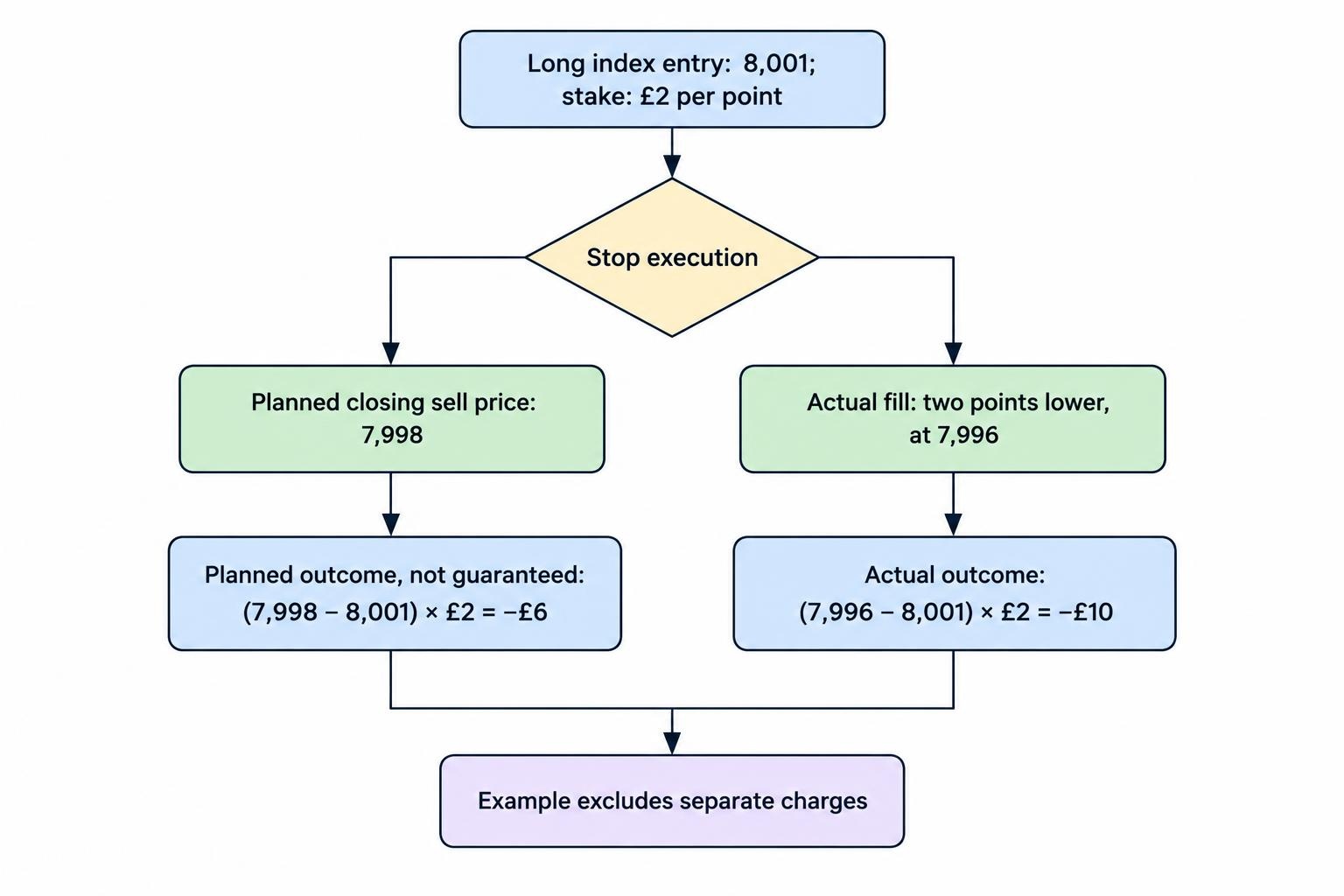
Suppose a hypothetical index is quoted at 8,000.0/8,001.0 after a brief pullback within an intraday rise. A trader buys at 8,001.0 for £2 per point, planning to sell at 8,005.0 for a four-point gain. The intended stop exit is 7,998.0, three points below the actual entry, giving a planned price loss of £6. If the market reaches 8,005.0/8,006.0 and the closing sale fills at 8,005.0, the gain is £8. If an ordinary stop fills at 7,998.0, the loss is £6. These calculations already use the correct buy and sell prices, so the spread is included. They assume the contract permits these order distances and that no separate fees apply.
| Alternative outcome | Actual closing sell price | Calculation at £2 per point | Profit or loss before separate charges |
|---|---|---|---|
| Immediate close at unchanged quote | 8,000.0 | (8,000 − 8,001) × £2 | −£2 |
| Target reached and filled | 8,005.0 | (8,005 − 8,001) × £2 | +£8 |
| Stop filled as planned | 7,998.0 | (7,998 − 8,001) × £2 | −£6 |
| Stop slips two points lower | 7,996.0 | (7,996 − 8,001) × £2 | −£10 |
The slipped exit shows why a planned £6 loss is not a guaranteed maximum. It also shows how misleading it would be to describe the trade solely as having an £8 target. With ideal £8 winners and £6 losers, the break-even win rate is approximately 42.9% before separate costs. If actual losses average £10 because of poor execution or delayed exits, while winners still average £8, the threshold rises to approximately 55.6%. Actual results need not follow either simplified distribution. A journal should record the entry, intended stop, fill and reason for any difference, allowing the trader to distinguish a weak setup from an execution problem. Both can make the method unprofitable, but they require different changes.
Practical example: a short forex scalp
Suppose EUR/USD is quoted at 1.0850/1.0851 and the hypothetical contract defines one point as one pip, or 0.0001. A trader sells at 1.0850 for £2 per pip after a failed attempt to move higher. The planned exit is a purchase at 1.0847, giving a three-pip gain, while a stop purchase at 1.0853 would create a three-pip loss. If the quote falls to 1.0846/1.0847 and the trader closes at the offer of 1.0847, the result is £6 before any separate charges. Buying back at 1.0853 instead loses £6. A bid chart touching 1.0847 would not itself establish that the profitable exit was available, because the offer used to close the short could still be higher.
Scalping methods traders can investigate
Trading a pullback within an intraday trend
A pullback method starts by defining an intraday direction, then waits for a temporary move against it before considering an entry. The definition might combine price structure on a broader chart with a trigger on a shorter chart, rather than relying on a moving average crossing alone. A long setup could require rising swing lows, a controlled retreat and a renewed move above a nearby short-term level. The stop belongs where the premise fails, and the target must leave enough room after the spread. The main risk is mistaking the start of a reversal for a temporary pause. Trend trading principles can help frame the idea, but the scalping version needs separate testing at its intended holding period and cost level.
Trading a short-term breakout
A breakout scalp attempts to capture a quick continuation after price moves outside a defined intraday boundary. A usable rule identifies the boundary before the move, states what confirms the break and sets a maximum acceptable spread and entry distance. Without those limits, the trader may repeatedly enter after most of the intended movement has already happened. False breaks are a central risk: price can briefly clear a level, trigger entries and reverse. A stop-entry order can help apply a rule consistently, but its execution may differ from the trigger price. The related breakout trading guide covers the broader concept; for scalping, assess whether the remaining movement after actual entry can reasonably cover costs and the planned losing trades.
Trading a range or brief mean reversion
A range method looks for movement back from a boundary while the market remains contained. A scalper might consider buying near the lower part of a pre-defined range after evidence of rejection, with an exit before the opposite boundary. The trade depends on the range continuing, so the stop must address a genuine break rather than assume price will always return. Mean reversion is related but broader: it concerns movement back towards a chosen reference, not necessarily a visible horizontal range. An overbought or oversold indicator reading alone does not establish that such a return is imminent. During a strong trend, repeated attempts to trade against the move can accumulate losses much faster than the trader expected.
Charts and indicators for scalping
One-minute charts are a common starting point for examining brief moves, but they are not inherently superior to tick charts or other short intervals. A broader chart can provide context while the shorter chart defines the entry. Moving averages may describe direction, RSI may describe recent price momentum, and ATR may help compare recent movement with the proposed stop distance. These tools organise observations; none makes a small target more achievable by itself. Changing settings until historical trades look attractive can create an illusion of precision. Use the technical analysis guide to understand what an indicator measures, then state its role in the trading rule clearly. Several indicators calculated from the same prices should not be treated as independent confirmation of success.
Volume and order-book information need particular care. A volume display might represent activity on an underlying exchange, tick changes from a quote feed or activity from a narrower source. Those are different measurements. Retail spot forex does not have a single consolidated exchange order book, and a futures order book is not the same thing as the executable quote on a spread betting account. Check the data source, contract, timestamp and any delay before using it to justify an immediate trade. A strategy presented as reading order flow may depend on data or execution access that the spread betting product does not provide. Copying its chart layout without those conditions can produce a materially different strategy with materially different costs.
Position sizing, margin and session loss limits
Choose the stake from the acceptable trade risk and a defensible stop distance, rather than deciding how much money a small move should earn. As an illustration, suppose a trader assigns £10 to planned price risk and the stop is five points from the actual entry. Dividing £10 by five gives £2 per point, before allowing for separate charges and the possibility of slippage. This is arithmetic, not a recommended risk budget. A tighter stop should not be used simply to justify a larger stake; ordinary price fluctuations may then close the position repeatedly. The position sizing guide develops the calculation further. If the minimum permitted stake creates more exposure than the plan allows, the contract does not fit that plan.
Margin is separate from this planned loss. Under FCA retail rules in COBS 22.5, minimum initial margin includes 5% for major stock indices and 3.33% for major currency pairs; firms can require more. At an index level of 8,001 and £2 per whole index point, the approximate exposure is £16,002, so an assumed 5% margin requirement is £800.10. Neither that deposit requirement nor the short holding period caps the trade’s loss. The same rules require account-level margin close-out when net equity falls below 50% of required margin, as soon as market conditions allow, and negative balance protection for relevant retail accounts. Those protections can still leave the money in the account exposed to loss.
A session plan also needs a stopping rule that applies across trades. A hypothetical trader could stop opening positions after £30 of realised losses, after repeated order errors or when spreads move outside the tested range. Such a threshold is a behavioural rule, not a guaranteed loss ceiling: an open position can slip, and several positions can lose together. Switching markets or increasing the stake should not reset the allowance. Closely related trades can also concentrate the same exposure, such as simultaneous positions in several equity indices. The risk management guide should therefore sit alongside any scalping method, covering aggregate exposure, losing streaks and the possibility that the strategy itself has stopped working under current market conditions.
How to get started with a scalping process
Begin by choosing one market, one trading window and one entry pattern that can be described without hindsight. Check the contract’s point value, minimum stake, stop distances, charges and funding cut-off, then read the execution policy and terms governing short-duration trading or automated orders. Do not assume that every account supports every version of scalping. Before opening an account, follow the FCA’s instructions for checking that a firm is authorised and genuine, including its permissions and contact details. The legal entity named in the agreement matters. Regulatory authorisation does not establish that a trading strategy is suitable or profitable, but checking the firm is a necessary part of evaluating the service through which the strategy would operate.
Use a demonstration environment to practise placing, amending and closing orders, including checking that no unwanted pending orders remain. Write down the entry condition, invalidation point, target, maximum spread and circumstances requiring a pause before starting a session. Include a response to lost connectivity and establish what happens to protective orders when the trading device disconnects. Simulated results can help identify mistakes and unworkable rules, but may not reproduce live fills, rejected orders, slippage or the emotional effect of losing real money. There is no need to progress to live trading merely because a set number of practice days has passed. If live evaluation is appropriate, the smallest suitable stake can help assess execution differences without treating the test as an income source.
How to test whether a scalping strategy has an edge
A credible test needs data fine enough to represent the proposed trade. A one-minute candle can show both a target and a stop inside its range without revealing which occurred first. Assuming the profitable sequence every time can turn a losing method into an attractive backtest. Where possible, test with bid and offer data at an appropriate resolution, realistic order handling and observed costs for the relevant session. Account for missed fills as well as slippage. Keep a separate period for evaluation after choosing the rules. Research on the probability of backtest overfitting explains how selecting among many historical strategy variations can produce misleading results. A profitable historical fit is therefore evidence to investigate, not proof of future profitability.
For each trade, record the setup, time, spread, expected and actual entry, expected and actual exit, stake, charges and reason for closing. Review average net win, average net loss, win rate, drawdown and the frequency of losses larger than planned. Expected profit per trade can be estimated as win probability multiplied by average net win, minus loss probability multiplied by average net loss, provided the recorded outcomes cover the full result set. Include flat trades appropriately and avoid counting already embedded costs twice. Many trades taken in one unusually favourable session do not establish reliability across different conditions. Evaluate results over multiple sessions and market states, and examine whether modestly worse execution would erase the apparent advantage.
Mistakes that make scalping harder
A common mistake is treating activity as progress. When a planned setup disappears, taking a weaker replacement trade preserves the pace of the session while changing the strategy being tested. Another is widening a stop because the monetary loss feels inconvenient, or turning an unsuccessful scalp into an overnight position without a new analysis of the risks. Chasing major announcements can also replace an orderly method with exposure to sharp jumps and uncertain fills. Repeatedly changing indicator settings after losses makes the record difficult to interpret. Keep operational mistakes separate from rule-compliant losses, but count both in the account result. The trader pays for an accidental order just as surely as for a planned one, so a viable process must address both.
Is scalping spread betting tax-free in the UK?
HMRC’s Business Income Manual states that a person placing a spread bet is not normally carrying on a trade, with profits normally not taxable and losses not relieved under that treatment. Its separate guidance on spread betting explains that exceptions depend on the contract and economic substance, including whether winnings arise from carrying on an existing trade. Calling an approach scalping does not itself settle the tax position. Residence, circumstances and the legal nature of the product matter, and company arrangements need separate consideration. Tax treatment should not be used to rescue an otherwise unprofitable strategy: a loss remains a loss, and the normal absence of loss relief is part of the calculation.
Can scalping provide a reliable trading income?
Scalping should not be approached as a way to convert a fixed number of daily points into a dependable wage. The availability of setups, market conditions, costs and the trader’s execution all vary. A daily profit target can encourage unnecessary trades when the market does not offer the intended opportunity. The more useful question is whether a clearly defined method produces a positive result after realistic costs, survives less favourable sessions and can be followed without unacceptable losses or demands on attention. Answering that requires records and cautious evaluation, not a promise about how many trades to place. For many traders, comparing the same idea with a slower holding period will reveal whether the speed of scalping adds value or simply adds expense.