For an individual placing ordinary personal financial spread bets, losses normally receive no UK tax relief. They are not allowable capital losses, so they cannot reduce taxable gains elsewhere. This is the other side of the tax treatment of winnings: HMRC’s guidance on financial spread betting confirms that these bets produce neither chargeable gains nor allowable losses.
The practical questions are what you can offset, whether losses can be carried forward, and whether trading full time changes anything. This article covers personal betting by UK individuals; the wider UK spread betting tax guide covers the surrounding rules. Do not assume the UK position settles any liability you may have in another country.
Why a spread betting loss is not an allowable tax loss
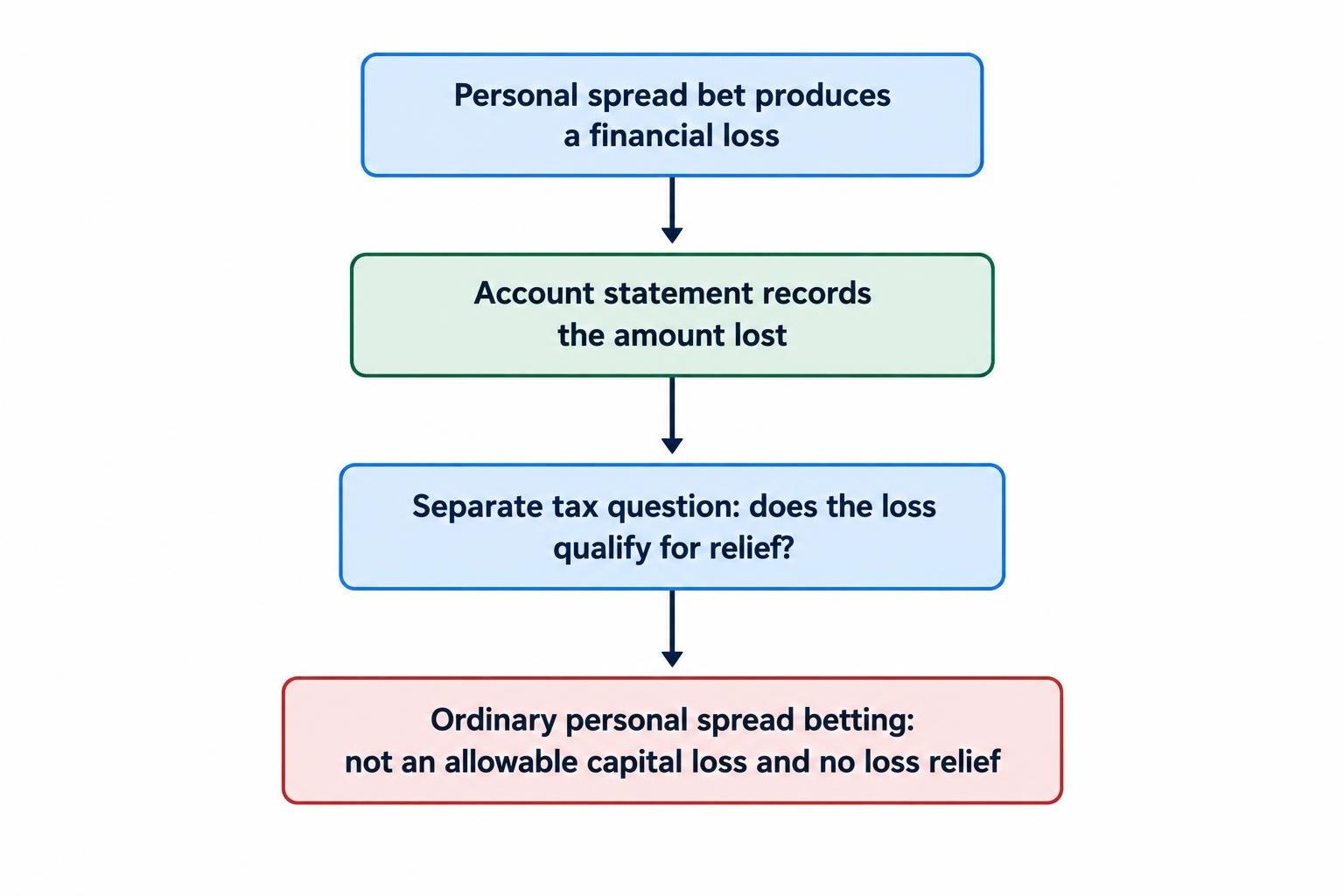
A financial loss and an allowable tax loss are different things. A broker can correctly show that you lost £5,000 without that amount qualifying for a deduction on your tax return.
Betting winnings sit outside chargeable gains under section 51 of the Taxation of Chargeable Gains Act 1992. For ordinary personal spread betting, the absence of tax on winnings does not come with relief for losing bets. You do not get to treat profitable transactions as exempt betting while treating unsuccessful ones as taxable investments.
The market you bet on does not change that distinction. A losing spread bet on a share is not the same transaction as selling shares at a loss. The bet references a price movement; it does not make you the owner of the underlying shares.
Keep two separate questions in mind: how much did the activity cost you, and does that cost qualify for tax relief? Your account statement answers the first. It does not, by itself, answer the second.
Can spread betting losses reduce Capital Gains Tax?
Ordinary personal spread betting losses cannot reduce chargeable gains from shares, property or other investments. The general distinction between allowable and non-allowable capital losses appears in section 16 of the Taxation of Chargeable Gains Act 1992. A loss does not become deductible simply because it appears beside taxable investments in your personal finances.
This also means you should not combine every investment account into one net figure and use that as your capital gains result. Different contracts can require different tax treatment, even when they track the same market.
Worked example: share gains alongside spread betting losses
Suppose an individual has the following results during one tax year. All spread bets are personal bets, with no connection to an existing trade. The figures are hypothetical and ignore dealing costs for simplicity.
| Activity | Result |
|---|---|
| Gain from selling shares outside a tax wrapper | £12,000 gain |
| Winning spread bets | £6,000 winnings |
| Losing spread bets | £9,000 losses |
| Net spread betting result | £3,000 loss |
The individual is £3,000 down on spread betting. That does not reduce the £12,000 share gain to £9,000 for Capital Gains Tax purposes. The share gain must be calculated separately, with any applicable exemption, allowable losses and other reliefs considered within that calculation.
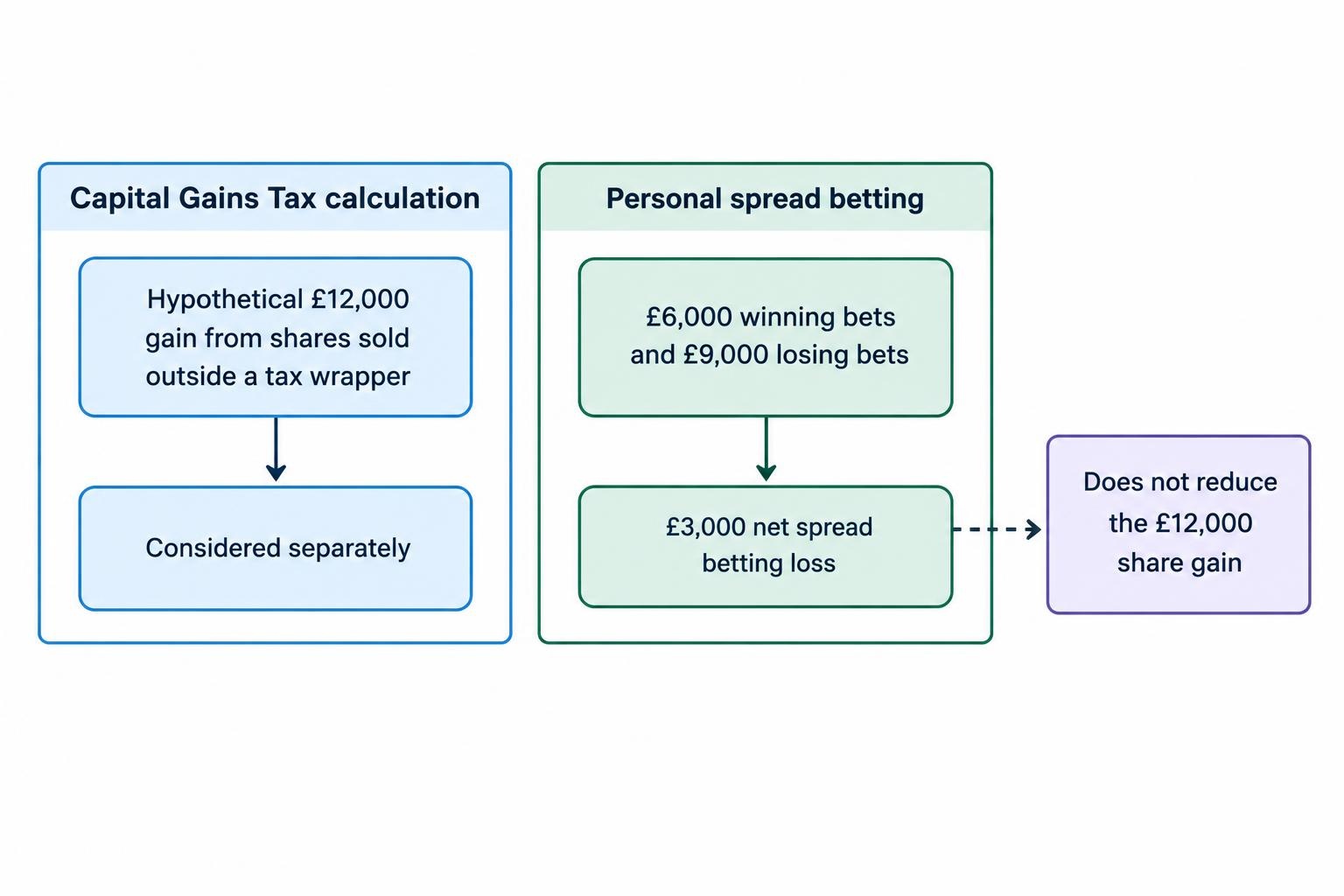
Nor should the £6,000 of winning bets be added to the share gain. The ordinary personal spread betting results remain outside the capital gains calculation on both sides. The separate guide to spread betting and Capital Gains Tax covers that boundary in more detail.
Can you carry losses forward or back?
No allowable capital loss arises from these personal bets, so there is nothing to carry forward against future chargeable gains. An unused spread betting loss is not a tax asset waiting for a profitable year.
The same loss cannot be carried back to reduce tax on an earlier share disposal. Recording it in a spreadsheet, closing the account or sending the figure to HMRC does not change its character.
If you lose £4,000 in one year and make £7,000 from ordinary personal spread bets the next, the earlier loss has not created a deduction to claim. Keep both years’ results for your own financial records, rather than treating them as a capital loss account.
Can losses reduce salary, business income or other taxable income?
Ordinary personal spread betting losses cannot normally be deducted from salary, rental income or the profits of an unrelated business. Betting itself does not ordinarily constitute a trade, and HMRC’s guidance on betting and gambling expressly pairs the absence of tax on personal spread betting profits with the absence of loss relief.
Suppose you earn £40,000 from employment and lose £5,000 on personal spread bets. You do not reduce your employment income to £35,000. Funding those bets from wages on which you have already paid tax does not create a refund.
Being self-employed in another occupation does not change this either. A consultant’s personal betting losses do not become consultancy expenses because both activities use the same laptop or bank account.
What about financing charges and other costs?
Do not assume that separating charges from losing bets makes them deductible. For ordinary personal betting, financing charges, platform subscriptions and similar private expenditure do not become expenses of a taxable trade simply because they support your betting activity.
Still include relevant charges when measuring your actual performance. A strategy that breaks even before costs can lose money after them. That is a useful accounting distinction, not an automatic tax deduction.
Does trading full time make the losses deductible?
Not by itself. Using a system, having expertise or earning a living from gambling does not automatically turn betting into a trade. That distinction is set out in HMRC’s guidance on professional gamblers.
A disciplined routine is not an election into business taxation. Keeping detailed records, trading daily and treating the activity seriously may help you manage it, but those facts alone do not establish entitlement to trading loss relief.
The phrase “professional trader” also needs care. It can describe someone’s occupation, their approach or a broker’s account classification. None is a substitute for analysing the actual activity and contracts for tax purposes.
If you also receive payments for services, keep those receipts distinct from your own betting results. The existence of another income stream does not settle how every associated transaction should be treated. The guide to spread betting tax for professional traders examines those distinctions without assuming that working full time changes the answer.
When a connection with an existing trade needs closer examination
There are exceptions to the ordinary personal betting position. A bet can have a different treatment where it arises from carrying on an existing trade. The contract terms and the economic substance of the arrangement matter under HMRC’s rules for spread betting connected with a trade.
That is a narrower test than having a business and placing bets. A trade might give someone knowledge or an opportunity to bet without making the bet part of that trade.
Where a genuine business connection may exist, get advice before assuming either that winnings are exempt or that losses qualify for relief. The assessment needs to address both outcomes consistently, rather than choosing the more favourable treatment after the result is known.
Business hedging is not the same as personal speculation
A bet used to hedge interest on a business loan is an example of an arrangement that needs closer examination. HMRC’s guidance on betting within an existing trade distinguishes bets arising from the trade from private bets that the trade simply made possible.
Do not treat “hedge” as a label that guarantees deductibility. An adviser will need the contract, the exposure being hedged and evidence of the commercial purpose. Keep that evidence when entering the transaction, not after discovering that it lost money.
Personal investment hedging also needs care. A bet intended to offset movements in your share portfolio should not automatically be treated as an allowable investment loss. The guide to hedging with spread bets and tax covers that separate issue.
Company accounts need separate advice
If a company is the contracting party, do not apply this article’s personal betting treatment to its accounts. Establish who legally entered the contract before considering any loss claim.
Keep the company’s contracts, funding and records separate from your personal bets. See the guide to spread betting through a company for that different set of questions.
Do not mix spread betting losses with CFD results
If you use both spread betting and CFDs, identify each contract before preparing tax figures. Similar price charts, markets and order tickets do not establish identical tax treatment.
Download separate transaction histories where possible. A combined broker statement may be useful for monitoring your finances, but it is not a reason to give every entry the same tax classification.
Before including any CFD loss in a tax calculation, check the rules for that contract rather than applying the personal spread betting rule in reverse. The comparison of spread betting and CFD tax treatment covers the distinction. Do not move a loss between categories simply because one might offer relief.
What to do when preparing your tax return
For ordinary personal spread betting, there is normally no allowable loss to enter in the capital gains calculation and no trading loss to claim against income. Do not register the figure as a capital loss for future use.
That does not remove any filing obligation arising for other reasons. If you already complete Self Assessment, keep personal betting results separate from taxable investment disposals and business accounts.
Give your accountant the contract descriptions, not just a total headed “trading losses”. That phrase could refer to share disposals, CFDs, personal spread bets or transactions connected with a business. The description alone is too vague to support a claim.
If you previously claimed relief for personal spread betting losses, ask an adviser to review the return and any correction required. Do not assume an earlier claim was valid simply because it was processed without a question.
Keep records even when there is no deduction
A useful record should let you establish what happened and how each transaction was classified. Keep:
- Account terms identifying the product and contracting account holder.
- Transaction statements showing closed bets, dates and outcomes.
- Deposits and withdrawals, recorded separately from betting results.
- Charges, adjustments and any written tax advice you relied on.
Deposits are particularly easy to confuse with losses. Suppose you start with £10,000, add £3,000 and finish with £8,000, with no withdrawals or open positions. The account has lost £5,000, not £2,000, assuming the figures include all charges and adjustments. Adding funds can disguise the size of a loss unless you reconcile the account.
Use the spread betting record keeping guide to organise those documents. Keep a note of why an amount was excluded from a tax calculation as well as evidence for amounts you included.
Plan for the full cash loss
When setting a budget for ordinary personal spread betting, do not reduce the amount at risk by an expected tax refund. A £1,000 loss should be assessed as £1,000 of your capital gone, not as a smaller amount after assumed relief.
Keep that distinction in your position sizing calculations. Tax treatment does not repair an oversized position or make recovering a loss more likely.
Before making any loss claim, establish the product, the account holder and whether the transaction was personal or genuinely connected with a trade. If those facts are straightforward personal spread betting, the normal answer is straightforward too: the loss is yours to bear, without a UK tax deduction.