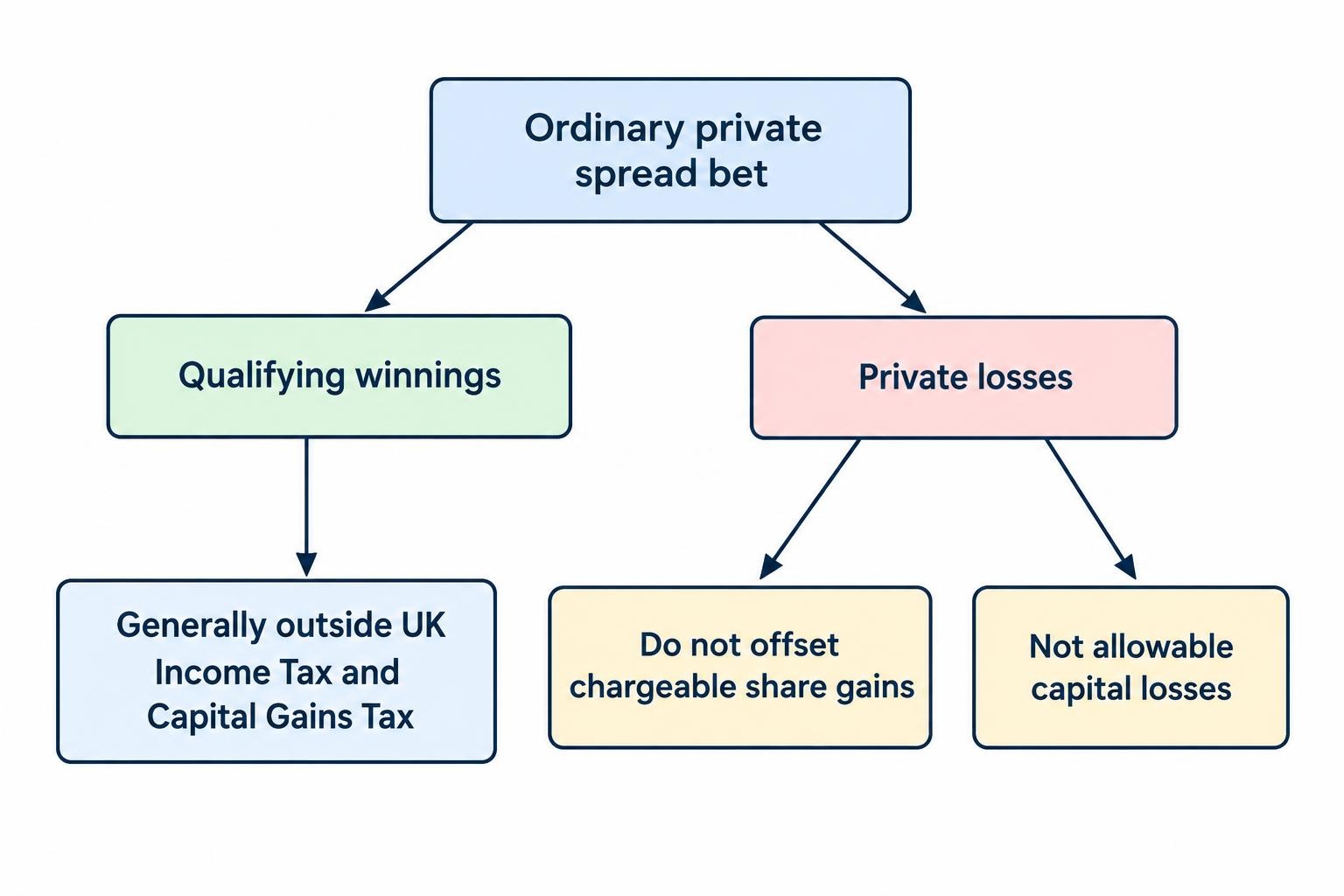
Financial spread betting is generally free from UK Capital Gains Tax and Income Tax for individuals placing genuine private bets. There is also no purchase of the underlying shares, so the usual share transfer taxes do not arise on the bet itself.
That answer needs boundaries. A company placing spread bets, a business using them within its trade, or someone with tax obligations outside the UK should not assume the same result. The other side of the arrangement matters too: ordinary private spread betting losses do not qualify for tax relief.
This article covers the usual personal position and the circumstances that need a closer review. The broader UK spread betting tax guide covers the related issues in more detail. This is general information, not a determination of your own tax position.
What does “tax-free spread betting” actually mean?
It means that qualifying winnings fall outside the relevant tax charge. It does not mean that profits use up a special trading allowance, that withdrawals receive an exemption, or that every payment appearing in a spread betting account has the same treatment.
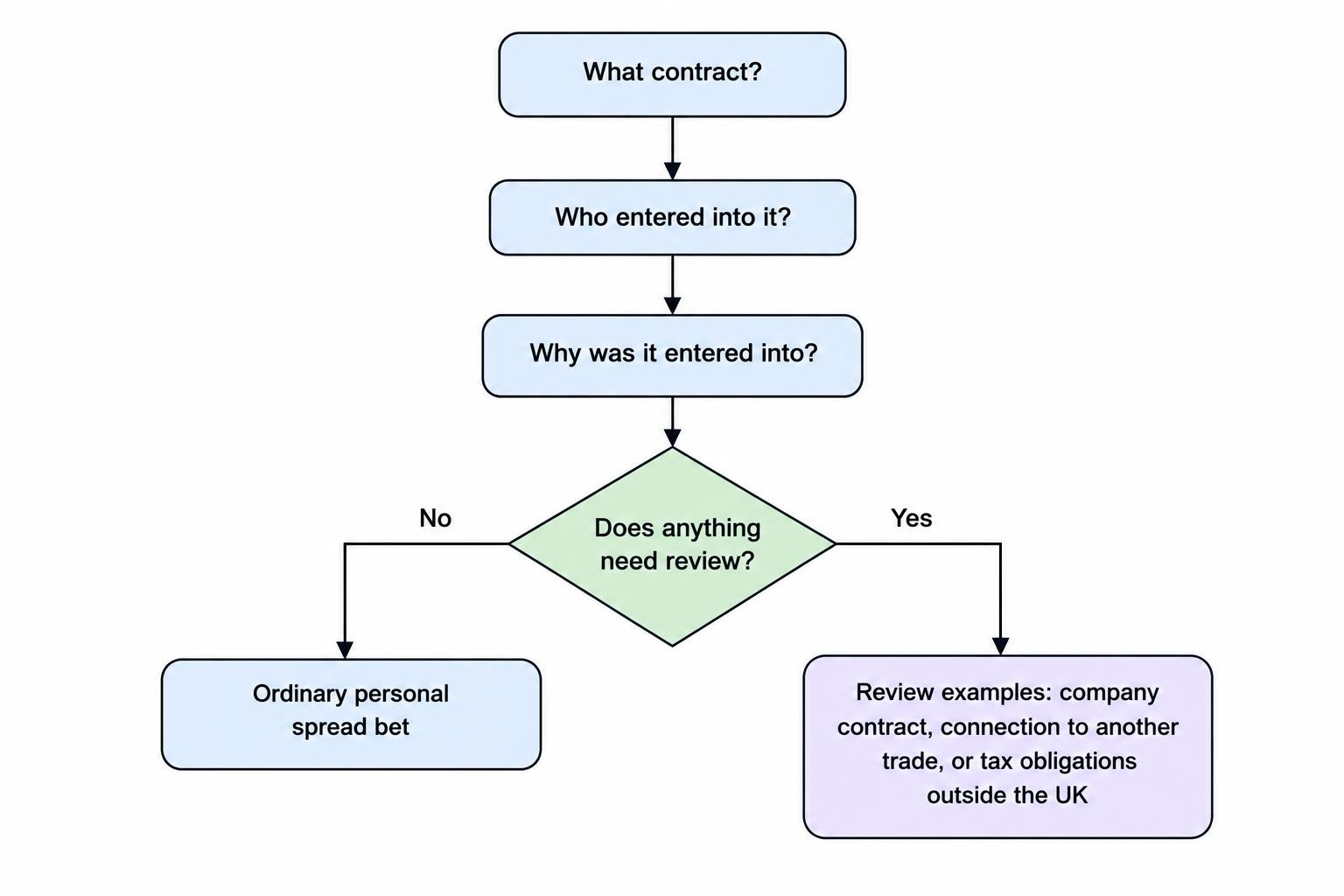
Three questions help establish the starting point: what contract have you entered into, who owns it, and why was it entered into? A personal spread bet placed to speculate on an index is not the same arrangement as a company contract used to manage commercial exposure.
Capital Gains Tax
Betting winnings are not chargeable gains under section 51 of the Taxation of Chargeable Gains Act 1992. For an individual placing an ordinary financial spread bet, the profit therefore does not become a taxable capital gain simply because it follows a share price, currency pair or market index.
This treatment is separate from the annual Capital Gains Tax exempt amount. Qualifying winnings do not consume that allowance, and exceeding the allowance with those winnings does not turn the excess into a chargeable gain.
The distinction is between an exempt receipt and a taxable gain covered by an allowance. Both can produce no tax bill, but for different reasons. The separate guide to spread betting and Capital Gains Tax examines that distinction without mixing spread bets into an investment portfolio’s tax calculation.
Income Tax
The usual private betting position is not a charge to Income Tax. There is, however, a business exception: taxable winnings must arise from carrying on a trade, rather than simply from an opportunity that the trade presents. The contract and its economic substance determine the result. This distinction appears in HMRC’s spread betting guidance in BIM22020.
Calling yourself a trader does not settle that question. Nor does calling a payment “spread betting profit” settle it in the other direction. Examine what actually happened, rather than relying on the account name or a description in a spreadsheet.
If an activity connects private betting with a commercial operation, separate the arrangements before reaching a tax answer. Our guide to spread betting and Income Tax covers this boundary.
Stamp Duty and Stamp Duty Reserve Tax
A spread bet on a share does not transfer that share into your ownership. You hold a contract with the provider, not the underlying company’s shares.
The ordinary Stamp Duty charge concerns instruments effecting a conveyance or transfer on sale, under Schedule 13 to the Finance Act 1999. Without that share transfer, the usual share purchase Stamp Duty charge does not arise on the spread bet.
Stamp Duty Reserve Tax is a separate tax whose principal charge concerns agreements to transfer chargeable securities for consideration. A cash settled spread bet does not make that transfer; see the SDRT charging provision in section 87 of the Finance Act 1986.
That does not make spread betting equivalent to owning shares without the paperwork. You have a different contract, different costs and different risks. The absence of a transfer tax answers one question, not the whole investment decision.
Does spread betting become taxable if it is your full-time occupation?
Earning your living from betting does not, by itself, make the activity a taxable trade. Having a system, applying expertise and being successful enough to live on winnings are not enough on their own. These points are expressly addressed in HMRC’s guidance on professional gamblers.
The common claim that “spread betting becomes taxable once it replaces your salary” is therefore too broad. A change in how you pay the household bills does not, on its own, identify a change in the legal nature of your receipts.
Separate three questions: are you betting for yourself, are the bets part of another trade, and are you being paid for something other than your own betting results? Those questions are more useful than debating whether a trading routine looks sufficiently professional.
A professional client classification at a broker is another issue again. It concerns the regulatory relationship and protections attached to the account. Opting up can remove protections available to retail clients, a risk addressed in the FCA’s guidance for CFD and spread betting customers. Do not use that classification as a substitute for a tax analysis.
If you plan to rely on withdrawals for living expenses, review the tax position before building your household budget around them. The guide to spread betting tax for professional traders covers the distinction between earning a living and carrying on a taxable trade.
When might the normal personal treatment not apply?
Bets connected with an existing business
A business connection deserves more attention than the frequency of your bets. Suppose a sole trader enters a currency spread bet to offset exchange rate exposure arising from customer invoices. The bet now has a commercial purpose linked to the business, rather than being an unrelated personal speculation.
That example calls for a review; it is not a declaration that every hedge has one tax outcome. An adviser would need the contract, the underlying exposure, the accounting treatment and the relationship between them.
Document that purpose when entering the arrangement. Reconstructing it after a large profit or loss invites avoidable disagreement. The separate guide to hedging with spread bets and tax examines the business and investment questions.
Spread bets entered into by a company
Do not transfer the usual individual treatment to an incorporated business. A financial spread bet entered into by a company can fall within the corporate derivative contracts rules. Its character as a wager does not, by itself, keep it outside those rules, as set out in HMRC’s corporate guidance on contracts for differences.
Before using company funds, establish who will be the contracting party and obtain advice on the proposed arrangement. A personal account, a company account and company money paid into a personal account raise different questions.
The guide to spread betting through a company covers that structure separately. “The company can do it tax-free too” is not a safe starting assumption.
Tax obligations outside the UK
This article describes the UK position. It does not establish how another country will classify a contract or receipt.
If you live abroad, move during the year, have dual residence concerns or remain subject to another country’s tax rules, obtain advice covering those jurisdictions. A sterling account and a UK provider are not enough to answer those questions.
Tell the adviser about the cross-border position at the start. Otherwise, you risk getting a technically correct UK answer to only half the problem.
Can you claim tax relief on spread betting losses?
Not for ordinary private financial spread betting. No chargeable gains or allowable capital losses arise from those bets. This is the treatment set out in HMRC’s financial spread betting guidance in CG56105.
Consider a hypothetical investor with £10,000 of chargeable share gains before other reliefs and £4,000 of private spread betting losses. The spread betting loss does not reduce the share gain to £6,000. The share transactions need their own tax calculation.
Nor should the investor treat that £4,000 as a capital loss available for use in a later year. Mixing the accounts in one performance spreadsheet does not merge their tax treatment.
This is the part of “tax-free” that promotional summaries can leave out. There is no tax on qualifying winnings, but there is no corresponding tax cushion for a losing private bet. The guide to the tax treatment of spread betting losses covers the practical consequences.
Why CFDs need a separate tax calculation
A spread betting account and a CFD account can offer exposure to the same market through similar screens. That does not give their results identical tax treatment.
Retail CFD outcomes generally fall within the capital gains regime unless the profits are taxable as trading income. Relevant debits and credits enter the calculation when the contract closes, under HMRC’s guidance on retail contracts for differences.
Check the actual product before preparing records. “Forex profit” or “index trading loss” describes the market, not the contract. Keep spread bets, CFDs and direct investments in separate categories even if they share a login.
The spread betting versus CFD tax comparison covers that distinction. It is particularly relevant before switching products in response to a tax headline.
Do withdrawals from a spread betting account create a tax charge?
For the ordinary private betting case described here, withdrawing qualifying winnings does not turn them into taxable earnings or chargeable gains. The character of the receipt matters, rather than the act of moving cash to your bank account.
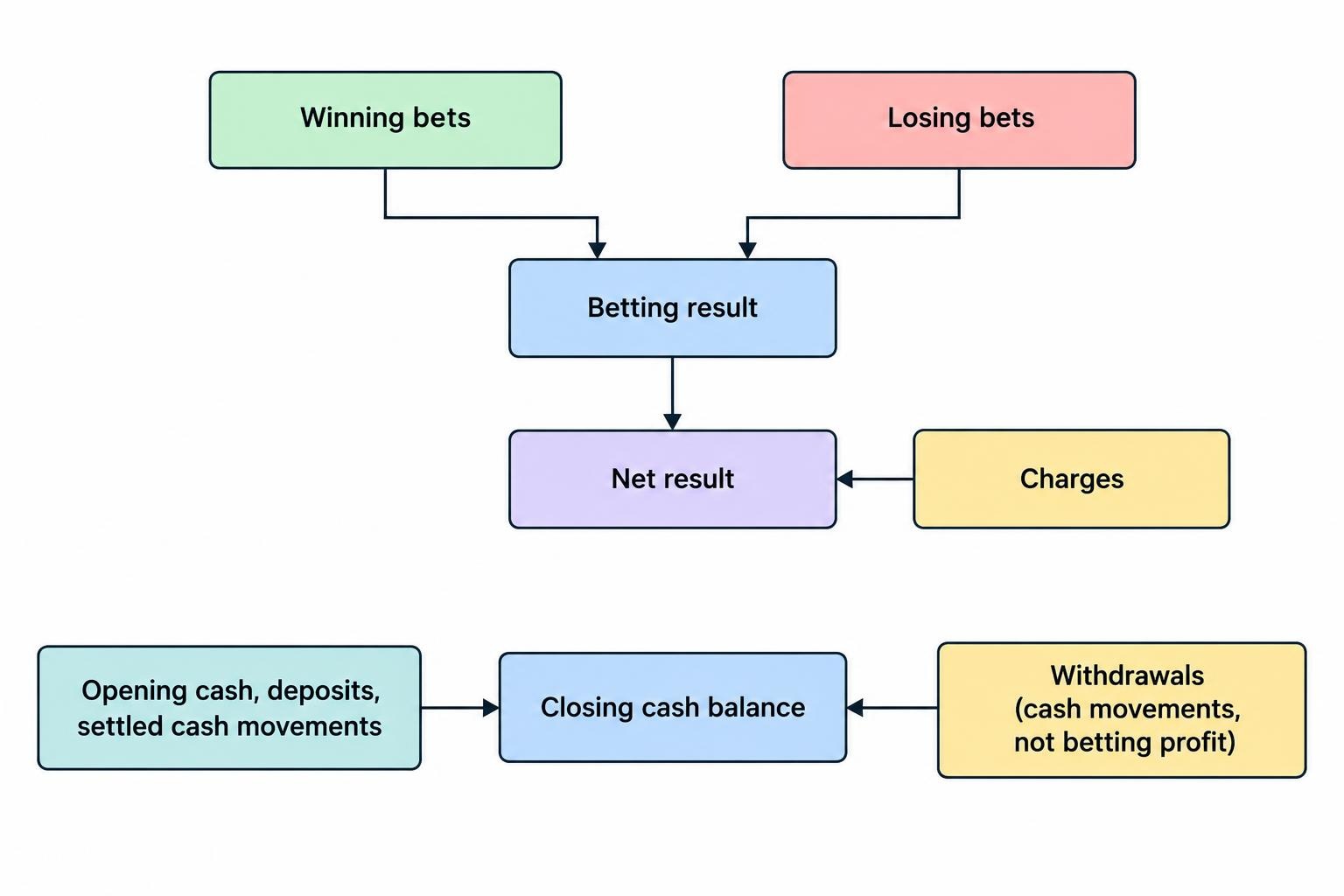
There are two separate accounting questions: how much did the betting activity make, and how much cash moved into or out of the account? A withdrawal can include original deposits as well as winnings.
For your own records, reconcile opening cash, deposits, withdrawals, settled results and charges. Keep open positions separate so that a statement balance is not mistaken for a completed result. This approach makes the numbers easier to explain without treating bank transfers as a profit calculation.
What about Self Assessment?
Ordinary exempt private winnings should not be entered as taxable trading income or chargeable capital gains. That does not mean you can ignore a request from HMRC.
A notice can require a return and supporting information under section 8 of the Taxes Management Act 1970. Deal with that notice even if you believe no tax is payable on the spread betting results. If you think a return is unnecessary, resolve that with HMRC rather than assuming the notice has no effect.
If a return is required for other reasons, keep the exempt betting activity separate from taxable transactions. Where the classification is uncertain, take advice on the treatment and any explanation needed before filing.
Keep records even when no tax is due
A useful record should establish what the transactions were, who entered into them and how the cash balances reconcile. Save statements and contract details while they are readily available, rather than relying on continued platform access.
- Keep account opening documents identifying the account holder and product.
- Download transaction histories, statements and charge records.
- Record deposits and withdrawals separately from betting results.
- Retain any written tax advice and the facts on which it relied.
For accounts used alongside a business, add a contemporaneous note explaining the purpose of each connected arrangement. Our guide to spread betting record keeping covers how to organise the paperwork without turning it into a second occupation.
A worked example: profit, withdrawals and the tax distinction
Assume an individual places genuine private spread bets, has no relevant overseas tax obligations and does not use the bets within another trade. The following figures are hypothetical; all bets are closed and the charges have already been identified.
| Account item | Amount |
|---|---|
| Opening cash balance | £20,000 |
| Winning bets | £12,000 |
| Losing bets | £7,000 |
| Charges | £1,000 |
| Net result after charges | £4,000 |
| Cash withdrawn | £3,000 |
| Closing cash balance | £21,000 |
The account made £4,000 after charges. It did not make £3,000 because that was the amount withdrawn, or £1,000 because that was the increase in cash left on the platform.
Under the assumptions above, the qualifying private betting winnings follow the normal personal tax treatment. The withdrawal does not set the taxable amount.
Now change the assumptions rather than the figures. If the contracts belonged to a company, formed part of another trade or created obligations elsewhere, the same table would not establish the tax result. A neat reconciliation proves the arithmetic. It does not prove the legal classification.
Tax-free does not mean cost-free or low risk
A tax advantage cannot rescue an unprofitable approach. In a simple hypothetical comparison, £2,000 of costs against £5,000 of results before costs leaves £3,000. Against £1,000, those same costs leave a £1,000 loss. The tax description does not change either calculation.
Compare products using the intended holding period, exposure and charges, not just a headline tax rate. A position held briefly needs a different cost estimate from one intended to remain open for months. The guide to spread betting costs provides the broader cost framework.
Keep the risk budget separate from the hoped-for tax saving. Decide how much capital you can afford to put at risk before choosing a stake, then check the effect of an adverse price move. Use the position sizing guide to structure that calculation.
When to obtain a personal tax review
Get advice before relying on the usual exemption if company funds are involved, bets connect with another business, contracts are unclear, or your circumstances cross national borders. Do the same if you receive payments for services or other arrangements alongside your own betting: do not assume every receipt is a winning bet.
Give the adviser the contracts and a factual account of what you do, not just an annual profit figure. Ask for the reasoning in writing and identify which changes would require another review.
For a straightforward private UK bettor, the normal answer remains favourable: qualifying winnings generally escape UK Income Tax and Capital Gains Tax. Apply that answer to the right contracts and circumstances, and accept the matching restriction on loss relief.