UK individuals do not normally pay Income Tax on profits from private financial spread bets. The usual treatment applies because placing bets does not, by itself, amount to carrying on a taxable trade. That treatment has a less attractive counterpart: ordinary spread betting losses do not qualify for tax relief. Both points appear in HMRC’s guidance on betting profits and losses.
The difficult questions concern the boundaries. Does living off winnings change the answer? What happens when a bet protects a business against exchange rate movements? And how should someone separate personal betting profits from payments for trading services?
This article addresses UK Income Tax for individuals. The broader UK spread betting tax guide covers related taxes. Obtain advice before applying these principles to a company, an overseas tax position or an arrangement involving someone else’s money.
The normal Income Tax treatment of private spread betting
For an individual placing genuine private wagers, the starting point is that the winnings are not taxable trading income. This is not a special annual allowance that disappears once profits reach a certain figure.
Suppose a private spread bettor finishes a year £8,000 ahead. Another finishes £35,000 ahead. The difference in profit does not, on its own, establish a different kind of activity. Before considering amounts, establish what each person actually did and why they received the money.
A useful starting description would be: “I placed financial spread bets in my own name, using my own funds, for my own account.” Compare that with: “A customer paid me to carry out work involving financial markets.” Those descriptions raise different questions, even if both people spend their working day looking at the same chart.
Keep the distinction between a financial result and a payment for work clear. “Trading income” is often used casually to mean any money made from market activity. For tax purposes, that description needs more care.
Does spread betting become taxable if it is your main income?
Relying on winnings to pay living costs does not automatically turn betting into a trade. Having a system, studying markets and being successful enough to earn a living are not sufficient on their own. HMRC’s guidance on professional gamblers expressly addresses these points.
A rule such as “spread betting becomes taxable when profits exceed your salary” is therefore not a sound basis for a tax decision. Neither is the suggestion that keeping a small part-time job automatically protects the treatment of every bet.
For example, consider an individual who leaves employment and continues placing the same private bets, with the same account ownership and contractual arrangements. The loss of a salary should prompt a financial planning review, but it does not, by itself, establish that the betting has changed character.
Anyone considering that step should assess more than the tax position. Prepare a household budget that separates living expenses from money available for betting. Test it against a losing year, not just a profitable month. The tax treatment cannot make irregular returns behave like a dependable payslip.
The separate guide to spread betting tax for professional traders examines the questions raised by earning a living from market activity.
When can spread betting profits become trading income?
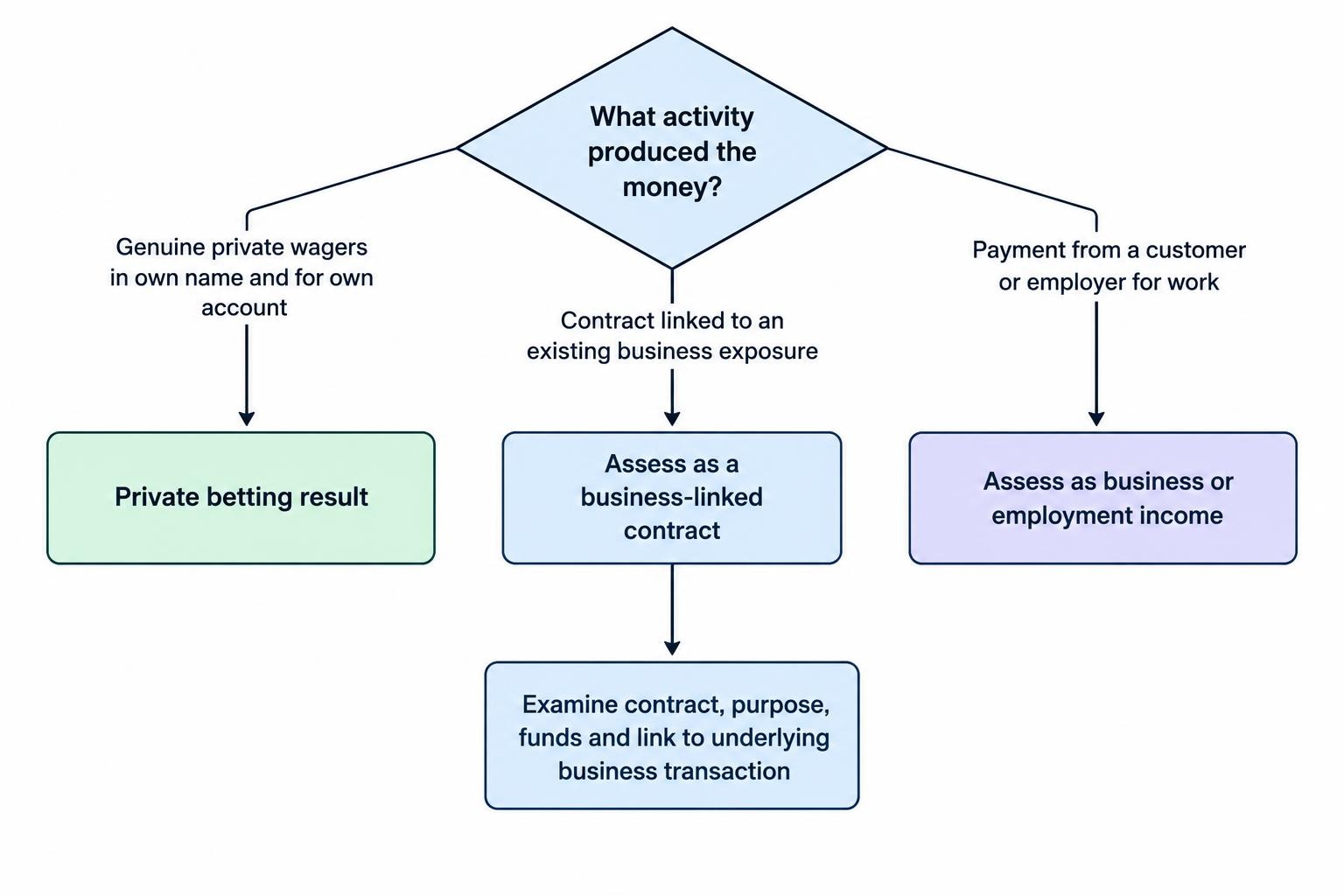
The important exception concerns bets that arise from carrying on a trade. A connection with someone’s occupation is not enough by itself. The contract and the economic substance of the arrangement matter, rather than the label attached to the account. This distinction is set out in HMRC’s spread betting Income Tax guidance.
Consider two different situations. An engineer follows commodity prices through work and places personal bets on copper. Separately, a business owner enters a transaction intended to offset a price risk in their business. Both may involve the same market, but the reasons for entering the contracts differ.
Do not try to resolve that difference by counting trades or measuring screen time. Instead, prepare a short description of the arrangement: who entered the contract, whose money was used, what exposure it addressed and how the proceeds relate to the business.
That description gives a tax adviser something useful to assess. “I am a full-time trader” does not reveal whether someone places private wagers, runs a customer-facing business, receives employment earnings or enters contracts for an existing trade.
If the boundary is uncertain, review spread betting as a business before treating either profits or losses as business items.
Business hedging needs a separate assessment
A spread bet used for a commercial purpose cannot simply inherit the treatment of a private wager. Derivatives held for trade purposes can produce trading profits, and the usual treatment of an individual’s private spread bets does not apply automatically to commercial hedges. HMRC’s guidance on derivatives, trading profits and commercial hedges draws this distinction.
An illustrative currency hedge
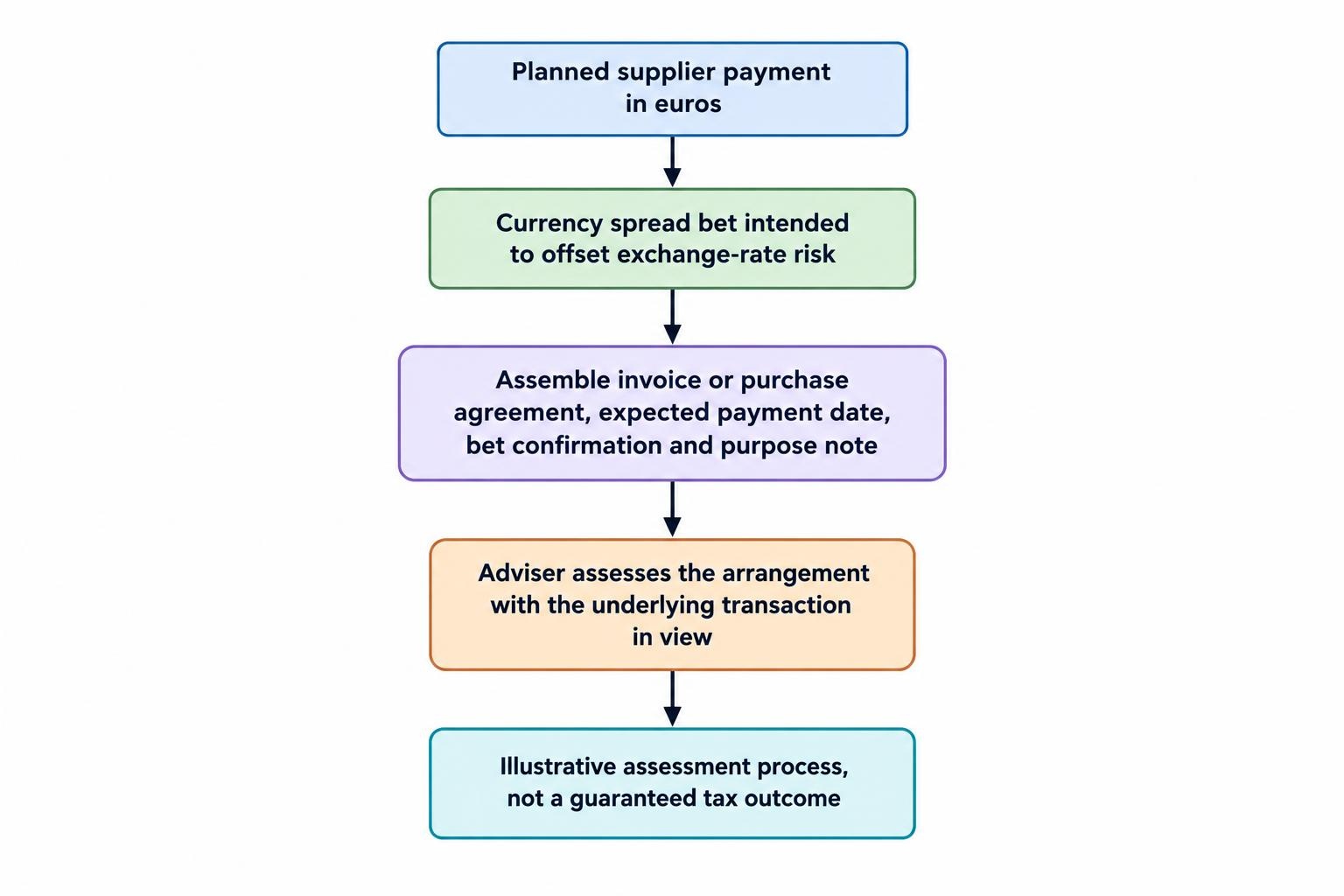
Suppose a sole trader expects to pay a supplier €40,000 in three months. They enter a currency spread bet intended to offset the cost of an adverse exchange rate movement. The bet is linked to a planned business purchase, rather than being considered in isolation.
Before deciding its tax treatment, assemble the supplier invoice or purchase agreement, the expected payment date, the bet confirmation and a note explaining the intended relationship between them. An adviser can then assess the arrangement with the underlying transaction in view.
A profitable bet and a more expensive supplier payment should not be reviewed as unrelated events without considering their connection. Nor should a losing bet be entered as a business expense just because doing so would produce a better tax result. See the separate discussion of hedging with spread bets and tax.
Company accounts are not personal accounts
Companies have a different tax framework for derivative contracts. Do not apply the private individual’s betting treatment to a company account. Before using company funds or opening an account in a company’s name, obtain advice on spread betting through a company.
Separate betting winnings from payments for work
Someone can place private spread bets and also run a business connected with trading. Money received from customers needs its own assessment. Income Tax is charged on the profits of a trade, profession or vocation under section 5 of the Income Tax (Trading and Other Income) Act 2005.
For example, consider someone who records £12,000 of private betting profits and receives £4,000 for providing paid market commentary. Keep the customer payments separate from the betting results. Do not combine both figures into a single category called “spread betting income” and assume one treatment covers everything.
Apply the same discipline to education fees, subscription services and commissions. Preserve the agreement showing what the payer received in return. The practical question is not whether the payment relates to financial markets, but what activity generated it.
Employment payments also require separate treatment. Salary, wages and employment fees fall within the statutory meaning of earnings in section 62 of the Income Tax (Earnings and Pensions) Act 2003. An employee should not assume that a market-related payment is a private betting win.
Be especially careful with funded-account arrangements or performance payments. Ask who owns the account, who bears the losses, what the contract requires and why the payment becomes due. Do not assume that a payment described as a “profit split” has the same character as winnings from a personal spread bet.
Also check the product itself. If your records include CFDs as well as spread bets, use the guide to spread betting versus CFD tax treatment rather than treating every position on the platform alike.
Can spread betting losses reduce your Income Tax bill?
Ordinary private spread betting losses do not qualify for tax relief. A losing year does not create a deduction against salary or unrelated business profits simply because the winnings would normally have been outside the Income Tax charge.
For an illustration, assume an individual has employment earnings and loses £6,000 on genuine private spread bets. Do not subtract that £6,000 from employment pay when preparing a tax calculation.
Keep two separate records: one for measuring the financial performance of the betting activity, and another for establishing the tax treatment of each category of receipt or expense. A result can matter greatly to personal finances without being an allowable tax item.
If someone argues that a transaction belongs to a business, review that position consistently across profitable and losing periods. Avoid deciding that bets were private when they won but commercial when they lost. The guide to tax treatment of spread betting losses covers this issue in more detail.
Withdrawals, account balances and profits are different figures
A bank transfer is not a tax category. To prepare useful records, distinguish money paid into an account, money taken out and the result generated inside it.
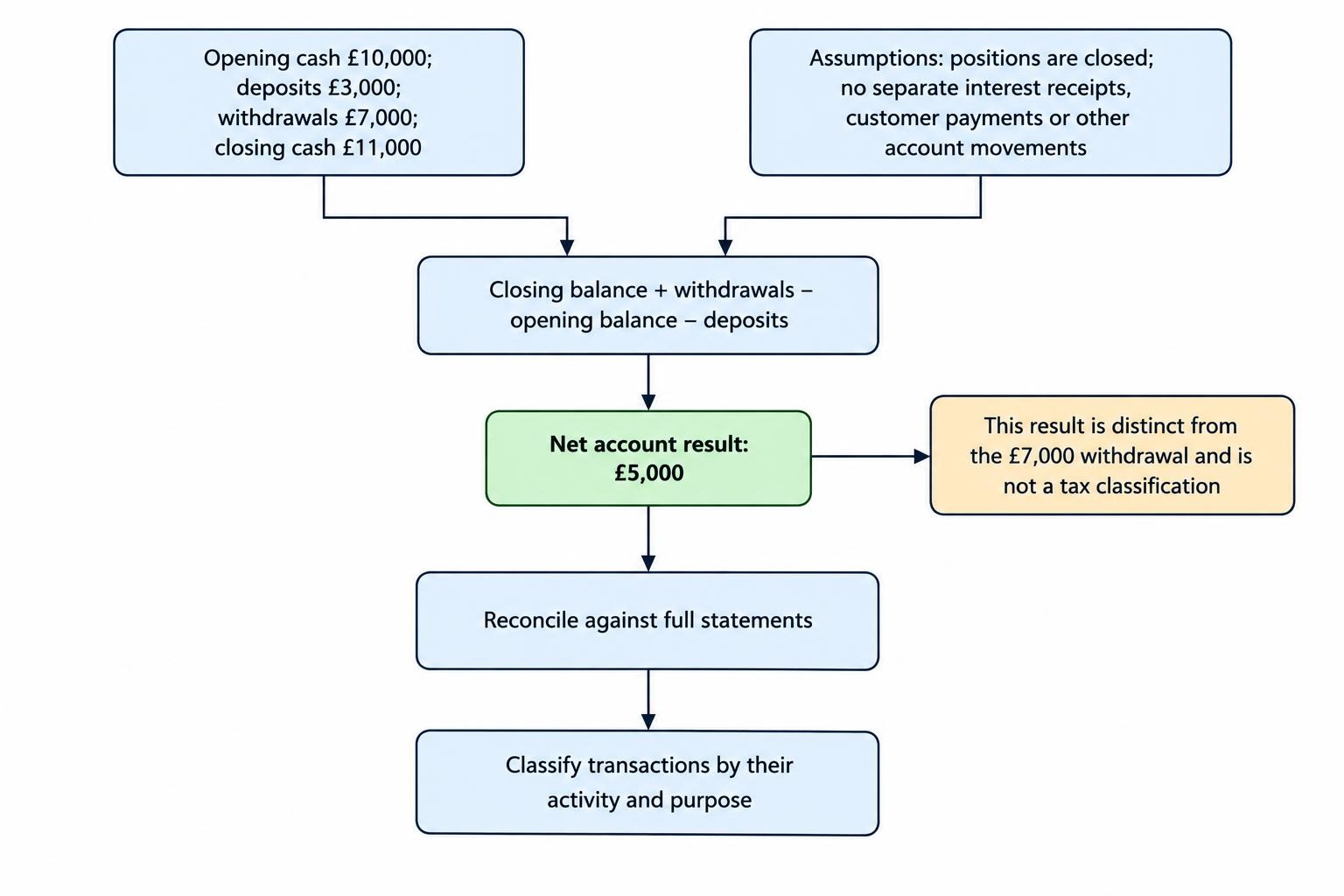
The following illustration assumes every position is closed at the end of the period. It also assumes there are no separate interest receipts, customer payments or other account movements.
| Account movement | Amount |
|---|---|
| Opening cash balance | £10,000 |
| Further deposits | £3,000 |
| Withdrawals | £7,000 |
| Closing cash balance | £11,000 |
The net account result is £5,000: the £11,000 closing balance, plus £7,000 withdrawn, less the £10,000 opening balance and £3,000 deposited. The £7,000 withdrawal is therefore not the same figure as the profit.
Use this calculation as a reconciliation check, not as a substitute for transaction records. If the figures do not agree with the account statement, investigate the difference. Check for omitted deposits, transfers between accounts, charges or entries belonging to another product.
For performance measurement, record charges as well as winning and losing positions. Otherwise, a result calculated from selected trades may overstate what the account actually earned. The guide to spread betting costs helps identify the charges to include.
Only after reconciling the account should you classify its contents. A clean spreadsheet is useful, but arithmetic cannot determine whether an arrangement was a private wager, a business hedge or a payment for work.
Do you need to declare spread betting profits to HMRC?
In the ordinary private betting case described here, the winnings are not self-employment turnover. Do not enter them as taxable business receipts simply because they arrived in a bank account or helped meet household bills.
Whether you need to submit a tax return is a separate question. Other income or circumstances may require one. If HMRC has asked you to file, do not ignore that request because you believe your betting profits are not taxable. Use HMRC’s Self Assessment checker and filing instructions to assess the filing requirement.
Before preparing a return, separate your records into categories rather than sending an accountant one unexplained total. Identify private betting results, employment payments, customer receipts, business-linked contracts and any interest entries. Ask for advice where an item does not fit comfortably into one category.
Where the treatment is uncertain, provide the contract and a factual explanation. Avoid asking only, “Is spread betting tax-free?” That broad question may produce an answer that does not address the arrangement you actually entered.
If you already filed using a different treatment, ask an adviser whether a correction is appropriate. Do not move the figure into another box solely to match a general statement found online.
Keep records that explain the activity
Good records should make the arrangement understandable to someone who was not watching the account throughout the year. Save complete statements rather than relying on screenshots of profitable trades.
A practical file should contain:
- Account ownership details, product documents and the relevant contractual terms.
- Full statements showing positions, charges, deposits and withdrawals.
- Agreements supporting any customer fees, employment payments or performance payments.
- Notes and documents explaining the purpose of any business-linked position.
Use consistent filenames and keep a separate folder for each account. Where a platform offers several products, preserve enough detail to identify which product each transaction used. Avoid relabelling everything as “forex” or “index trading”; those descriptions identify markets, not the contracts.
For any position associated with a business, write the explanation when entering it rather than reconstructing the purpose after seeing the result. A short note can identify the exposure, the expected timing and the intended relationship with the business transaction.
The guide to spread betting record keeping covers a fuller filing approach. The aim is not to create paperwork for its own sake. It is to preserve enough evidence for a reasoned assessment.
Get advice before changing the arrangement
A tax review is particularly useful before introducing company funds, using bets to address business risks, accepting payments for services or entering a funded-account contract. Review the proposed arrangement before money starts moving, rather than waiting until the first return is due.
Give the adviser the account agreement, an example statement, details of any connected business and a plain description of who pays whom. Ask them to identify which facts support their answer and which changes would require another review.
If you plan to depend on betting profits, keep that tax review separate from the decision about how much capital to risk. Prepare for losses, household expenses and periods with no withdrawals available. The principles in protecting your trading capital remain relevant whatever the tax treatment.
The useful distinction is between genuine private betting, contracts used for business purposes and payments received for work. Establish which activity produced the money, keep evidence of that activity, and assess the tax position on those facts—not on the size of a withdrawal or the job title you give yourself.