Overnight trading in financial spread betting means keeping a position open beyond a trading session or into the following day. It can also mean actively trading while another region’s markets are open during your local night. These activities overlap, but they create different demands. Holding an index position while you sleep requires a plan that can operate without your attention; trading an overseas session requires you to be available and alert. In either case, crossing a provider’s funding cutoff can introduce additional costs. This guide explains how overnight spread betting works, who it may suit, how to assess its advantages and disadvantages, and how to calculate realistic outcomes before placing a trade.
An overnight position needs an identifiable reason to remain open. A continuing trend, a planned swing trade or a specific event may provide that reason, but simply hoping that a losing day trade recovers does not establish a strategy. The Financial Conduct Authority includes spread betting within its CFD product supervision and describes these leveraged products as high risk and unsuitable for some retail consumers. This article provides trader education rather than a recommendation to open a position. Its prices, rates, charges and trade outcomes are hypothetical. Actual contracts differ, so the relevant dealing hours, point value, funding terms and order rules must be checked for the particular market being traded.
What Is Overnight Spread Betting?
Financial spread betting involves taking a position on a market’s price movement at a chosen monetary stake per point. A long position benefits when its closing sell price exceeds its opening buy price; a short position benefits when its closing buy price is below its opening sell price. Holding that position overnight does not change the basic profit calculation, but it changes the conditions under which the position operates. You may face funding adjustments, a different liquidity environment, news while you are unavailable, or a period when the contract cannot be traded. Overnight exposure therefore belongs in the original trading plan, alongside the entry signal, exit rules and amount of capital committed.
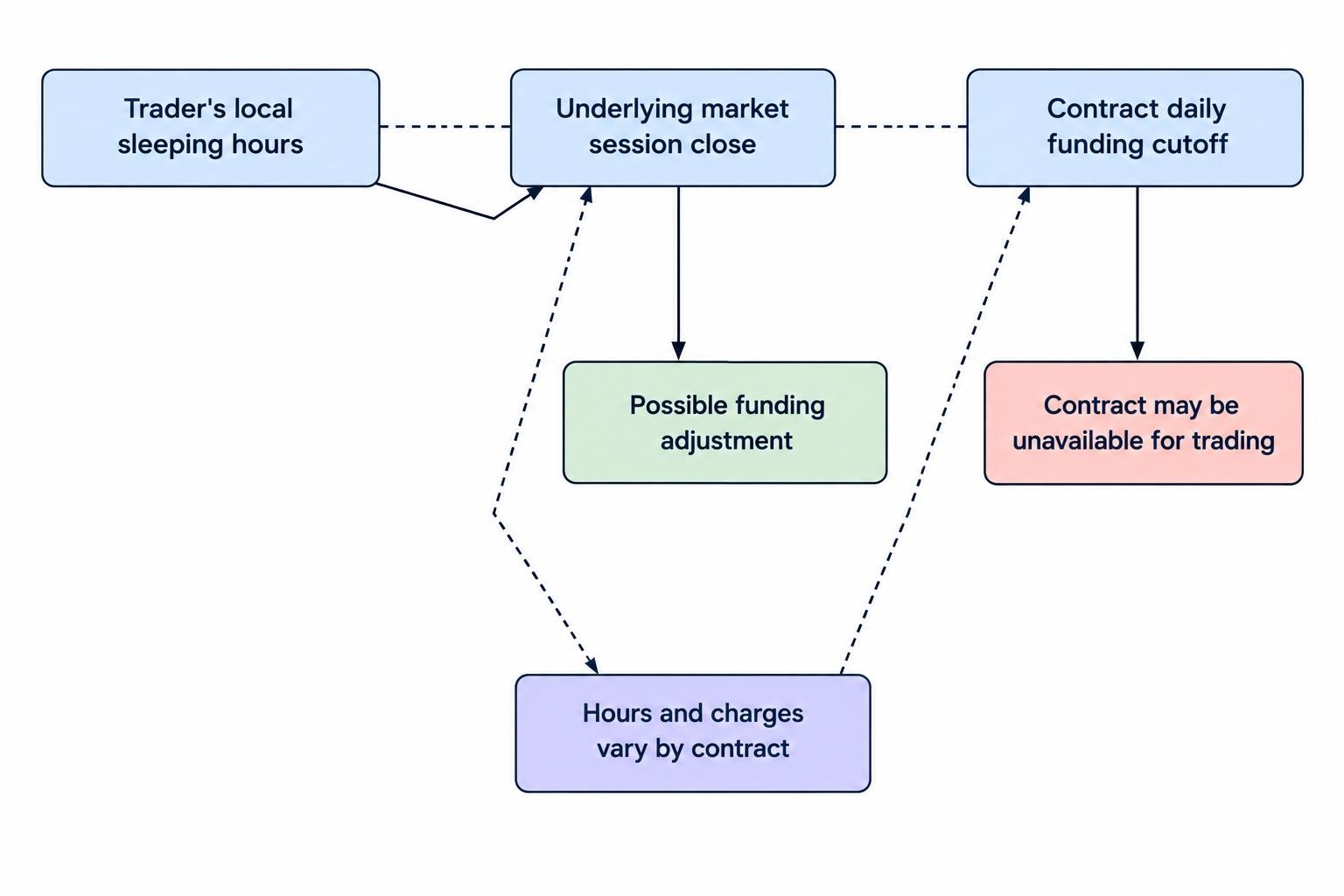
The word “overnight” can refer to three separate boundaries: your own sleeping hours, the underlying market’s session close, and the contract’s daily funding cutoff. They do not necessarily coincide. A trade opened shortly before a funding cutoff and closed shortly afterwards may attract a charge despite lasting only minutes. Another trade may remain open through much of your local night without crossing that particular cutoff. Similarly, a spread betting contract may continue to be quoted after the underlying cash exchange has closed. These distinctions matter because costs depend on contractual charging rules, while execution risk depends on when and how your particular contract can actually be traded.
| Activity | What it involves | Main planning issue |
|---|---|---|
| Holding a position overnight | Keeping an existing trade open into another session | Funding, unattended exposure and exit orders |
| Trading an overseas session | Opening and managing trades during your local night | Availability, fatigue and session liquidity |
| Holding through a market closure | Remaining exposed while your contract is unavailable for trading | Reopening gaps and delayed execution |
| Holding over a weekend | Carrying a position through a longer break | News accumulation, reopening conditions and funding days |
| Trading around a funding cutoff | Being open when a daily adjustment is assessed | The exact cutoff, charge calculation and settlement conventions |
How Overnight Trading Fits Into a Wider Strategy
Overnight trading is primarily a decision about when to hold exposure, rather than an independent method for predicting direction. A swing trading strategy may require several nights for a price move to develop, while position trading may involve much longer holding periods. A trend trader may keep a position open while the trend remains intact; a news trader may deliberately hold through an announcement. Each approach needs its own evidence and exit logic. “Hold until tomorrow” is incomplete unless tomorrow represents a defined review point, target window or time limit. The overnight component should support the wider strategy rather than substitute for one.
An especially important distinction is whether overnight exposure was planned before entry. Suppose a day trader bought an index expecting an afternoon breakout, but the breakout failed and the position is losing at the close. Keeping it open because the loss feels uncomfortable changes the strategy after the evidence has deteriorated. The original stop, position size and funding assumptions may no longer fit. A more disciplined approach specifies in advance whether an intraday trade can ever become an overnight holding and what conditions would permit that change. If the rules do not allow it, the trade should be managed under its original plan rather than relabelled as a longer investment.
Who Might Overnight Spread Betting Suit?
Overnight exposure may fit a trader whose tested approach uses price moves that extend across sessions and whose finances can tolerate the associated losses. It also requires enough understanding to estimate funding, recognise scheduled events, and distinguish an ordinary stop from guaranteed protection. Someone who cannot watch a screen continuously may find a slower strategy easier to schedule than scalping, but less screen time does not remove the need for preparation. The relevant question is whether the position can remain within acceptable risk while unattended. That depends on its size, the market, the order arrangements and the trader’s wider exposure, rather than on how convenient it would be to leave the trade running.
It is a poor fit when the trader needs the money for essential spending, relies on a precise ordinary stop as an absolute loss limit, or feels compelled to check the position throughout the night. Interrupted sleep can impair the next day’s decisions, creating a cost that does not appear on the account statement. Actively trading overseas hours introduces similar problems if it conflicts with work or normal rest. Beginners also face a practical learning difficulty: a position may move sharply before they have encountered the relevant execution conditions. Practising the mechanics first can expose misunderstandings, although a demonstration account cannot establish how a person will respond emotionally to a real overnight loss.
Advantages and Disadvantages of Holding Overnight
The main potential advantage is continuity. A position can remain exposed to a move that develops across several sessions, without requiring repeated exits and re-entries. This may avoid some transaction costs and the risk of missing a move between sessions. A defined holding period can also reduce the pressure to react to every intraday fluctuation. However, these benefits matter only when the underlying strategy justifies continued exposure. Keeping a position open to save a small spread can be a poor decision if it introduces a much larger event risk. The comparison should consider the likely benefit of staying in, the costs of doing so, and the consequences if the market moves sharply against the position.
| Potential advantage | Corresponding limitation |
|---|---|
| Participation in moves across sessions | Adverse moves can also develop while the trader is unavailable |
| Fewer exits and re-entries | Funding and other holding costs may offset spread savings |
| Compatibility with slower trading methods | Overnight exposure still requires preparation and review |
| Access to overseas trading opportunities | Night trading can create fatigue and scheduling problems |
| More time for a valid thesis to develop | More time also permits new information to invalidate it |
| Predefined orders can manage some decisions | Ordinary orders do not guarantee execution at the requested price |
The principal disadvantages are uncertain execution, ongoing costs and reduced control during periods of absence or closure. These risks interact. A negative announcement can produce a gap, widen the quoted spread and reduce account equity at the same time. Several related positions can suffer together, leaving less margin flexibility than their individual trade plans suggest. Even without a dramatic event, repeated funding charges can weaken the economics of a strategy targeting small movements. A useful evaluation therefore goes beyond asking whether the market is likely to rise or fall. It also asks how the position behaves when the timing is wrong, the expected move takes longer, or the next available exit is substantially worse than anticipated.
Market Hours: What Remains Tradable Overnight?
A market name does not tell you when its spread betting contract can be traded. An index contract might reference a cash index during one period and draw on related futures pricing outside the cash session, depending on the provider’s methodology. An individual share may have much narrower dealing hours, even where some trading in the underlying security occurs elsewhere. The NYSE publishes its official session hours and holiday calendars, but those exchange schedules do not establish the hours of a separate spread betting contract. Check the contract’s own timetable, daily breaks and holiday notices. Also confirm the displayed time zone and how daylight saving changes affect the hours shown on your platform.
Trading availability should not be confused with consistent liquidity or spread width. A contract quoted across much of the weekday may become more expensive to enter or exit during quieter periods. Currency trading, for example, moves between regional sessions, and the conditions for a particular pair can change with the participants and announcements active at that time. An index may react to overseas news before its domestic cash market reopens. A commodity can respond to developments in another region while a UK trader is asleep. These are reasons to study the specific hours your position will cross, rather than assuming that a familiar daytime chart describes the whole overnight trading environment.
How Overnight Funding Charges Work
Many daily funded spread bets apply an adjustment when a position remains open at a specified cutoff. The calculation may depend on the market, direction, exposure, reference rate, administrative charge and number of funding days. The FCA’s review of CFD pricing and value highlights differences between firms’ funding charges and the importance of understanding that charges can apply to the full underlying exposure, without an offset for account funds. Consequently, a modest margin deposit does not imply a modest financing cost. Before holding overnight, establish both the estimated cash adjustment and the method used to calculate it, including whether the amount can change as prices or rates change.
For a simplified illustration, suppose a contract carries £6,000 of exposure and an assumed annual funding rate of 8%, calculated on a 365-day basis. One funding day would cost approximately £1.32: £6,000 multiplied by 0.08, divided by 365. Three funding days would cost approximately £3.95. This is an arithmetic example, not a universal spread betting formula or a current quoted rate. Some contracts use a different day-count basis, while currency funding may be expressed through swap points and other adjustments. For a multi-night estimate, apply the actual methodology to each chargeable period. Do not automatically multiply one displayed charge by calendar nights without checking what that charge already covers.
Weekends, Holidays and Short Positions
Weekend funding is particularly easy to misunderstand. A contract can account for non-trading days through a multiple-day adjustment on a specified dealing day, and holidays can alter the schedule. There is no single triple-charge day that should be assumed for every market and contract. Check which days the adjustment covers, rather than relying on the label “overnight”. Direction matters too: a short position does not automatically receive interest. The FCA’s pricing review found differences in whether comparable short positions attracted a charge or a credit. Share shorts may also involve borrowing costs under the contract terms. A strategy should remain understandable after every applicable charge or credit is included.
Daily Funded Bets Compared With Dated Contracts
A daily funded contract often makes ongoing financing visible as a separate account adjustment, whereas a dated contract may incorporate financing and other market factors into its quoted price. The absence of a separate daily funding debit does not establish that the dated alternative is cheaper. Its spread, expiry arrangements and relationship to the underlying cash market also matter. For a single night, the difference in dealing costs may be more important than the financing saving; for a longer holding period, the balance can change. Compare the total expected cost for the intended holding period using the actual terms available, and consider what happens if the position remains open longer than originally planned.
Moving between contracts also introduces complications. A dated index price can differ from the cash-style contract, so the same numerical stop or target may represent a different market level. At expiry, a position might settle or roll according to the provider’s arrangements, potentially changing the entry reference and generating further costs. A change in the displayed price when moving to another expiry is not, by itself, an economic profit or loss. For overnight traders, the practical lesson is to choose a contract deliberately and understand its lifecycle before opening it. A product intended for longer exposure should not be selected solely because its account statement appears to contain fewer separate charges.
Practical Example: Holding a Long Index Spread Bet Overnight
Assume a hypothetical index spread bet is quoted at 8,000/8,002, with the first figure being the sell price and the second the buy price. A trader buys at 8,002 for £0.50 per whole index point, planning to hold into the following session if an established trend remains valid. The ordinary stop is placed at a sell price of 7,962, creating £20 of intended price risk: 40 points multiplied by £0.50. The intended target is a sell price of 8,082, offering £40 of gross profit. Assume one overnight funding debit of £1.10, no other adjustments and no guaranteed-stop premium. The examples below show alternative outcomes for that same initial plan.
| Alternative outcome | Closing sell price | Price profit or loss | Funding debit | Net result |
|---|---|---|---|---|
| Target reached after the overnight hold | 8,082 | +£40.00 | £1.10 | +£38.90 |
| Small rise, followed by a planned morning exit | 8,012 | +£5.00 | £1.10 | +£3.90 |
| Closed at the original opening buy price | 8,002 | £0.00 | £1.10 | −£1.10 |
| Ordinary stop filled at its requested level | 7,962 | −£20.00 | £1.10 | −£21.10 |
| Adverse gap; ordinary stop filled at 7,922 | 7,922 | −£40.00 | £1.10 | −£41.10 |
The spread is already reflected in these entry and exit prices, so it should not be deducted again. Immediately after entry, selling at an unchanged quote’s bid of 8,000 would produce a £1 price loss. After the assumed funding charge, the closing sell price needed for overall break-even is 8,004.2, before considering permitted price increments or any other costs. The example also shows why “£20 risk” is incomplete when it refers only to an ordinary stop. Funding increases the loss, and a gap can produce a substantially worse fill. The trader must assess these possibilities before deciding whether the planned stake is appropriate for an unattended overnight position.
Practical Example: Holding a Short Share Spread Bet Overnight
Now suppose a hypothetical share spread bet is quoted at 1,000p/1,004p. A trader expects further weakness and sells at 1,000p for £0.50 per penny, placing an ordinary stop at a buy price of 1,030p. That creates £15 of intended price risk. The following session, the quote is 960p/964p, and the trader buys back at 964p. The favourable movement is 36 points, producing £18 gross profit. Assume the account then includes a £0.20 funding debit and a £0.30 borrowing charge for the holding period, with no dividend adjustment. The net result is £17.50. These assumed charges illustrate the calculation; actual share contract costs and borrowing arrangements must be checked individually.
Consider an alternative outcome in which favourable company news arrives while the share contract is closed. It reopens at 1,050p/1,054p, and assume the ordinary stop executes at the buy price of 1,054p. The loss is 54 points multiplied by £0.50, or £27, before the assumed £0.50 of holding costs. The resulting £27.50 loss exceeds the original £15 stop-based estimate. A different reopening spread or execution price would change the result again. This is why an overnight share short should be assessed against company announcements and the possibility of a sharp upward gap. The fact that a stop was entered does not make the reopening price controllable.
Dividends and Other Overnight Adjustments
An overnight change in a share or index price may coincide with an ex-dividend adjustment. Depending on the contract terms, a long position may receive a dividend adjustment and a short position may pay one. These adjustments should be assessed alongside the associated price movement rather than treated as a standalone opportunity. In a simplified example, a 10-point downward price adjustment creates a £5 price loss on a £0.50-per-point long position, while a corresponding £5 cash credit offsets it before other movements and costs. Actual calculations can differ, including through deductions and index constituent effects. Read the relevant terms and the guide to spread betting dividends before holding across an ex-dividend event.
Other corporate actions and contract adjustments can also complicate a comparison between yesterday’s closing chart and today’s account balance. A share split, for example, can require changes to price references and position quantities or stake arrangements under the contract. For commodity contracts, a roll or a change in the underlying futures reference can affect displayed prices and adjustments. The practical discipline is to reconcile the entire position: opening and closing dealing prices, stake, funding, borrowing, cash adjustments and any contract changes. A chart alone may not explain the result. If the accounting cannot be reproduced from the contract terms and statement, resolve the discrepancy before relying on similar trades in future.
Ordinary Stops, Guaranteed Stops and Gap Risk
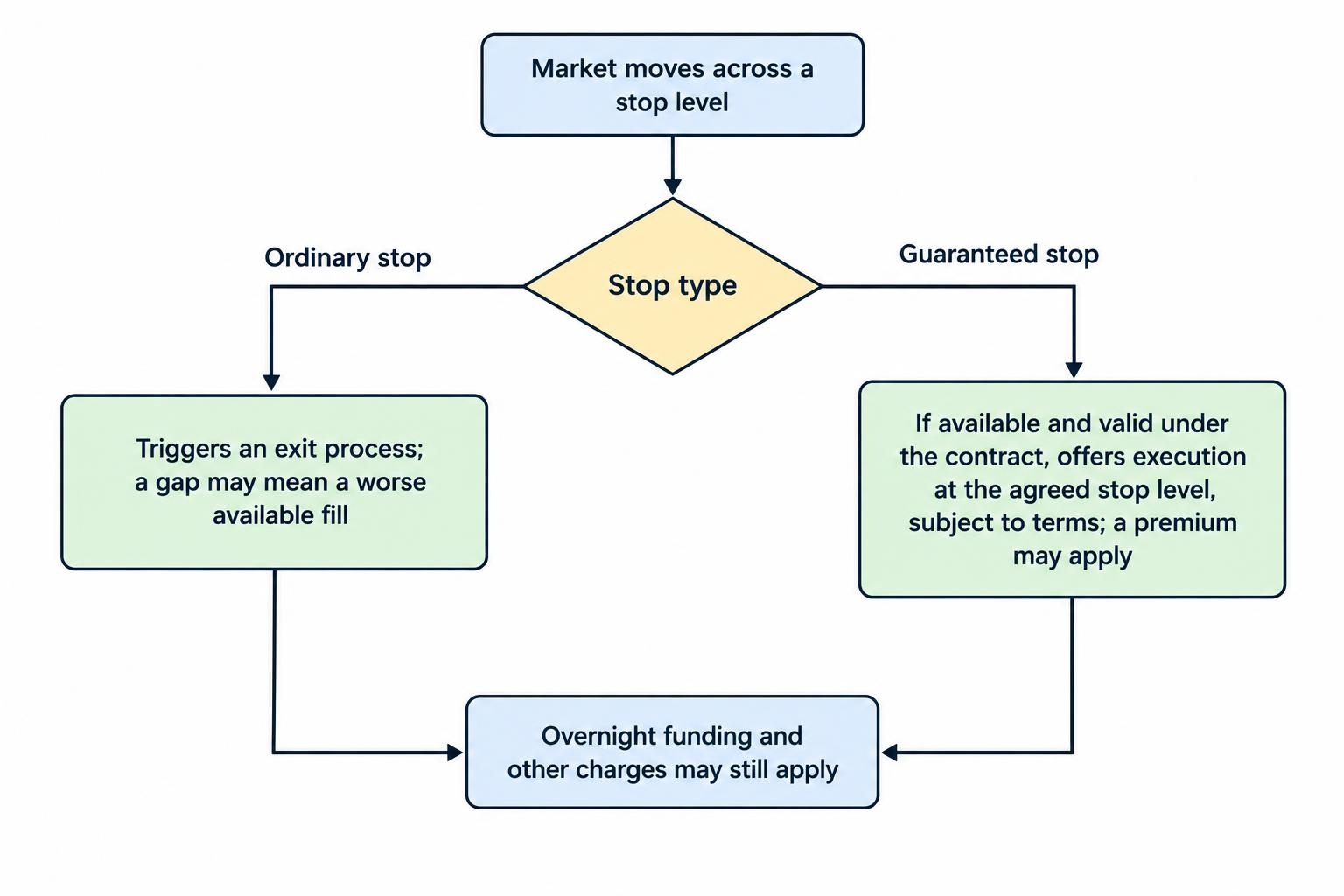
An ordinary stop defines a trigger for an exit process; it does not guarantee the requested execution price. When a market jumps across that level, the trade may close at a worse available price. A spread widening can also matter because a long position is generally closed against the sell quote and a short against the buy quote, subject to the provider’s trigger rules. Your chart may display a different reference, such as a midpoint or the opposite side of the spread. Before leaving a position unattended, confirm what triggers its orders and whether those orders remain active throughout the quoted session. The separate gap risk guide explains why a stop distance alone cannot describe every possible loss.
A guaranteed stop, where available and valid under the contract, offers execution at the agreed stop level subject to its terms. It can therefore make a specific price-loss limit more dependable when an overnight gap occurs. However, availability, minimum distances, amendment rules and premium arrangements vary, and the guarantee does not remove funding or every other account charge. For example, a £20 price loss plus a £2 triggered guarantee premium and £1.10 funding debit would produce a £23.10 overall loss under those assumptions. Evaluate the complete arrangement before using it. The guaranteed stops guide should be read alongside the contract’s own rules, particularly where other open positions or account-level closeout provisions could affect the account.
Position Sizing, Margin and Account Protection
Position sizing should begin with the market level that invalidates the trade and the loss the trader is prepared to budget, followed by a separate assessment of gaps and costs. With a £20 price-risk budget and a 40-point stop distance, the calculated stake is £0.50 per point. If an overnight plan requires an 80-point stop, maintaining the same budget implies £0.25 per point, assuming that stake is permitted. Keeping the original stake would double the intended price risk. Equally, choosing an artificially tight stop merely to support a larger position can make the trade vulnerable to normal fluctuations. The position sizing guide develops this relationship between stop distance, stake and trading capital.
Margin is a separate calculation. In the index example, 8,002 multiplied by £0.50 gives approximately £4,001 of underlying exposure. At an assumed 5% margin requirement, the opening margin would be approximately £200.05. The FCA’s retail rules specify a minimum 5% opening margin for major stock market indices, although firms can require more. Neither £200.05 of margin nor the £20 stop-based estimate is a universal maximum loss. The account also needs capacity for adverse price movements and charges. Capital committed to supporting the trade should be considered when evaluating returns; expressing profit only as a percentage of the minimum margin can exaggerate how attractive the trade appears.
Account protections do not make overnight exposure harmless. Under the FCA’s retail margin closeout and negative balance protection rules, positions must be closed as soon as market conditions allow when account net equity falls below 50% of the required margin; liability for the covered investments is limited to funds in the relevant account. These are account-level protections, not a guarantee of a particular stop price or preservation of deposited money. Several losing positions can contribute to a closeout, and charges can reduce the equity available to support them. A trader should understand the firm’s actual closeout arrangements before holding overnight rather than expecting an alert or an opportunity to transfer money before action occurs.
Planning for News, Weekends and Correlated Positions
Check the period from the intended entry through to the next time you can reliably review the trade. Relevant events may include company results, inflation releases, central bank decisions and announcements in a different time zone. Use primary schedules where available, such as the Federal Reserve’s FOMC calendar and the Office for National Statistics release calendar, alongside company investor relations pages. Calendars identify scheduled events; they cannot exclude unexpected news. Decide in advance whether the strategy permits holding through each type of announcement. If it does, size and test that exposure explicitly. If it does not, specify the exit time rather than leaving the decision until a release is imminent.
A weekend hold deserves its own assessment because the period without normal trading access may be longer. Political developments, company announcements or unexpected economic events can accumulate before the next available quote. A weekday overnight method should not automatically be extended from Friday into the following week without considering this difference. Portfolio exposure matters as well: a long equity index, a long share position and another growth-sensitive market may all react adversely to the same development. Their separate stop-based budgets do not make them independent. Review combined exposure and plausible simultaneous losses using the principles in portfolio correlation, including the possibility that relationships become stronger or change during market stress.
How to Get Started With an Overnight Trading Plan
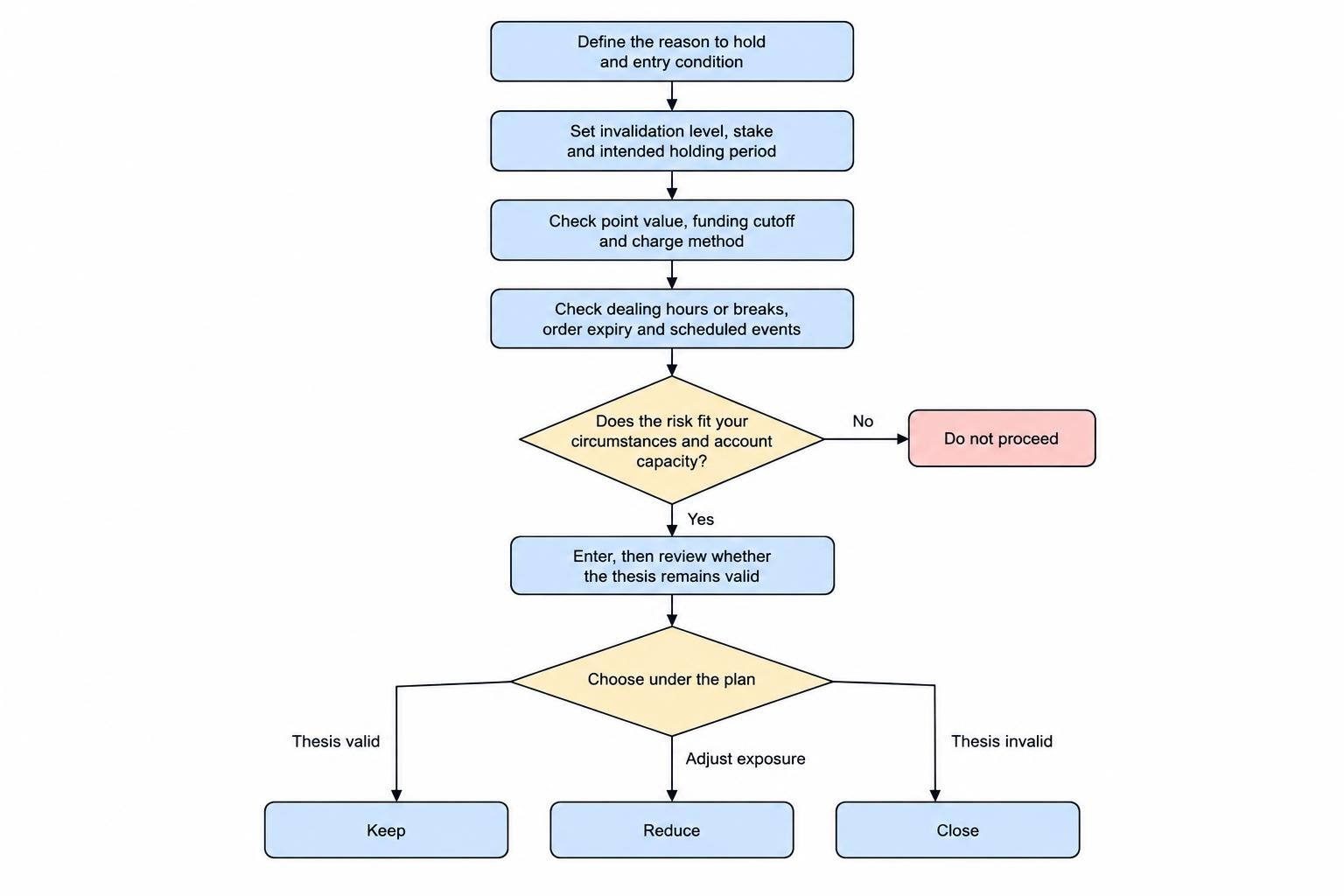
Start with one clearly defined market and one reason to hold across sessions. Write down the entry condition, invalidation level, intended holding period, event exclusions and planned exit procedure. Then check the contract’s point definition, minimum stake, funding cutoff, charge formula, dealing breaks and order expiry settings. Confirm whether protective orders remain active until cancelled or expire earlier. Before depositing money, follow the FCA’s guidance on checking a firm’s authorisation, including its permissions and contact details. A familiar name or a convincing website is insufficient evidence. Authorisation addresses regulatory status; it does not establish that the chosen strategy is profitable or appropriate for the trader’s financial circumstances.
Use a demonstration account to practise the full overnight process, including reading the next day’s adjustments and checking whether orders behaved as expected. Record the quoted spread at entry, around the relevant session transition and at exit. Work through an adverse gap on paper even if the demonstration period does not produce one. A quiet week offers little information about performance during a stressed reopening. If considering a move to real money, first establish that the smallest available stake can fit the risk budget and leave enough account capacity for the proposed exposure. Where the minimum stake is too large, the practical answer may be to choose a different contract or leave the trade unplaced.
The evening review should lead to a concrete decision: keep the position under its existing plan, reduce it, or close it. Check that the thesis remains valid, the order size matches the remaining position, and the next scheduled event is permitted by the rules. Consider internet access and whether you will actually be available when you expect to review the trade. Alerts can support a routine, but they depend on delivery and your ability to respond. Repeatedly waking to inspect a position can indicate that its size or structure does not fit your circumstances. A workable overnight plan should remain coherent during normal absence, rather than depend on improvised intervention whenever the trader becomes anxious.
Testing Whether Holding Overnight Adds Value
Evaluate the overnight decision separately from the original entry signal. Compare a predefined session-close exit with a predefined next-session exit across a representative set of trades, allowing for the different spreads, funding and execution conditions. Include losing trades and nights when the market did very little. If the strategy uses a signal calculated from the official closing price, ensure the simulated entry occurs only after that information was available and at a price that could realistically have been dealt. Using the same closing price both to generate a completed signal and to assume an earlier fill can create an unrealistic result. Historical cash-market returns also do not automatically equal returns on a particular spread betting contract.
The distribution of outcomes matters as much as the average. Suppose 19 hypothetical overnight trades each make £4 after costs, while one adverse gap loses £100. The total is a £24 loss despite a 95% winning proportion. This example does not describe typical performance; it shows why frequent small gains cannot establish that a method is sound. Examine the largest losses, losing clusters, drawdowns and dependence on a few favourable nights. Test more than one market environment and avoid repeatedly changing the rules until historical results look attractive. Keep a record of assumptions and then assess the unchanged rules on later observations. Demonstration results and historical tests remain estimates rather than guarantees of future execution or profitability.
Is Overnight Spread Betting Tax-Free in the UK?
Holding a spread bet overnight does not, by itself, determine its tax treatment. HMRC’s guidance on betting and gambling sets out the general position that betting profits are not normally taxable and losses are not normally relieved. Its specific guidance on spread betting also explains that the terms and economic substance matter, including where activity forms part of an existing trade. Personal circumstances, residence and the nature of the activity can therefore be relevant. Do not assess an overnight strategy on a blanket tax assumption or treat tax treatment as compensation for trading losses. Where the position is unclear, obtain advice that addresses the actual circumstances and current rules.
When Should an Overnight Position Be Closed?
The exit should follow the reason the position was opened and the limits established before entry. That may mean closing when the target is reached,