Dividends affect both the cash balance and the running profit or loss of a share spread bet. A long position will normally receive a dividend adjustment, while a short position will normally incur a debit. Neither adjustment should be viewed in isolation: the underlying share starts trading without entitlement to that dividend, which also affects its price.
For anyone holding share spread bets across an ex-dividend date, the practical questions are straightforward. Which positions qualify, how much will be credited or charged, and what happens to stops and available margin? The answers depend on the contract, not just the dividend announced by the company.
Do Share Spread Bets Receive Dividends?
A share spread bet does not make you a shareholder. You have a contract linked to the share price rather than ownership of the shares, so you do not receive the company’s shareholder dividend directly. This distinction between price exposure and ownership is set out in the Financial Ombudsman’s explanation of spread betting and CFDs.
Instead, a cash or rolling share spread bet normally receives a contractual adjustment when the underlying share goes ex-dividend. For a qualifying long position, the provider credits the account. For a qualifying short position, it debits the account. The purpose is to account for the dividend-related change in the underlying share’s value, rather than reward one side of the trade.
The adjustment is not necessarily identical to the announced dividend multiplied by your exposure. Deductions, the market’s point size and the provider’s corporate action terms can affect the amount. Check whether the long credit and short debit use the same percentage of the gross dividend; do not assume they are symmetrical.
Which Dividend Date Matters?
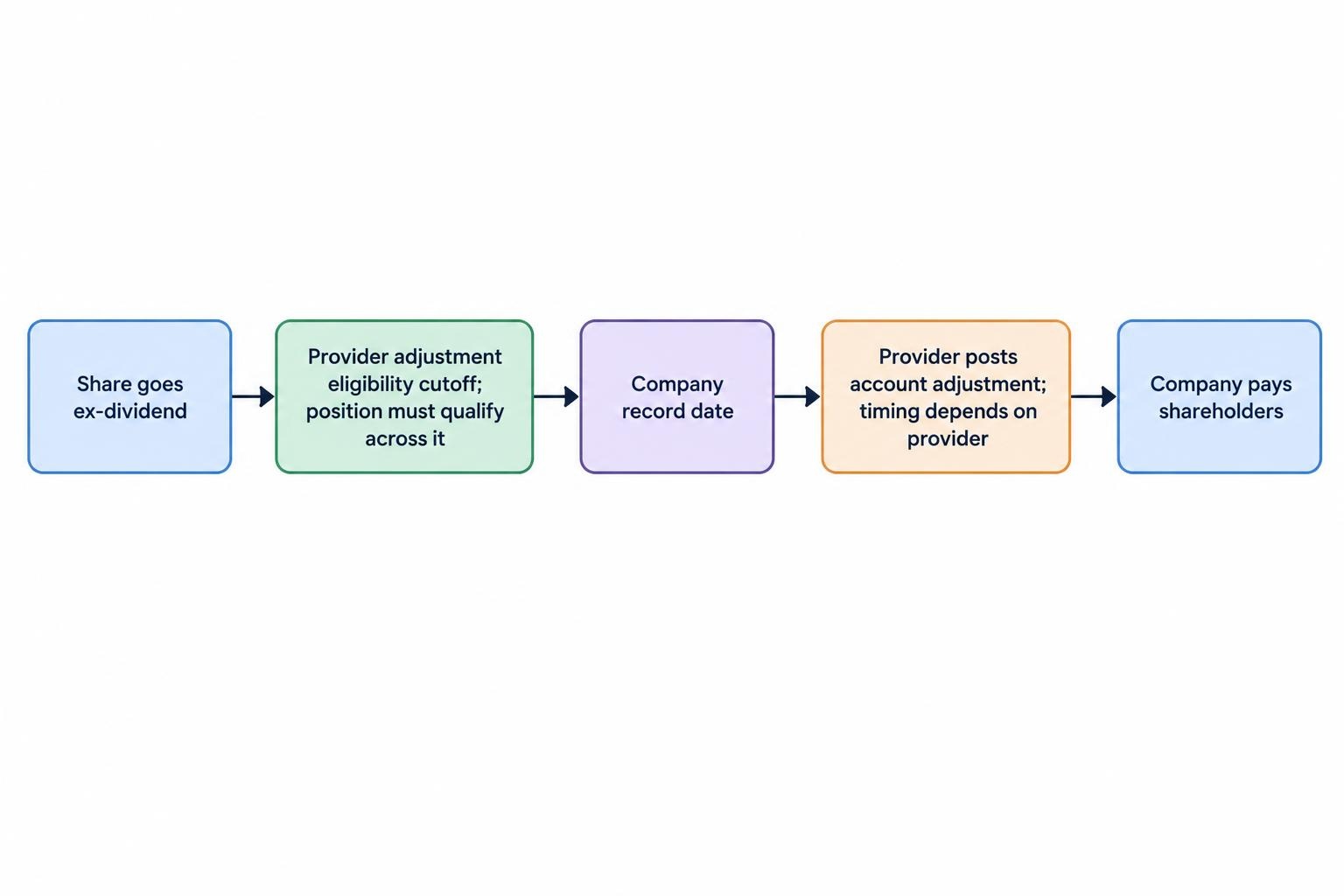
Three dates need separating. The ex-dividend date is when the share begins trading without entitlement to the upcoming dividend. The record date identifies eligible shareholders on the company’s register. The payment date is when the company pays its shareholders.
For spread betting, focus on the provider’s adjustment cutoff around the ex-dividend date. A qualifying position normally needs to remain open across that cutoff. Opening a position after the share has gone ex-dividend does not ordinarily qualify it for the adjustment relating to that dividend.
Do not assume the shareholder payment date is also the day your spread betting account will be adjusted. Establish both the eligibility cutoff and the expected posting date before holding the position overnight. They answer different questions: whether an adjustment applies, and when it appears.
The London Stock Exchange’s 2026 dividend timetable normally pairs a Thursday ex-dividend date with a Friday record date, but includes holiday exceptions and procedures for other timetables. Use the company’s announced dates and the provider’s notice rather than treating Thursday as a permanent rule, especially for overseas shares.
Why the Share Price Also Changes
Before the ex-dividend date, buying the underlying share carries entitlement to the upcoming distribution. Once the share trades ex-dividend, a new buyer no longer receives that payment. The SEC’s explanation of ex-dividend entitlement distinguishes this change in entitlement from the later payment date.
All else being equal, removing the dividend entitlement reduces the share’s theoretical value by the dividend amount. A share priced at 1,000p before going ex-dividend with a 20p distribution would therefore have a theoretical ex-dividend value of 980p.
That is an accounting comparison, not a guaranteed opening quote. News, changes in the wider market and buying or selling pressure can move the actual price above or below 980p. The dividend adjustment addresses the distribution; it does not cancel unrelated market movements.
How to Calculate a Share Dividend Adjustment
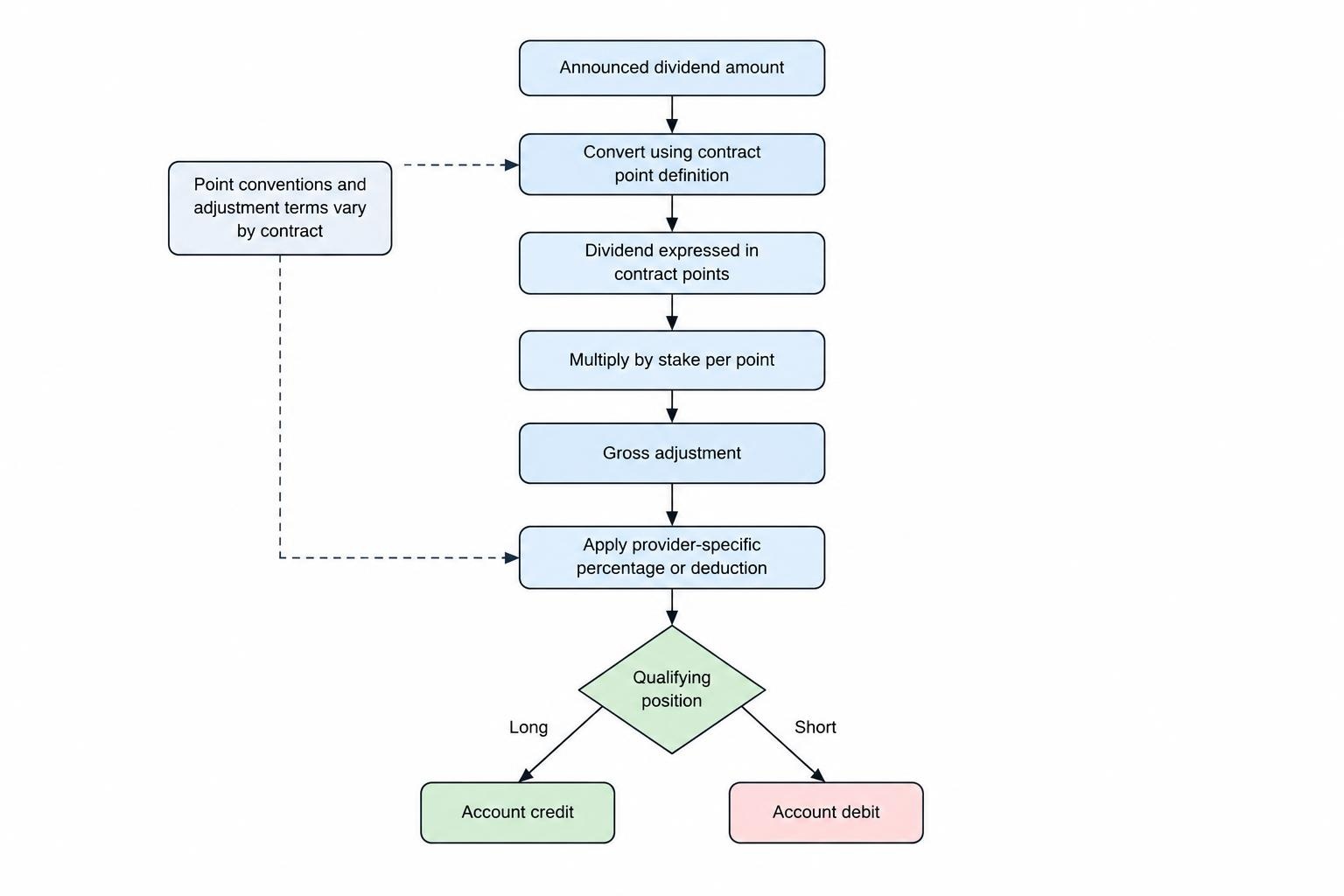
Start by translating the dividend into the same points used by the spread betting contract. Before deductions, the calculation is:
Dividend adjustment = dividend expressed in contract points × stake per point.
Suppose a UK share contract defines one point as a 1p movement. A dividend of 20p equals 20 points. At £2 per point, the gross adjustment is 20 × £2 = £40. A qualifying long position would receive a £40 credit if the contract pays the full gross amount; a qualifying short would incur a £40 debit if charged on the same basis.
The units matter. Multiplying £0.20 by a £2 stake gives the wrong result because the dividend has not been converted into contract points. The stake per point calculation must match the market’s definition of a point.
The same check applies overseas. If a US share contract defines one point as one US cent, a $0.50 dividend represents 50 points. At £1 per point, that produces a £50 gross adjustment before any contractual deduction. This example assumes that exact point convention; confirm it on the trade ticket rather than applying it to every US share market.
Worked Example: Long and Short Positions
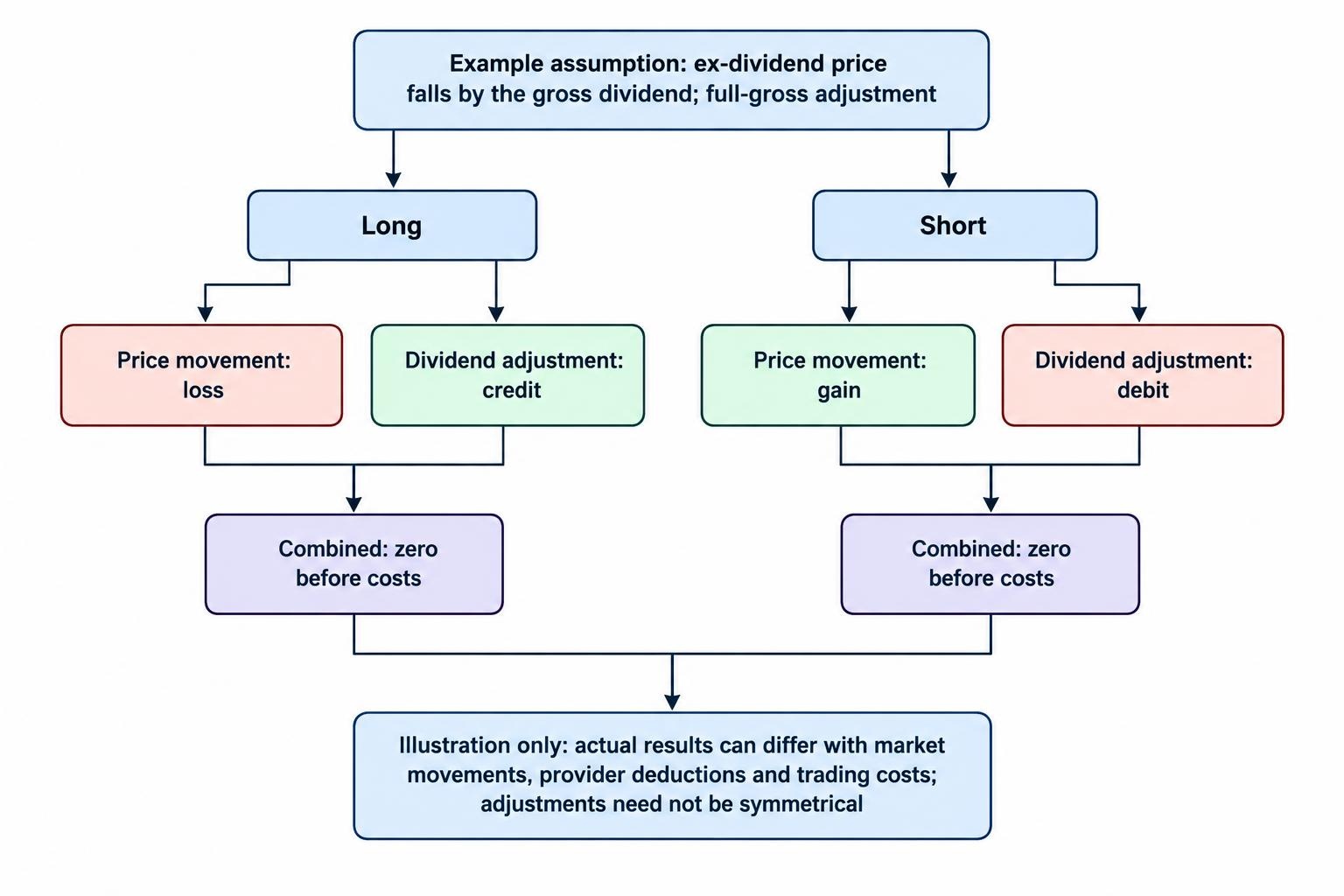
Assume a share moves from 1,000p to 980p when it goes ex-dividend with a 20p distribution. The stake is £2 per point, and both sides receive a full gross adjustment. The table isolates the dividend effect: it excludes the dealing spread, financing, deductions and other price changes.
| Account movement | Long position | Short position |
|---|---|---|
| Price movement from 1,000p to 980p | £40 loss | £40 profit |
| Dividend adjustment | £40 credit | £40 debit |
| Combined result before costs | £0 | £0 |
The long holder has not earned £40 of extra profit: the credit offsets the £40 price loss. Nor has the short seller earned a free £40 from the expected price decline: the debit offsets that gain. This is particularly relevant when short selling shares through spread betting around dividend dates.
Now change the opening price to 990p. The long position loses £20 on price but receives £40, leaving £20 before costs. The short gains £20 on price but pays £40, leaving a £20 loss. The market has performed better than the simple 980p theoretical reference.
Buying immediately before the cutoff and selling immediately afterwards therefore does not create a mechanical dividend profit. Any result must account for both the price movement and adjustment, then subtract share spread betting costs. A cash credit is only one line of the calculation.
Gross Dividends, Deductions and US Shares
A quoted gross dividend is not a promise that the same amount will reach your account. Establish the percentage payable on long positions, the basis of the short charge and whether any deduction is described as tax withholding or a contractual adjustment.
As a hypothetical example, suppose the gross long adjustment is £40 but the contract credits 90%, or £36. If the price-related loss is £40, the combined result is a £4 loss before other costs. The 90% figure here is an illustration, not a standard market rate.
US shares require care because certain dividend-equivalent payments on derivatives can attract US withholding even though the holder does not own the underlying stock. The IRS Publication 515 provisions on dividend equivalents describe their treatment as US-source dividends for withholding purposes. Do not assume that using a UK spread betting account removes this issue.
Ask the provider which treatment applies to the instrument and what documentation it requires. Keep the gross calculation and deduction separate in your records. That makes it possible to distinguish a correctly applied deduction from a wrong stake, point size or dividend amount.
What Happens to Stops and Margin?
A dividend adjustment can affect more than the account’s cash balance. Providers may also adjust stop levels or other position settings under their corporate action terms. Guaranteed stops should not be assumed to remain unchanged: the Financial Ombudsman decision on dividend adjustments and guaranteed stops documents a dispute involving cash adjustments, stop settings and margin calculations.
Before the cutoff, ask whether the provider adjusts ordinary stops, guaranteed stops and attached limits, and how it calculates each change. A general answer that “the dividend will be credited” does not answer those order-management questions.
For a long position, an unchanged stop could sit closer to the expected ex-dividend price after the distribution is removed. A contractual stop adjustment may address that change, but it does not remove unrelated gap risk. Ordinary stops can still execute at a worse price during a market gap.
Review risk management with stop losses alongside the dividend notice. Check account equity and available margin after processing, not just the cash credit. Cash balance alone does not show whether the position’s running loss, order settings or margin requirement have also changed.
Special Dividends and Dated Contracts
Do not automatically apply the ordinary cash-dividend calculation to a special dividend, return of capital or distribution linked to a share consolidation. Read the provider’s event notice for the announced treatment, including whether it changes the position’s reference price, stake, attached orders or cash balance.
If a company combines a distribution with another event, reconcile the whole event rather than treating the cash entry as the complete adjustment. The separate guide to corporate actions and spread bets covers these broader changes without confusing them with an ordinary dividend.
Contract type also matters. The examples above concern cash or rolling share bets with a separate dividend adjustment. With a dated contract, check whether expected dividends are already reflected in the quote and what adjustment provisions apply. Do not add an assumed cash credit to a calculation that already includes the dividend effect through its pricing.
Are Dividend Adjustments Taxed Like Shareholder Dividends?
A statement entry labelled “dividend adjustment” is not, by itself, evidence that you received an ordinary shareholder dividend. The starting point is the legal and economic nature of the spread betting contract.
For individuals, HMRC’s capital gains guidance on financial spread betting states that no chargeable gains or allowable losses arise from spread betting. That also means a spread betting loss does not automatically become a capital loss available against gains elsewhere.
Income tax treatment requires a separate assessment. HMRC’s guidance on spread betting and trading income makes the terms of the contract and the economic substance relevant to whether a particular bet is taxable. Do not treat “tax-free” as an unconditional description covering every person, business arrangement or jurisdiction.
UK tax treatment and overseas withholding are also separate questions. Use the UK spread betting tax guides for the wider position, and obtain tax advice where your circumstances fall outside straightforward personal speculation.
Checking the Adjustment on Your Statement
Reconcile the dividend against the position that existed at the eligibility cutoff, particularly if you increased or reduced the stake nearby. Use the announced dividend amount and currency, the contract’s point definition and the provider’s stated adjustment percentage.
Then compare the expected amount with the posted entry. A separate cash adjustment and a movement in running profit or loss can both be correct; the worked example shows why. Review them together before deciding that the adjustment has been omitted or counted twice.
The guide to spread betting account statements helps separate cash movements from open-position profit and loss. If an entry still appears wrong, send the provider the instrument name, position reference, qualifying stake, dividend notice and your calculation.
Before holding a share spread bet across an ex-dividend date, confirm four things:
- The eligibility cutoff and expected posting time.
- The dividend amount in contract points and the applicable credit or debit percentage.
- Any changes to attached orders and margin calculations.
- The combined effect of price movement, adjustment and trading costs.
The useful number is the position’s total result, not the size of its dividend credit. Treat the adjustment as part of the trade’s accounting, never as protection against the share moving against you.