Commodity spread betting brokers let you take long or short positions on markets such as gold, crude oil and wheat using a cash stake per point. You trade a price movement rather than buying bullion, taking delivery of oil or holding an exchange futures contract yourself.
The useful comparison is not simply which broker lists the most commodities. It is which provider offers the contract you want, at a manageable stake, with clear pricing and suitable order controls. A narrow gold spread does little for a trader whose main market is Brent crude.
When comparing spread betting brokers, start with the legal entity and account type, then examine contract details, costs and execution. This guide focuses on those commodity trading checks rather than treating one provider as the right choice for every strategy.
Risk warning: Commodity spread betting can produce rapid losses. Margin is a deposit against exposure, not a ceiling on the loss from an individual trade.
How to Compare Commodity Spread Betting Brokers
Build a shortlist around the markets and holding periods you actually intend to trade. Someone trading gold for twenty minutes needs a different cost comparison from someone holding an oil position for three weeks.
Use four initial filters:
- Account suitability: the correct regulated entity, permission to provide the service and a spread betting account rather than a CFD account.
- Contract suitability: the right commodity benchmark, point definition, minimum stake and contract duration.
- Total cost: the dealing spread, holding adjustments, any rollover charges and optional order premiums.
- Trading controls: suitable stops, clear margin information, reliable order management and accessible support.
Apply these filters before comparing chart layouts or mobile app appearance. A platform can look excellent and still offer the wrong oil benchmark, an awkward minimum stake or a funding method that does not suit your holding period.
Also separate essential requirements from preferences. If you need a guaranteed stop on natural gas, availability on that exact contract is a pass or fail condition. A convenient watchlist is not.
Check the Legal Entity and Account Type
Check the business that will hold your account, not just the brand displayed above the application form. Match its legal name, regulatory reference and contact details against the official record. The FCA guidance on checking a firm’s authorisation sets out how to verify permissions and warns that clone firms can copy the identity of genuine businesses.
A group operating in several countries may use different entities and account agreements. Confirm the entity named in your own agreement rather than assuming that information elsewhere on the group’s site applies to you.
Next, confirm that the account supports financial spread betting. Access to commodity CFDs does not establish that you can place a commodity spread bet. The same trading platform can display different products, account types and market menus.
Ask whether the commodities you want are available to your account classification and country of residence. Check this before completing an application or transferring money, particularly if you have reached a provider through an international landing page.
Keep a copy of the account agreement, current charges and relevant contract details. Marketing pages are useful for an initial shortlist; the terms determine how the account operates.
Look Beyond the Number of Commodity Markets
A headline market count tells you little about whether a broker covers your strategy. Separate commodities, contract months and daily versus dated products may all contribute to the advertised range. Examine the actual trading tickets.
Our commodity spread betting guide covers the markets themselves. For broker selection, concentrate on how each provider packages the exposure.
Gold, Silver and Other Metals
For a metals contract, check the benchmark, quotation currency and point definition. Do not assume that a one dollar move in gold has the same cash effect across two platforms at the same displayed stake.
Compare the available product types too. A provider may offer an undated gold market, dated contracts or both. Those choices matter if you want to hold a position through several funding cutoffs or compare a broker’s quote with an external chart.
If you trade more than one metal, inspect each separately. Suitable gold terms do not establish that silver, copper or platinum has an acceptable spread, stake increment or stop distance.
Crude Oil and Natural Gas
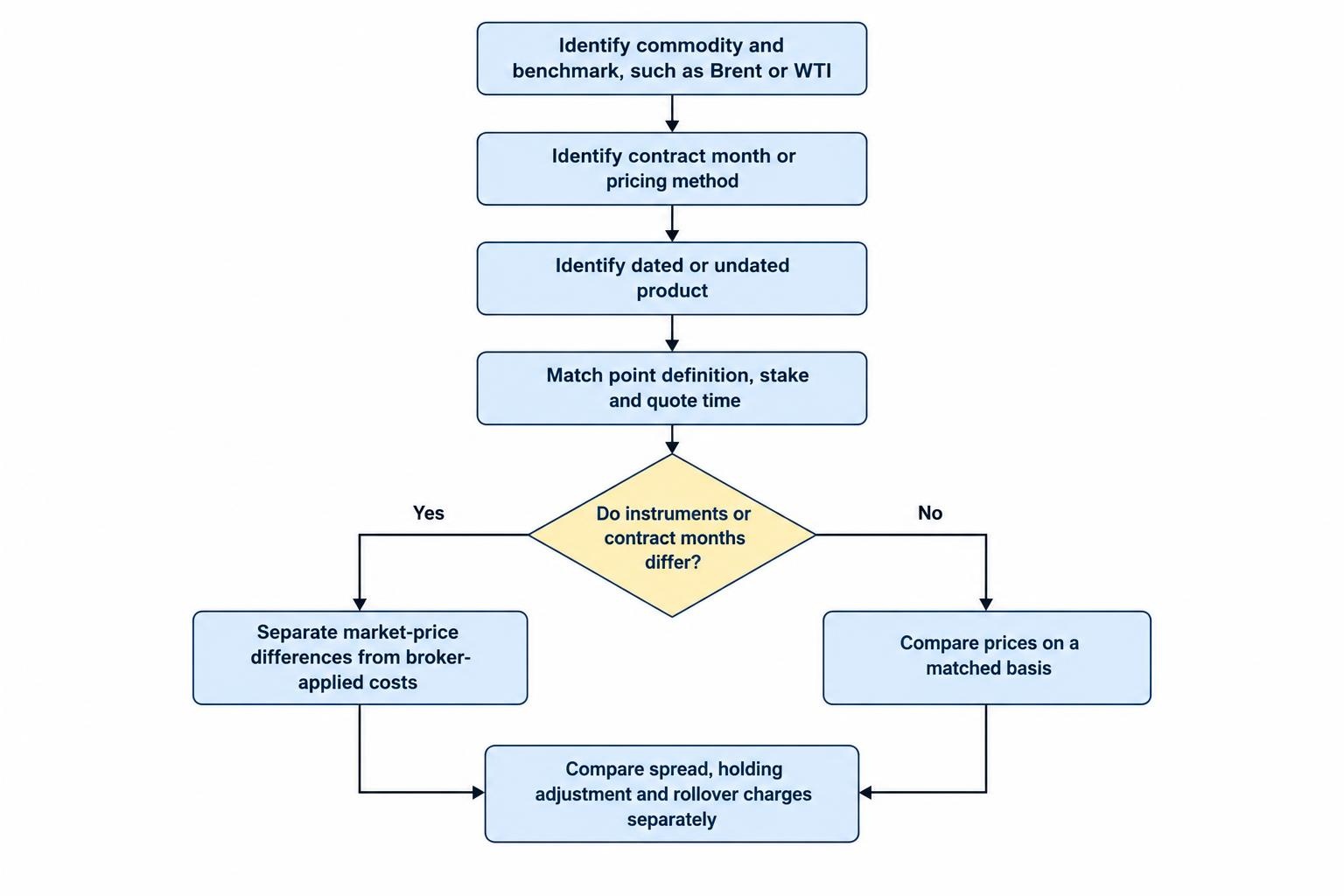
“Oil” is not a complete contract description. Confirm whether you are trading Brent or WTI, which contract month or pricing method the quote references, and how expiry is handled.
For natural gas, identify the referenced regional benchmark rather than relying on a shortened platform label. Then check whether the price displayed on your research chart represents the same instrument.
This is a practical comparison, not a naming exercise. If the chart and trading ticket reference different benchmarks or months, apparent price discrepancies may not be execution problems at all.
Agricultural and Other Commodities
Check individual contracts for markets such as wheat, corn, coffee, cocoa and sugar. Availability alone is not enough: record the minimum stake, dealing hours, expiry arrangements and available orders.
A provider with fewer markets can still be the better fit if it offers usable terms on the contracts you trade. A longer menu is not a trading edge.
Check Point Values and Minimum Stakes
Minimum deposits attract attention, but minimum stakes determine whether you can size an actual position sensibly. A small opening deposit does not make a contract suitable for a small account.
Read the broker’s definition of one point before comparing spreads or placing an order. A point might represent one cent, a fraction of a dollar or another stated increment. Decimal places on a chart are not a substitute for the contract specification.
Suppose a hypothetical oil spread bet defines one point as $0.01 per barrel. A move from $80.00 to $80.50 is then 50 points. At £2 per point, that movement produces a £100 gain or loss before charges, depending on the direction of the position.
Use the same approach when comparing providers: convert the quoted movement into points, then multiply by the stake. The explanation of stake per point covers this calculation in more detail.
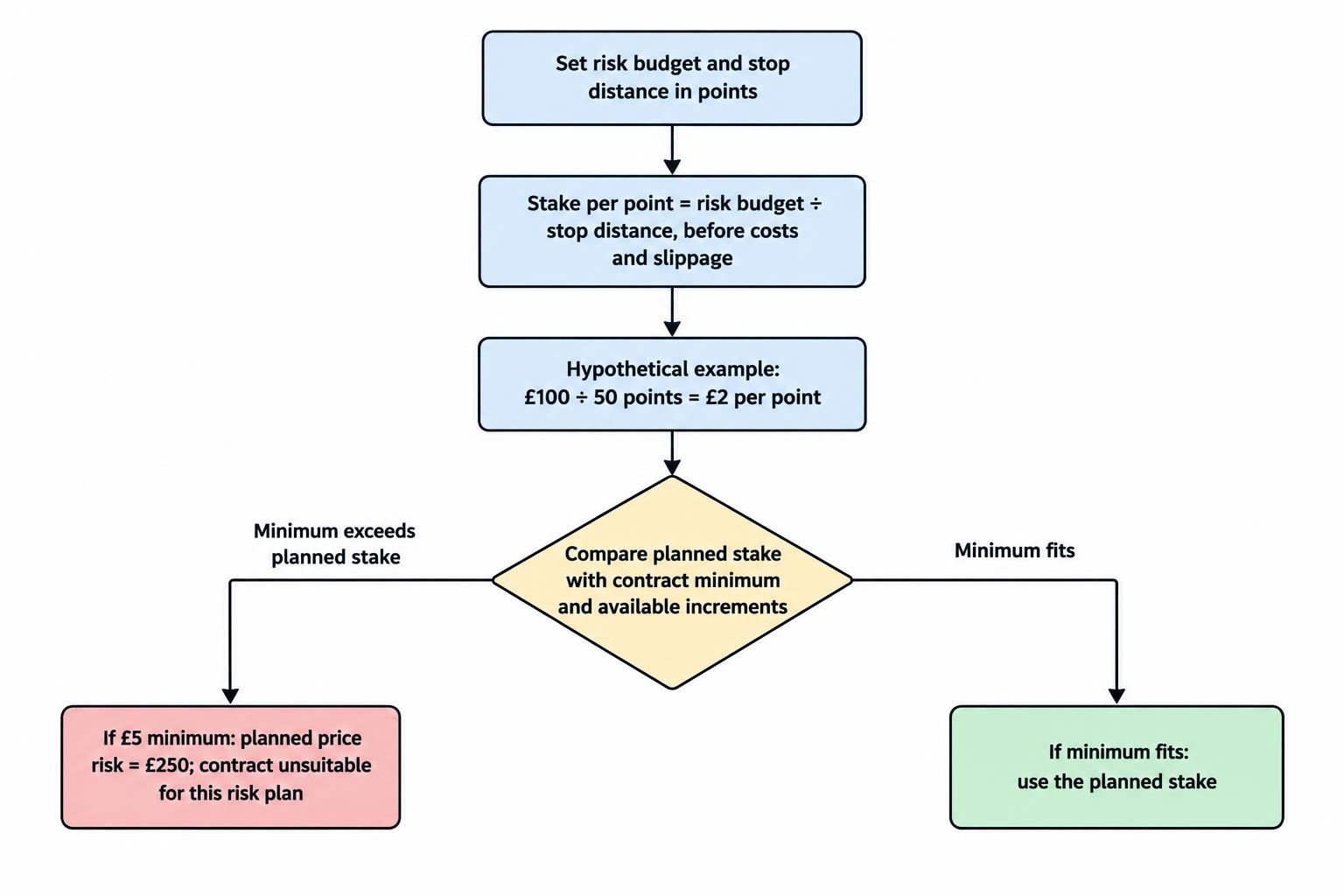
Now work backwards from the planned loss. If your risk budget is £100 and your intended stop is 50 points from the entry price, the corresponding stake is £2 per point before allowing for charges and possible slippage. If the contract’s minimum stake were £5, the planned price risk would instead be £250.
That contract would fail the sizing test. Moving the stop closer just to accommodate a larger minimum stake changes the trade rather than solving the account mismatch.
Check stake increments as well as minimums. The ability to trade £1 per point does not necessarily mean you can select £1.10 or £1.25. Use your position sizing rules to judge whether the available increments are practical.
Compare Trading Costs in Pounds, Not Just Points
The spread is the difference between the broker’s buying and selling prices. For a position opened and closed at an unchanged underlying price, an unchanged spread creates a dealing loss equal to the spread multiplied by the stake.
That makes the spread a useful starting point, but not a complete broker comparison. Holding adjustments can change the result when a position remains open beyond the provider’s daily cutoff.
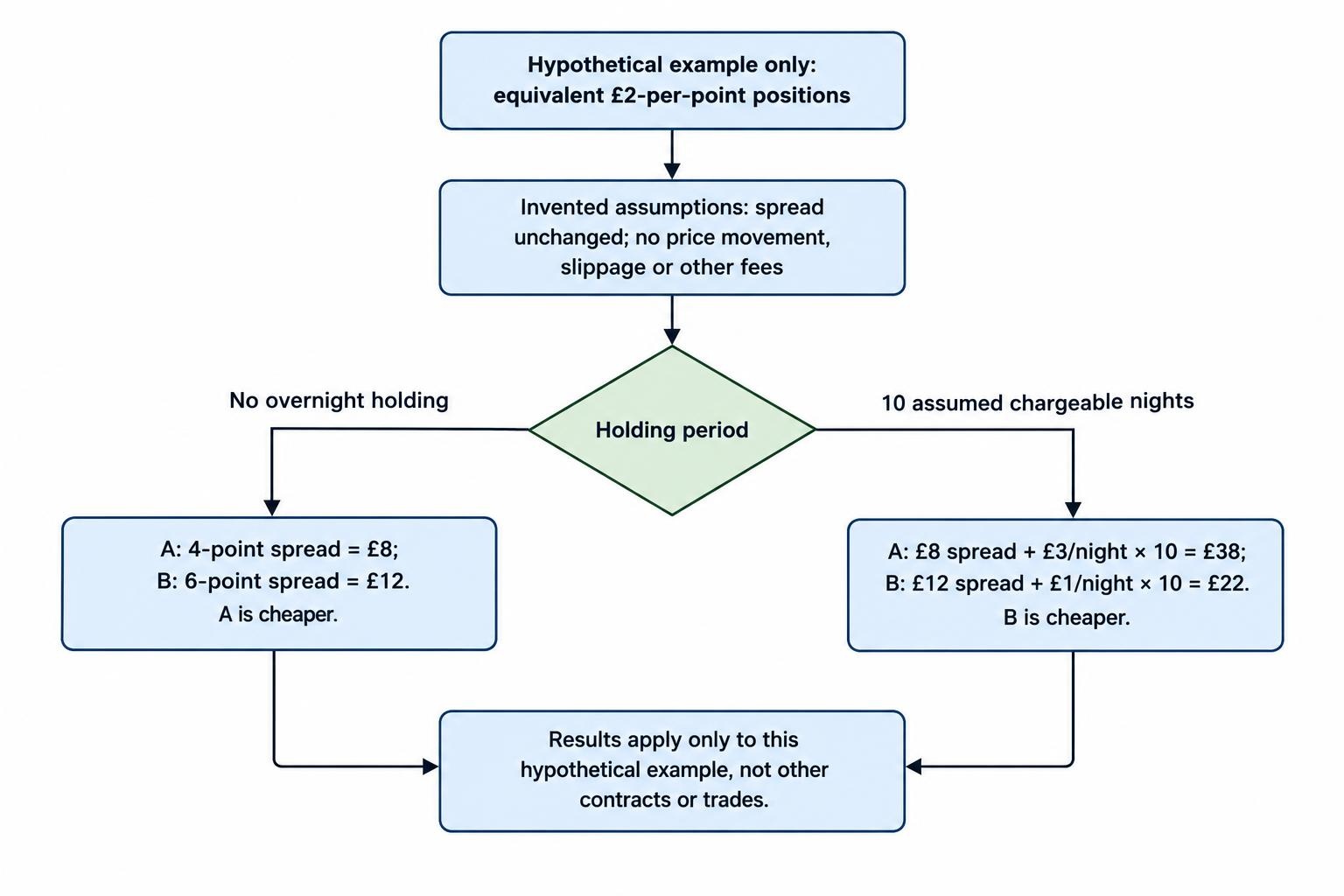
The following example uses invented quotes and charges to show the method. It assumes identical point definitions, a £2 stake, unchanged spreads and no price movement, slippage or other fees.
| Comparison item | Broker A | Broker B |
|---|---|---|
| Dealing spread | 4 points | 6 points |
| Spread cost at £2 per point | £8 | £12 |
| Assumed net holding charge per night | £3 | £1 |
| Cost with no overnight holding | £8 | £12 |
| Cost across ten chargeable nights | £38 | £22 |
Broker A is cheaper for the assumed trade without overnight holding. Broker B is cheaper over the ten chargeable nights. Neither result establishes which provider is cheaper for another commodity, direction or contract type.
For a useful comparison, collect quotes for the same benchmark, contract month, stake and trading time. Record whether the advertised spread is a minimum, a fixed spread within stated hours or a variable quote.
Check long and short holding adjustments separately. Do not assume that selling a commodity earns a daily credit, or that a charge shown on one day will remain unchanged throughout the trade.
Also ask how weekends and holidays enter the calculation. Count chargeable days rather than simply counting the number of evenings you expect to hold the position.
Guaranteed stop premiums, rollover charges and account related fees belong in the calculation when they apply. A total spread betting cost comparison should reflect the trade you intend to place, not an attractive headline quote.
Match the Contract to Your Holding Period
Commodity broker comparisons become misleading when an undated product at one provider is measured against a dated product at another. Establish the contract structure before judging the price.
Undated and Daily Funded Markets
For an undated commodity market, ask how the broker constructs the quote and calculates daily adjustments. A product labelled “cash” or “spot” does not, by itself, tell you whether its pricing references futures contracts or how those references change.
Find out which parts of the daily adjustment reflect financing, commodity pricing adjustments and the provider’s charge. Ask where the current calculation is displayed and whether you can see an estimate before opening the position.
This matters when comparing holding costs. Two providers can use different pricing and adjustment methods, so comparing one published percentage without examining the rest of the calculation can produce the wrong answer.
The comparison of daily funded bets and futures bets covers the broader product choice. For broker selection, the test is whether you can calculate the likely cost for your intended holding period.
Dated Commodity Bets
With a dated bet, check the last dealing date, settlement method and any rollover option. Do not assume the month in the market name tells you when trading ends. The ICE Brent crude futures specification, for example, places expiry before the named contract month.
Your broker’s own deadline is the one that governs the spread bet. Confirm whether a position closes automatically, can roll into another contract, or requires an instruction before a cutoff. Also check what happens to attached stops and limits.
Different contract months need not trade at the same price. Deferred futures prices above nearby prices form an upward sloping curve, commonly called contango; the reverse structure is backwardation. The CME Group analysis of oil futures curves and rolling positions shows why a sequence of headline prices is not the same as the return from holding and rolling exposure.
A price difference between months is therefore not automatically a broker fee. Separate the market price difference from any spread or charge applied during rollover. Review the provider’s spread betting expiry arrangements before treating a dated contract as an open ended position.
Check Margin Requirements and Retail Protections
For UK retail clients, the FCA requires initial margin of at least 5% for gold and 10% for commodities other than gold. These correspond to maximum exposure of 20 times and 10 times the margin respectively. Providers can require more.
The rules also require account level margin closeout when net equity falls below 50% of the relevant margin requirement, with positions closed as soon as market conditions allow. Negative balance protection restricts liability for covered products to the funds dedicated to that trading account. These requirements appear in the FCA rules for retail spread bets and similar speculative investments.
Negative balance protection does not protect your deposit from trading losses. Nor does the margin closeout threshold replace a planned exit.
When comparing brokers, record the actual margin shown for your intended stake. Ask whether larger positions attract higher margin, how changes are communicated and where the account’s closeout level is displayed.
Keep position risk separate from margin. A trade requiring £1,000 of margin is not necessarily a trade with £1,000 of planned risk. The distinction is covered in the guide to spread betting margin.
Assess Stops, Execution and Trading Hours
Check Orders on the Exact Commodity Contract
A broker’s general order menu does not establish which controls are available on every commodity. Open the intended market and check its ordinary stops, guaranteed stops, trailing stops and limit orders.
An ordinary stop triggers an instruction to close but does not guarantee the execution price. A market gap or fast price movement can lead to a worse fill. A limit order controls the acceptable price but may remain unfilled.
Where a guaranteed stop is available, inspect the premium, minimum distance, maximum position size and amendment rules. Check when the premium is charged and whether changing the order affects its cost.
If that protection is a requirement, compare brokers offering guaranteed stops on the commodity you intend to trade. Availability on an index or currency pair is not enough.
Execution deserves more attention than a platform speed slogan. Check how the platform records requested prices, actual fills and order timestamps. Find out how rejected orders appear and how to contact the dealing desk if an order’s status is unclear.
Check Hours, Breaks and Event Coverage
Record the provider’s opening hours, daily breaks and holiday arrangements. Distinguish between being able to view an indicative price, place a pending instruction and execute a trade.
Event timing matters too. The US Energy Information Administration normally releases its Weekly Petroleum Status Report at 10:30 a.m. Eastern time on Wednesday, with exceptions listed in its official petroleum report release schedule. Check the calendar rather than assuming the same day and time every week.
For broker assessment, examine quotes and order handling during the sessions your strategy uses, including relevant announcements. A spread recorded during a calm period is not a promise about the next data release.
Check how platform time relates to your local clock, particularly around daylight saving changes. The guide to commodity trading hours provides the broader scheduling context.
Test the Platform Before Funding an Account
Use a demonstration account to test the workflow, not to prove that a strategy will make money. You should be able to identify the contract, select the stake, attach an exit and understand the estimated cash exposure without guessing.
Place a hypothetical trade, amend its stop, partially close it and inspect the resulting history. Check whether pending orders remain after a position closes and whether attached orders adjust after a partial closure.
Inspect the mobile version separately if you expect to manage positions away from a desktop. Confirm that it exposes contract details and margin information, rather than only the buy and sell buttons.
Account statements matter as much as charts. Look for a clear separation between trading profit or loss, holding adjustments, rollover entries and other charges. If a daily adjustment is difficult to interpret, ask for a worked explanation before funding.
Spread betting demo accounts are useful for these operational checks, but simulated fills do not establish how live orders will execute. Treat the demo as a platform rehearsal, not an execution audit.
Choose the Broker Around the Trading Plan
For intraday trading, prioritise spreads during your trading session, usable stake increments and efficient order management. Check the funding cutoff even if you intend to close every day; an unfinished trade can become an overnight position.
For positions held over several days, compare the full holding adjustment and the dated contract alternative. Include expiry and rollover administration rather than assuming the narrowest opening spread wins.
For smaller accounts, make minimum stakes and workable stop distances the first product tests. If the smallest available position exceeds your planned risk, the broker is unsuitable for that contract regardless of its minimum deposit.
For traders using several commodities, check each market separately. Do not let good gold terms hide expensive oil exposure or impractical agricultural contract sizes.
Before depositing, you should be able to identify the account’s legal entity, explain what one point means, calculate the smallest practical position, estimate the intended trade’s costs and describe how it ends. If any answer depends on guesswork, resolve it first.
The better commodity spread betting broker is the one whose terms fit a controlled trading plan. Choose on that basis, not on the largest market count or the smallest number in an advertisement.