Broker market coverage is the range of financial markets available through a trading account. For spread betting, the useful measure is narrower: which underlying assets you can trade as spread bets, through your account’s legal entity, at a workable stake and during the hours you need.
A large advertised market count does not answer those questions. A provider could offer the index you follow but not its constituent shares, the cash contract but not a dated alternative, or buying access without allowing new short positions. The market exists on the platform; your intended trade still does not.
A sound comparison separates catalogue size from usable access. The framework below shows how to assess that access, record the evidence and compare providers without treating every symbol as an equally useful trading opportunity. The worked figures are illustrative, not results from a live broker inventory study.
What Broker Market Coverage Actually Measures
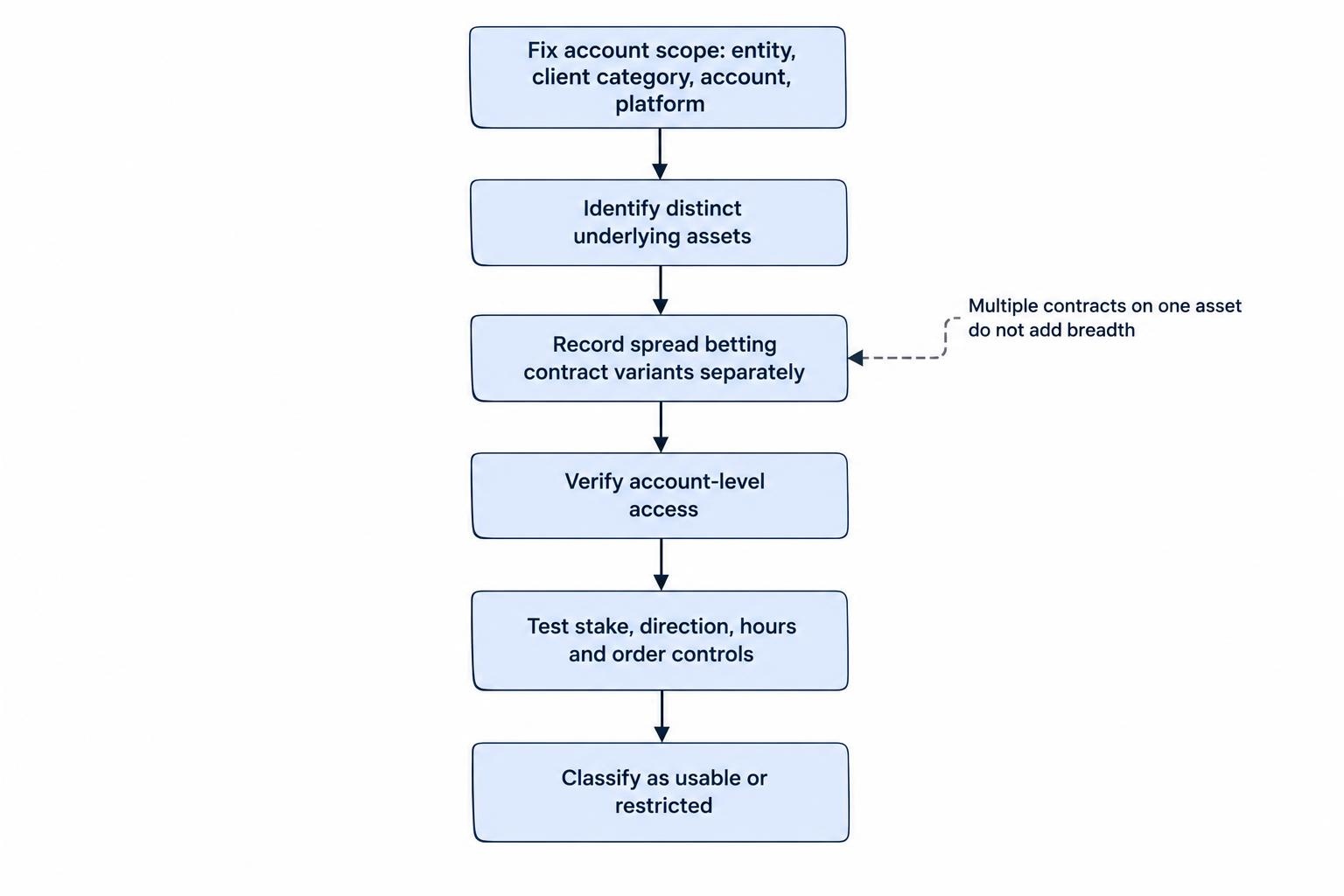
Market coverage has three layers. Breadth measures the range of underlying assets. Contract choice measures the available ways to trade each asset. Usability asks whether those contracts meet your requirements for stake size, trading hours, direction and order controls.
These layers should remain separate. Ten expiry dates on one equity index provide useful contract choice, but they do not provide exposure to ten different underlying markets. Conversely, a provider with fewer contracts could cover every asset on your watchlist.
Start with the account rather than the brand. Record the contracting company, jurisdiction, retail or professional classification, account type and platform. A comparison that mixes products from different group companies or account categories is not comparing like with like. The distinction between a trading name and the company behind an account is covered in our research on broker legal entities.
For a UK retail spread betting comparison, use that account category consistently. Do not add overseas products, professional-only contracts or share dealing instruments to the accessible spread betting total.
Why Advertised Market Totals Need Checking
Before comparing two headline numbers, establish what each number counts. Is it the number of underlying assets, platform symbols, contracts, expiry dates or products across several account types? Without a common definition, the larger figure tells you very little.
Consider a hypothetical provider offering a rolling contract and three dated contracts on the same index. That represents one underlying index and four tradable contracts. Both counts are legitimate, provided the label makes the distinction clear.
The same discipline applies to product wrappers. A share available for cash investment, CFD trading and spread betting should appear once in the count of underlying companies, with separate availability fields for each product. A combined product catalogue is not a spread betting inventory. Our spread betting versus CFDs comparison covers the product differences beyond market access.
For your own research, keep four totals separate:
- Distinct underlying assets: the shares, currency pairs, indices and other assets represented.
- Spread betting contracts: the available rolling, dated and other contract variants.
- Accessible contracts: those confirmed for the chosen entity, account and platform.
- Strategy-compatible contracts: those that pass your practical trading requirements.
Do not count a searchable symbol as confirmed access. A chart, an indicative price and an order ticket that permits a new position are different levels of evidence. Record what you actually verified.
Compare Coverage Within Each Asset Class
A single total hides where the range sits. Separate the inventory by asset class, then examine the markets that matter to your strategy. The following table is an assessment template, not a statement that every provider offers each category.
| Asset class | Coverage questions | Contract details to record |
|---|---|---|
| Forex | Are your required major, minor and less commonly traded pairs available? | Pair identity, point convention, minimum stake and dealing hours |
| Equity indices | Are the required countries, benchmarks and smaller-company indices covered? | Underlying benchmark, rolling or dated contract, session and expiry |
| Individual shares | Are your required exchanges, companies and share classes represented? | Ticker, listing venue, opening direction, minimum stake and corporate action terms |
| Commodities | Are the required metals, energy products and agricultural markets available? | Benchmark, contract month, point value, expiry and rollover treatment |
| Government bonds and rates | Are the required countries, maturities and interest rate contracts covered? | Reference contract, quotation basis, expiry and settlement terms |
| ETFs and sectors | Is the required fund or sector benchmark available as a spread bet? | Underlying identity, product wrapper, session and adjustments |
Forex: Check the Actual Pair List
Build the comparison around named currency pairs, not labels such as “major forex markets”. A trader following EUR/USD and GBP/USD has different requirements from someone following regional currencies or cross pairs.
Record both currencies and the direction in which the pair is quoted. Also separate ordinary rolling contracts from any dated alternatives. An additional expiry provides another trading format, not another currency pair.
For usability, establish what a point means on each ticket. A minimum stake of £1 per point cannot be compared sensibly until the point convention is clear. The forex spread betting guide covers those mechanics; the coverage audit should record them rather than repeat the full calculation for every pair.
Indices: Identify the Benchmark Behind the Name
Record the actual reference index rather than relying on a platform’s abbreviated market name. “US technology”, “US 100” and similar labels require a contract specification before they can be matched confidently across providers.
The distinction matters because an index name defines the exposure. The Nasdaq-100 represents 100 of the largest non-financial companies listed on Nasdaq; it is not a complete list of Nasdaq-listed businesses. The benchmark’s composition is set out in the Nasdaq-100 official factsheet.
Keep index access separate from share access. Offering a spread bet on an index does not establish that every constituent company is available individually. Nor should several contracts on one benchmark receive the same breadth score as access to several different benchmarks.
Shares: Geography Is Only the Starting Point
“UK shares” or “US shares” is too broad for a useful audit. Check named companies, listing venues and share classes. A strategy focused on large companies needs a different inventory from one that screens smaller businesses or newly listed shares.
Choose the comparison universe before checking providers. That might be a fixed watchlist, an index constituent list dated for the exercise, or a documented screening list. This prevents the denominator changing whenever one provider lacks a market.
Record buying and short-selling access separately. If your strategy requires short positions, availability only for purchases is partial coverage, not a pass. The broader share spread betting guide explains how individual equity exposure works without assuming ownership of the shares.
Commodities: A Familiar Name Is Not Enough
For oil, gas, metals and agricultural products, identify the reference benchmark and contract structure. A line labelled “oil” is not enough to establish whether it matches another provider’s product.
Expiry dates also need their own field. CME publishes an official futures and options expiration calendar, which provides reference-market dates. Those dates are a starting point for checking a futures-linked spread bet, not a substitute for the provider’s last dealing date and settlement terms.
Count distinct commodities separately from delivery months. Then assess whether the available months suit your intended holding period. For the wider market structure, use the commodity spread betting guide.
Bonds, Rates, ETFs and Sector Contracts
These categories deserve separate rows rather than a miscellaneous total. For government bond exposure, record the country, reference contract and maturity segment. For interest rate products, record the benchmark, quotation basis and contract period. A familiar country name does not make two contracts interchangeable.
For ETFs, distinguish a spread bet referencing a fund from a facility to purchase fund units. For sector products, establish whether the reference is an independently maintained index or a provider-defined basket. If it is a basket, record its composition rules before treating it as a comparable market.
Leave unclear products unconfirmed. A neat spreadsheet is not worth a false equivalence.
Contract Choice and Trading Hours Change the Result
Rolling and Dated Contracts Are Different Coverage Features
Once the underlying asset is confirmed, assess the contract formats. A trader holding positions for several hours may need only one format. A trader planning to hold for weeks may want to compare financing, expiry and rollover terms before deciding which version is usable.
Keep this separate from a cost ranking. First establish whether a suitable contract exists. Then compare its expected holding costs. Our daily funded bets versus futures comparison covers that decision in more detail.
For each dated contract, record the named expiry, last dealing time, settlement method and any rollover instruction. For a rolling contract, record the daily funding cutoff and adjustment terms. A continuous-looking chart should not replace those details.
Exchange Hours Are Not the Same as Provider Hours
Use exchange schedules as reference points, then check the spread betting contract’s own dealing session. The NYSE’s core equity session runs from 9:30 a.m. to 4:00 p.m. Eastern Time, with other sessions depending on the venue and security, as shown in its official trading hours.
That schedule does not establish when a provider will quote a spread bet on an NYSE-listed share. Record the provider’s opening and closing times, any daily breaks, holiday changes and the time zone used.
Also distinguish order entry from execution. Being able to submit an instruction while a market is closed does not mean it can execute immediately. If access around earnings announcements or an index opening matters, verify that exact window. The spread betting trading hours guide covers session terminology.
Separate Standard, Extended and Weekend Access
If a provider offers an additional session, record whether it uses the same contract and how positions are treated when the standard session resumes. Check the available order types, stop terms and quoting arrangements for that session rather than carrying assumptions across from ordinary hours.
For weekend products, ask whether the position closes independently, transfers into another contract or receives an adjustment. Treat the answer as part of the contract specification. Extra hours deserve credit only if you understand what you would be trading.
When an Available Market Is Not a Usable Market
Minimum Stakes Can Rule Out an Otherwise Suitable Contract
Suppose a trader sets a planned loss budget of £60 and places an ordinary stop 120 points from entry. Before costs and execution differences, the corresponding stake is £0.50 per point. If a hypothetical contract requires at least £1 per point, the planned price risk becomes £120.
The market is available, but it fails that trader’s sizing requirement. Moving the stop closer just to accommodate the minimum stake changes the trade rather than solving the access problem.
This is planned risk, not a guaranteed loss ceiling: execution beyond an ordinary stop and other costs can increase the loss. Use the position sizing guide to set the stake first, then test whether the contract permits it.
Direction, Margin and Order Controls Need Separate Fields
For every required market, check whether you can open a new long position, a new short position, or neither. Mark “close only” separately from “absent”. It describes a different access restriction, particularly if an existing position still needs managing.
Record the margin requirement at the intended trade size, including any size tiers. Do not use the smallest advertised margin as the answer for every position.
Order controls also need market-level confirmation. If a strategy requires a guaranteed stop, a trailing stop or a particular pending order, verify that feature on the relevant ticket. Account-level feature lists are not enough.
A Quote Is Not an Execution Study
A displayed bid and ask provide evidence of a quote at one moment. They do not establish the fill price, the treatment of a larger order or performance during a fast market.
Keep coverage research and execution research separate. A market can pass the availability test while its execution characteristics remain untested. Our broker execution quality research addresses that second question.
This separation keeps the findings honest. “Confirmed in the live order ticket” is a defensible observation. “Reliable execution in all conditions” requires evidence of a very different kind.
UK Retail Eligibility Sets the Boundary
A UK retail comparison must exclude products that are not available to that client category. The FCA prohibits the sale, distribution and retail marketing of the cryptoasset derivatives covered by its rules. A crypto section in a group-wide catalogue therefore does not establish UK retail crypto spread betting access. Access to an exchange traded note is also not access to a spread bet; the product distinction matters under FCA rules on retail cryptoasset derivatives.
Keep the account classification fixed throughout the comparison. Do not use professional account access or an overseas entity’s catalogue to fill gaps in a UK retail inventory.
For in-scope retail accounts, FCA rules set minimum opening margins, require position close-out when account equity falls below 50% of the required margin as soon as market conditions allow, and restrict liability to funds dedicated to trading the covered products. These protections sit within FCA restrictions on retail spread bets and similar investments.
Wider product access should not be treated as an automatic reason to change classification. The differences extend beyond the market menu, as covered in our guide to retail and professional client classification.
A Repeatable Market Coverage Audit
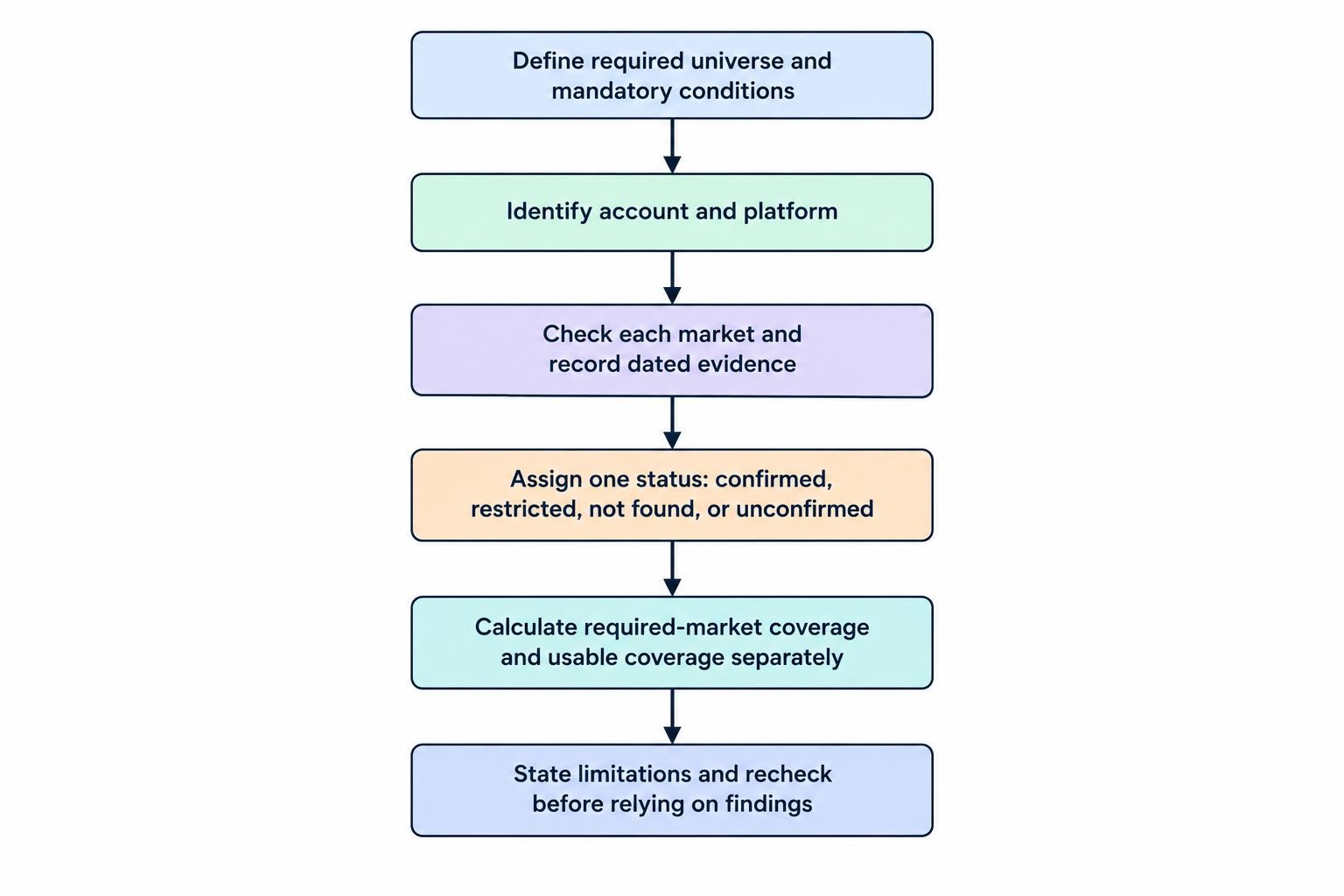
A useful audit should let another person check the result. That means fixing the comparison rules, preserving evidence and stating what was not tested.
Define the Required Universe Before Collecting Data
Write down the markets you need, the intended contract formats and the account conditions. Add practical requirements such as short access, maximum acceptable minimum stake and the necessary trading session.
Separate mandatory requirements from preferences. A missing contract that is central to the strategy should not be offset by hundreds of unrelated shares. Apply those pass or fail conditions before calculating a score.
For a published comparison, define whether the universe represents a particular trader profile or a broader benchmark. A small intraday watchlist can support a useful personal decision, but not a claim about the entire market range.
Use an Evidence Record for Every Market
Each spreadsheet row should identify the provider entity, account category, platform, underlying asset, exact contract name and date checked. Add the minimum stake, point convention, permitted direction, session, margin and required order features.
Use a consistent set of access statuses:
- Confirmed: the relevant account and order ticket show the required new-position access.
- Restricted: the contract exists, but direction, size, session or another condition prevents the intended trade.
- Not found: the search and documentation checks did not locate the required contract.
- Unconfirmed: public material suggests availability, but account-level access has not been established.
“Not found” is more careful than “not offered” when the evidence is incomplete. Keep any dated confirmation from support alongside the relevant row, especially when the contract name differs from the underlying market name.
A spread betting demo account can help you inspect search functions, contract names and ticket settings. Record demo observations as demo evidence. They do not confirm live permission, live execution or identical live terms.
Report Coverage and Usability Separately
Required-market coverage = confirmed required underlying assets ÷ total required underlying assets × 100.
Usable coverage = required underlying assets with at least one contract meeting every mandatory condition ÷ total required underlying assets × 100.
Use underlying assets as the denominator in both calculations. Report contract variants separately. Otherwise, a provider could receive extra breadth credit simply because it offers more expiries on an already covered asset.
If you add a weighted score, publish the weights and set them before examining the results. Keep missing mandatory markets visible even when the weighted result is high. A decimal score should not hide a failed requirement.
Finally, date the findings. State which accounts and platforms were checked, which observations came from documentation or demos, and whether any orders were actually executed. Recheck access before relying on an old comparison for a new trade.
Worked Example: Fewer Markets, Better Watchlist Coverage
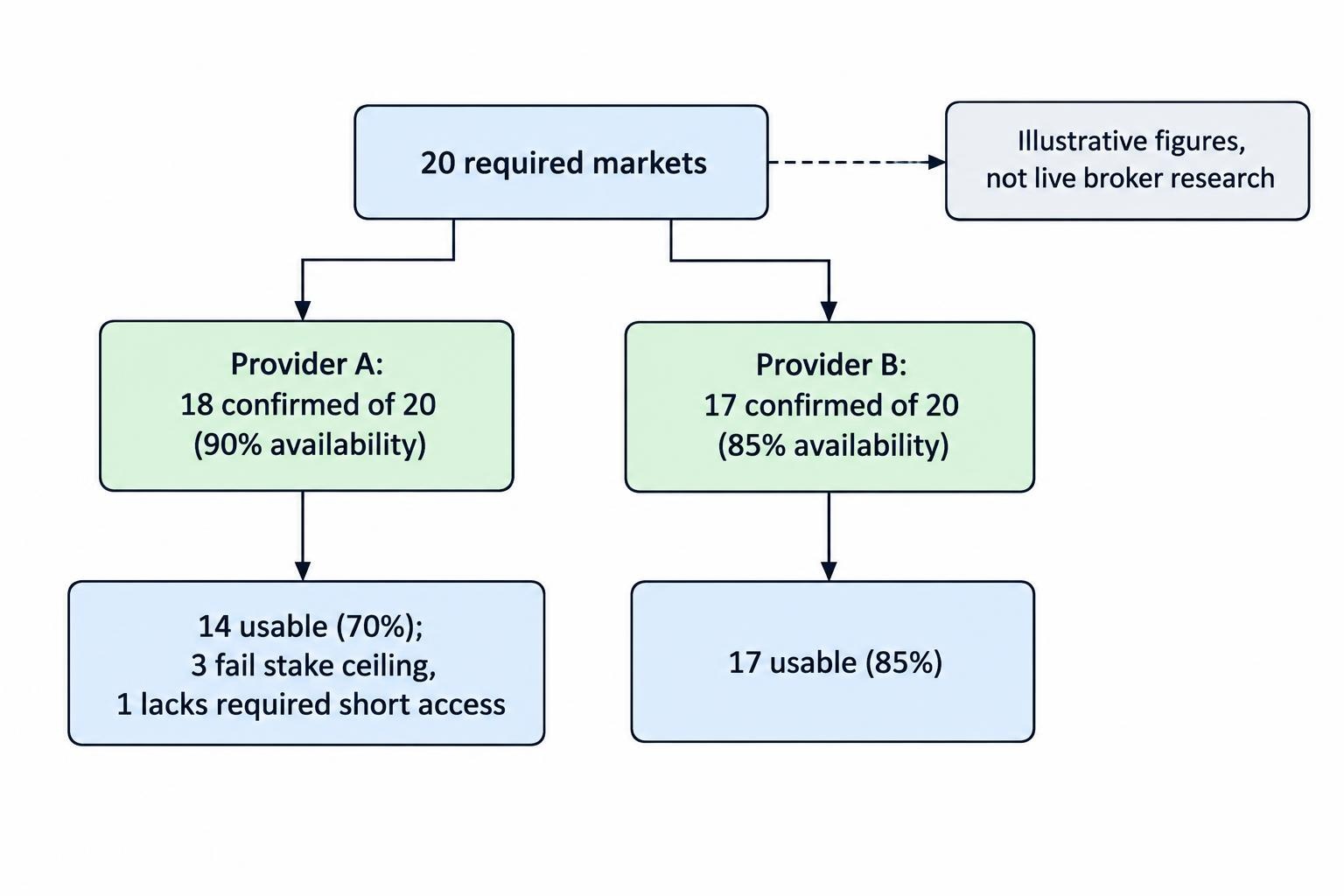
Consider two fictional providers assessed against a fixed list of 20 required underlying markets. Assume Provider A confirms 18 and Provider B confirms 17.
Provider A therefore has 90% required-market coverage. Provider B has 85%. On availability alone, A leads.
Now apply the practical conditions. Three of A’s confirmed markets require stakes above the trader’s ceiling, and one further market lacks the required short access. That leaves 14 usable markets, or 70% of the original list.
All 17 confirmed markets at Provider B meet the same conditions. Its usable coverage remains 85%. B provides better access for this defined watchlist despite covering fewer of its underlying assets.
The result could change for another trader. Someone using larger stakes and taking only long positions might prefer A’s range. That is why the account assumptions and strategy requirements belong beside the result, not buried beneath it.
Neither percentage establishes which provider has better pricing or execution. Those require separate comparisons using the same intended trade sizes and holding periods.
Choose Coverage That Matches the Trading Plan
Choose the range that supports the trades you intend to make. An index trader may need only a few benchmarks, suitable contract formats and dependable access during a chosen session. A share trader screening many companies needs a broader equity inventory and more frequent checks on individual-market restrictions.
Once providers pass the coverage requirements, compare the cost of using the relevant contracts. Spread, financing, rollover treatment and any applicable order premiums belong in a total spread betting cost comparison, not inside an unexplained market-count score.
The decision should rest on a short set of verified facts: the required underlying exists, the correct spread betting contract is accessible, and its stake, direction, session and controls fit the plan. Everything beyond that is optional range.
Spread betting involves a high risk of rapid losses. A longer market menu does not make an individual position safer, and there is no obligation to trade everything on it.