Position trading with financial spread betting means holding a planned market exposure for an extended period, commonly several weeks or months, to participate in a broader price movement. The trader usually makes fewer entry decisions than a day trader and accepts fluctuations within the holding period. That slower pace does not make the product passive or low risk. Financing, changing margin requirements, overnight gaps and contract expiry can affect the result long before the original market view has played out. This guide explains how position spread betting works, who it may suit, its advantages and disadvantages, and how to evaluate a practical approach. All examples are hypothetical and distinguish price profit from the result after carrying costs and adjustments.
What is position trading in financial spread betting?
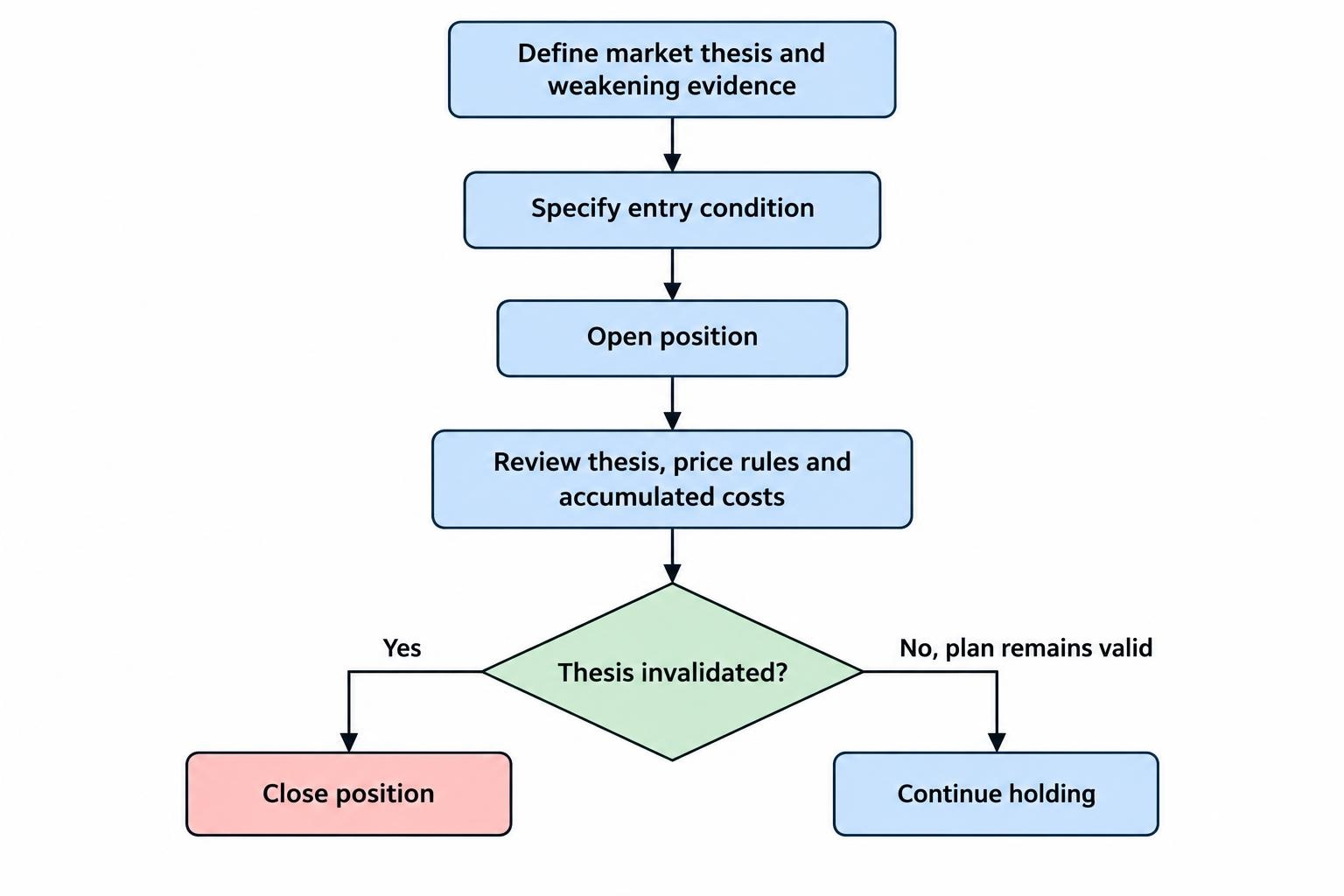
Position trading describes a holding approach rather than one entry signal. A trader might build a view around a sustained economic change, company developments, commodity conditions or a longer-term price trend. The entry and exit can use fundamental analysis, technical analysis or a defined combination. There is no universal number of days that separates a position trade from a swing trade. What matters is that the longer holding period, review process and exposure were planned before entry. Within financial spread betting strategies, position trading provides the framework for maintaining a view over time. It still requires clear rules for invalidation, costs and exit; patience alone does not turn an uncertain forecast into a workable method.
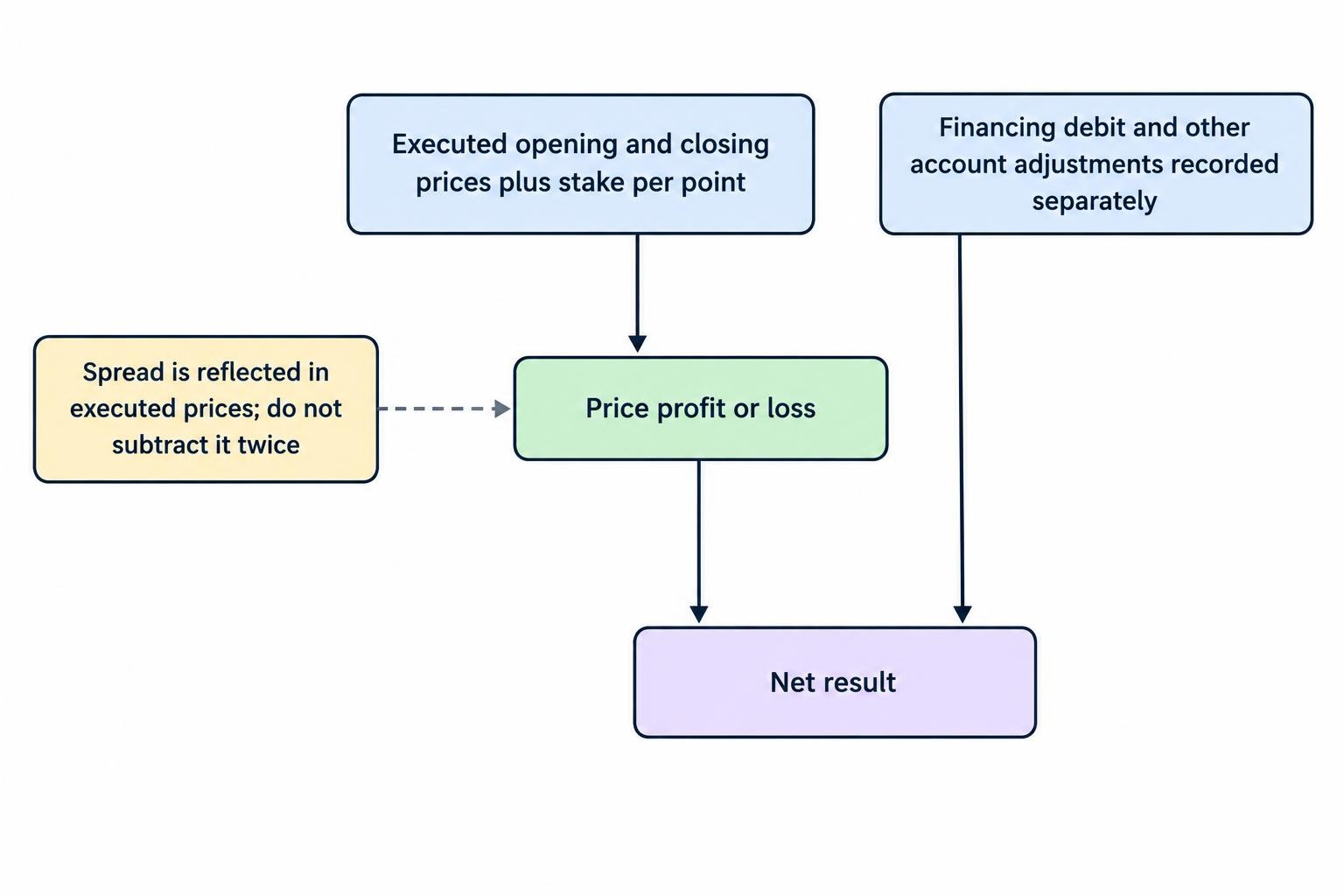
The spread bet provides exposure without ownership of the underlying asset. A long position opens at the buy price and closes at the sell price; a short opens at the sell price and closes at the buy price. Price profit or loss is the difference between those executed prices multiplied by the stake per point, with financing and other adjustments included separately. The FCA includes spread betting within its supervision of contracts for difference and related products, which it identifies as high risk. Holding for several months does not change that classification or remove the possibility of rapid losses. A position can encounter a gap, margin pressure or a contractual event even when its original thesis concerns a much longer period.
Position trading versus swing trading, day trading and investing
Day trading normally closes exposure during the session, while swing trading commonly holds through several sessions to capture an intermediate move. Position trading generally allows a broader development to unfold and may use daily or weekly charts for its main decisions. The boundaries overlap, so the label matters less than the actual rules. A trader needs to specify how long the idea is expected to take, how often it will be reviewed and what would justify closing earlier. Reclassifying a failed day trade as a position trade changes its cost and risk assumptions. A longer chart showing a favourable direction does not retrospectively supply the plan that was missing when the position opened.
Position spread betting also differs from buying an asset outright. A share spread bet does not make the trader a shareholder, and dividend adjustments are contractual cash flows rather than dividends received through ownership. A fully paid investment does not have the same spread-bet margin mechanism or daily funding structure, although it has its own costs and market risks. For a view expected to last many months, compare whether the intended exposure requires a spread bet at all. Directional flexibility and a small initial margin can be useful features, but neither establishes that the contract is economical for a long hold. The appropriate comparison considers total cost, ownership rights, exposure, taxation and the ability to remain invested during adverse movements.
| Feature | Day trading | Swing trading | Position trading through spread bets |
|---|---|---|---|
| Typical holding period | Within a session | Several sessions to weeks | Often weeks to months |
| Main decision horizon | Intraday movement | Intermediate movement | A broader thesis or sustained trend |
| Monitoring | Active during the trading window | Scheduled reviews plus event monitoring | Planned reviews plus ongoing account and event monitoring |
| Overnight exposure | Normally avoided by design | Common | Usually part of the plan |
| Carrying-cost importance | Usually lower if closed before the relevant cut-off | Can be material | Can materially change the strategy’s economics |
| Common failure | Intraday losses exceed the plan | A swing reverses or gaps | Costs, thesis failure or account constraints end the position |
Who might position trading suit?
Position trading may suit someone who prefers fewer decisions, can develop a written market view and is comfortable allowing a trade to fluctuate without reacting to every short-term movement. It can be easier to organise around a scheduled review process than a strategy requiring continuous screen attention. The trader still needs to respond to material events and changes in account conditions between those reviews. A suitable temperament includes patience, willingness to revise the thesis and acceptance that the final exit may occur below the highest unrealised profit. The approach also requires capital that can remain committed without depending on a near-term withdrawal. A long expected holding period and a short personal deadline for needing the money are a poor combination.
It may be unsuitable for someone who treats a longer horizon as permission to ignore losses, automatically adds to losing positions or assumes that a fundamentally sensible view must eventually be profitable. A market can move against the position for longer than the account can support. Beginners may appreciate having more time to analyse decisions, but slower trading still requires an understanding of funding, point values, expiry and margin. A person who cannot monitor open exposure or respond to contractual changes should not confuse fewer entry decisions with no management requirement. Position trading also produces relatively few completed observations over a short learning period, making a handful of successful trades weak evidence that the method works across different conditions.
Advantages and disadvantages of position spread betting
One potential advantage is the ability to organise a trade around a broader development instead of repeatedly forecasting small movements. A longer horizon can reduce transaction frequency and give a well-defined thesis time to develop. Daily or weekly decision rules may also be easier to follow around other commitments than very short-term signals. Spread betting permits both long and short expressions, subject to availability and contract terms, and the stake per point makes the immediate price sensitivity explicit. These features can make a process understandable and manageable. They do not establish superior returns, and lower turnover does not necessarily mean lower total cost. A position entered once can still become expensive if it remains financed for many months.
The disadvantages include accumulating carrying costs, exposure across market closures and the difficulty of separating an ordinary fluctuation from a failed thesis. A wider stop can mean a smaller suitable stake, not a licence to risk more money. The account may also face higher margin requirements or an expiring contract before the expected move is complete. Long periods without a clear result can encourage attachment to the original view, especially after substantial research. A trader may keep extending the deadline or moving the exit because closing would acknowledge that the idea failed. The method therefore needs scheduled reviews and pre-defined failure conditions. A persuasive economic explanation should remain open to revision rather than become a reason to disregard the account’s actual losses.
Building a position-trading thesis
A thesis should identify the proposed driver, the instrument through which it is expressed and the evidence that would weaken or invalidate the view. For a currency pair, the idea might concern changing relative economic conditions; for a share, company performance and valuation; for a commodity, supply and demand; for an index, a broader earnings or financial-conditions outlook. These are subjects for investigation, not automatic directional rules. Much of an apparently favourable development may already be reflected in the price. The fundamental analysis guide helps frame that distinction. State why the expected change could still affect the market from the actual entry price, rather than treating a positive story as sufficient reason to buy.
Technical analysis can help define entry, invalidation and review levels without replacing the thesis. A trader may require a long-term trend, a pullback towards a relevant area or a confirmed breakout before taking exposure. The trend-trading guide covers one way of maintaining a position while directional conditions persist. Specify the chart interval and when decisions become observable. A weekly closing signal cannot justify an entry earlier in that same week using information not yet available. Also decide how technical and fundamental exits interact. If either can invalidate the trade, that should be explicit. Otherwise, the trader can alternate between explanations, using the chart when the story weakens and the story when the chart weakens.
Choosing markets for a longer holding period
Market selection should consider the entire intended hold, not just the attractiveness of today’s spread. Check the contract’s trading hours, financing method, adjustment rules, expiry and the availability of protective orders. A single share can be dominated by company events, while an index spreads exposure across constituents but remains sensitive to shared market factors. Currency pairs require attention to both currencies and their funding terms. Commodity contracts can be influenced by seasonality, storage conditions and the relationship between delivery months. A thesis about the spot market may not translate directly into the return on a particular dated contract. Start with an instrument whose contract and drivers can be documented clearly before considering a portfolio of several longer-term positions.
Daily funded bets versus dated contracts
A daily funded bet generally offers continuing exposure subject to its terms, with financing applied according to the relevant schedule. It can be convenient when the intended exit date is uncertain, but convenience does not settle the total cost. A dated spread bet has an expiry or settlement date, and its pricing may incorporate financing and other components rather than charge the same daily funding arrangement. The quote can differ from the cash market even when both refer to the same underlying asset. Compare like-for-like exposure over plausible holding periods, including spreads, funding, adjustments and any cost of extending the trade. There is no universal rule that one contract type is cheaper for every position or that a dated contract provides free financing.
| Contract feature | Daily funded bet | Dated or forward bet |
|---|---|---|
| Holding structure | Continuing exposure under the product terms | Exposure linked to a stated expiry or settlement |
| Financing | Typically applied through recurring adjustments | May be reflected in the quoted price instead |
| Reference price | Often related to the cash market, depending on product | Can differ from cash because of the forward or futures basis |
| Extending the trade | Usually means continuing to hold and incur relevant costs | May require settlement and a new contract or rollover |
| Main comparison | Expected funding plus all other charges | Spread, embedded pricing, expiry and rollover terms |
| Important limitation | Costs can accumulate while price goes nowhere | No separate daily debit does not mean no economic carrying cost |
Rollover requires care because replacing one contract with another is not the same as holding an unchanged instrument indefinitely. Closing the old position realises its result, while the new position starts at a new executed price, unless the provider uses another documented adjustment process. A difference between contract-month prices is not automatically a fresh gain or loss from a market move. Understand how the account records the transition, what charges apply and how stops and targets are transferred or reset. Historical continuous futures charts may also be adjusted across rolls. A technical level copied from such a chart may not correspond directly to the new executable contract price. Check these details before expiry rather than discovering them while attempting to maintain the position.
How financing changes the economics of a long hold
Financing should be estimated before entry and reviewed while the position remains open. The FCA’s review of CFD providers’ price and value, covering spread bets and related products, highlights differences in overnight funding practices and charges applied to the full underlying exposure rather than simply the margin deposited. This distinction matters when comparing the apparent size of a daily debit with the cash committed to the account. A small percentage applied repeatedly to a much larger exposure can become material. The relevant question is whether the expected market movement remains worthwhile after plausible carrying costs, not whether the first day’s charge looks affordable or whether the initial margin requirement is relatively small.
For illustration, assume an unchanged £8,000 exposure, an annual funding debit of 8% and a 365-day calculation basis. Holding for 90 chargeable days would cost approximately £157.81: £8,000 multiplied by 8% and by 90/365. The same assumptions over 180 days produce approximately £315.62. These are simple examples, not current product quotes; actual charges can use changing exposure, variable rates, different day-count conventions and product-specific schedules. A short position does not automatically receive financing income either. Compare several holding durations rather than one optimistic exit date. If the thesis takes twice as long to develop, the price forecast might remain unchanged while the trade’s expected net result becomes much less attractive.
Practical example: a long index position
Suppose a hypothetical index meets the trader’s longer-term thesis and entry conditions. The provider quotes 8,000/8,004, and the trader buys at 8,004 for £0.50 per whole index point. The intended stop exit is 7,704, creating 300 points or £150 of planned price risk. The trader intends to review the position over roughly twelve weeks, with an exit governed by the thesis and price rules rather than the calendar alone. If the unchanged position were closed immediately at the original sell price of 8,000, the price loss would be £2. The example assumes the contract permits the stake and order distances. The £150 figure does not include future financing or guarantee the largest possible loss during a gap.
Assume the closing sell price eventually reaches 8,604, producing 600 points or £300 of price profit. Over the hold, the account records an assumed £78 financing debit and £20 of dividend credits, with no other adjustments. The net result is £242. If the closing price were only 8,104 after the same assumed holding period and adjustments, the £50 price gain would become an £8 net loss. The market moved in the anticipated direction, but the movement was too small to cover net carrying costs. These figures are hypothetical account adjustments rather than a funding-rate quotation. The calculation already includes the bid–offer spread through the actual opening buy and closing sell prices, so it must not be deducted again.
| Alternative outcome | Actual closing sell price | Price profit or loss at £0.50 per point | Financing debit | Dividend credit | Net result |
|---|---|---|---|---|---|
| Strong favourable move | 8,604 | +£300 | £78 | £20 | +£242 |
| Small favourable move | 8,104 | +£50 | £78 | £20 | −£8 |
| Earlier stop fills as planned | 7,704 | −£150 | £20 | £5 | −£165 |
| Earlier adverse gap beyond the stop | 7,604 | −£200 | £20 | £5 | −£215 |
These are alternative paths for the same entry, with smaller assumed carrying adjustments for the earlier exits. Dividend credits should not be interpreted as a bonus that makes the trade safer: the quoted market can also reflect the corresponding dividend-related price movement. The £150 intended stop loss becomes £165 after the assumed net costs in that scenario, and the gap scenario is worse again. In the two longer-hold examples, net carrying costs are £58. At £0.50 per point, covering them requires 116 points of price profit, giving a hypothetical break-even closing sell price of 8,120. That threshold depends on the stated adjustments; it changes if the position is held longer, rates change or further credits and debits arise.
Practical example: a short share position
Suppose a hypothetical UK share has a negative longer-term outlook under the trader’s analysis and is quoted at 1,200p/1,204p. The contract defines one point as one penny. The trader sells at 1,200p for £0.50 per penny, with an intended stop purchase at 1,300p, giving £50 of planned price risk. Later, the quote is 1,000p/1,004p and the position closes at the offer of 1,004p. The 196-point favourable movement produces £98 of price profit. Assume £12 of financing, £8 of borrowing charges and a £15 dividend debit over the holding period, with no other adjustments. The resulting profit is £63. The actual charges and availability of a short position depend on the contract and market conditions.
A sharp upward repricing can reverse that arithmetic. If an ordinary stop purchase fills at 1,350p rather than 1,300p, the price loss is 150 points or £75 before carrying adjustments. A short position also requires attention to borrowing availability, corporate actions and contractual provisions affecting continued exposure. The fact that a company appears expensive does not establish when its price will fall or how far it could rise first. Record the evidence that would invalidate the view and the cost of maintaining it until the next review. A short closes at the buy price, so a sell-price chart reaching the target does not establish that the required purchase was available. Actual execution and adjustments determine the account result.
Wider stops and smaller stakes
A position trade may require more room for ordinary fluctuations than an intraday trade, but that changes the appropriate stake rather than automatically increasing the risk allowance. A £150 allowance divided by a 300-point stop distance gives £0.50 per point. If a defensible stop is 600 points away, retaining the same planned price allowance reduces the stake to £0.25, assuming the contract permits it. These are arithmetic examples, not recommended risk budgets. Financing, other charges and slippage still need separate consideration. The position sizing guide develops the calculation in more detail. A position that cannot be sized appropriately at the minimum stake should not be made to fit by placing an unrealistically close stop or assuming the thesis is unusually reliable.
Stop placement should follow the method’s invalidation or exposure rule. A relevant swing, price channel or volatility measure can provide context, but none predicts the largest possible gap. An ordinary stop can execute beyond its stated level, while a stop-limit exit can remain unfilled if its price restriction cannot be met. A guaranteed stop, where offered, provides a contractual exit under its terms, with premiums, distance restrictions and any expiry or rollover treatment to check. The guaranteed stops guide explains that distinction. Review protection throughout the hold, especially around contract changes. Moving a stop farther away merely because the position is approaching it increases the planned loss and can conceal the failure of the original risk decision.
Margin, cash reserves and staying power
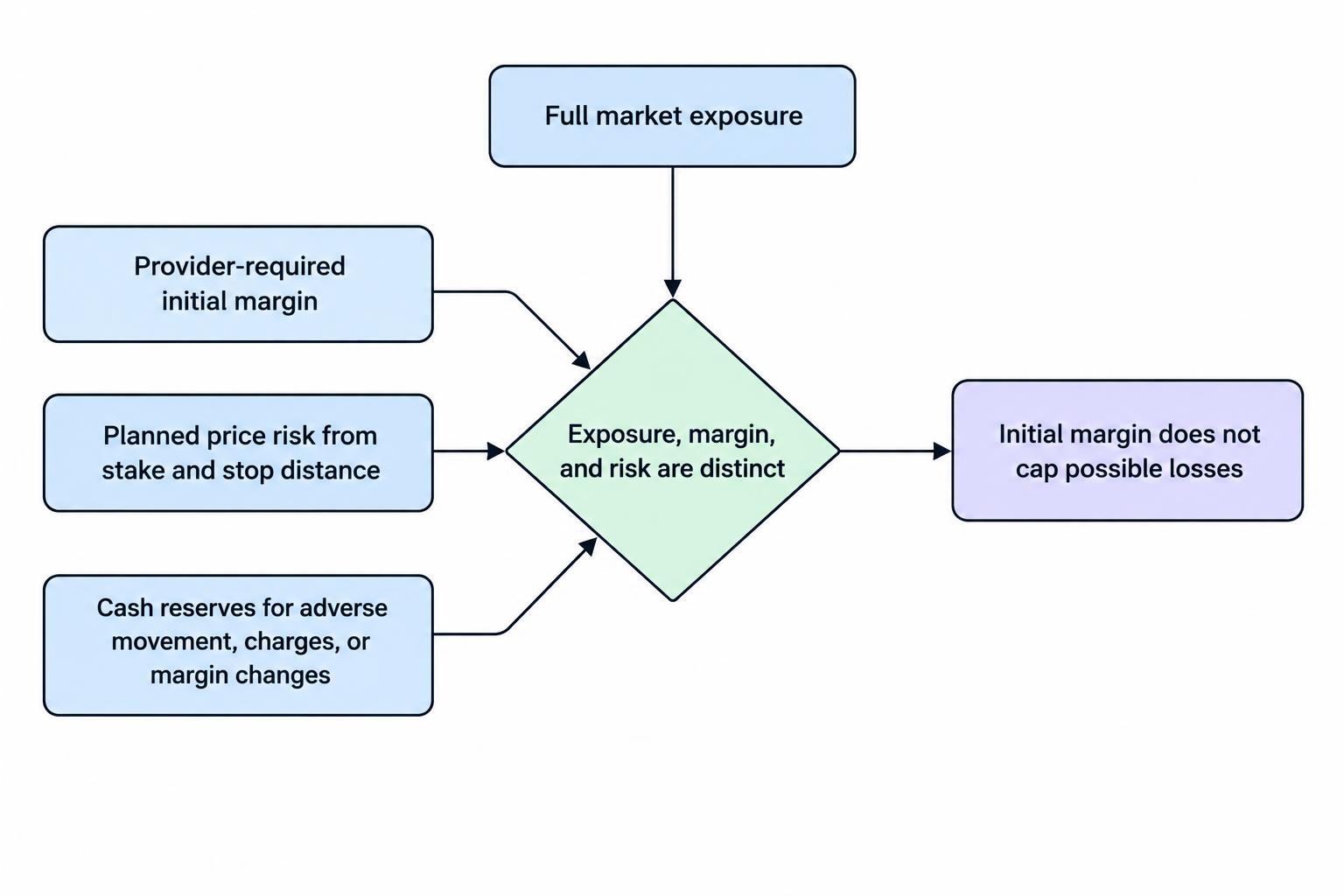
Under FCA retail rules in COBS 22.5, minimum initial margin includes 5% for major stock indices and 20% for individual shares; firms can require more. In the index example, 8,004 multiplied by £0.50 gives approximately £4,002 of exposure, requiring £200.10 at an assumed 5%. That is separate from the £150 planned price risk and future charges. The rules also provide account-level close-out when net equity falls below 50% of required margin, as soon as market conditions allow, and negative balance protection for relevant retail accounts. Those protections do not preserve deposited funds or guarantee an individual stop price. A position intended to last months can still be closed under the account’s margin arrangements much sooner.
Plan for adverse price movement, accumulated charges and possible changes to the provider’s margin requirements under the contract. Money reserved for those contingencies is still capital committed to supporting the strategy, even if it is not posted as initial margin on the first day. Assess performance and risk against the account resources actually assigned to the approach, rather than presenting profit as a percentage of a small initial margin deposit alone. A large return on that narrow denominator can obscure the exposure and losses that were possible. Also decide when reducing or closing a position is preferable to adding funds. Continuing to finance a losing thesis should be a defined decision, not an automatic response whenever the account needs more money.
Overnight gaps, events and changing conditions
A longer hold will usually pass through several scheduled and unscheduled events. Earnings, economic releases, central-bank decisions, political developments and supply disruptions can alter both the market price and the thesis. A daily or weekly review schedule does not remove the need to know which events are approaching. Decide in advance whether to maintain, reduce or close exposure around the events most relevant to the instrument. These choices must become part of the method’s evaluation rather than ad hoc reactions to anxiety. The news-trading guide explains how expectations and execution interact around announcements. A position trader may choose not to trade the release itself while still carrying substantial exposure to its outcome.
Markets can reopen beyond the intended stop after a weekend or another closure, and a provider’s out-of-hours quote need not offer the same conditions as the main underlying session. A holiday, interruption or company event can also affect when and how exposure can be closed. Check the product’s trading hours and terms, and understand what happens to protective orders when the device disconnects. Alerts can assist monitoring but do not themselves close a position. Longer-term trading still needs an operational plan for access, order management and unexpected account developments. It is reasonable to make fewer discretionary decisions; it is not reasonable to assume that an open financed contract needs no attention simply because the original analysis used a weekly chart.
Managing the position without constantly changing the thesis
A scheduled review should ask whether the expected driver remains relevant, whether contrary evidence has appeared, what costs have accumulated and whether the remaining opportunity still justifies exposure. Review the original reasoning rather than replacing it with a new explanation every time the market moves against the trade. A price target can be revised if the method specifies how new information changes it, but revisions should be documented. The same applies to the expected holding period. Extending a three-month plan to a year changes financing, uncertainty and the demands on capital. A position can be closed even if the broad idea remains plausible when the achievable return from the current price no longer compensates for its costs and risks.
Exits can use a fixed target, a trailing rule, a thesis failure or a time limit. A trailing exit can retain participation in an extended move but normally gives back some unrealised profit before closing. A fixed target provides a defined destination while potentially leaving later gains uncaptured. Partial exits secure some result and reduce exposure but change the distribution of outcomes, so they should be evaluated rather than treated as an automatic improvement. A move to the entry price is also not necessarily a net break-even exit after financing and adjustments. Define the interaction between price-based and thesis-based exits in advance. Otherwise, the trader can always find one reason to ignore whichever rule currently calls for closure.
Adding positions and managing portfolio concentration
Adding to a winning position increases exposure even when the first entry has a paper profit. Each addition needs a planned stake, an exit and a calculation of the combined outcome if the market reverses. Adding to a losing position lowers the average entry of a long but does not improve the probability that the thesis succeeds. A planned multi-entry method needs a total risk limit and evaluation of the entire sequence, including carrying costs on each part. It should not appear as an improvised response to discomfort. Over a long holding period, several apparently modest additions can create a much larger financed position than the original plan contemplated. Review the account’s complete exposure rather than focusing on the attractiveness of the latest entry price.
Separate instruments can also express substantially the same view. Several equity indices, related shares or currency pairs may react together to a change in financial conditions. A portfolio of long-term positions is not diversified simply because the tickets have different names. Assess common adverse scenarios, the combined carrying cost and the possibility that several exits suffer slippage at once. Equal stakes per point do not necessarily create comparable exposure or risk across different markets. The portfolio correlation guide and broader risk management guide address those relationships. Set limits before positions accumulate, including a process for reducing exposure if correlations increase or the account becomes dominated by one economic assumption.
How to get started with position spread betting
Begin with one instrument and a thesis that can be written clearly. Define the proposed driver, expected horizon, evidence already reflected in price, entry condition, invalidation and review schedule. Compare the available contracts and estimate the result under shorter, expected and longer holding periods. Before choosing an account, follow the FCA’s guidance on checking that a firm is authorised and genuine, including relevant permissions and contact details. Read the funding terms, execution policy and provisions for expiry, corporate actions and closing exposure. Authorisation does not establish that the strategy is suitable or profitable. The account must also support the intended trade size and management process throughout the hold, not just offer an attractive opening quote.
Use a demonstration environment to learn order mechanics, monitor adjustments and practise reviewing a position against its original rules. A short demo period cannot demonstrate the long-term profitability of a method whose trades last months. It can still reveal misunderstandings about point values, funding, stops or expiry before real money is committed. Historical analysis and recorded hypothetical decisions can add observations, provided their limitations are recognised. Demo fills and charges may differ from live conditions, and simulated drawdowns do not recreate the pressure of real losses. If a live evaluation is appropriate, a suitably small position can help investigate those differences. There is no obligation to increase exposure merely because the first long-term trade happened to finish profitably.
Testing a strategy with long holding periods
Longer holds create fewer completed trades over a given calendar period, so a small record can be dominated by one favourable trend. Test across different conditions and include the actual constraints of the chosen contract: funding, spreads, slippage, dividends, borrowing charges, expiry and rollover treatment where relevant. Account for historical changes in the tradable universe rather than selecting only instruments that survived and performed well. Research on the probability of backtest overfitting explains why choosing among many historical rule variations can produce misleading results. Keep an evaluation period separate from the data used to choose the method. A chart showing that price eventually reached the target does not establish that the account could have maintained the position through the path taken to get there.
Review net profit alongside drawdown, time in the market, capital committed and losses beyond intended exits. Record financing and other adjustments separately so that changes in product cost can be distinguished from changes in the trading idea. A useful stress assessment asks what happens if the expected move is smaller, the hold is longer or execution is worse than assumed. For example, the index trade above can move in the right direction and still lose after net costs; extending its duration would change that threshold again. Avoid treating a high win rate or a large profit relative to initial margin as sufficient evidence. The method needs to remain interpretable after accounting for the capital and uncertainty required to sustain it.
UK tax treatment of position-trading spread bets
HMRC’s Business Income Manual states that a person placing a spread bet is not normally carrying on a trade, with profits not taxable and losses not relieved under that normal treatment. Its guidance on spread betting exceptions explains that the contract and economic substance matter, including whether winnings arise from carrying on an existing trade. Holding a position for several months does not itself settle every tax question or turn the spread bet into ownership of the underlying asset. Residence, individual circumstances and company arrangements can require separate consideration. Tax treatment belongs in the comparison between products, but it cannot make an otherwise uneconomic financed position attractive or remove the normal absence of relief for spread betting losses.
Building a position strategy that remains workable over time
A workable position-trading process joins a clear market view to a contract that can support the intended horizon at an acceptable total cost. It also defines how much adverse movement the account can bear, what evidence ends the thesis and when the remaining opportunity no longer justifies holding. Fewer trades can make the process calmer, but the practical work continues through financing, account monitoring and event reviews. Keep the original reasoning visible so that patience does not become an excuse for avoiding a difficult exit. Use the complete record, including costs and drawdowns, to decide whether the approach deserves further evaluation. The goal is a planned exposure that remains manageable as conditions change, not simply the ability to leave a trade open for a long time.