Calculating spread betting profit and loss starts with one rule: multiply the price movement in points by your stake per point. For a short bet, reverse the price difference. Then include charges and cash adjustments to find the net result.
The arithmetic is straightforward. Most mistakes come from using the wrong side of the quote, misreading what counts as one point, or treating a position’s displayed profit as the final account return. The examples below use hypothetical prices and charges, not live market quotes.
The spread betting profit and loss formula
For prices expressed in betting points, use these formulas:
| Position | Price profit or loss | Profitable when |
|---|---|---|
| Long: buy to open | (Closing sell price − opening buy price) × stake per point | The closing sell price exceeds the opening buy price |
| Short: sell to open | (Opening sell price − closing buy price) × stake per point | The closing buy price falls below the opening sell price |
A positive answer is a profit before separate charges and adjustments. A negative answer is a loss. Keep the minus sign in your calculation rather than removing it and trying to remember which direction the trade went.
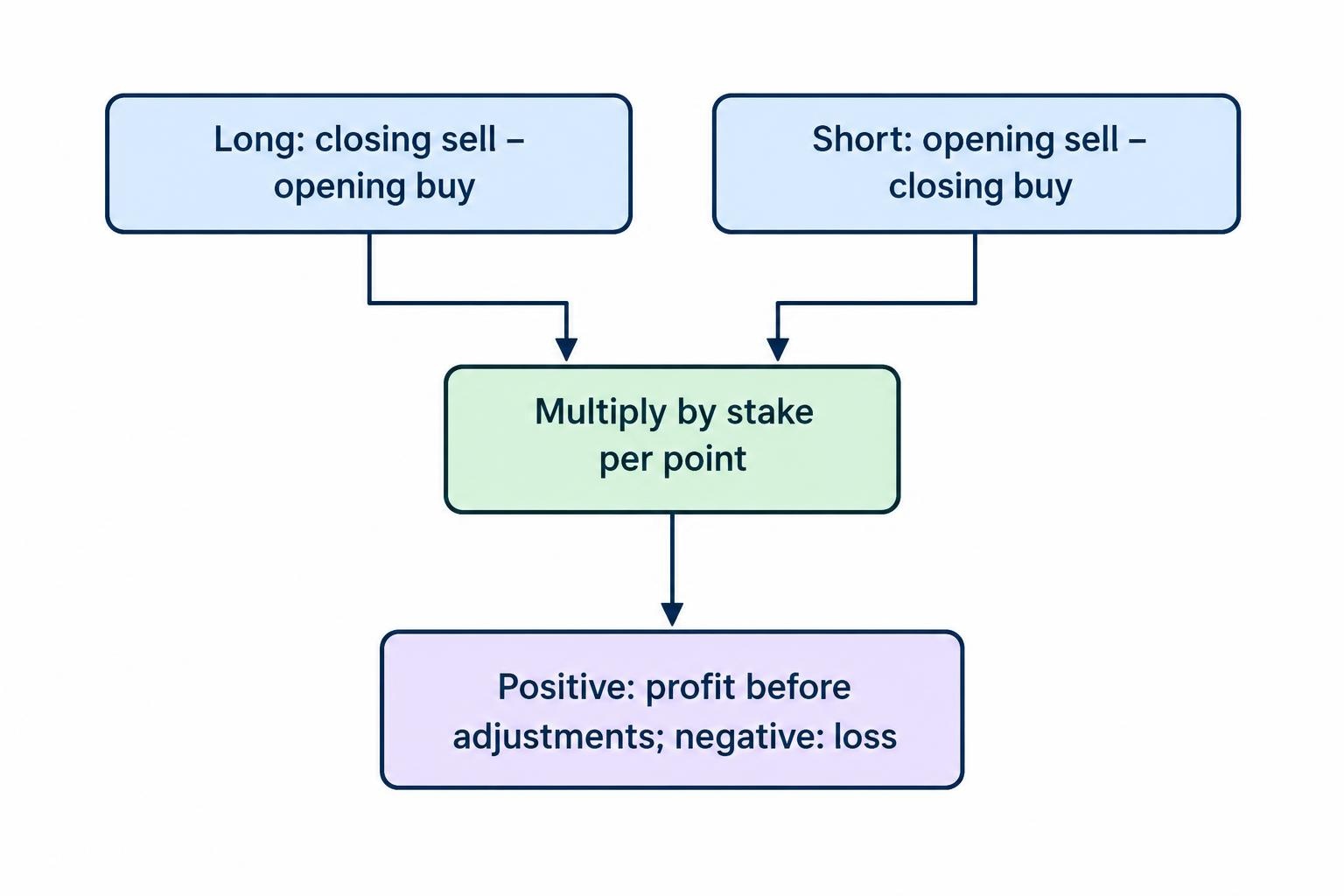
Your stake per point determines the cash effect of each point gained or lost. At £3 per point, a favourable 20-point movement produces £60. An adverse 20-point movement loses £60, before any separate costs.
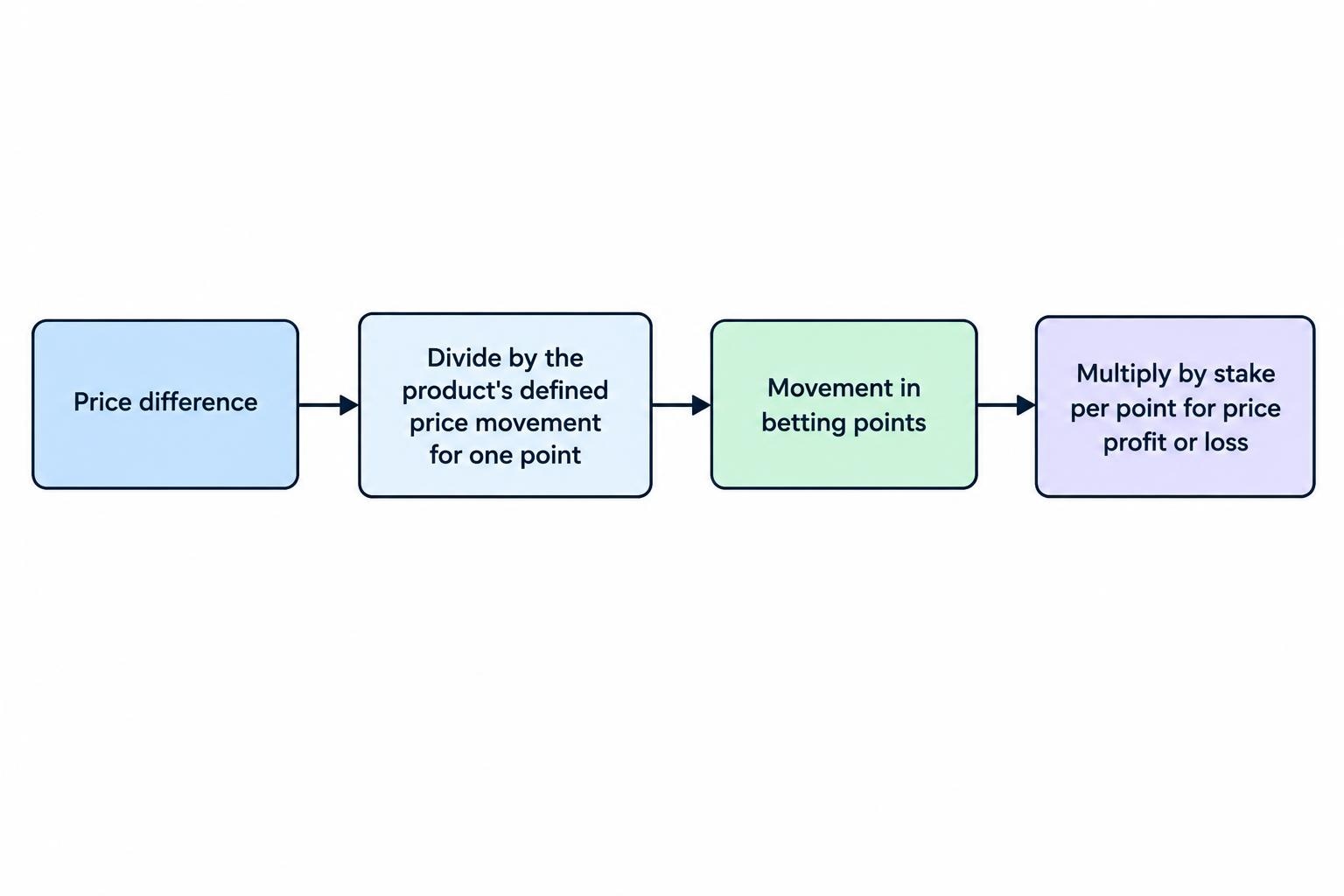
If the quoted prices are not already expressed in betting points, convert the difference first:
Movement in points = price difference ÷ price movement defined as one point.
Worked examples for long and short bets
Calculating profit on a long spread bet
Suppose an index has a sell quote of 7,998 and a buy quote of 8,000. You expect it to rise, so you buy at 8,000 for £3 per point.
Later, the quote becomes 8,048 to sell and 8,050 to buy. You close the long position by selling at 8,048:
(8,048 − 8,000) × £3 = £144 profit.
The relevant closing price is 8,048, not 8,050. Using the buy quote for both entry and exit would overstate the result.
If you instead closed at a sell price of 7,968, the calculation would be:
(7,968 − 8,000) × £3 = −£96.
Calculating profit on a short spread bet
Start with the same opening quote: 7,998 to sell and 8,000 to buy. This time, you expect a fall and sell at 7,998 for £2.50 per point.
The market drops. You close by buying at 7,950:
(7,998 − 7,950) × £2.50 = £120 profit.
If the market rose and you bought back at 8,040, the result would be:
(7,998 − 8,040) × £2.50 = −£105.
For a short position, subtract the closing buy price from the opening sell price. Keeping that order prevents an adverse rise from accidentally appearing as a profit.
How the spread affects your calculation
A newly opened trade normally starts with a price loss because buying and selling happen at different quotes. In the long example, buying at 8,000 and immediately selling at an unchanged quote of 7,998 would lose two points:
(7,998 − 8,000) × £3 = −£6.
This is the immediate effect of the spread between the buy and sell prices. The market must move far enough in your favour to overcome it before the position reaches price break-even.
Do not subtract the spread again when your calculation already uses the actual opening and closing execution prices. Those prices already contain its effect. Deducting another two points from the £144 long-trade profit would count a cost twice.
A wider spread can also worsen an open position’s valuation without an equivalent change in the market’s midpoint. For checking current price profit or loss, use the quote at which you could close, rather than assuming the chart price is executable.
Check what one point means
The same formula works across markets, but the point definition can change. A decimal place on the screen is not automatically a full betting point.
Forex point calculation
Suppose a EUR/USD spread bet defines one point as 0.0001. You buy at 1.08020 and later sell at 1.08270.
The price difference is 0.00250. Dividing by 0.0001 gives 25 points. At £4 per point:
25 × £4 = £100 profit before separate adjustments.
The extra displayed decimal represents a fraction of a point under these assumed contract terms. Check the dealing ticket rather than counting digits. The guide to how forex spread betting works covers currency-pair quoting in more detail.
Share point calculation
Suppose a UK share spread bet defines one point as one penny. Buying at 250p and selling at 257.5p gives a 7.5-point gain. At £5 per point, the profit is £37.50.
If those same prices appear as £2.50 and £2.575, divide the £0.075 difference by £0.01 before multiplying by your stake. Otherwise, the answer will be wrong by a factor of 100.
Also check the stake currency. A £3-per-point bet produces its price profit or loss in pounds, even if the underlying market is quoted in dollars. Do not apply an extra dollar-to-pound conversion simply because the instrument is American. Conversion may still matter for separately booked foreign-currency amounts.
From price profit to net profit
Price profit measures the result between your execution prices. Net profit includes the cash charges and credits attached to the position:
Net profit or loss = price profit or loss + cash credits − cash charges.
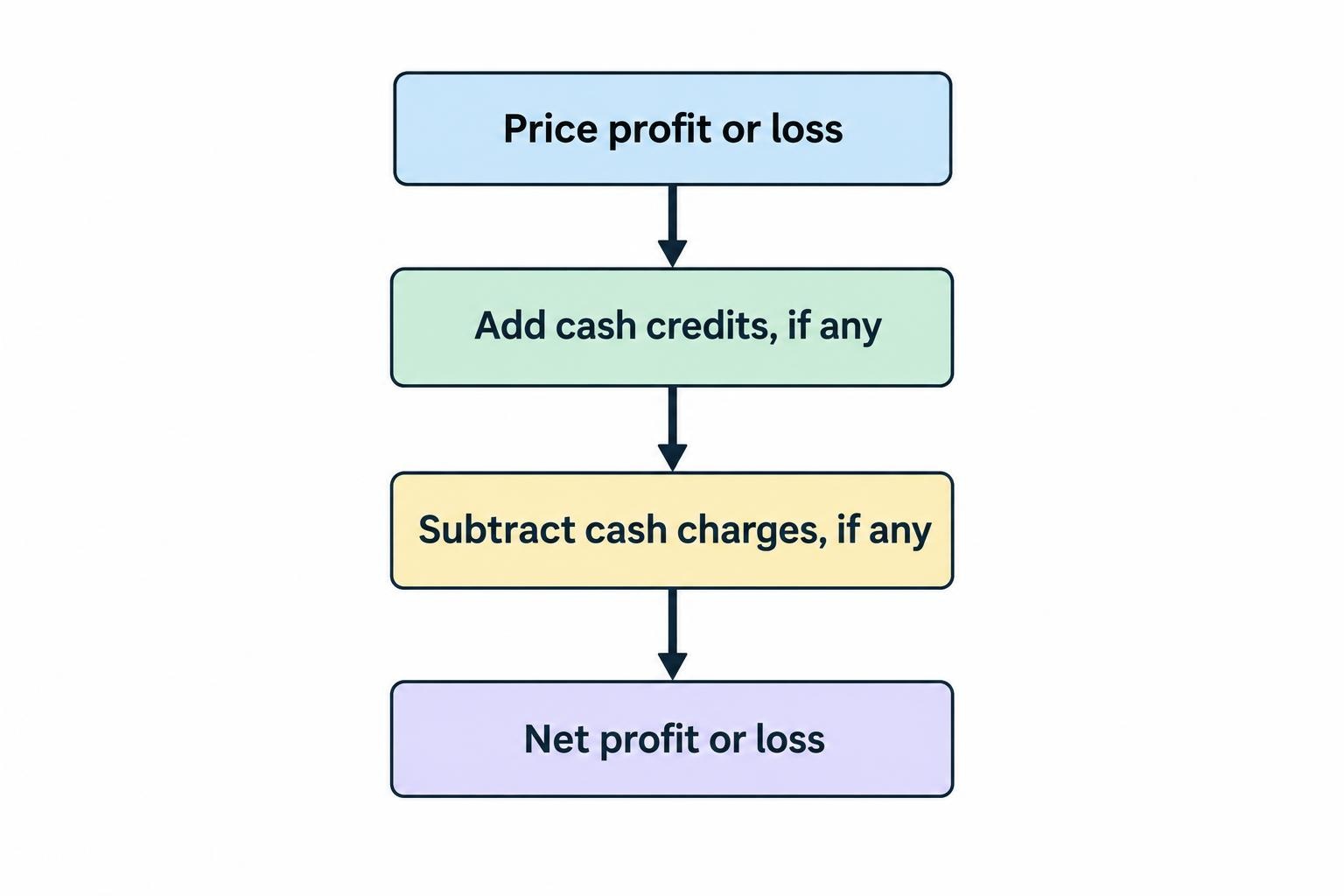
Charges can include overnight financing and other fees applicable to the product. Their treatment matters: the FCA review of spread betting and CFD charges addresses dealing spreads, funding costs and the information firms provide about those charges.
Return to the long trade with a £144 price profit. Suppose the statement records £9 of financing and £3 of other applicable charges, with no cash credits:
£144 − £9 − £3 = £132 net profit.
Use the amounts actually booked for a completed trade. For an open position, future costs remain estimates. The calculation of overnight financing costs depends on the contract terms and how long the position remains open.
Cash adjustments can also increase or reduce the result. Match each adjustment to the relevant position instead of treating every credit as trading profit. In particular, spread betting dividend adjustments need to be considered alongside the related price movement; a dividend credit is not automatically an extra return.
Calculating the break-even closing price
Separate costs move your break-even level beyond the opening execution price. For a long position:
Break-even closing sell price = opening buy price + net cash costs ÷ stake per point.
For a short position:
Break-even closing buy price = opening sell price − net cash costs ÷ stake per point.
These formulas assume prices are expressed in betting points. With £12 of net cash costs and a £3 stake, you need four favourable points beyond the opening execution price.
The long entered at 8,000 would therefore need a closing sell price of 8,004. That is six points above the original sell quote of 7,998: two points to overcome the opening spread, then four to cover the separate costs.
Why margin is not the amount used to calculate profit
Margin is collateral for the position, not the multiplier in the profit formula. Your stake and the movement in points determine price profit or loss.
Suppose an index position at 8,000 carries a £2-per-point stake and requires £800 of margin. An adverse 80-point move loses £160. You do not multiply that movement by the £800 margin, and you do not stop counting losses when they reach £800.
The spread betting margin guide covers how the deposit requirement differs from the exposure you control. For performance measurement, also distinguish a return calculated against margin from a return calculated against your whole account. A £160 loss equals 20% of £800, but 3.2% of a £5,000 account.
For UK retail accounts covered by the rules, the FCA margin close-out and negative balance protection provisions operate at account level. Negative balance protection does not cap an individual trade’s loss at its opening margin. Account protections are not a substitute for calculating the cash loss a position could produce.
Calculate planned losses separately from actual losses
A stop level gives you an intended exit, not necessarily the final execution price. Suppose you buy at 8,000 for £3 per point and place an ordinary stop at 7,970. The planned price loss is:
(7,970 − 8,000) × £3 = −£90.
If the actual closing fill is 7,965, the price loss becomes £105. Use that fill in the final calculation, then include any separate charges. The difference between the intended and executed price is covered in the guide to spread betting slippage.
You can reverse the arithmetic when planning a stake: divide the intended cash risk by the distance from entry to the planned exit. That gives a starting stake calculation, not a guaranteed loss ceiling. Allow for costs and execution risk when applying position sizing for spread betting.
Realised, unrealised and partially closed profit
Realised profit or loss belongs to the portion of a trade that has closed. Unrealised profit or loss is the current valuation of the portion still open. For your own estimate, value a long against the available closing sell quote and a short against the closing buy quote.
Check whether the platform’s displayed position figure includes financing and other adjustments. If these appear elsewhere on the account, the position line alone will not show the complete net result.
Calculating a partial closure
Suppose you buy at 8,000 for £4 per point. You later close £1.50 per point at 8,050, leaving £2.50 per point open.
The closed portion produces:
(8,050 − 8,000) × £1.50 = £75 realised profit.
If you close the remaining £2.50 per point at 7,980, that portion produces:
(7,980 − 8,000) × £2.50 = −£50.
The combined price result is £25 profit before separate charges and credits. Applying the original £4 stake to both exits would overstate the result because each exit closes only part of the position.
When entries also occur at different prices, calculate each matched portion separately or use the provider’s recorded average entry and allocation method. Do not use a simple average of entry prices when the stakes differ.
Reconcile profit and loss with your account statement
A rising cash balance does not necessarily mean your trading made money. Deposits increase the balance without creating profit, while withdrawals reduce it without creating a trading loss.
To check the cash amount gained or lost over a period, use comparable opening and closing equity figures:
Period net profit or loss = closing equity − opening equity − deposits + withdrawals.
Suppose opening equity was £5,000 and closing equity is £5,280. During the period, you deposited £300 and withdrew £100:
£5,280 − £5,000 − £300 + £100 = £80 net profit.
The account grew by £280, but only £80 came from net account performance. Because equity includes open-position valuations, this calculation includes changes in unrealised results as well as realised activity.
Reconcile that £80 against closed trades, changes in open-position valuations, charges and adjustments. The guide to reading spread betting account statements helps separate those entries. Do not deduct financing again if it has already reduced the closing equity used in your calculation.
Check the inputs before accepting the answer
A reliable calculation needs more than two prices and a calculator. Before placing a trade, or checking a completed one, confirm:
- The opening and closing prices are the correct execution sides for a long or short position.
- The price difference has been converted into the product’s betting points.
- The stake matches the portion being valued or closed.
- Separately booked charges and credits have been included once, not twice.
- The result uses the intended currency and distinguishes an estimate from a completed trade.
If your calculation differs from the platform, check point size and execution prices first. Then compare the position figure with the account ledger. A small mismatch may be rounding; a much larger one often starts with the wrong unit, stake or quote.