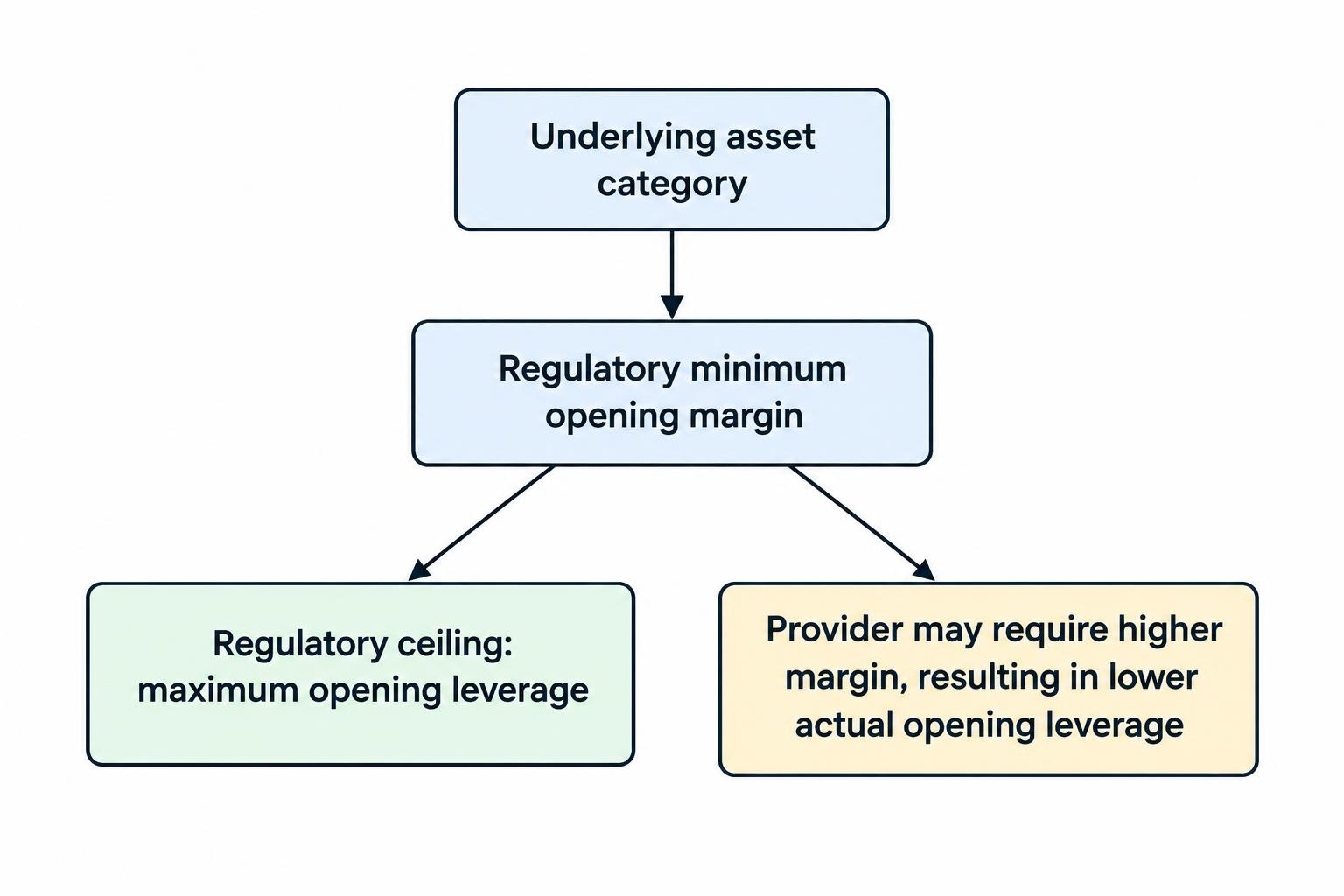
UK retail spread betting leverage can reach about 30:1, but that ceiling does not apply to every market. The permitted ratio depends on the underlying asset, and a broker can require more margin than the regulatory minimum.
The distinction matters when comparing accounts or choosing a stake. A leverage limit controls how much exposure a provider can offer against your opening margin. It does not tell you how much to trade, or how much you could lose on an individual position. These limits form part of the wider UK spread betting regulatory framework.
UK Retail Spread Betting Leverage Limits by Market
The FCA sets minimum opening margin requirements for retail clients under COBS 22.5 rules for spread bets and similar speculative investments. The familiar leverage ratios are another way of expressing those requirements.
| Underlying market | Minimum opening margin | Equivalent leverage ceiling |
|---|---|---|
| Major currency pairs and relevant sovereign debt | 3.33% | Approximately 30:1 |
| Major stock market indices, minor currency pairs and gold | 5% | 20:1 |
| Minor stock market indices and commodities other than gold | 10% | 10:1 |
| Individual shares and other assets not covered by the preceding categories | 20% | 5:1 |
The 30:1 figure is the conventional rounded expression of the 3.33% margin requirement. The table shows regulatory boundaries, not a promise that a provider will offer the maximum on every qualifying instrument.
Check the Market Classification and the Broker’s Margin
Regulatory categories do not always match everyday trading labels. GBP/USD and EUR/USD qualify as major currency pairs, but AUD/USD does not. The FTSE 100 and S&P 500 belong to the defined major index group. Nor should every government bond be assumed to qualify as relevant sovereign debt.
Providers can also set lower leverage by requiring more margin, including during periods of greater volatility. They can increase requirements on existing positions, subject to considering retail clients’ interests and providing reasonable notice. These distinctions appear in the FCA leverage policy, asset definitions and margin guidance.
Check the instrument’s current dealing terms rather than relying on an account advertisement. If a qualifying index has a 5% regulatory minimum but the provider requires 8%, the available opening leverage is 12.5:1. The broker’s higher requirement governs the trade.
How to Calculate Margin Under a Leverage Limit
The basic calculation is:
Required opening margin = position exposure × applicable margin rate.
For a straightforward index spread bet quoted in whole index points, exposure equals the index level multiplied by the stake per point. Other instruments can use different point conventions, so check the contract details before applying the formula. The spread betting margin guide covers the mechanics across different markets.
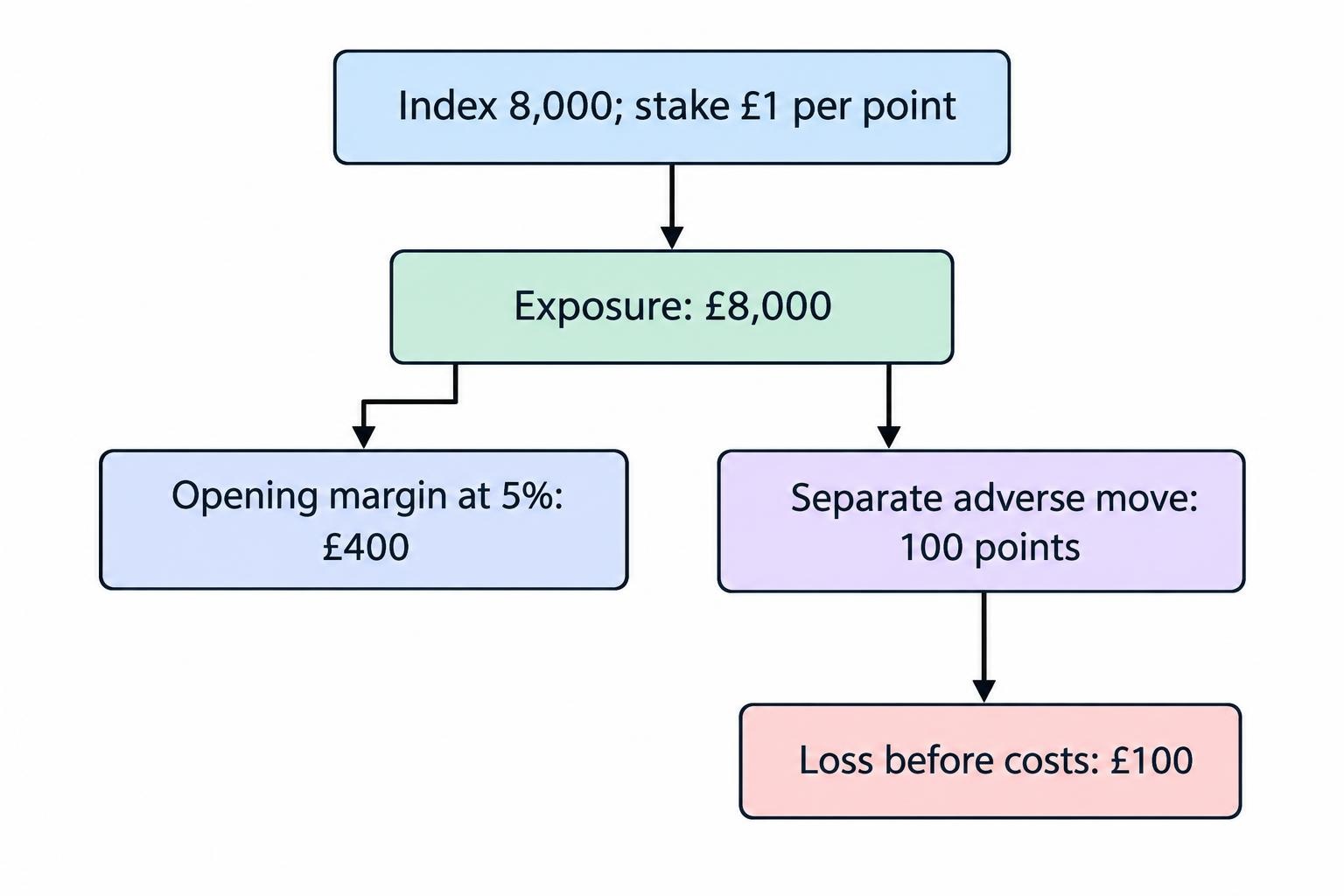
Take a hypothetical FTSE 100 bet at 8,000, with a stake of £1 per point and a provider margin requirement of 5%:
- Position exposure: 8,000 × £1 = £8,000.
- Required opening margin: £8,000 × 5% = £400.
- Exposure divided by opening margin: £8,000 ÷ £400 = 20:1.
A 100 point move against the position produces a £100 trading loss before costs. That is 25% of the £400 opening margin. The margin deposit is collateral for the position, not its purchase price or a preset loss allowance.
Available Leverage Is Not the Same as Account Leverage
Suppose the same £8,000 position sits in an account with £2,000 equity and no other trades. Exposure divided by account equity is 4:1, even though the instrument permits opening leverage of 20:1.
These ratios answer different questions. The first describes the provider’s margin terms; the second describes how much exposure the account is carrying relative to its equity. The broader explanation of spread betting leverage separates these measures.
Adding cash without increasing the position reduces account leverage. Increasing the stake after adding cash may erase that reduction. A larger balance is not much of a buffer if every extra pound immediately supports another trade.
Leverage Limits Do Not Restrict Losses to Opening Margin
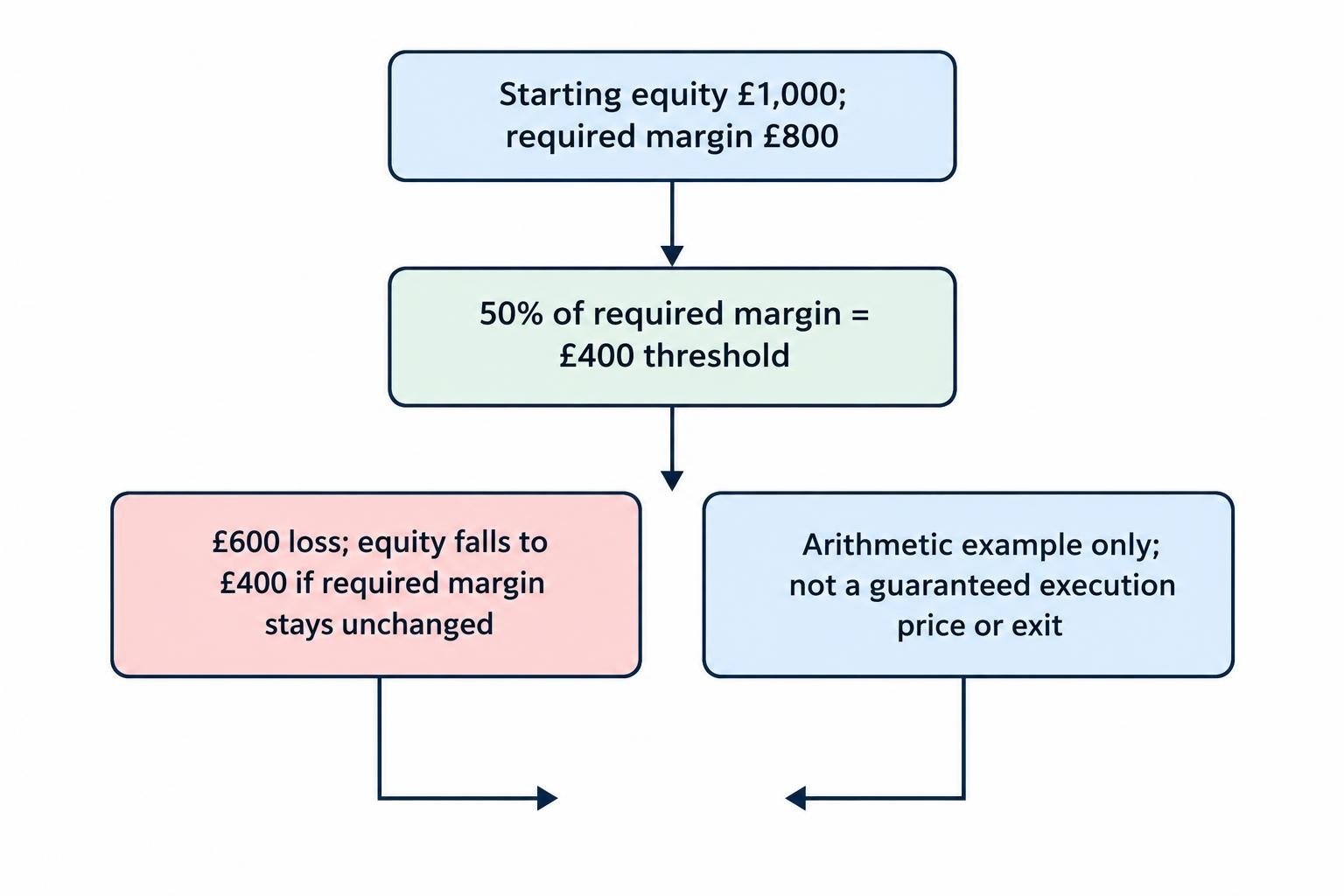
Three separate controls are often confused: opening margin, margin close-out and negative balance protection. UK retail rules require account-level close-out when net equity falls below 50% of the required margin, with positions closed as soon as market conditions allow. Negative balance protection restricts liability for covered trading to funds dedicated to that account. These protections sit alongside leverage limits in the FCA retail derivatives protection measures.
Consider a simplified account containing £1,000, with open positions requiring £800 margin. Half that requirement is £400. If the requirement stays unchanged, a £600 loss would bring equity to that threshold. It would not take a loss of half the original £1,000 deposit.
This is arithmetic, not a forecast of an execution price. Price gaps, changing margin requirements and the provider’s terms can affect what happens. Do not treat the threshold as a guaranteed exit.
Negative balance protection also does not preserve the opening margin or prevent the loss of money held as a buffer. In the earlier index example, the £400 margin does not mean only £400 of a larger trading account is exposed to losses.
The practical relationship between account equity, required margin and forced closure is covered in the margin close-out rule guide.
Professional Accounts and Offers of Higher Leverage
The retail limits above do not apply in the same way to clients properly classified as professional. However, professional status is a regulatory classification, not an account upgrade obtained simply by choosing a different setting.
Elective professional classification requires an assessment of expertise, experience and knowledge, plus the applicable quantitative criteria. It also requires a written request, a warning about protections that may be lost and a separate acknowledgement. These duties appear in the FCA professional client classification rules.
Do not assume retail leverage caps, close-out arrangements or negative balance protection will continue unchanged after reclassification. Read the provider’s written terms and compare the consequences through the retail versus professional client guide.
An advertisement offering 100:1 or 500:1 deserves further checks before any deposit. Establish which legal entity would hold the account, where it is authorised and which client category the offer concerns. A shared brand name does not establish that two companies provide the same protections.
Use the account agreement to identify the contracting company, then follow the process for checking a broker on the FCA Register. Do not assume a firm’s overseas account has UK retail protections because another company in its group is FCA authorised.
Choose the Stake Before Checking Whether the Margin Fits
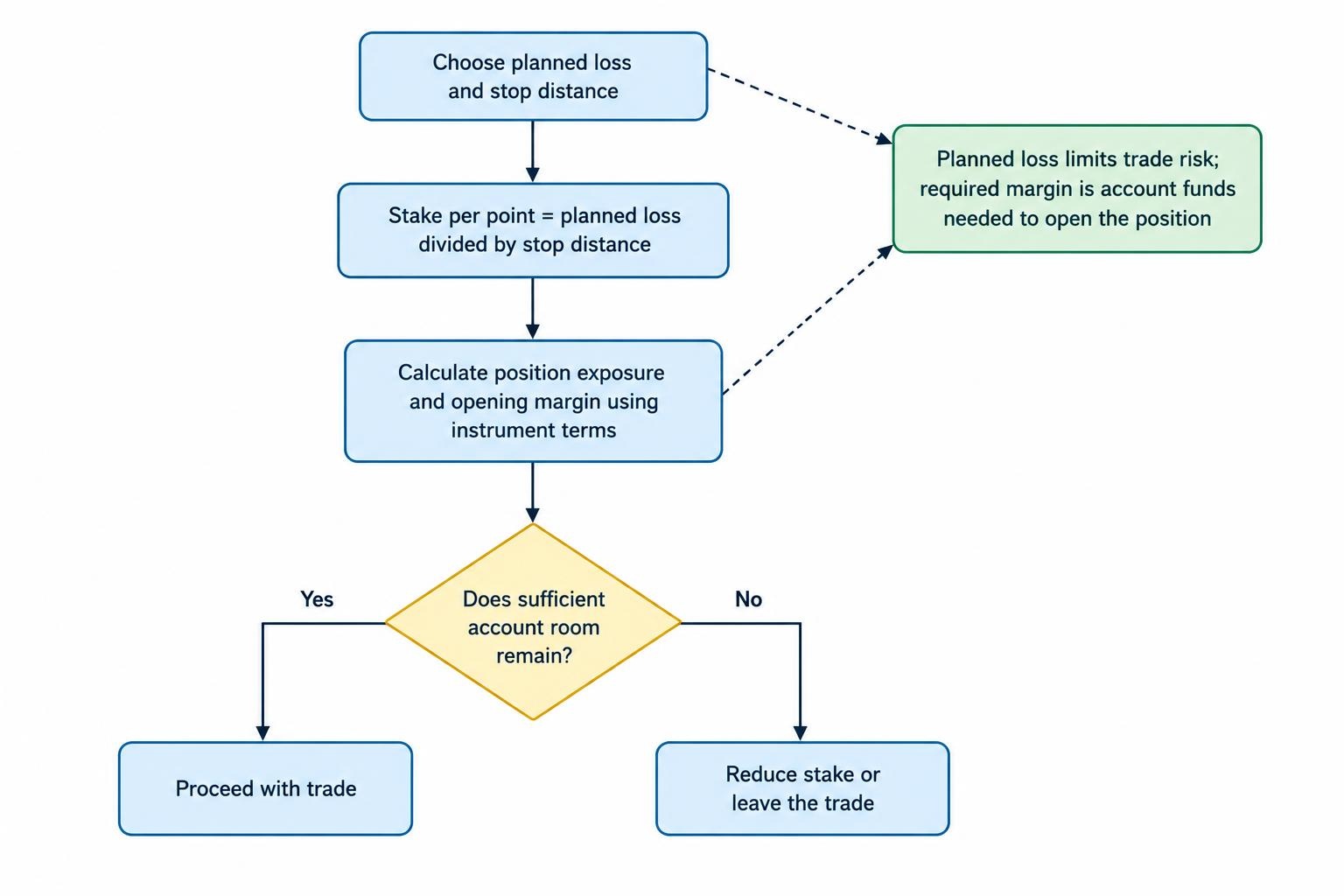
A regulatory ceiling is not a recommended trading size. Working backwards from the largest position your available margin permits puts the funding requirement ahead of the potential loss.
A more useful starting point is the amount you are prepared to lose if the trade fails, followed by the distance between entry and the intended stop. For a basic calculation:
Stake per point = planned trading loss ÷ stop distance in points.
Suppose a hypothetical plan allows a £60 trading loss and places the stop 40 points from entry. The resulting stake is £1.50 per point, before allowing for costs and execution uncertainty.
At an index level of 8,000, that stake creates £12,000 exposure. If the applicable margin rate is 5%, opening margin is £600. The two figures serve different purposes: £60 is the planned price loss at the stop, while £600 is the collateral required to open the position.
If that margin requirement leaves too little room in the account, reduce the stake or leave the trade. Do not move the stop closer simply to make a larger stake appear affordable. The position sizing guide develops this risk-first approach.
Also consider what happens if several positions move against you together. Three trades using different market names may still respond to the same economic event. Meeting each position’s opening margin requirement does not mean the account can comfortably absorb their combined losses.
Common Questions About Spread Betting Leverage Limits
Is Cryptocurrency Spread Betting Available at 2:1?
Not as a permitted UK retail crypto derivative offering. The FCA prohibition on retail cryptoasset derivatives prevents covered firms from selling, distributing or marketing these products to retail clients. An older table showing a 2:1 cryptocurrency limit should not be read as current permission to offer retail cryptocurrency spread bets.
Does a Stop-Loss Allow More Leverage?
Do not assume that attaching a stop removes the minimum opening margin requirement. A stop addresses the intended exit; the margin requirement addresses the collateral supporting the exposure. They perform different jobs.
An ordinary stop can execute at a worse price than requested. Even where a guaranteed stop is offered, check its terms, premium and displayed margin before placing the trade. A stop is not permission to ignore the dealing ticket.
Does a Larger Deposit Increase the Leverage Limit?
No. More cash can support more exposure at the same margin rate, but it does not change the asset’s regulatory category. In a hypothetical market requiring 5% margin, £500 supports £10,000 exposure and £1,000 supports £20,000 exposure. Both calculations use 20:1 opening leverage.
The deposit changes the amount available, not the ratio. Keeping some of that money unused creates a buffer; committing all of it to margin removes that room.
Are the Limits Different for Long and Short Bets?
The regulatory categories are based on the underlying asset, not whether the position is long or short. Nevertheless, check the provider’s terms for the intended direction and instrument. Availability, dealing restrictions and the actual margin shown on the ticket still matter.
The practical test is straightforward: confirm the market category, check the provider’s current margin requirement, calculate the exposure and decide whether the potential loss fits the account. The maximum permitted leverage belongs at the end of that process, not the beginning.