FSCS protection can compensate eligible spread betting clients when a covered financial firm fails and cannot return money it owes them. It does not insure a trading strategy or reimburse ordinary market losses. The current investment compensation limit is £85,000 per eligible person, per firm, subject to the claim meeting the scheme’s rules. The FSCS investment protection rules distinguish between money missing after a provider fails and money lost through poor investment performance.
For a spread bettor, the practical questions are straightforward: which legal company holds the account, does the activity qualify for protection, and how much money could remain unrecovered if that company collapses? Those questions matter more than an FSCS logo in a broker’s footer.
What FSCS protection covers in spread betting
The Financial Services Compensation Scheme is a compensation scheme for customers of failed financial services firms. A possible claim arises when a covered firm owes you money but cannot meet that obligation. With a spread betting account, a shortfall in client money is one situation in which protection may become relevant.
Eligibility depends on more than the broker having held an FCA authorisation. The FSCS compensation eligibility rules require several conditions to be satisfied:
- The firm has failed and cannot, or is likely to be unable to, pay claims against it.
- The firm was appropriately authorised when you used its services.
- The activity involved falls within the scheme’s protection.
- You have suffered a financial loss.
- The firm owes you a legal liability, and you qualify as an eligible claimant.
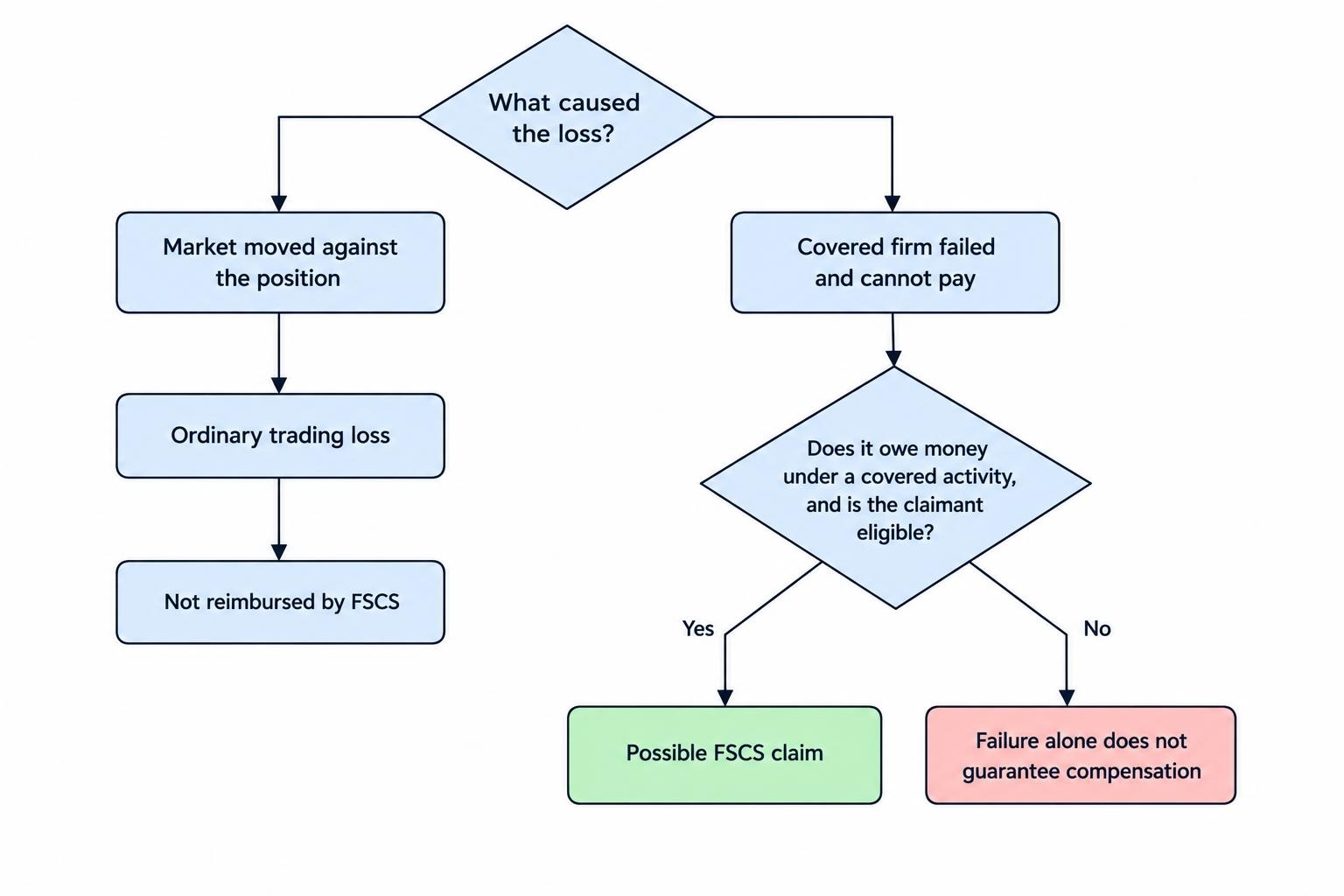
This means a frozen withdrawal or a disagreement about an account balance does not, by itself, establish an FSCS entitlement. There must be a covered claim against a firm that cannot meet it. Equally, a firm’s failure does not mean every customer automatically receives the maximum payment.
FSCS protection sits within the wider system of UK spread betting regulation. It addresses a different problem from trading controls: recovering eligible losses after a financial firm fails, rather than preventing losses on an open position.
Trading losses are not a compensation claim
If you deposit £10,000, lose £3,000 on trades and withdraw the remaining £7,000, the trading loss is not something FSCS reimburses. A market moving against your position is not the same as a broker failing to return money legally owed to you.
Nor should compensation protection influence your stake size. A £5 per point position remains a £5 per point exposure regardless of the broker’s compensation arrangements. Treat the scheme as protection against a covered firm failure, not as spare trading capital.
How the £85,000 investment limit works
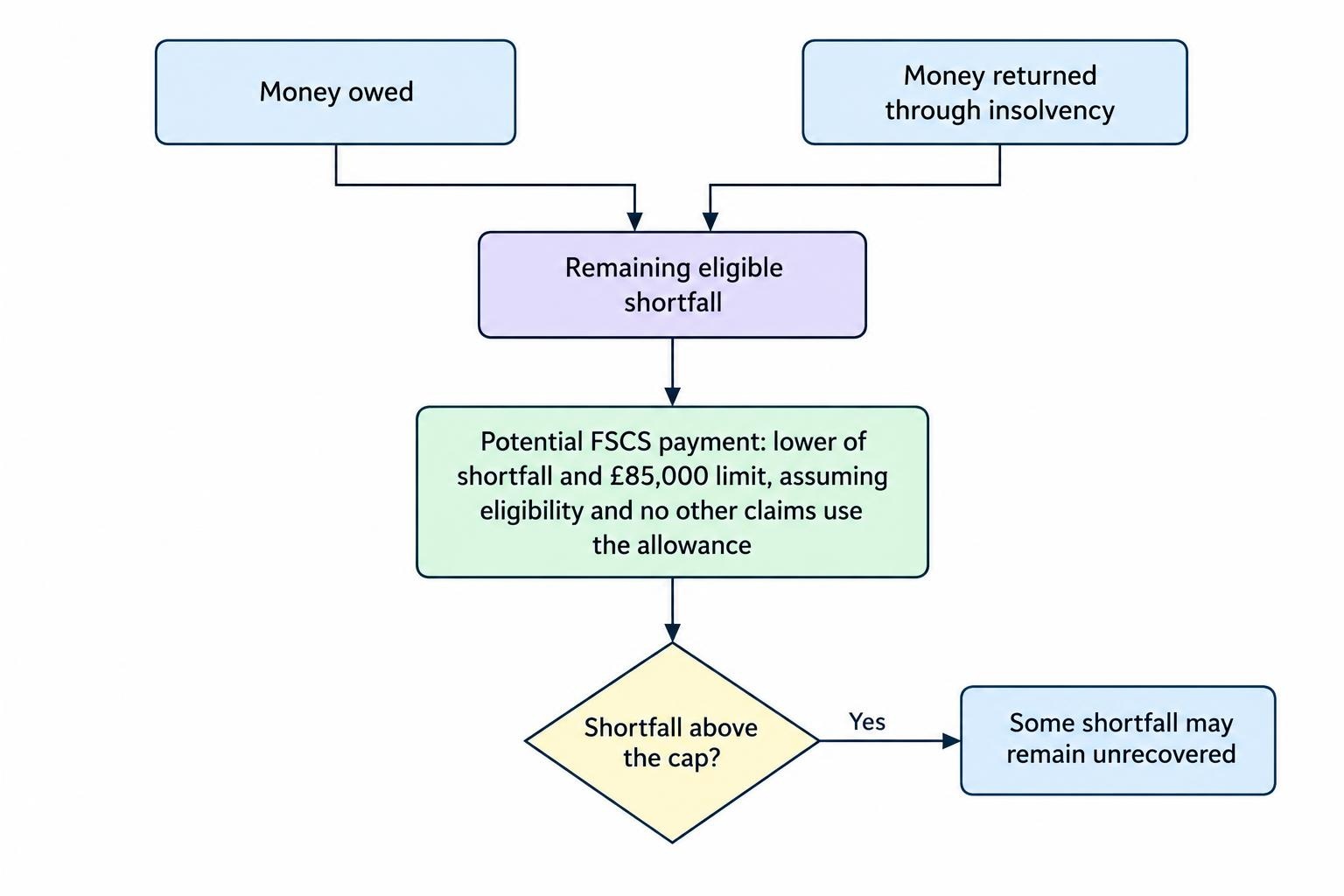
The limit applies to eligible compensation claims, not to every pound that can be returned through an insolvency. Money recovered from the failed firm and compensation paid by FSCS are different parts of the recovery process.
Claims within the same protected category against the same firm are aggregated. Opening another account with that firm does not create another investment compensation allowance. The FCA rules on compensation limits and aggregation set the maximum payment for ordinary protected investment business at £85,000.
Per person and per firm, not per account
Suppose one person has two covered trading accounts with the same legal company. If each produces an eligible claim of £50,000, the combined claim is £100,000. The investment compensation ceiling remains £85,000, rather than £85,000 for each account.
The same principle matters where a company operates several trading names. Two differently branded platforms do not provide separate protection if the claims are against the same covered firm. Conversely, do not assume that every company within a corporate group must share one investment compensation limit. Establish which legal entities would owe the money.
A useful account record should therefore show the contractual company, its firm reference number and the accounts connected to it. A list of app names is not enough.
The limit is not a ceiling on all money returned
The following examples illustrate the difference between an account entitlement, money returned through an insolvency and a remaining shortfall. They assume the stated shortfall qualifies for compensation and that no other investment claims use the same allowance.
| Money owed to the client | Money returned before compensation | Remaining eligible shortfall | Potential FSCS payment |
|---|---|---|---|
| £60,000 | £45,000 | £15,000 | £15,000 |
| £120,000 | £80,000 | £40,000 | £40,000 |
| £120,000 | £0 | £120,000 | £85,000 |
In the middle example, the client receives £120,000 in total: £80,000 returned and £40,000 in compensation. That does not breach the compensation ceiling because FSCS pays only £40,000. In the final example, £35,000 remains outside the illustrated FSCS payment.
These are simplified calculations, not predictions of an insolvency outcome. Do not assume that the last balance displayed on a trading screen will be the final agreed amount owed.
Why the £120,000 deposit limit is different
The UK deposit protection limit increased from £85,000 to £120,000 on 1 December 2025, for deposit-taking firms that fail from that date. That protection concerns eligible deposits with PRA-authorised banks, building societies and credit unions. It is not a general increase in every FSCS compensation category. The Bank of England’s explanation of the deposit protection increase sets out the change.
A payment described as a “deposit” into a spread betting account does not make the broker a bank. The label on the funding button does not determine the compensation category. A protected investment claim against a failed broker and a protected deposit claim against a failed bank concern different obligations.
What if the bank holding client money fails?
There can be a separate deposit protection question where a broker places client money with a bank. Eligible underlying beneficiaries of a client or pooled account may receive protection at beneficiary level, depending on the arrangements. Their share can also aggregate with personal deposits held at the same bank. The FSCS guidance on client accounts and beneficial ownership explains these distinctions.
For example, assume an eligible person has £100,000 in personal deposits and an identifiable £30,000 beneficial interest in a client account at the same bank. If those amounts fall within the same deposit allowance, their combined exposure is £130,000, leaving £10,000 above the ordinary £120,000 ceiling.
That example concerns the bank failing. It does not increase the investment compensation allowance against the broker, or create an automatic right to collect both limits for the same loss. Ask which institution has failed, which obligation remains unpaid and how your money was held.
Client money segregation and FSCS are different protections
Segregation separates client money from a firm’s own money. Its purpose is to protect client funds rather than leave them mixed with the cash used to run the business. The FCA’s client money segregation rules govern these arrangements for relevant investment business.
FSCS protection addresses eligible compensation claims after failure. It does not replace segregation, reconciliation or accurate ownership records. A compensation allowance is not permission for a firm to handle client money casually.
For account selection, read both the compensation disclosure and the client money terms. Ask whether your funds receive client money treatment, how the firm identifies your entitlement and which arrangements apply to your account classification. The separate guide to spread betting client money rules covers those arrangements in more detail.
Can insolvency costs affect the amount recovered?
Yes. Returning client money can involve costs that reduce the amount available for distribution. In the AFX Markets special administration, the FCA confirmed that distribution costs would be deducted from client money and that FSCS coverage for eligible clients included shortfalls and associated distribution costs, within the £85,000 ceiling. The FCA’s AFX Markets administration notice provides a practical example.
The lesson is not to estimate a claim from missing cash alone. Read the administrator’s calculation and distinguish the amount owed, deductions, distributions and proposed compensation. Keep those figures separate when checking whether the proposed outcome adds up.
Does professional client status affect FSCS eligibility?
Professional client classification does not, by itself, answer whether someone can claim FSCS compensation. Claimant eligibility has its own rules. The FCA’s eligible claimant provisions exclude categories including many financial institutions, large companies and certain people connected with a failed firm, subject to applicable exceptions.
An individual who elects to be treated as a professional client may still qualify, depending on their circumstances and the claim. It would be wrong to assume either that every professional client is excluded or that everyone using a professional account remains protected.
Before changing classification, request written confirmation of the proposed client money treatment and the firm’s explanation of compensation eligibility. Keep that confirmation with the categorisation documents. It helps establish what was represented, although it cannot override the scheme’s rules.
Compare this separately with the changes covered in retail versus professional client classification. Do not treat the word “professional” as a single switch controlling every protection.
How to check a spread betting broker’s FSCS position
Start with the legal company named in the account agreement. Then check its regulatory status, permissions and official contact details. The FCA’s firm checking guidance distinguishes authorisation from registration and warns that clone firms can copy genuine firms’ identities. Matching a company name or reference number is not enough if the contact details do not match.
Compare the account agreement with the regulatory record and the payment instructions. If one document names a UK company and another names an overseas affiliate, resolve the discrepancy before transferring money. Do not accept a group logo as an explanation of which company is responsible.
For a more detailed check, use the guide to checking a broker on the FCA Register. Save the relevant account documents rather than relying on a page you may struggle to find later.
Ask the firm to explain whether the service provided to you falls within FSCS protection and which compensation category applies. The answer should identify the account entity, not simply repeat that the wider group is regulated somewhere.
Be particularly cautious if an application redirects you to another jurisdiction or an account transfer changes the contractual company. Review the compensation arrangements afresh rather than carrying your old assumptions across. The issues associated with offshore spread betting brokers deserve a separate check before accepting such a move.
What to do when a broker fails
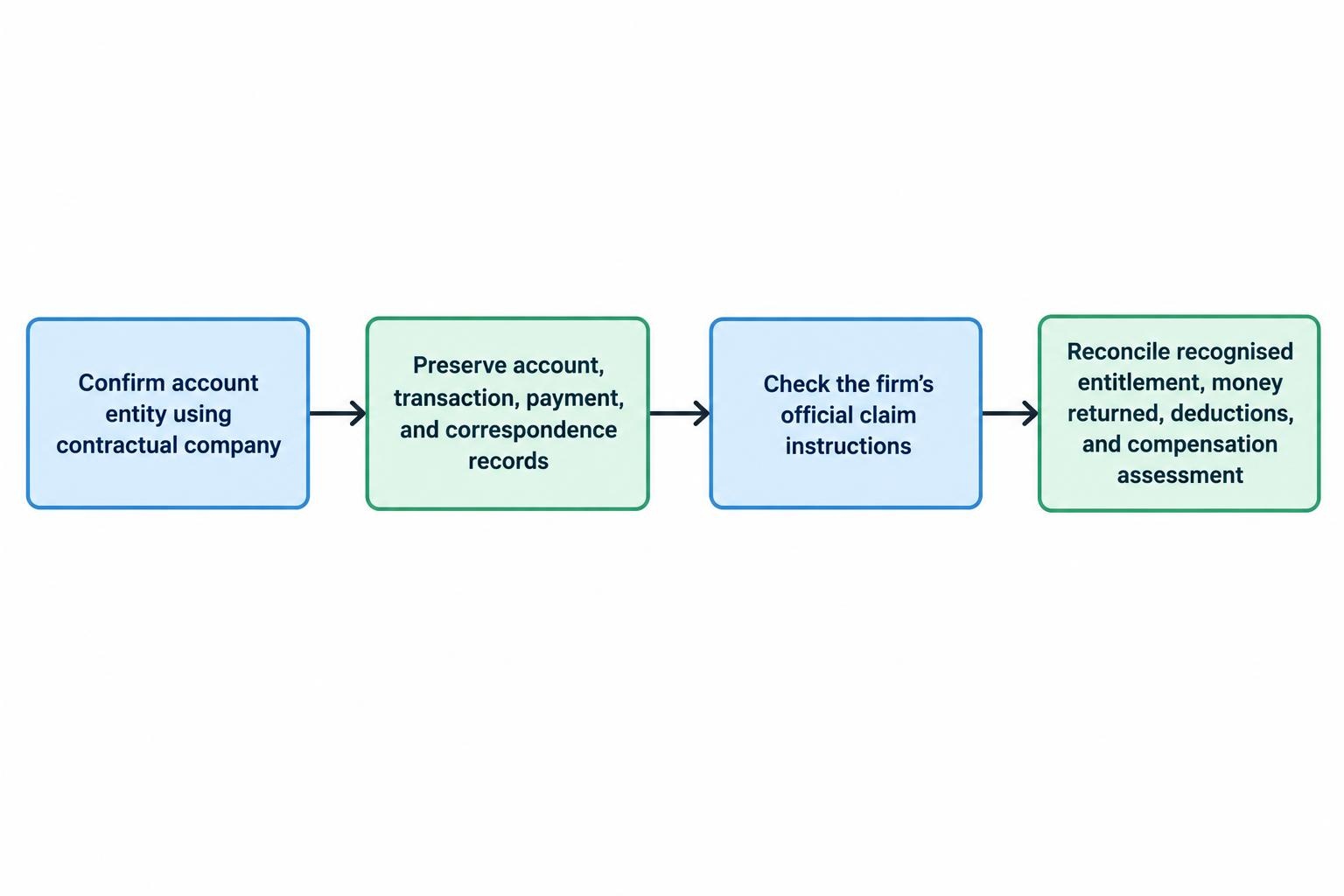
Keep the compensation task focused: establish what you are owed, preserve the evidence and follow the verified instructions for that firm. A useful working sequence is:
- Confirm the account entity. Use the contractual company, not just the platform’s trading name.
- Preserve your records. Save account agreements, transaction histories, statements, payment evidence and relevant correspondence.
- Check the firm’s official claim instructions. Establish whether you must apply directly or follow an administrator-led process.
- Reconcile the proposed figures. Compare the recognised entitlement, money returned, deductions and compensation assessment.
FSCS provides a free direct claims service and asks claimants to prepare supporting documents before applying. Its claim preparation guidance includes transaction histories showing payments, withdrawals and charges, with other evidence depending on the claim. You do not need to assume that paid representation is a condition of receiving compensation.
For a spread betting account, retain evidence that helps distinguish transfers of your own money from trading results. A bank statement proves a payment was made; an account statement helps explain what happened after it arrived. Keep both where available.
Regularly downloading spread betting account statements is a sensible administrative habit. Do it before access becomes an issue, and keep copies somewhere other than the trading app.
Do not assume the process will be immediate
FSCS investigations can involve evidence gathering and individual assessments. Foreign Currency Innovations, which offered services including spread bets, entered liquidation on 10 March 2023. Its FSCS updates later requested client agreements, transaction evidence, statements and correspondence; an update dated 2 December 2024 said submitted claims would move to assessment on a case by case basis. The FSCS record for Foreign Currency Innovations illustrates why complete records matter.
Do not build a cash plan around receiving compensation on a date of your choosing. If your money is tied up in a claim, the practical problem is access as well as eventual recovery. Keep essential household funds separate from money committed to trading.
The broader insolvency process, including the treatment of trading positions and customer communications, is covered in what happens when a spread betting broker fails.
FSCS claims and complaints are not the same process
If a firm is still operating and your dispute concerns its conduct, begin with its complaints procedure rather than assuming the issue belongs with FSCS. For most complaints, a financial business has eight weeks to consider the complaint before the Financial Ombudsman Service can usually step in. The Financial Ombudsman’s complaint time limits explain the applicable deadlines and exceptions.
Write the complaint around the disputed action, the evidence and the remedy requested. “My account lost money” is not the same allegation as “the firm deducted a charge contrary to the agreement.” Separating those issues makes the dispute easier to assess.
If the firm later fails, keep the complaint and its response with your claim records. For the complaint route itself, see spread betting complaints and the Financial Ombudsman.
Managing exposure beyond the compensation limit
Use the protection limit as one input into account planning, not as a recommended account balance. Start with the funds needed for your intended trading activity and an appropriate margin buffer. Then ask how much additional cash you are leaving exposed to the same company without a trading reason.
If you consider using more than one provider, assess the legal entities rather than counting brands. Also weigh the administrative burden: multiple accounts mean more statements, more balances to monitor and more opportunities to overlook an open position. Splitting funds should solve a clearly identified problem, not create several new ones.
Leave room for balances to change. A successful run of trades can increase the amount held with one firm; withdrawals, charges and losses can reduce it. Review the actual balance and contractual arrangements periodically rather than treating the account-opening check as permanent.
Above all, keep compensation protection separate from position risk. FSCS eligibility cannot make an oversized trade sensible, and withdrawing every spare pound can leave too little room for normal margin requirements. A practical plan for protecting trading capital needs to address both the money held with the firm and the risk taken in the account.
The useful question is not simply “Is this broker FSCS protected?” It is: which firm owes me money, which claim would be covered, and what could remain unrecovered? Establish those answers before funding the account, and retain the documents that support them.