A long spread bet gains from a rising market price and loses from a falling one. A short spread bet does the reverse: it gains from a falling price and loses from a rising one. You open a long position by buying and a short position by selling.
The distinction sounds straightforward. The practical challenge is using the correct entry and exit prices, setting an appropriate stake and recognising that either direction can produce substantial losses. Choosing “sell” changes your exposure, not your need for risk controls.
What Is the Difference Between Long and Short Spread Bets?
Long and short describe the direction of a position, not how long you intend to hold it. A long trade can last minutes. A short trade can remain open for days, subject to the contract’s terms and sufficient account funds.
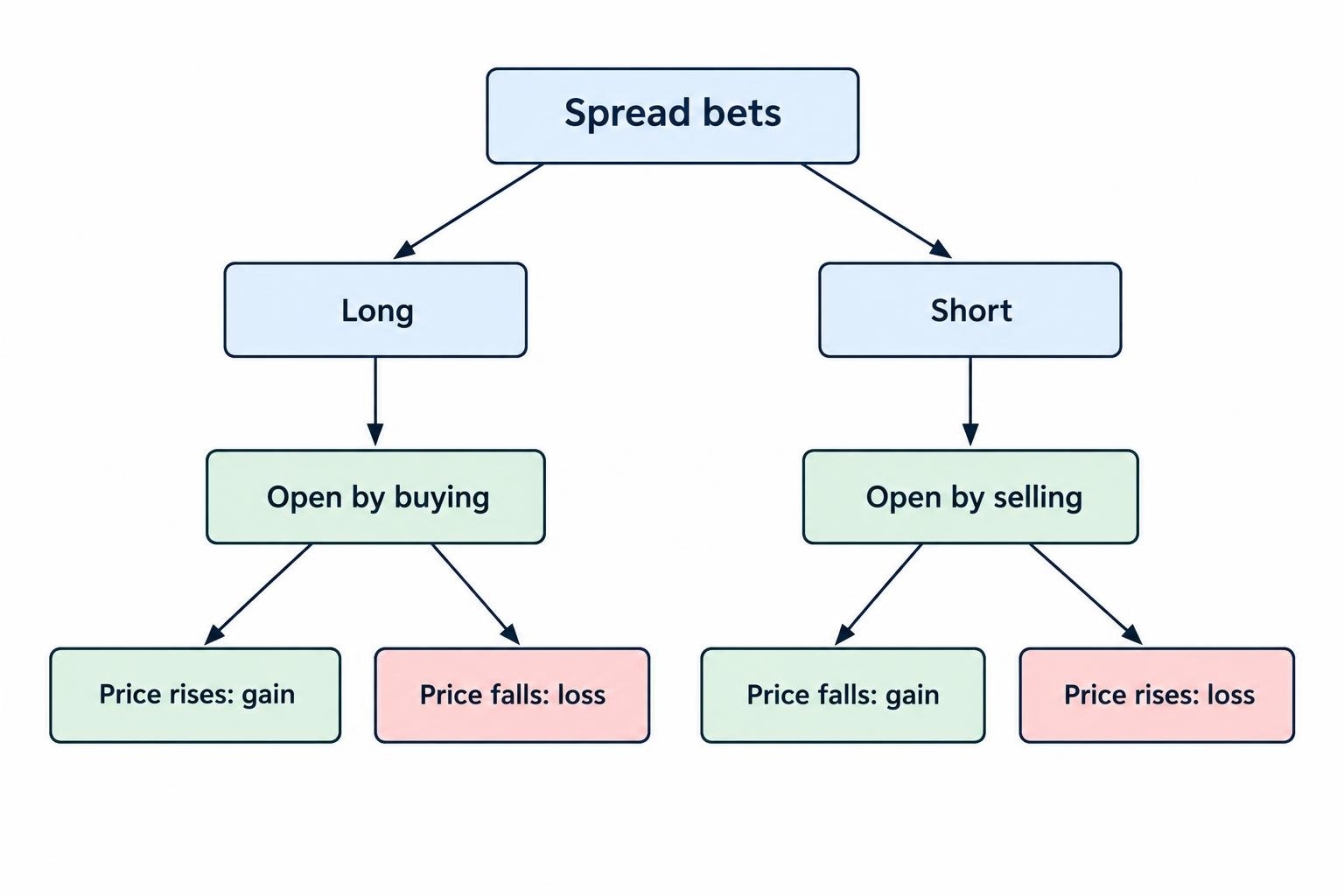
| Feature | Long spread bet | Short spread bet |
|---|---|---|
| Opening action | Buy | Sell |
| Favourable price movement | Upwards | Downwards |
| Adverse price movement | Downwards | Upwards |
| Opening price | Buy price, also called the offer or ask | Sell price, also called the bid |
| Closing price | Sell price | Buy price |
Neither position gives you ownership of the underlying asset. Buying a share spread bet does not make you a shareholder, and opening a short spread bet does not require you to hold those shares first. The contract settles the price difference; HMRC’s financial spread betting example sets out both directions and confirms that no underlying assets are acquired or disposed of.
How the Buy and Sell Prices Affect Both Directions
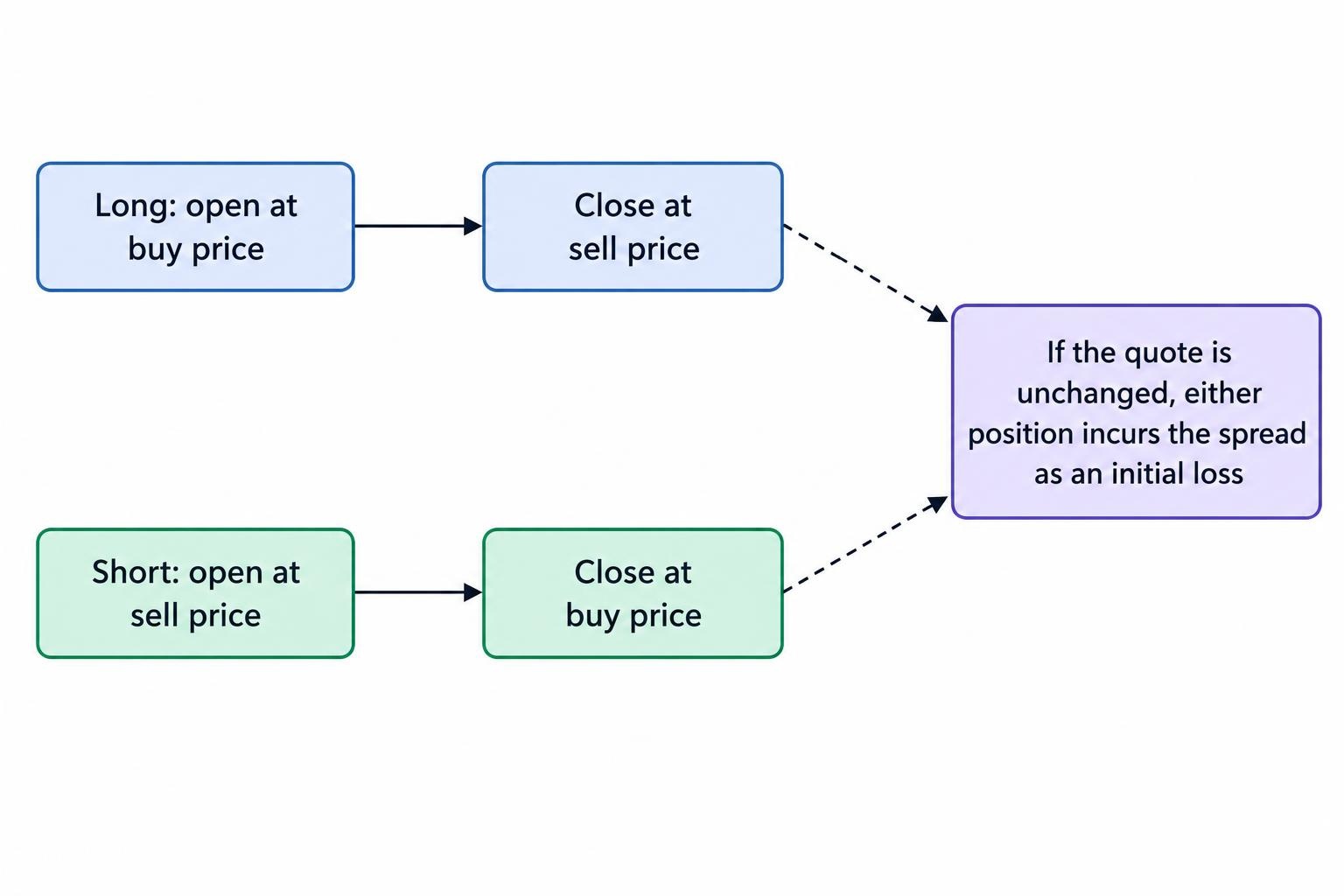
A provider quotes two prices. Suppose an index spread bet has a sell price of 7,999 and a buy price of 8,001. The spread is two points.
A long position opens at 8,001. If you immediately close while the quote is unchanged, you sell at 7,999 and lose two points multiplied by your stake. A short position opens at 7,999 and would close at 8,001, producing the same initial loss.
Both directions therefore start behind the spread. The relevant exit price must move past your entry price before the trade produces a price profit. Other charges can move the net break-even level further away. Our guide to spread betting spreads covers this dealing cost in more detail.
Long and Short Spread Betting Examples
The following examples use hypothetical index quotes and a stake of £2 per point. They include the spread through the entry and exit prices, but exclude financing, adjustments and other charges.
Going Long: Buying Before a Rise
The opening quote is 7,999–8,001. You expect the index to rise, so you buy at 8,001 for £2 per point.
Later, the quote reaches 8,049–8,051. You close at the sell price of 8,049:
Profit = (8,049 − 8,001) × £2 = £96.
If the market instead falls to 7,949–7,951, you close at 7,949:
Loss = (8,001 − 7,949) × £2 = £104.
The different outcomes reflect the spread. A 50-point rise in the midpoint produces a 48-point gain, whereas a 50-point fall produces a 52-point loss, assuming the spread stays unchanged.
Going Short: Selling Before a Fall
Return to the opening quote of 7,999–8,001. This time, you expect a decline and sell at 7,999 for £2 per point.
The quote falls to 7,949–7,951. You close by buying at 7,951:
Profit = (7,999 − 7,951) × £2 = £96.
If the quote instead rises to 8,049–8,051, you close by buying at 8,051:
Loss = (8,051 − 7,999) × £2 = £104.
The short trade uses the same stake and price sensitivity as the long trade. What changes is which direction helps you. For further calculations, including account charges, see calculating spread betting profit and loss.
Is Going Short Riskier Than Going Long?
At the same stake per point, an equal adverse point movement produces the same price loss in either direction. A 100-point move against a £3-per-point position costs £300 before other charges, whether the position is long or short.
That does not make their risks identical. Price behaviour, the possible size of a move and the costs of holding the position can differ.
Short Share Positions Have Asymmetric Price Risk
A share price has a floor of zero, but no fixed ceiling. A short position on that share therefore has a finite favourable price move and no predetermined maximum adverse price move.
A short seller can also face a sharp rebound during an otherwise falling market. Buying by traders closing short positions can contribute to that rebound, often called a short squeeze. A bearish view does not prevent an uncomfortable rally before the expected decline.
This price exposure should not be confused with unlimited personal liability under every account arrangement. Retail account protections affect how much a customer can owe, as discussed below.
Stake Size Matters More Than the Margin Deposit
Margin is the money required to support a position. It is not a statement of the most that position can lose. A small opening margin does not make a large stake affordable.
Suppose your planned exit is 40 points from the entry price. At £2 per point, the intended price risk is £80. At £10 per point, it is £400. Both figures assume execution at the planned exit and exclude other charges.
Choose the exit level and cash risk before selecting the stake. The guide to position sizing for spread betting develops that process without treating available margin as a spending target.
Stops Work in Opposite Directions
A protective stop for a long position sits below the entry price. For a short position, it sits above the entry price.
Ordinary stops do not guarantee the execution price. A gap or fast market can result in a worse fill, increasing the loss beyond your planned amount. Where available, a guaranteed stop provides price protection under its terms, usually with a premium or other conditions. Review the mechanics of stop-loss orders before relying on one.
Retail Protection Applies at Account Level
For UK retail accounts covered by the relevant FCA rules, negative balance protection restricts liability to the funds in the trading account. The rules also require margin close-out when account net equity falls below 50% of the required margin, with positions closed as soon as market conditions allow. These safeguards sit within the FCA Handbook’s retail margin and negative balance protection rules.
Neither safeguard caps each trade at its opening margin or guarantees your chosen exit. A losing position can consume funds supporting other trades. Do not assume that professional or overseas account arrangements provide the same protection.
Do Long and Short Spread Bets Have Different Costs?
Both directions face the spread, but their holding costs need not match. For a position kept overnight, check the contract type, funding calculation and applicable rate on each side.
A short position is not automatically free to hold. It may receive a funding credit in some circumstances, or incur a charge after the provider’s adjustments and mark-up. The FCA’s review of derivative funding charges identifies variation between firms and assets, including charges or credits on short positions.
Compare the expected cash cost over your intended holding period rather than assuming the sell side must be cheaper. Our guide to overnight financing costs covers the calculation separately.
Dividend adjustments can also differ by direction. On relevant cash share and index contracts, long positions generally receive an adjustment around the ex-dividend date, while short positions generally pay one. The amount and treatment depend on the contract.
A dividend-related price fall is therefore not an automatic windfall for a short position: the accompanying debit can offset the price benefit. Check the provider’s terms and the explanation of spread betting dividend adjustments before holding through an ex-dividend date.
Choosing Between a Long and a Short Position
The choice should follow your view of the next tradeable price move, not whether you like the asset or consider it a good long-term investment.
You might consider a long position after a price holds above support, provided your trading method gives you a defined entry and exit. A short position might follow a failed rally or a break below support. Neither chart pattern guarantees a profitable outcome.
Price alone is not a reason to choose a direction. A share that has doubled can rise further; one that has halved can fall again. “It looks expensive” is not an exit plan.
Currency pairs need particular care. Going long GBP/USD expresses a view that sterling will strengthen against the US dollar. Going short expresses the opposite relative view. It does not require a prediction that every sterling exchange rate will move the same way.
If the evidence does not support either direction, remaining out of the market is a valid decision. Access to a sell button does not create a reason to use it.
Closing, Reversing and Hedging Are Different Actions
Selling does not always mean opening a short position. It can mean closing an existing long. Buying can mean closing an existing short rather than opening a new long.
Suppose you hold a £2-per-point long position. Selling £2 per point against it may close the trade. Selling £3 per point may close the long and leave a £1-per-point short exposure. The result depends on whether the platform nets opposing trades or allows separate positions.
Use the platform’s close-position function when your intention is simply to exit. Check the resulting position rather than assuming an opposite order has done what you intended.
A short spread bet can also offset some exposure from an investment portfolio. That is a hedge, not necessarily a prediction made for standalone profit. An index hedge may not track individual holdings closely, and it adds costs and margin demands. Our guide to hedging with financial spread betting covers those trade-offs.
Checks Before Opening Either Direction
Before submitting the order, confirm:
- Direction: does the position gain from the move you expect?
- Prices: which quote opens the trade, and which closes it?
- Cash risk: what does the intended exit distance mean at your chosen stake?
- Holding terms: what funding, adjustments and expiry conditions apply?
- Order effect: are you opening, closing, reducing or reversing a position?
Long and short spread bets use the same basic arithmetic. A disciplined trade needs more than the right directional label: it needs an acceptable entry, a manageable stake and an exit plan that accounts for execution risk.