Bond spread betting lets you trade changes in a bond market price without owning the underlying debt. You choose a stake per point, buy if you expect the quoted price to rise, or sell if you expect it to fall. Your profit or loss depends on the price movement, your stake and the costs of holding the position.
The awkward part is translating between bond prices, yields, futures quotations and the provider’s betting points. These are different measurements. Confusing them can turn an apparently modest stake into a much larger exposure than intended.
This guide covers that translation, with worked trades and practical checks. The broader guide to bond markets for spread betting covers market selection; here, the focus is how the trade operates.
What Are You Trading in a Bond Spread Bet?
A bond spread bet is a contract with a spread betting provider. Its price references a named bond market, often through a government bond futures contract. You do not purchase a bond, lend money to a government or become entitled to the bondholder’s coupon payments.
That distinction matters. A market labelled “UK Long Gilt” may reference gilt futures rather than one named gilt with a particular coupon and redemption date. A Treasury market may reference a note or bond futures contract rather than the cash security shown on a financial news page. Read the instrument details before treating two similar names as interchangeable.
The spread betting contract sets your stake, dealing spread, margin requirement, trading hours and settlement arrangements. The exchange futures contract supplies a reference market, but its contract size does not automatically become your position size.
The underlying futures contract
The ICE Long Gilt future represents £100,000 nominal of a notional gilt and is quoted per £100 nominal. Its minimum price movement is 0.01, worth £10 for one exchange futures contract. It is a deliverable contract covering eligible gilts with remaining maturities from eight years and nine months to 13 years. These are ICE Long Gilt futures specifications, not the stake rules for a retail spread bet.
If a provider defines one betting point as a 0.01 movement and you stake £2 per point, that movement produces £2 profit or loss on your bet. It does not produce the exchange contract’s £10 tick value. The gilt spread betting guide covers the UK market in more detail.
Different reference contracts have different specifications. Euro-Bund futures, for example, have a €100,000 contract value and a minimum movement of 0.01 worth €10 per exchange contract. The eligible maturity range is 8.5 to 10.5 years under the Eurex Euro-Bund contract specifications. Again, your spread betting stake is a separate choice.
Bond Prices and Yields Move in Opposite Directions
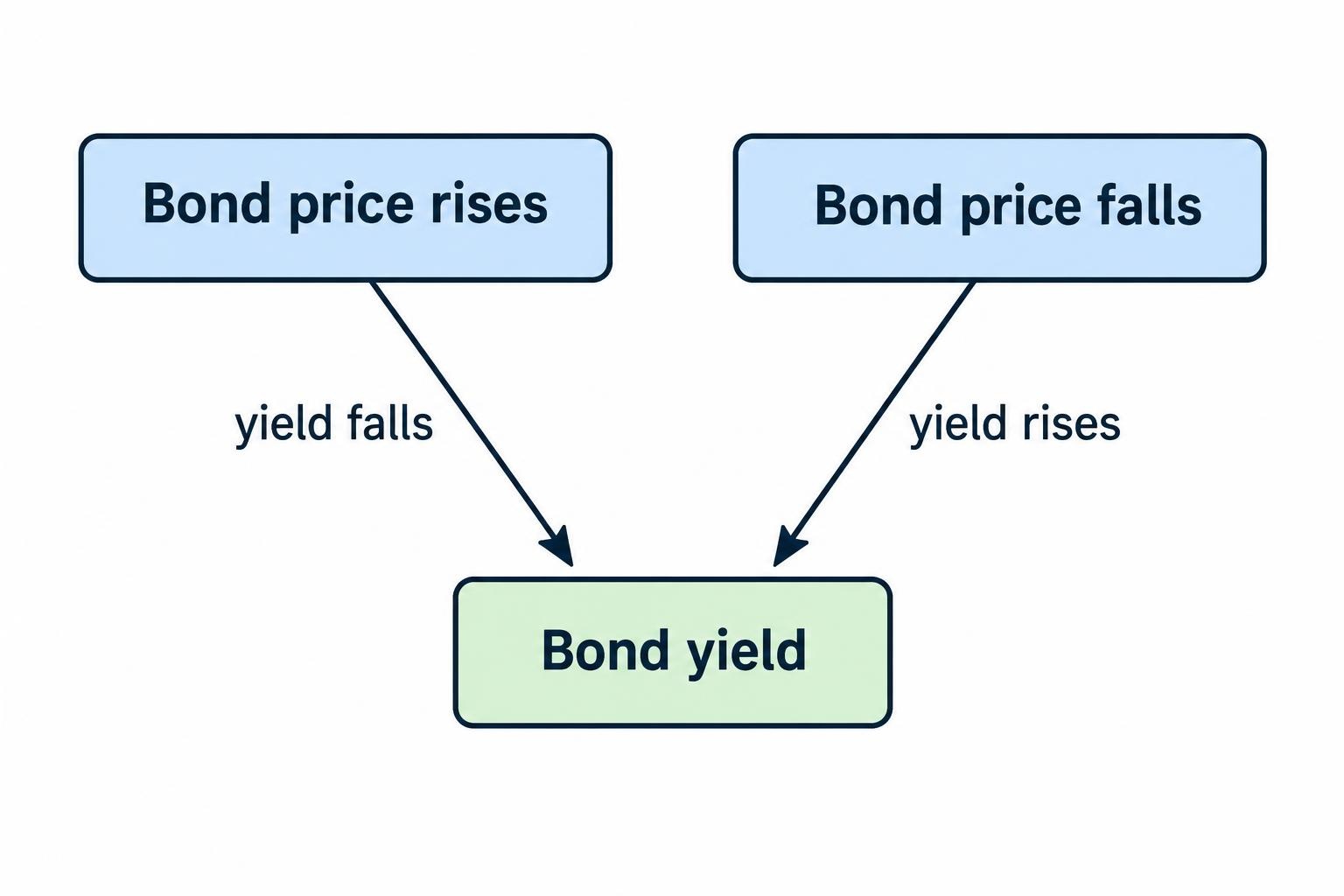
For a conventional fixed rate bond, a higher price means a lower yield, and a lower price means a higher yield. The fixed cash payments have not changed; the amount an investor pays to receive them has. The UK Debt Management Office’s explanation of gilt prices and yields also distinguishes the coupon from the redemption yield, which accounts for the purchase price and repayment at maturity.
This creates the first decision in a bond price spread bet:
- Expect bond prices to rise: consider a buy position, which generally corresponds to a view that relevant yields will fall.
- Expect bond prices to fall: consider a sell position, which generally corresponds to a view that relevant yields will rise.
Buying a bond price market because you expect “bond rates to go up” gets the direction backwards. Before entering, write the view in price terms: “I expect the quoted futures price to fall.” That removes much of the ambiguity.
A yield basis point is not a betting point
One yield basis point is 0.01 percentage points. A yield rising from 4.20% to 4.30% has risen by 10 basis points. This does not mean the spread betting price has moved by 10 points.
A full bond price point, an exchange tick and a provider’s betting point can each mean something different:
| Measurement | Meaning | Illustration |
|---|---|---|
| Yield basis point | A change of 0.01 percentage points in yield | 4.20% to 4.21% |
| Full price point | A movement of 1.00 in the bond price quotation | 105.00 to 106.00 |
| Exchange tick | The exchange contract’s minimum price increment | 0.01 for the Long Gilt future |
| Betting point | The price increment to which your stake applies | 0.01, if the provider defines it that way |
There is no universal conversion from a one basis point yield change to a fixed number of betting points. The contract’s interest rate sensitivity and the provider’s quotation scale determine the relationship.
How to Read Bond Spread Betting Quotes
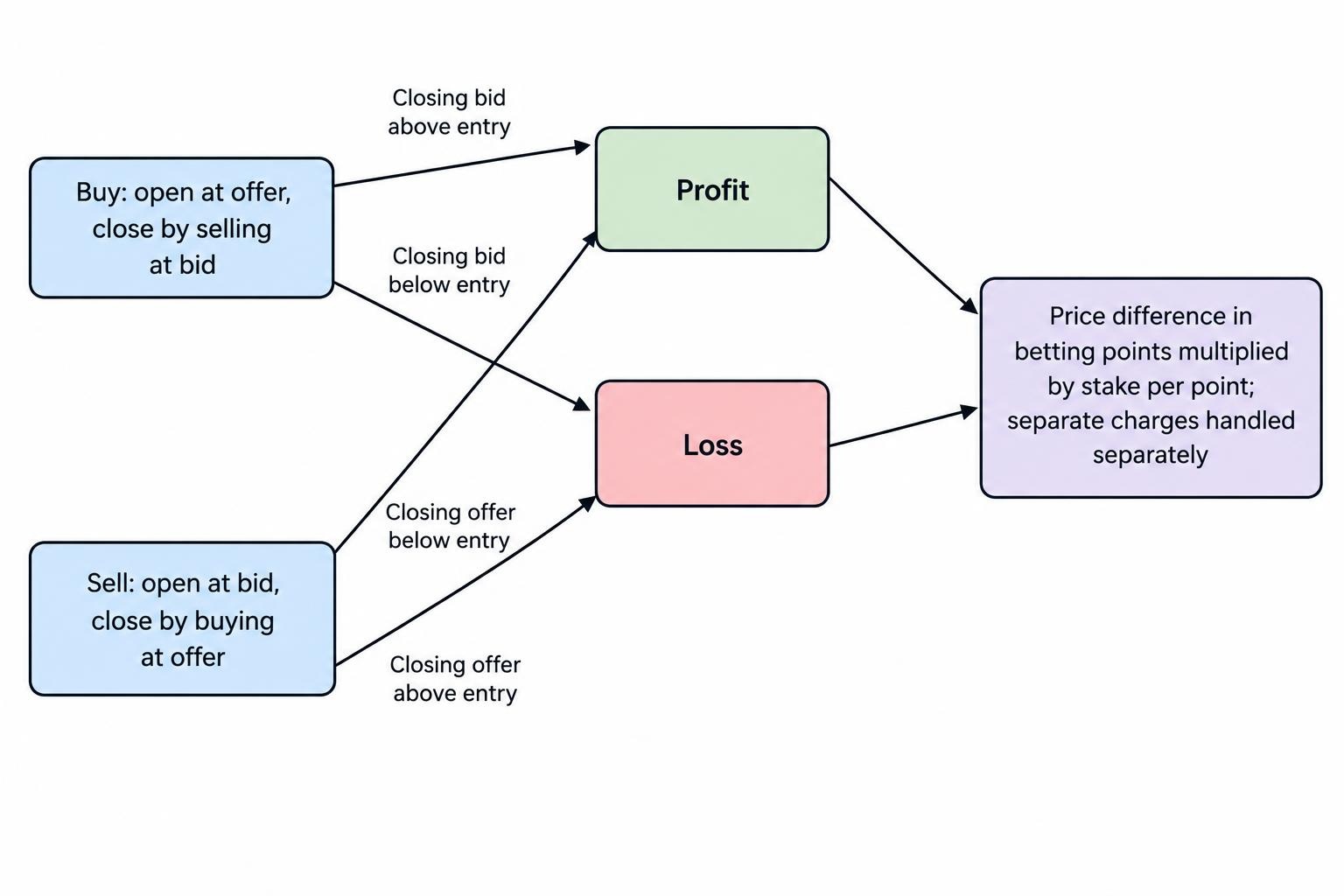
The provider displays a bid and an offer. You buy at the higher offer and sell at the lower bid. Closing a buy position means selling at the available bid; closing a sell position means buying at the available offer.
For the examples below, assume a hypothetical market quotes 10,520–10,524. The provider has scaled a decimal reference price of 105.20–105.24 by 100, so one betting point represents 0.01 in the reference price.
Under those assumptions, a rise from 10,524 to 10,604 is an 80 point movement. At £2.50 per point, it represents £200. A full reference price movement of 1.00 equals 100 betting points, not one.
Another provider could use a different display or stake convention. Check the monetary effect of a small price change in the order ticket rather than inferring it from the number of decimal places. The general stake per point calculation applies once the instrument’s point size is clear.
Treasury fractions need a separate calculation
Traditional US Treasury futures quotations use full points and fractions of 1/32, with smaller fractional increments for some contracts. A quotation of 110-16 therefore means 110 plus 16/32, or 110.50. It does not mean 110.16. The fractional notation and conversion method appear in CME Group’s Treasury pricing calculations.
Consider a move from 110-16 to 110-24. The difference is 8/32, or 0.25 of a full price point. You must then translate that movement into the provider’s betting points before multiplying by your stake.
If the provider defines one betting point as 1/32, this example is eight betting points. If it uses a decimal scale, the calculation will differ. Neither convention should be assumed from the market’s name alone.
The US Treasury spread betting guide covers Treasury market selection. For any individual trade, the order ticket’s point definition takes priority over a notation convention remembered from another platform.
Worked Bond Spread Betting Examples
All prices and stakes below are illustrative, not live quotes. Each example uses the hypothetical 10,520–10,524 market, where one betting point represents a 0.01 reference price movement. The stake is £2.50 per point.
Buying because you expect bond prices to rise
You buy at the offer of 10,524. Later, the market quotes 10,604–10,608 and you close by selling at 10,604.
Profit = (10,604 − 10,524) × £2.50 = £200.
The reference price has risen from your entry of 105.24 to an exit bid of 106.04. That is 0.80 in full price terms, or 80 betting points under the stated convention.
If the market instead falls and you sell to close at 10,394, the result is:
Loss = (10,394 − 10,524) × £2.50 = −£325.
Both calculations use executable dealing prices. They include the effect of entering at the offer and exiting at the bid, but exclude financing, premiums and other separate account charges.
Selling because you expect bond prices to fall
You open a sell position at the bid of 10,520. Later, you buy it back at an offer of 10,440.
Profit = (10,520 − 10,440) × £2.50 = £200.
If the closing offer is 10,650 instead, the loss is £325. The calculation reverses because you sold first: opening sale price minus closing purchase price. The mechanics of long and short spread bets remain the same across markets.
| Position | Opening price | Closing price | Result at £2.50 per point |
|---|---|---|---|
| Buy, favourable move | 10,524 | 10,604 | £200 profit |
| Buy, adverse move | 10,524 | 10,394 | £325 loss |
| Sell, favourable move | 10,520 | 10,440 | £200 profit |
| Sell, adverse move | 10,520 | 10,650 | £325 loss |
Do not subtract the spread twice
The opening spread is four points. At £2.50 per point, closing immediately at an unchanged quote would produce a £10 loss.
However, the worked results already use the actual buy and sell prices. Subtracting another £10 from those results would count the opening spread again. Only separately charged costs still need to be deducted. The spread betting profit and loss guide covers this distinction across different trade types.
Why the Same Yield Change Can Produce Different Results
Duration measures a bond’s sensitivity to changes in yield. Higher duration means greater price sensitivity, other things equal. Maturity contributes to duration, but the two are not interchangeable: coupon payments and other bond features also matter. FINRA’s explanation of duration risk sets out that distinction.
A useful approximation for a small yield change is:
Percentage price change ≈ −modified duration × yield change expressed as a decimal.
Suppose an illustrative bond exposure has a modified duration of eight. A yield increase of 10 basis points is 0.001 in decimal form. The estimated price change is −8 × 0.001, or −0.8%.
At a reference price of 105.00, that would be roughly a 0.84 price decline. If one betting point represents 0.01, it becomes about 84 betting points. At £2.50 per point, the estimated adverse movement is £210 before dealing costs.
Futures sensitivity comes from the deliverable bonds
For Treasury futures, implied sensitivity depends on the cheapest to deliver security and its conversion factor. The cheapest to deliver bond is the eligible security that is most financially efficient for the seller to deliver. Its basis point value, adjusted by the conversion factor, helps estimate the futures contract’s sensitivity. This relationship is covered in CME Group’s Treasury risk measurement material.
The practical lesson is not to borrow the duration of a convenient cash bond and assume it precisely describes your futures based spread bet. Nor should you assume that £2 per point in two different bond markets creates comparable yield risk. Compare the potential cash loss under a plausible market move.
Margin Is Collateral, Not Your Maximum Loss
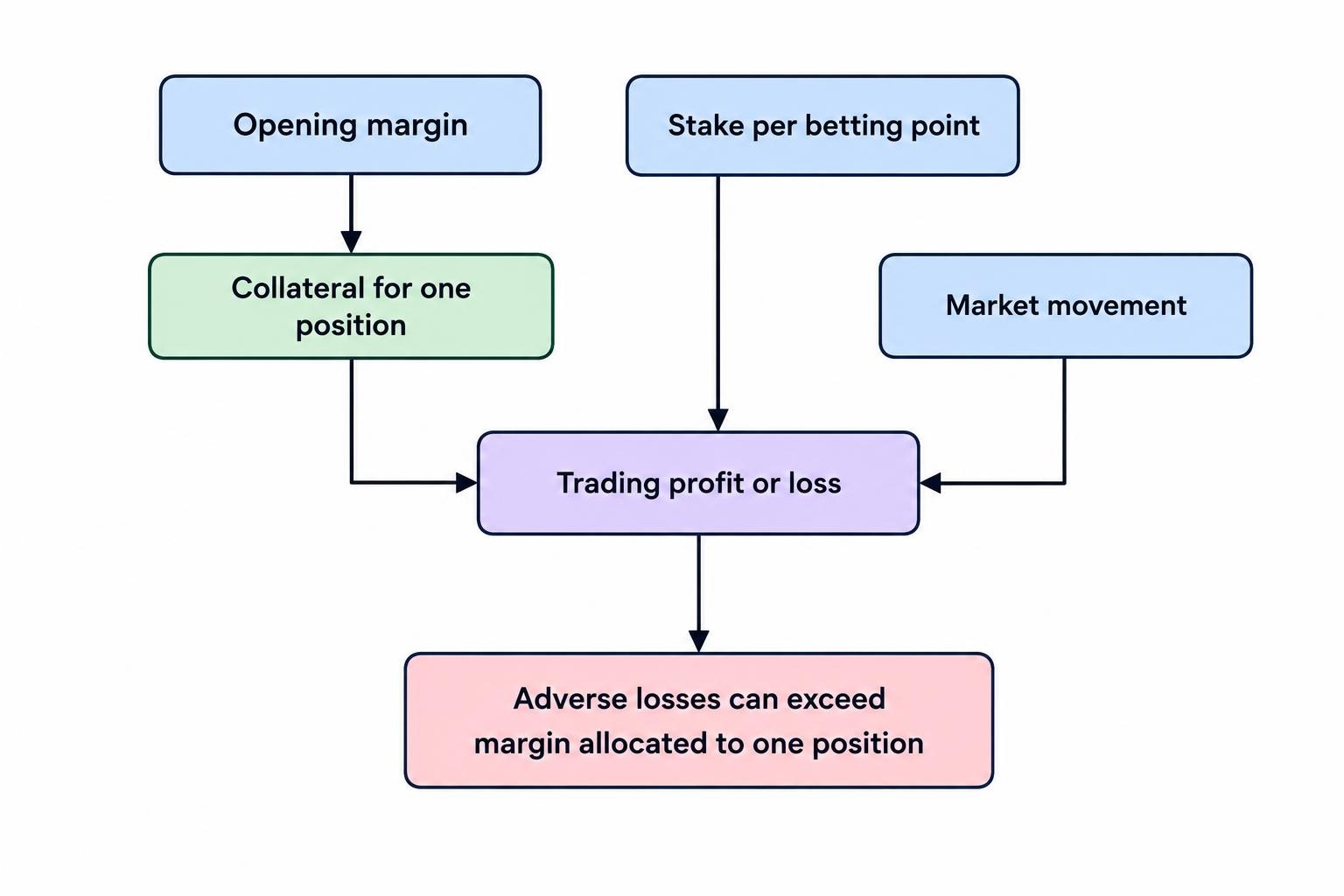
Bond spread bets use margin: you deposit part of the exposure’s value rather than funding the entire equivalent position. The stake still applies to every betting point moved. A smaller opening deposit does not reduce the loss per point.
UK retail margin rules distinguish qualifying sovereign debt from other assets. The FCA definition of relevant sovereign debt includes debt issued by or on behalf of the UK, US and euro area member states, among other listed governments.
For relevant sovereign debt, the regulatory minimum opening margin is 3.33% of exposure. Firms can require more. The rules also require account level close out when net equity falls below 50% of the applicable margin requirement, as soon as market conditions allow, and restrict a retail client’s liability to funds in the account. These provisions sit in FCA COBS 22.5 margin and retail protection rules.
Neither close out protection nor negative balance protection guarantees that a particular trade will exit at your intended price. You can lose more than the margin allocated to one position and put other funds in the account at risk.
A simplified margin example
Assume a linear bond market quoted at 10,000, a stake of £2 per point and equivalent price exposure of £20,000. Suppose the provider requires 5% margin. The opening requirement would be £1,000.
A 100 point adverse movement creates a £200 trading loss. That is a 1% move in the quoted price but 20% of the opening margin, before other charges. The example is hypothetical; the provider’s exposure calculation and margin schedule govern the actual requirement.
Size the position from an acceptable cash loss, not the amount the platform permits you to open. The spread betting margin guide explains how margin interacts with account equity and available funds.
Costs, Financing and Contract Expiry
A correct directional view can still produce a disappointing net result if the price movement is small relative to the spread and holding costs. Check the cost structure of the exact bond instrument, not just the provider’s headline pricing.
The dealing spread
The difference between bid and offer creates an initial hurdle. In the worked example, a buy at 10,524 needs the closing bid to reach 10,524 just to break even before separate costs. A chart’s midpoint reaching your entry number is not necessarily enough.
Compare spreads in cash terms. A four point spread at £2.50 per point costs £10 to cross at an unchanged quote. A different instrument with a two point spread is not automatically cheaper if its point definition or required stake creates greater exposure. The broader guide to spread betting costs covers the charges to include.
Daily funded and dated positions
If the provider offers a daily funded bond market, check the financing rate, calculation basis, adjustment time and treatment of non-business days. Do not assume that opening a sell position guarantees a financing credit.
A dated futures based bet can use a different cost structure. Financing or carry may be reflected in the contract price or dealing terms rather than appearing as the same daily adjustment used on a rolling product. That does not make the position free to hold.
Compare the expected total cost over your planned holding period. A narrow opening spread may not compensate for several weeks of charges. The overnight financing guide explains how to separate price performance from account adjustments.
Expiry and rolling the position
A spread bet’s expiry is not the maturity date of a government bond. A bet referencing a quarterly futures contract may end well before any eligible underlying bond matures.
Check the provider’s last dealing time, settlement calculation and rollover process. Do not assume these match the exchange’s delivery timetable. Your cash settled spread bet does not become a holding of government bonds simply because the underlying futures contract permits physical delivery.
Rolling generally means closing exposure to one contract month and opening exposure to another, whether you do that manually or the provider offers an automatic process. The next contract can trade at a different price. A jump between contract months is not automatically a trading gain or loss of the same amount.
The guide to futures and forward spread bets covers the contract structure. Before carrying a position into its final days, confirm the relevant spread betting expiry arrangements and whether existing orders will transfer.
Why Bond Prices Can Move Against Your Interest Rate View
A long dated bond yield is not simply the central bank’s policy rate stretched over a longer period. It reflects expectations for future short term rates and a term premium: compensation for holding longer dated debt rather than repeatedly holding short term instruments. Inflation uncertainty, fiscal concerns and supply and demand can affect that premium. The Bank of England’s analysis of long term yield drivers separates these components.
A hypothetical rate cut therefore need not make every bond price rise. If traders expected a larger cut, the announcement could disappoint. Alternatively, concerns about future inflation or borrowing could outweigh the change in the policy rate.
For a spread bet, the practical question is whether the chosen contract responds to the part of the interest rate outlook you are trading. A view about the next policy meeting is not automatically a sound reason to take exposure to a much longer dated bond market.
Write down both the forecast and what would invalidate it. “Rates will fall eventually” is too vague to govern a leveraged trade with daily price movements, costs and an expiry date.
Stops and Position Sizing in Bond Markets
Start with the price level that would invalidate the trade, then calculate the stake. Reversing that order often produces a stop chosen to fit a preferred stake rather than the market.
Suppose you plan to buy at 10,524 and place a stop at 10,424. The distance is 100 betting points. With a planned trading loss of £100 before separate charges and slippage, the corresponding stake is £1 per point.
Check whether the stop distance is measured from your entry, the current market or another reference shown in the ticket. Also check which quote triggers it. A buy position is closed by selling, so the relevant bid can matter even when the chart appears not to have reached the displayed level. The guide to managing risk with stop losses covers order placement in more detail.
An ordinary stop sets a trigger, not a guaranteed execution price. If the market passes through the level without an available fill, execution can occur at a worse price. Treat a calculated stop loss as planned risk, not an unconditional maximum.
For a trade with a small target, execution costs deserve particular attention. A four point spread and an adverse fill can consume a large share of a ten point objective. The mechanics of slippage in spread betting matter just as much in a bond trade as in an index trade.
Do not treat separate bond positions as separate risks
Several positions can express much the same interest rate view. A trader buying multiple government bond markets may have accumulated one broad bet on falling yields rather than several independent opportunities.
Different maturities can also react differently. Equal stakes do not create equal interest rate exposure, and opposite positions do not necessarily cancel each other. Review plausible combined cash losses using the principles in portfolio correlation and spread betting risk.
Checks Before Placing a Bond Spread Bet
The order ticket should let you answer five questions without guessing:
- What is the reference market? Identify the futures contract, contract month and whether the quotation represents price rather than yield.
- What counts as one betting point? Calculate the cash result of a small favourable and adverse movement.
- What is the planned loss? Combine stake and stop distance, then allow for costs and execution uncertainty.
- What can change while the position is open? Check financing, margin requirements, trading breaks and scheduled announcements.
- How will the position end? Confirm your exit order, settlement terms or rollover choice before expiry approaches.
A demo ticket can help check the arithmetic and quotation scale before committing funds. Use it to test a buy, a sell and an immediate close at an unchanged market. The displayed result should match your calculation. Spread betting demo accounts are useful for this preparation, though simulated execution should not be treated as a promise of live fills.
Common Questions About Bond Spread Betting Mechanics
Do you receive interest on a long bond spread bet?
You do not receive the bondholder’s coupon simply by opening a long spread bet. Your position is a contract referencing a market price, not ownership of the debt. Check any financing or other adjustments in the product terms rather than adding an assumed coupon return to your forecast.
Does a price below 100 make a bond spread bet cheap?
Not by itself. A futures quotation below 100 is not evidence of a bargain, and a futures based bet is not a promise to repay you at par. Judge the expected price movement, costs and risk of the contract you are actually trading.
Can you calculate the result directly from a yield forecast?
You can estimate it if you have a suitable measure of the contract’s sensitivity and translate the estimated price change into betting points. The estimate is not exact. Realised profit or loss comes from the executable opening and closing prices, multiplied by the stake, then adjusted for separate costs.
What is the most useful final check?
Ask what a plausible adverse move would cost in pounds. If you cannot reconcile that figure with the point definition, stake and order ticket, the position is not ready to place. Bond terminology can be elaborate; the cash at risk should not be a mystery.