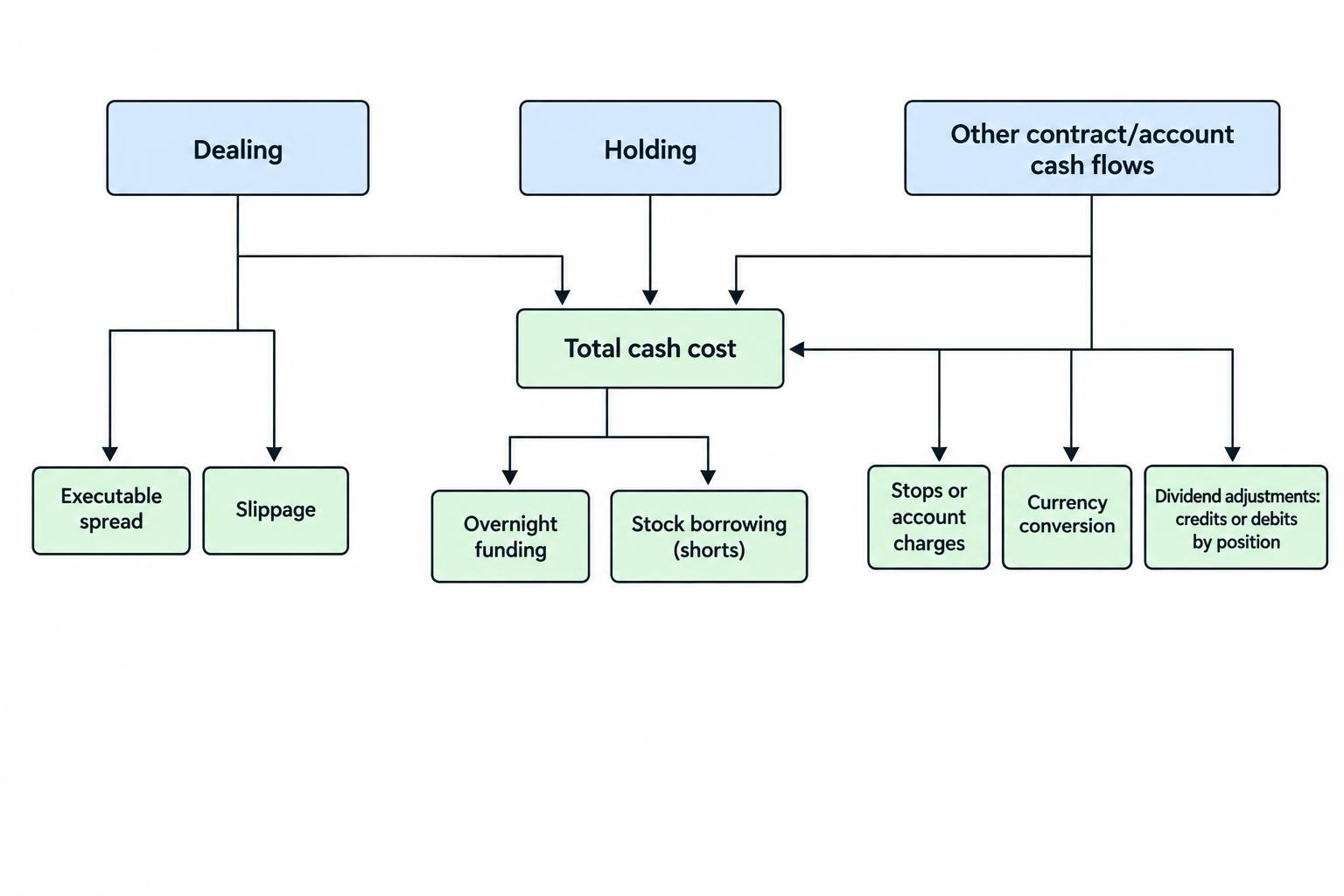
Share spread betting costs come from the dealing spread, overnight funding and any extra charges attached to the position or account. For short positions, stock borrowing charges may also matter. The cheapest trade to open is not necessarily the cheapest trade to hold.
The useful comparison is the total cash cost for the share, stake and holding period you intend to trade. A narrow advertised spread tells you little about a position held for six weeks. This guide focuses on those costs; the broader share spread betting guide covers how the product works.
How Share Spread Betting Costs Are Quoted
A provider may display its share dealing charge as a spread in points, a percentage adjustment to the underlying share price, or a minimum charge built into the quote. Check whether a quoted percentage applies on each side of the trade or represents the full difference between buying and selling.
For example, an adjustment of 0.1% on each side is not the same as a total spread of 0.1%. At a reference price of 500p, 0.1% equals 0.5p. Adding that adjustment to both sides creates one point of extra spread before allowing for the underlying market’s own bid and offer.
“Commission free” does not mean cost free. A dealing charge can sit inside the quoted prices rather than appear as a separate debit on your statement. Conversely, do not assume every share spread bet carries a separate commission simply because a provider charges commission on its share CFDs. They are different contracts with different pricing schedules.
Before comparing prices, establish what one point means. A UK share quoted in pence and a US share quoted in dollars can produce very different exposure from an apparently similar stake.
The Dealing Spread: Your First Cost
The spread is the difference between the price at which you can sell and the price at which you can buy. You open a long position at the higher buying price and close it at the lower selling price. A short position follows the opposite sequence.
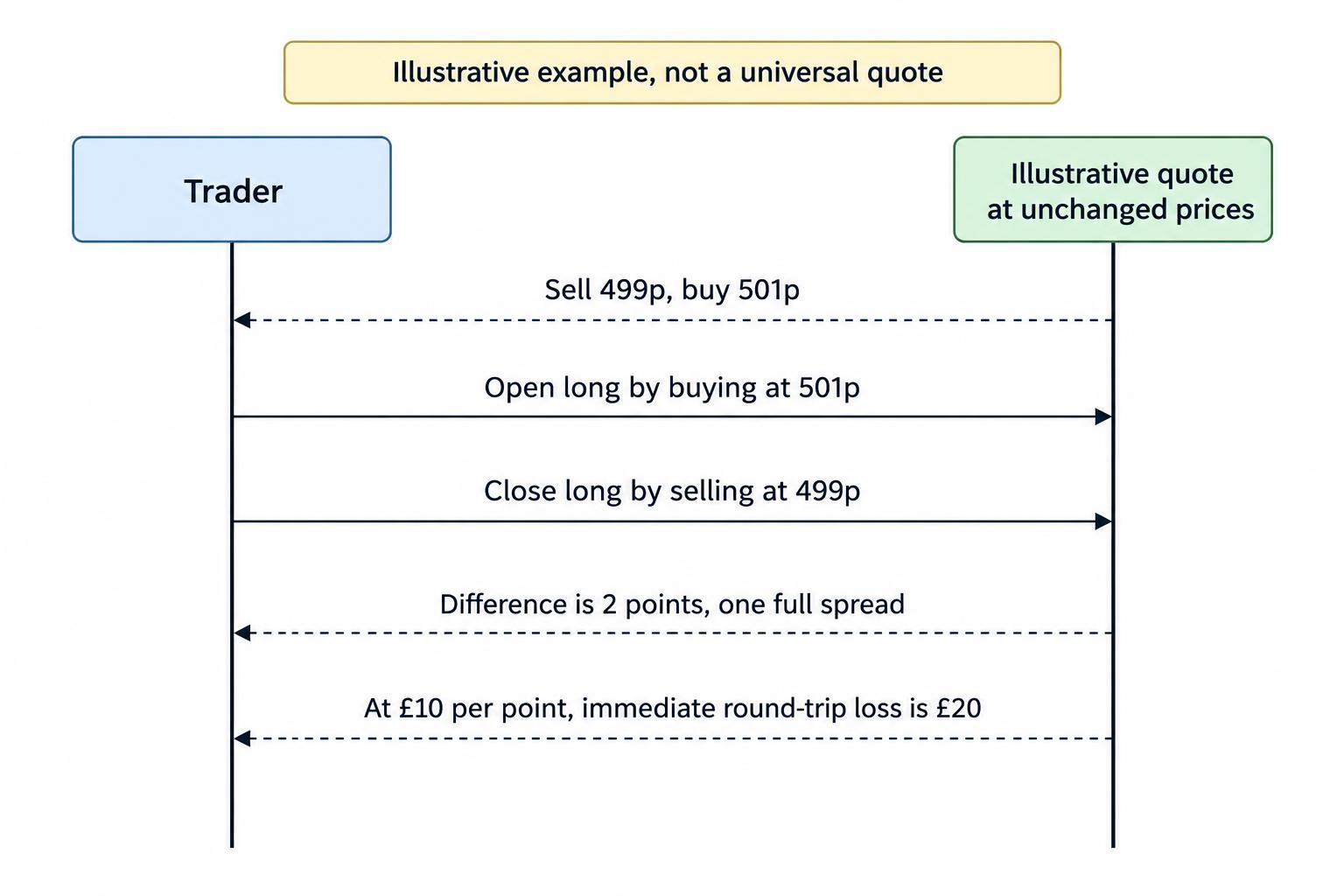
Suppose a share spread bet has a selling price of 499p and a buying price of 501p. If one point means 1p, the spread is two points. At £10 per point, buying and immediately selling at unchanged prices produces a £20 loss.
Immediate spread cost = spread in points × stake per point.
This is one full spread for an immediate round trip, not two full spreads. Viewed against the midpoint, you cross half the spread when opening and half when closing. The bid-ask spread guide covers that distinction in more detail.
Separate the Market Spread From the Provider’s Adjustment
The underlying share already has buying and selling prices. The provider’s quote may add its own adjustment to those prices. That means the full displayed spread can contain both the market’s spread and the provider’s dealing charge.
For your trading decision, the executable quote matters more than the advertised adjustment alone. A small adjustment on a share with a wide underlying spread can still produce an expensive trade.
Compare quotes for the same share at the same time, using the same stake. Check whether the displayed price applies to your intended size, rather than assuming a small indicative quote will remain available for a larger order.
Convert the Stake Into Share Exposure
For a UK share where one point equals 1p, £1 per point produces the same price sensitivity as 100 shares. A £10 stake therefore represents the price sensitivity of 1,000 shares.
At an opening buying price of 501p, that £10 stake creates £5,010 of share exposure:
501 points × £10 per point = £5,010.
This is exposure, not the amount you necessarily deposit. It also explains why a stake that sounds small can generate meaningful funding charges. Use the contract’s point definition, not a guess based on the share price; the stake per point guide explains the conversion.
Overnight Funding: The Cost of Holding the Position
For a daily funded share bet, overnight funding generally depends on the position’s notional exposure rather than just the margin deposited. The contract’s funding formula determines the reference value, annual rate and calculation basis.
Funding charges and their presentation deserve close attention. The FCA’s review of CFD and spread betting charges identifies concerns about overnight funding, including unclear markups and differences between firms’ charges. It also records calculations based on total notional exposure.
A useful estimate, where the contract uses an annual percentage rate, is:
Funding cost = reference exposure × annual funding rate × chargeable days ÷ annual day basis.
Use the provider’s stated day basis. Do not automatically insert 365 if the contract uses 360. Check the funding cutoff, how weekends and holidays are charged, and whether the reference value changes with the share price.
Where a rate combines a benchmark and a provider’s markup, compare the combined rate. A small markup does not tell you the final charge without the benchmark, and a daily cash estimate does not tell you the annual rate without the exposure.
The distinction matters most as a short trade becomes a longer hold. A position opened for an afternoon can become costly if “another day” turns into several weeks. The overnight financing guide covers the calculation mechanics beyond shares.
Daily Funded and Dated Contracts Need Different Comparisons
If a provider offers a dated share contract, check whether financing sits in the quoted price or spread instead of appearing as a separate daily debit. The absence of a daily funding entry does not establish that financing is free.
Compare both contracts over the same intended holding period. Include any cost of closing early, expiry arrangements and opening a replacement position. A wider spread with different funding treatment may suit one holding period but not another.
Worked Example: A Share Bet Held for 30 Days
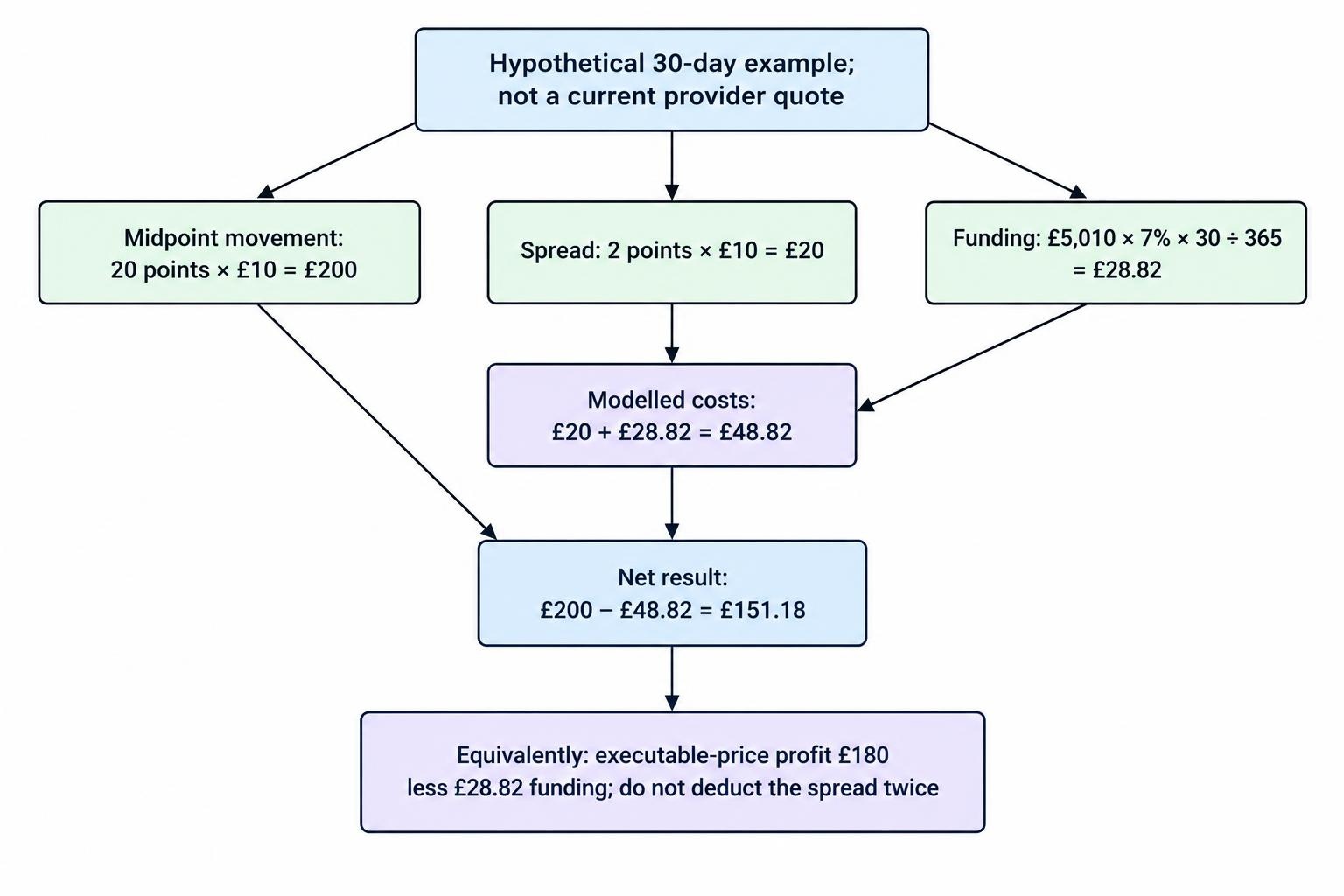
Assume a fictional UK share has a midpoint of 500p and a spread betting quote of 499p to sell and 501p to buy. You buy at £10 per point, with one point equal to 1p.
For this illustration, the opening exposure is £5,010. Assume a hypothetical annual funding rate of 7%, a 365-day basis and 30 chargeable days. To keep the comparison clear, hold the funding reference exposure constant. These are example inputs, not a current provider quote.
| Cost component | Calculation | Cash cost |
|---|---|---|
| Dealing spread | 2 points × £10 | £20.00 |
| Overnight funding | £5,010 × 7% × 30 ÷ 365 | £28.82 |
| Total modelled cost | Spread plus funding | £48.82 |
Now suppose the midpoint rises from 500p to 520p and the spread remains two points. The closing quote is 519p to sell and 521p to buy.
You bought at 501p and sell at 519p, producing an 18-point gain. At £10 per point, the trading profit is £180 before funding. Subtracting £28.82 leaves £151.18.
The same result can be calculated from the midpoint move: £200 gross movement, less £20 spread and £28.82 funding. Do not subtract the spread again from the £180 executable-price profit. It is already included in the entry and exit prices.
Under these assumptions, the midpoint must rise by roughly 4.88 points to cover the modelled costs. In practice, changing spreads, daily reference values and other charges can move that break-even level.
Short Share Bets: Check Funding and Stock Borrowing Separately
A short share position needs its own cost estimate. Do not take the long funding rate, reverse the sign and assume the result is a credit. Check the actual short rate and whether stock borrowing is charged separately or included within it.
Borrowing securities carries a fee in the underlying lending market. The SEC’s explanation of securities lending describes how lenders receive fees and how borrowed securities can support short sales. A spread bet does not make you the direct borrower, so your own charge depends on the provider’s contract.
Ask whether the quoted borrowing rate is annualised, what exposure it applies to and whether it can change while the trade remains open. Also establish what happens if the provider can no longer support the short position.
As an illustration, an additional annual borrowing charge of 5% on £5,010 would cost about £20.59 over 30 days using a 365-day basis. That is separate from any other funding charge unless the contract explicitly combines them.
Costs are only part of the decision. The guide to short selling shares through spread betting covers the position mechanics and risks without treating borrowing availability as guaranteed.
Execution, Currency and Optional Charges
Slippage Is Not a Published Fee
Slippage is the difference between the price you expected and the price at which an order executes. It can improve or worsen an execution, but an adverse fill increases the cost of carrying out your trading plan.
If a sell order executes two points below your expected price at £10 per point, the difference is £20. That can outweigh a modest saving in the advertised spread.
For individual shares, check prices and order conditions around results announcements, opening auctions and trading outside the main session. The guide to after-hours share trading covers the session issues. A narrow quote during normal trading should not be treated as a promise about the next available exit.
Guaranteed Stops Can Add a Premium
Where a guaranteed stop is offered on the share, check the premium and when it becomes payable. Also check the permitted stop distance and whether changing the order affects its terms.
An ordinary stop does not guarantee the execution price. Compare the contractual protection with its charge rather than treating either order as a free substitute for the other. The guaranteed stop premium guide covers those pricing questions.
Foreign Shares Need a Contract-Level Currency Check
A share’s listing currency does not, by itself, tell you which cash flows will be converted. Check the stake currency, point size and treatment of profits, losses, funding and adjustments.
For example, if a US share contract defines one point as one cent, a £1-per-point stake gains or loses £100 for a $1 move in the share. If the contract defines the point differently, that calculation changes.
Do not automatically apply the currency conversion model used by a share dealing account to a spread betting account. Establish which amounts, if any, are converted and what exchange-rate adjustment applies.
Account Charges Belong in the Calculation Too
Check for market data subscriptions, inactivity charges and other account fees you would incur to trade the shares concerned. Distinguish optional services from unavoidable charges.
A hypothetical £15 monthly data subscription adds £3 per trade if you make five completed trades that month. At 50 trades it adds 30p each. The subscription has not changed, but its effect on your trading costs has.
Dividend Adjustments Are Not Ordinary Dealing Fees
Dividend adjustments are cash flows linked to the share contract, not simply another spread or commission. A qualifying long position may receive an adjustment, while a qualifying short position may incur a debit. Check the amount, timing and any deductions in the contract terms.
Do not treat a dividend credit as free profit or a debit as an isolated provider charge. The share’s ex-dividend price movement belongs in the same calculation. Comparing the cash adjustment without the accompanying price effect gives an incomplete result.
Keep dividend adjustments separate from spreads and funding in your records. The guide to dividends and share spread bets covers their treatment in more detail.
Margin and Tax: Neither Makes the Trade Free
Margin is collateral supporting a position, not a dealing fee. For UK retail clients, the FCA’s COBS 22.5 margin requirements require at least 20% of exposure where the underlying asset is an individual share. A provider can require more.
At 20%, the £5,010 example would require £1,002 of opening margin. That does not reduce the exposure to £1,002 or mean funding must be calculated on that smaller amount. It also does not mean the opening margin is a maximum possible loss.
Tax treatment is separate from trading costs. HMRC’s financial spread betting guidance states that no chargeable gains or allowable capital losses arise from spread betting. That treatment does not reimburse spreads, funding or losing trades.
A genuine share spread bet does not involve buying the underlying shares. By contrast, SDRT applies to agreements to transfer chargeable securities for consideration under HMRC’s rules on the principal SDRT charge. Do not automatically add a share purchase tax to a spread bet, or assume that avoiding it makes the bet cheaper over every holding period.
How to Compare the Total Cost Before Trading
Build the comparison around a repeatable trade specification, not a provider’s lowest headline spread. Use the same share, direction, cash exposure, entry time and intended holding period.
- Record the executable spread: convert it into pounds at your intended stake.
- Estimate holding costs: include the funding rate, chargeable days and any borrowing charge.
- Check other cash flows: allow for relevant premiums, conversion charges, subscriptions and dividend adjustments.
- Allow for execution uncertainty: assess how a worse fill would affect the trade, without presenting an estimate as a guaranteed cost.
For a trade closed before the relevant funding cutoff, the spread and execution may dominate. For a position held for weeks, financing can outweigh a small spread saving. The total spread betting cost comparison guide provides a broader framework for comparing those charges.
After closing, reconcile the estimate with the actual entry price, exit price and account debits. Keep spread costs separate from funding so you can identify why the result differed from the plan. The aim is not to find a trade with no costs. It is to know the cost before deciding whether the expected move is worth paying for.