The margin close-out rule requires a broker to close positions when a covered UK retail trading account has too little equity relative to its margin requirement. For spread betting, the regulatory threshold is 50% of the margin required for the account’s open positions. If equity falls below that level, positions must be closed as soon as market conditions allow under FCA Handbook rule COBS 22.5.13R.
That does not mean trading stops after you lose half your deposit. Nor does it guarantee that half your money survives. The calculation compares account equity with required margin, not with your original deposit.
This protection forms part of UK spread betting regulation. It is a backstop against worsening losses, not a substitute for deciding how much a trade can reasonably risk.
What the 50% Margin Close-Out Rule Measures
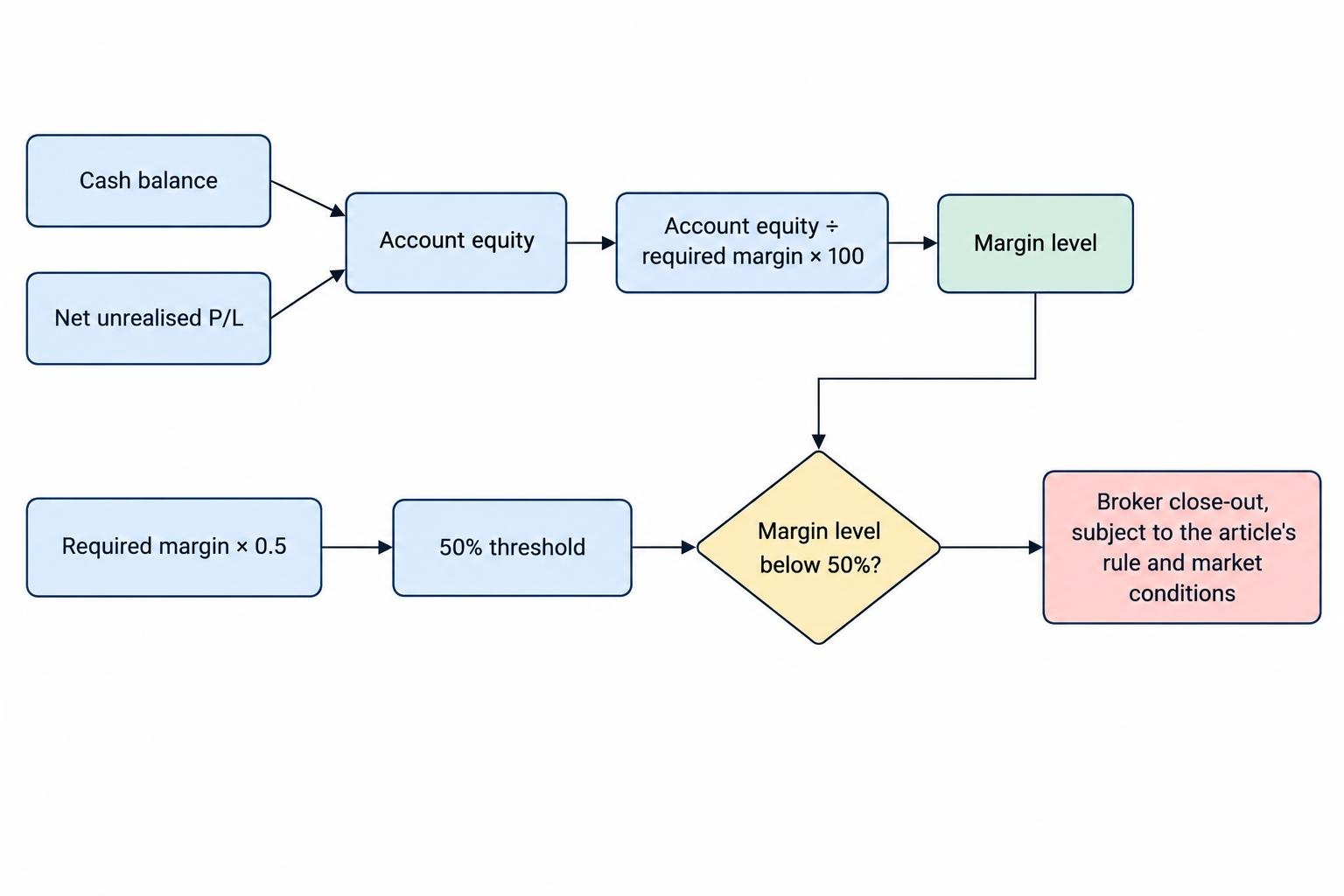
The calculation involves two amounts: net equity and required margin. Net equity combines the money supporting the account with the net unrealised profit or loss on its open positions. Required margin is the amount needed to support those positions under the applicable margin calculation.
For a simplified account with no pending adjustments:
Account equity = cash balance + net unrealised profit or loss
Margin level = account equity ÷ required margin × 100
50% close-out threshold = required margin × 0.5
If required margin is £1,000, the 50% threshold is £500 of equity. It remains £500 whether you originally deposited £1,000, £3,000 or £10,000, provided the margin requirement stays unchanged.
Cash balance and equity are not interchangeable. A £3,000 cash balance with £2,400 of open losses gives £600 of equity. Looking only at the balance hides how much of the account has already been consumed by losses.
Required margin is also different from money available for new trades. For the distinction between margin held against positions and spare account funds, see how spread betting margin works.
Use your broker’s definitions when reading its account display. A figure labelled “margin usage” may express the relationship differently from “margin level”. A percentage without its formula is not much help.
A Worked Margin Close-Out Example
Suppose you deposit £3,000 and open one spread bet at £5 per point. Assume the position requires £1,000 of margin throughout, the broker uses a 50% close-out threshold, and there are no other trades. This example ignores spreads, financing and execution differences so the calculation stays clear.
| Open loss | Account equity | Required margin | Margin level |
|---|---|---|---|
| £0 | £3,000 | £1,000 | 300% |
| £1,000 | £2,000 | £1,000 | 200% |
| £2,000 | £1,000 | £1,000 | 100% |
| £2,450 | £550 | £1,000 | 55% |
| £2,500 | £500 | £1,000 | 50% |
| £2,520 | £480 | £1,000 | 48% |
At £5 per point, an adverse movement of 500 points creates a £2,500 loss. Equity then reaches £500, or 50% of required margin. A further adverse movement puts the account below that boundary.
The important comparison is £500 against £1,000 of required margin. By this stage, the account has already lost more than 80% of its original £3,000 deposit. The rule never promised to preserve half that deposit.
The table shows a calculation, not a promised execution path. A live market can move from £550 of equity to £480 without offering an executable price at every intermediate amount.
Why 100% Margin Level Is Different
At £1,000 of equity and £1,000 of required margin, the margin level is 100%. In this simplified example, free margin, calculated as equity minus required margin, is zero.
That is not the same as reaching the FCA’s 50% boundary. It does mean there is no spare equity above the stated margin requirement. Whether the broker restricts new trades, sends warnings or takes earlier action depends on its terms.
The Rule Applies Across the Account
Account-based close-out considers the combined position, rather than treating each spread bet as an isolated pot of money. Open profits can offset open losses in the equity calculation, while the margin requirements of the positions contribute to the account total.
Consider a separate example with two positions:
- Position A requires £600 of margin.
- Position B requires £400 of margin.
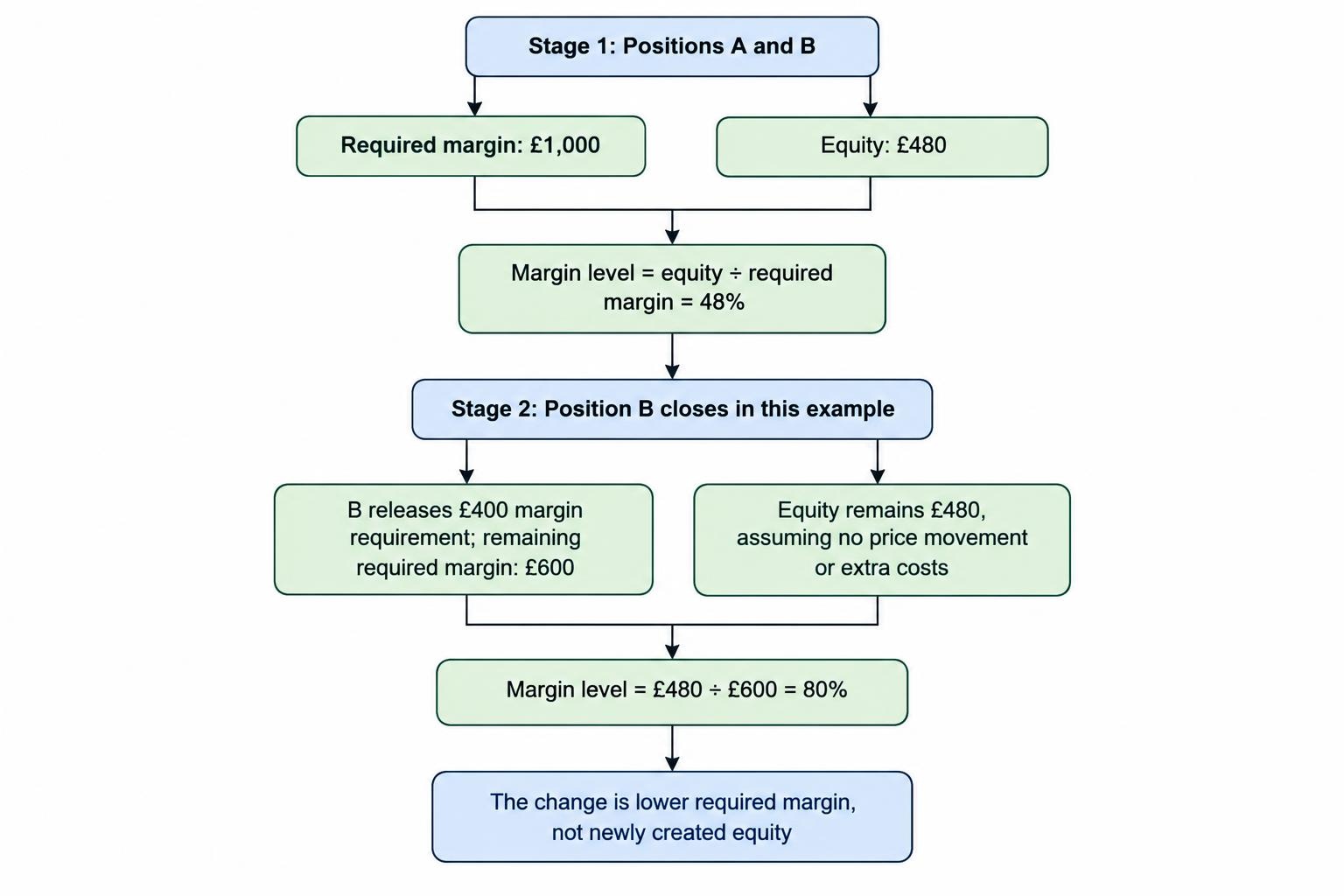
- Total required margin is £1,000, while account equity has fallen to £480.
The margin level is 48%. If the broker closes Position B and releases its £400 margin requirement, the remaining requirement becomes £600. Assuming no price movement or extra costs, equity stays at £480 and the margin level rises to 80%.
Closing the trade has not created £400 of new equity. It has reduced the margin needed to support the remaining exposure. Realising a loss generally moves that loss from the open profit and loss figure into the cash balance; it does not make the loss disappear.
Do not assume the largest losing trade must close first. The account-based intervention model does not prescribe a universal position-selection sequence, as reflected in the ESMA margin close-out FAQ. Check the closure policy applying to your account.
One closure may restore sufficient margin cover. In other circumstances, further closures may follow. The practical question is not simply which trade loses most, but how the account looks after each execution.
Can a Broker Close Positions Before 50%?
Yes. The FCA’s 50% requirement is not a right to keep every position open until that exact percentage. A broker can apply a higher close-out percentage. The FCA’s PS19/18 explanation of earlier margin close-out expressly permits this approach.
If your broker uses 70% and required margin is £1,000, its threshold would be £700 rather than £500. Planning around £500 would leave you working from the wrong boundary.
Read the contractual calculation before opening a position. Check whether it uses the margin figure shown on the platform, how different account sections are treated, and what happens if margin requirements change. Do not assume that the lowest regulatory margin rate is also the rate your broker applies.
A useful stress test is to hold equity constant and increase the assumed margin requirement. With £900 of equity, a £1,000 requirement produces a 90% margin level. A £2,000 requirement produces 45%. The account can become much tighter without another trading loss.
A Margin Call Is Not the Same as Close-Out
A margin call is a warning or request to address insufficient margin cover. Close-out is the actual closure of exposure. Receiving a warning does not mean you have a guaranteed period in which to transfer money or choose an exit.
Treat alerts as supplementary information, not as the control keeping the account safe. A plan that depends on seeing an email, finding a bank card and completing a payment during a sharp move has several opportunities to fail.
Our guide to margin calls and account warnings covers that distinction in more detail.
Adding £500 would increase equity by £500 once the money is credited, assuming nothing else changes. It would not reduce the stake per point or improve the trade’s prospects. It also places more money in the account at risk. Reducing exposure and adding funds solve different problems.
Why Close-Out Does Not Guarantee an Exit Price
The FCA rule requires closure as soon as market conditions allow. That qualification matters: a percentage trigger cannot create liquidity or an executable price where none exists.
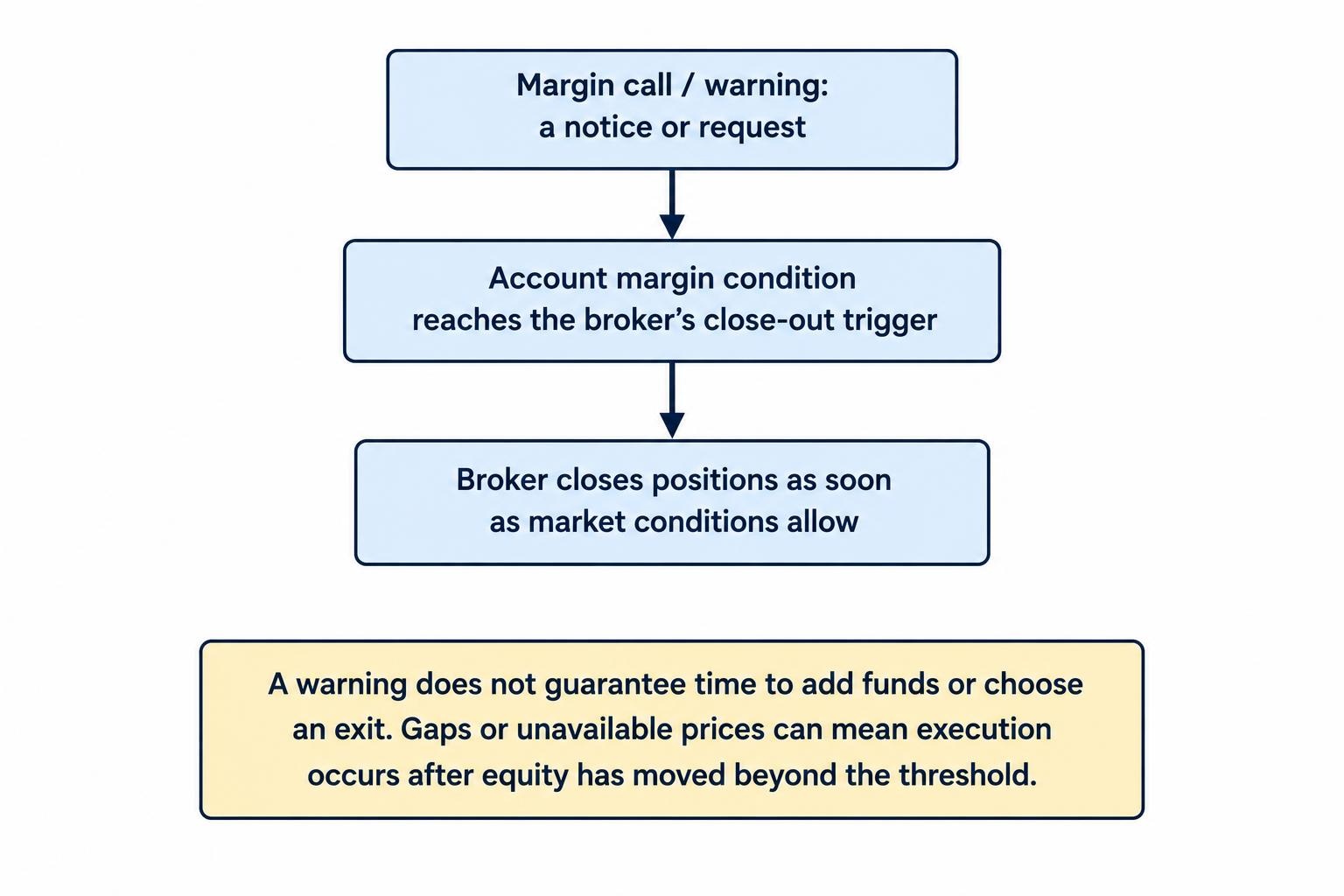
Suppose the calculated threshold is £500 of equity. A price gap might take equity from £650 to £200 before the broker can execute. The threshold identifies when action is required; it does not guarantee a £500 residual account value.
Market gaps are particularly relevant to this distinction because prices can move between available trading levels. A wider spread can also worsen the marked value of an open position, even where a chart’s midpoint appears to have moved less.
How Stop Losses Interact With Margin Close-Out
A stop loss is an instruction attached to a position. Margin close-out responds to the account’s margin condition. They are separate controls, and either can become relevant before the other.
A trade could therefore close through the account’s margin process before reaching its stop price. Having a distant stop does not reserve enough equity to keep the trade open until that price.
The same distinction matters for guaranteed stops. Account-based close-out can occur before a guaranteed stop level is reached; this interaction is addressed in ESMA’s guaranteed stop and margin close-out Q&A.
The purpose of a guaranteed stop-loss order is to provide the agreed stop protection under its terms. It is not a promise that the broker will maintain the position regardless of the account’s margin cover.
Margin Close-Out and Negative Balance Protection
Margin close-out seeks to reduce exposure before losses worsen. Negative balance protection addresses the separate question of liability beyond the funds dedicated to the covered retail trading account. These are distinct protections within the FCA’s retail CFD and spread betting framework, which also warns that opting into professional status removes some retail protections.
Neither protection makes the initial margin a maximum loss. Posting £1,000 of margin does not mean a position can lose only £1,000 when more funds are available in the account.
For the account-level liability boundary, see negative balance protection for spread betting. Keep that boundary separate from your own acceptable loss: losing the entire trading account is still losing the entire trading account.
Do not assume the retail 50% rule follows you to a professional account or a different overseas legal entity. Check the classification, contracting firm and protections attached to the actual account, rather than relying on the brand name.
How to Plan Without Relying on Forced Closure
Start with the loss your trading plan permits, then calculate the stake. Do not start with the largest position the margin calculator will accept. Margin availability and affordable risk are different measurements.
A practical account review should answer four questions:
- What equity figure does the broker use for close-out?
- What margin requirement and close-out percentage apply?
- What would happen to equity if all open trades reached their planned exits?
- Would the account still have adequate margin cover after those losses and expected costs?
For example, equity of £2,400 against £2,000 of required margin gives a 120% margin level. Planned losses totalling £800 would leave £1,600 of equity and an 80% level, assuming unchanged requirements. That sits above a 50% boundary, but the £800 loss would still consume one third of starting equity. Being above close-out does not make the risk modest.
Position sizing for spread betting addresses that earlier decision: matching the stake and exit distance to an acceptable cash loss.
Review the account again before adding another trade. A new position adds a margin requirement and may add exposure to the same market move as existing positions. The fact that each trade looks manageable on its own does not settle the account-level question.
No single buffer percentage suits every strategy. The useful test is whether the account can withstand the losses and cost changes your plan allows without handing the exit decision to the broker.
What to Check After an Unexpected Close-Out
If a closure appears inconsistent with the published terms, reconstruct the account at the relevant time. Your original deposit and the final closing price are not enough to establish what triggered the action.
Keep the account statement, order history, applicable margin terms, warning messages and available screenshots. Ask the broker for the equity calculation, margin requirement, trigger percentage, closure sequence and execution timestamps. Separate a disagreement about the trigger from a disagreement about the price obtained.
If the explanation does not resolve the issue, follow the firm’s complaints process. The guide to spread betting complaints and the Financial Ombudsman covers the escalation route.
The margin close-out rule is best treated as a final backstop. Set trade risk and account exposure before opening positions, rather than expecting a forced closure to preserve a chosen amount of capital.