The lowest spread is useful only if you can trade at it. A broker advertising a tiny minimum may quote a wider price during your usual trading hours, on your chosen platform or at your intended stake.
For eligible UK spread bettors, Trade Nation, Spreadex and CMC Markets provide useful starting points for a price comparison. Pepperstone also merits checking, particularly if platform choice matters, but its raw CFD spreads should not be mistaken for spread betting prices.
This guide focuses on the dealing spread rather than ranking every account charge. The published review observations below were checked on 22 October 2026. They are not simultaneous live quotes or the results of testing conducted by this site, so they establish a shortlist, not a permanent winner.
Use our broader comparison of spread betting brokers if you also need to assess market coverage, account features and platform choice. Low dealing costs matter, but they do not make leveraged trading safe or turn an unprofitable strategy into a profitable one.
Low-spread spread betting brokers to compare
These providers deserve different checks. A fixed spread needs its session schedule examined; a variable spread needs repeated observations; and a broker offering several account types needs its spread betting prices separated from its CFD prices.
Trade Nation: a starting point for fixed-spread comparisons
Trade Nation is worth comparing if predictable dealing costs matter more than chasing the smallest momentary quote. Published TN Trader testing recorded EUR/USD at a fixed 0.5 pips during UK and US sessions, with around 0.6 pips overnight. The same review distinguishes that pricing from the broker’s variable-spread MT4 account: DayTrading.com’s Trade Nation pricing and platform review.
That makes the account and platform distinction central to the comparison. Do not assume a price observed on one platform applies to every Trade Nation account.
Before choosing it, inspect the current spread betting ticket and the pricing schedule for your intended session. Fixed pricing can make a trading budget easier to calculate, but it does not guarantee an execution price. A stable gap between bid and offer is different from a market that stays still while your order reaches the dealing system.
Spreadex: a candidate for major-currency trading
Spreadex belongs on a shortlist for traders comparing straightforward major-currency prices. Published live-account research recorded EUR/USD spreads around 0.6 pips in stable conditions, with widening as volatility increased. The research also found broader access to smaller UK shares: BrokerListings’ Spreadex account and spread research.
The distinction between those markets matters. A competitive EUR/USD quote tells you little about the cost of trading a thinly traded share. Compare the instruments you actually intend to use, rather than treating the broker’s cheapest currency pair as a verdict on the whole account.
For a mainly forex watchlist, record quotes during your normal entry and exit windows. For a mixed watchlist, calculate separate costs for currencies, indices and shares. One attractive headline should not do the work of three comparisons.
CMC Markets: compare major-market pricing and account features
CMC Markets is another candidate for a major-currency shortlist. Published trading-cost research recorded EUR/USD around 0.7 pips during peak hours and identified guaranteed stop functionality. However, that review covers several account types and regions, so its forex observations are a benchmark rather than a guaranteed spread betting quote: BrokerListings’ CMC Markets pricing and account review.
The practical decision is whether the current spread betting account combines acceptable dealing costs with the order tools you need. Check the live price, the chosen platform and any premium attached to a guaranteed stop.
Do not automatically reject an account because its quoted spread is a fraction wider than another provider’s. Decide how much that difference costs in pounds, then assess whether the account’s other features justify it. Equally, do not pay for features you will never use.
Pepperstone: separate spread betting from Razor CFD pricing
Pepperstone merits a quote comparison if you want spread betting through familiar trading software. Its published review identifies spread betting support and TradingView integration, but also discusses Standard and Razor CFD pricing. Those are not interchangeable price lists: DayTrading.com’s Pepperstone account and platform review.
For that reason, a zero-pip Razor headline is not used here to rank its spread betting account. The correct comparison starts inside the intended spread betting account, on the intended instrument.
Request or inspect the applicable minimum and average spreads, then compare them with other providers during matching sessions. Platform familiarity can be valuable, but it should not become a reason to skip the arithmetic.
None of these observations establishes which broker will quote the lowest price when you next trade. Different observation periods, account settings and market conditions prevent an honest universal ranking from this evidence alone.
Compare the same account, instrument and trading session
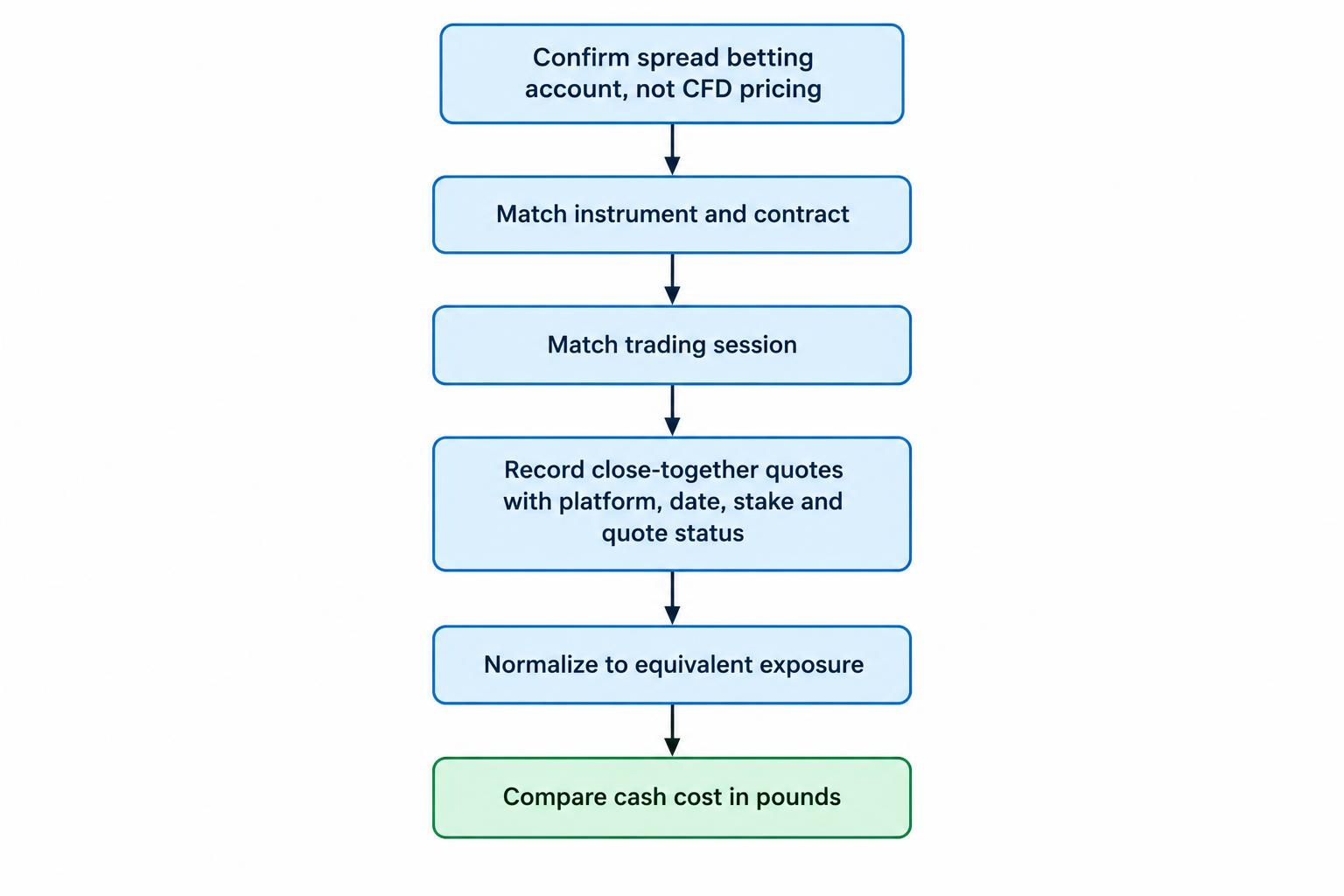
A useful comparison starts by making the products match. “EUR/USD spread” is not enough detail if one figure comes from a commission-based CFD account and another comes from a spread-only spread betting account.
Confirm the product label before collecting prices. A broker may offer several accounts under the same brand, each with a different charging structure. Our comparison of spread betting and CFDs covers the wider product differences; for this exercise, keep the account type constant.
Next, match the instrument. An index cash bet and a dated index contract are not equivalent price comparisons. Their quoted levels, expiry arrangements and funding treatment can differ. Even similar market names deserve a check of the contract details.
Then match the time. Comparing one provider during an active session with another during a thin overnight period tells you more about the sampling method than the brokers.
Record both quotes as close together as practical. Note the date, time, account type, platform and intended stake. If a quote is indicative rather than executable, label it that way rather than treating it as a confirmed dealing price.
Point size also needs checking. A platform may display more decimal places than the unit used to calculate your stake. A movement of one displayed digit does not always equal one point for profit and loss purposes. The explanation of stake per point helps resolve that distinction.
Normalize the comparison into pounds for equivalent exposure. Two prices cannot be ranked sensibly if the stakes represent different financial risks.
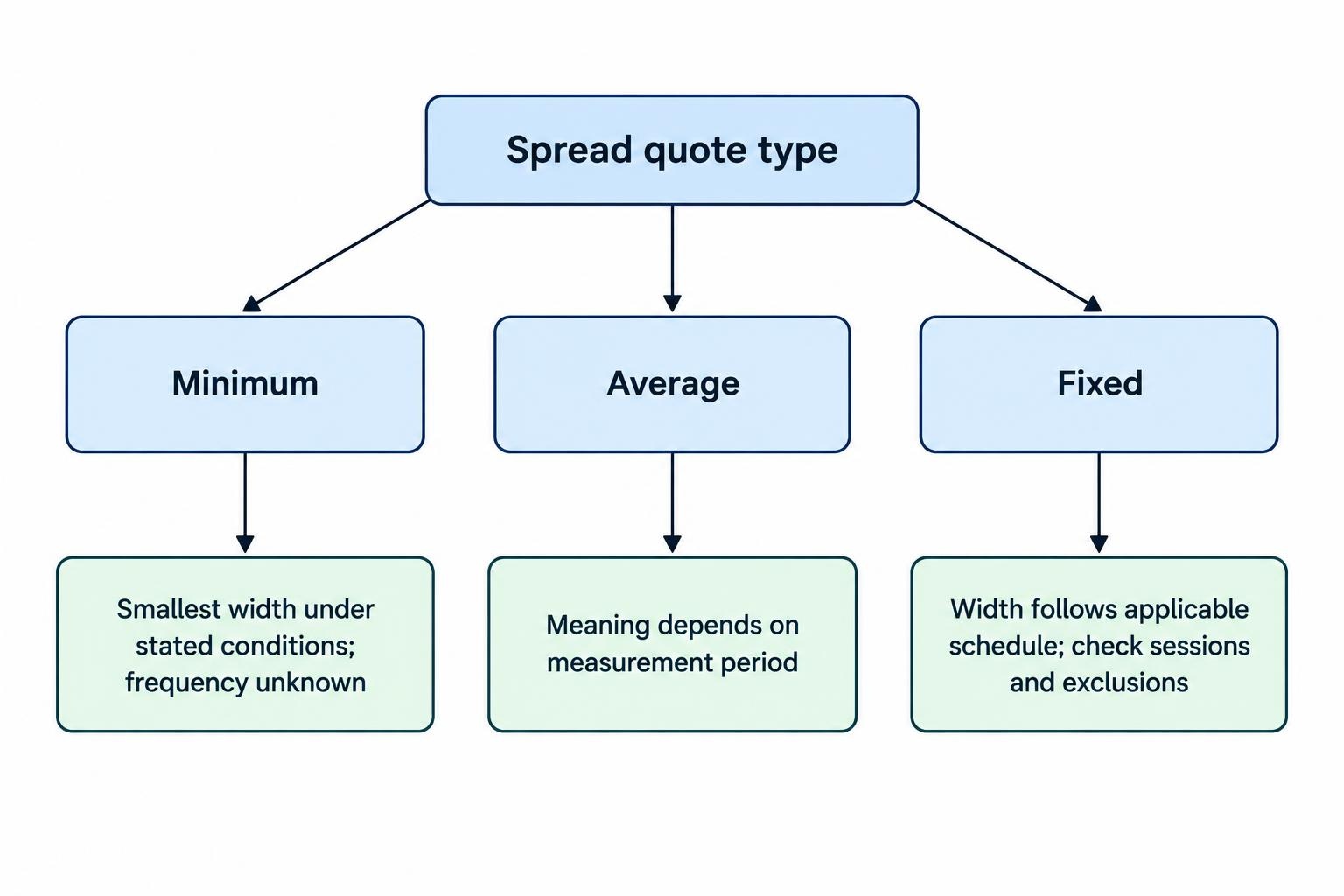
Minimum, average and fixed spreads measure different things
A minimum is a starting figure, not a trading budget
A minimum spread tells you the smallest quoted width available under the stated conditions. It does not tell you how frequently that price appears, how long it remains available or whether it applies when you usually trade.
Treat a “from” price as a filter. It can identify accounts worth examining, but it should not decide the account on its own.
Consider two hypothetical providers. One advertises a minimum of 0.4 points but usually quotes 0.9 during your trading window. Another advertises 0.6 and regularly quotes 0.7 during that same window. For your activity, the second provider has the lower recurring spread despite its higher minimum.
An average needs a measurement period
An average is more informative only when its calculation is clear. Ask whether it covers active market hours, the full trading day, a recent month or some other period.
A full-day average may be relevant to someone who trades at irregular hours. It may be less useful to someone who only opens positions during a short morning window. Neither figure is inherently wrong; they answer different questions.
Your own repeated observations can provide a better fit. Record the average alongside the widest spreads encountered during the sessions you intend to use. A low average can conceal occasional expensive entry or exit windows.
A fixed spread still needs its terms checked
Fixed pricing means the quoted width follows the applicable schedule rather than continuously changing with each shift in market liquidity. Do not read that as a promise that one rate applies to every instrument, account and hour.
Check any session changes, instrument exclusions and exceptional-market provisions. Also separate spread certainty from execution certainty: the bid and offer can move together while keeping the same distance apart.
Our guide to spread betting spreads explains the mechanics. For broker selection, the practical question is simpler: what width will apply when you expect to deal?
Calculate what a tighter spread saves in pounds
A fraction of a point can sound trivial until it is multiplied by stake and trading frequency. It can also sound more impressive than it is. Calculate the cash difference before making it the deciding factor.
Indicative spread cost = spread in betting points × stake per point.
Suppose three hypothetical accounts quote the same index at spreads of 0.6, 0.9 and 1.2 points. You trade at £5 per point and complete 40 opening-and-closing cycles in a month.
| Quoted spread | Spread cost per completed trade | Cost across 40 completed trades |
|---|---|---|
| 0.6 points | £3.00 | £120 |
| 0.9 points | £4.50 | £180 |
| 1.2 points | £6.00 | £240 |
The difference between the narrowest and widest quote is £120 in this example. That is a useful saving, not a trading edge.
Do not automatically charge the full spread twice in your calculation. If you buy at the offer and immediately sell at the bid while the market is unchanged, the loss is one full spread. With different entry and exit spreads, and a consistent mid-price reference, the combined spread effect is half the opening spread plus half the closing spread.
The table excludes financing, premiums and slippage. It also assumes every planned trade occurs at the quoted width. Real records should use the prices available at the time rather than applying one attractive minimum to an entire month.
Spreads affect the movement needed to break even too. If your target is a six-point favourable move in the mid-price, a one-point spread consumes one-sixth of that move before other costs. A strategy built around small price changes has less room for expensive dealing.
That makes low spreads especially relevant to frequent traders. It does not justify trading more often to make an account feel worthwhile.
Choose around your markets, not the broker’s cheapest headline
Forex and short-term trading
For a forex-focused account, compare the pairs you expect to trade most frequently. A particularly tight EUR/USD quote should not decide the account if most of your activity is elsewhere.
Build a weighted comparison using your intended trading pattern. In a hypothetical month with 30 EUR/USD trades and 10 GBP/USD trades, apply each pair’s observed spread to its expected number of trades and stake. That produces a more useful estimate than giving every currency pair equal weight.
Keep entry and exit timing in the calculation. An account can suit entries during an active session but become expensive if your strategy regularly closes positions near a daily pricing transition.
Indices and intraday positions
For index trading, distinguish the cash product from dated contracts and inspect the pricing schedule around the underlying market’s opening and closing hours.
If you close every position during the same session, dealing spread and execution deserve close attention. If positions sometimes run overnight, include that possibility rather than assessing the account as though every trade ends before funding applies.
Our comparison of spread betting brokers for day trading considers the wider account requirements. Here, the priority is finding a competitive quote during your actual trading window.
Shares and less liquid markets
For shares, inspect the underlying bid and offer alongside the provider’s charging terms. The broker’s addition is only part of the effective dealing width.
A quoted percentage can also be less intuitive than an index spread expressed in points. Convert the expected entry and exit cost into pounds for your intended position before comparing accounts.
Do not assume a broad share list means every instrument is economical to trade. A market can be available without being suitable for frequent short-term dealing. Our guide to share spread betting brokers addresses coverage and account selection beyond the headline spread.
Execution can erase a small spread advantage
A narrow displayed quote is not the whole transaction. Your order must also be accepted and filled, and the fill may differ from the price you expected.
Take a hypothetical choice between a 0.5-point spread and a 0.7-point spread. At £10 per point, the narrower quote saves £2 per completed trade under otherwise equal conditions. If execution at that account introduces an extra 0.3 points of adverse slippage across entry and exit, the £3 difference outweighs the spread saving on that trade.
That is not a forecast about any provider. It shows why a spread comparison should record fills as well as quotes.
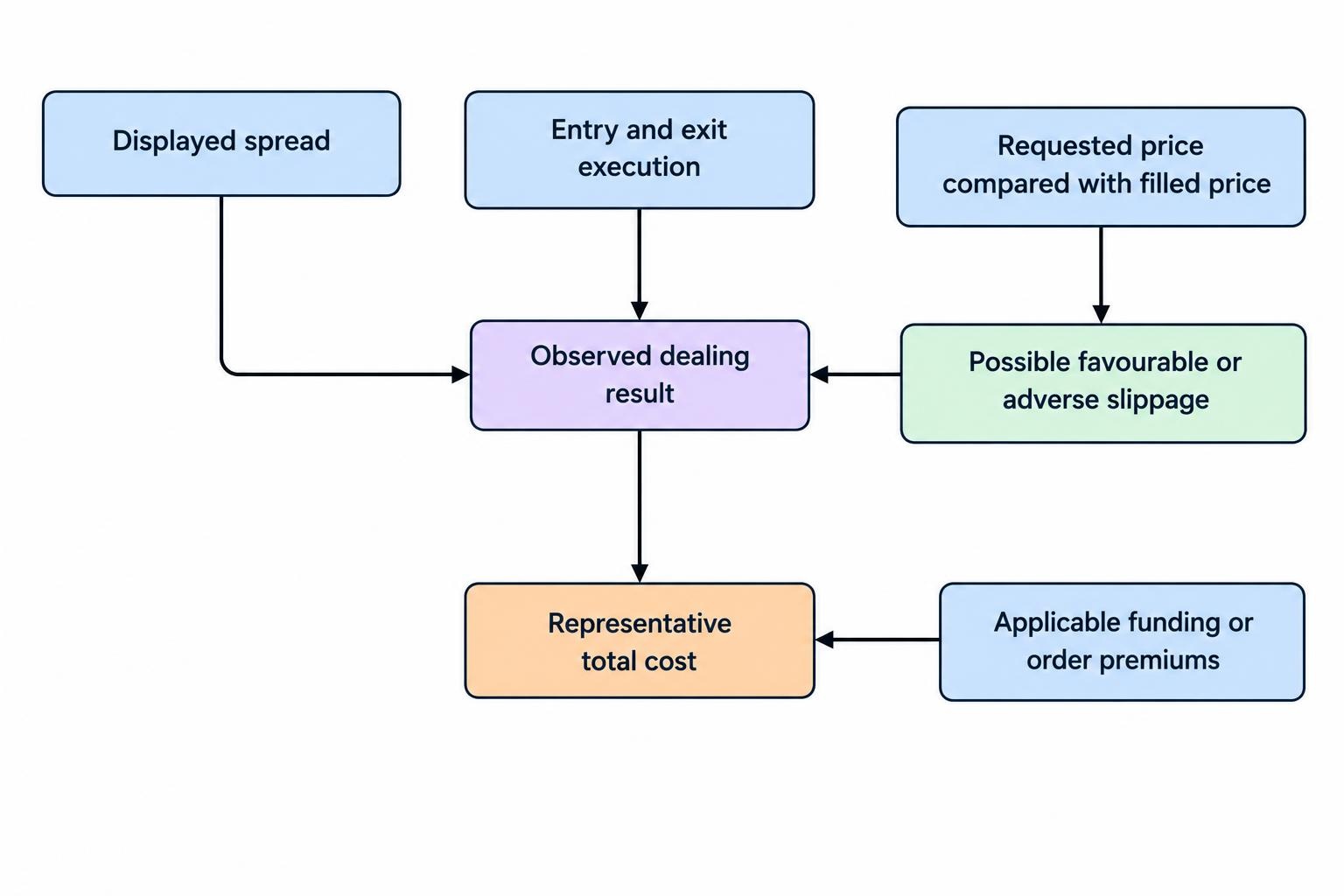
Track the price requested, the price filled and the order type. Include favourable slippage too; counting only adverse fills produces a distorted result. Rejected orders and delays also deserve a note, even where they do not appear as a separate account charge.
Our explanation of slippage in spread betting covers the mechanics. For account selection, assess whether execution differences are large enough to change the result of your spread comparison.
Limit orders are not a free cure. They control the worst acceptable price, but may remain unfilled. Compare providers using the order methods your strategy actually requires rather than switching methods solely to improve a cost spreadsheet.
Lowest spreads and lowest total costs are different rankings
The narrowest spread may be the right priority for frequent intraday dealing. It may matter less for a position held for several days, where recurring funding charges can outweigh a small saving at entry.
The distinction remains relevant in current regulatory research. The FCA’s review published on 15 October 2026 identified continuing concerns about overnight financing charges and the clarity of their disclosure across CFD providers, including spread betting firms: FCA findings on CFD pricing and fair value.
Before opening an account, estimate the cost of a representative trade from entry to exit. Include the expected spread, holding period and any order premium. Check account charges separately, particularly if you trade infrequently.
For positions that may stay open overnight, compare the applicable rate, calculation basis and funding timetable. A quoted rate is not useful unless you know the exposure to which it applies. Our guide to overnight financing costs covers those calculations.
Keep this assessment distinct from the search for the smallest dealing width. Our comparison of lowest-cost spread betting brokers addresses the broader question. An account can perform well in one comparison without winning the other.
Also keep minimum stakes in view. Do not increase a position beyond your risk budget just to access an apparently attractive price. A small saving on dealing costs does not compensate for taking more market exposure than intended.
Keep regulation and account protection ahead of price
A low spread should never be a reason to skip the legal entity check. Confirm which company will hold the account and whether its permissions cover the service being offered. The process for checking a broker on the FCA Register helps distinguish the contracting firm from a familiar trading name.
For UK retail accounts within the relevant rules, protections include minimum margin requirements, account-level margin close-out requirements and negative balance protection. The close-out threshold is tied to 50% of required margin, not a promise that each trade will lose no more than half its deposit. Negative balance protection applies to funds dedicated to the relevant trading account, not to a chosen loss limit on an individual position: FCA Handbook rules for retail speculative investments.
Those protections do not make a cheap account low risk. Set a separate risk budget for each position and assess whether the account’s minimum stake lets you stay within it.
Check the shortlist before funding an account
Use a small comparison worksheet rather than relying on memory. A few attractive screenshots are easy to remember; the wider quotes encountered between them are easier to forget.
- Define your trading basket. List the instruments, usual trading hours, intended stakes and likely holding periods.
- Verify the product. Confirm that every price belongs to the relevant spread betting account and contract.
- Collect repeated quotes. Observe matching periods across several sessions, including the conditions your strategy is designed to trade.
- Calculate the cash cost. Apply equivalent exposure and expected trading frequency, then add any relevant non-spread charges.
- Review execution and usability. Record fills where available and check that the platform supports the orders you need.
Where available, spread betting demo accounts can help you check contract details, point values and order entry without risking capital. Demo quotes and fills are not proof of the live execution you will receive, so keep practice observations separate from live-account evidence.
You do not need to trade through a major announcement simply to test a broker. If your strategy avoids those periods, assess pricing in the sessions you actually intend to use. Testing should serve the trading plan, not become an excuse to take extra risk.
Once the quotes are comparable, use a total spread betting cost comparison to check whether the apparent spread winner remains attractive after the rest of the charges.
Which broker should you choose?
Start with Trade Nation if fixed-spread budgeting is your priority. Include Spreadex and CMC Markets in a major-currency price comparison, and assess Pepperstone using its spread betting quotes rather than its Razor CFD headline.
Then let matching account data decide. Compare the same instrument, equivalent exposure and trading window; calculate the saving in pounds; and check whether execution or holding costs reverse it.
The best result is not the smallest number on a marketing page. It is a competitive, usable price on the trades you planned to make, within an account whose terms and risks you understand.