Bond spread betting lets you take a position on changes in bond market prices without buying the underlying debt. The markets to examine include UK gilts, US Treasury notes and bonds, and European government bond futures. Your result depends on the quoted price movement, your stake per point and the costs of holding the trade.
The distinction that matters most is price versus yield. Buying a conventional bond price market generally expresses a view that yields will fall; selling it generally expresses a view that yields will rise. Get that relationship backwards and a sound economic forecast can still produce the wrong trade.
What Are You Trading with a Bond Spread Bet?
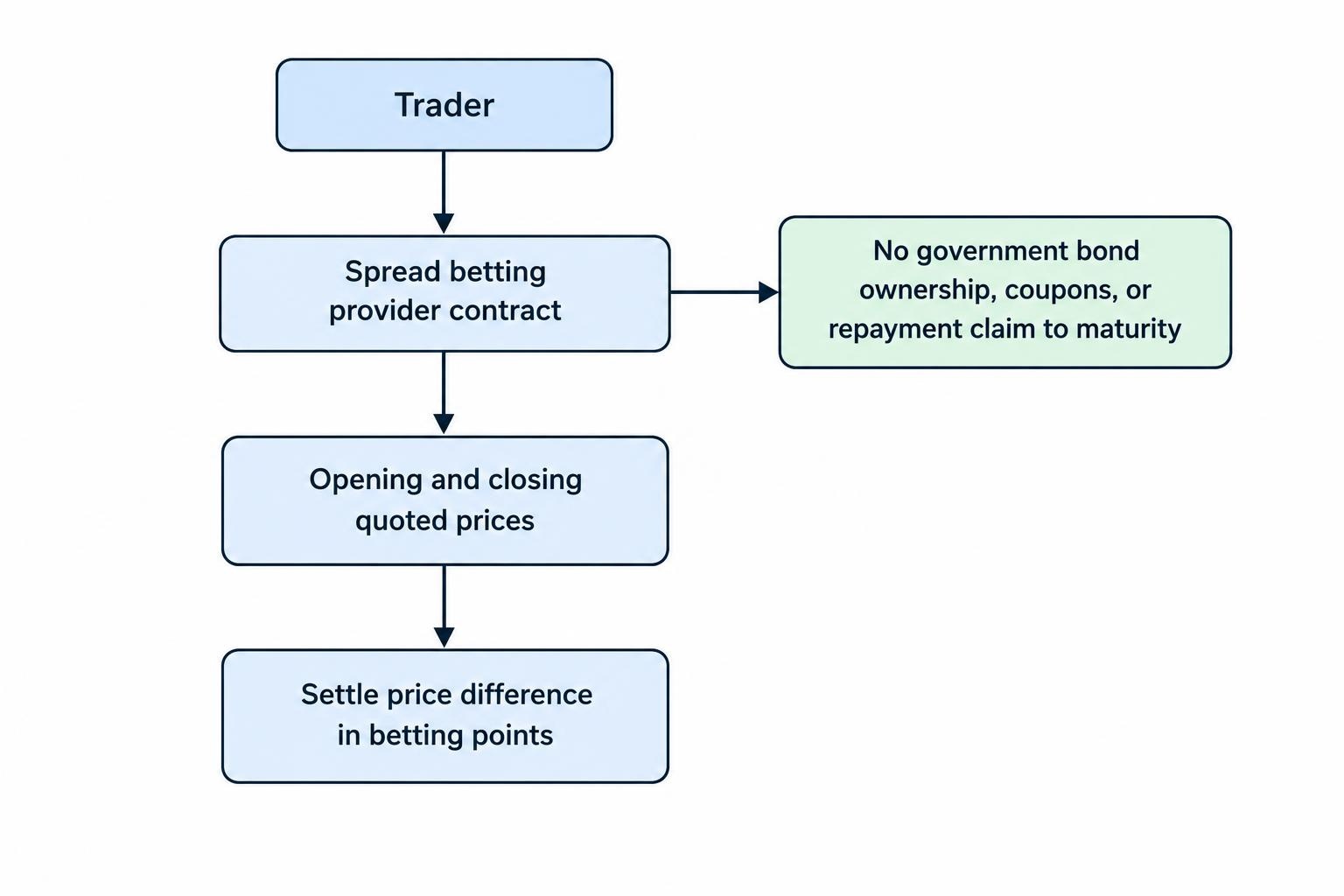
A bond spread bet is a contract with your provider, not ownership of a government security. You do not become a creditor of the government, receive the underlying bond’s coupon payments or acquire a right to repayment at its maturity. You settle the difference between your opening and closing prices in betting points.
Where a market references a bond futures contract, the underlying instrument is itself a derivative. Its price relates to eligible government bonds rather than necessarily tracking one named bond. Before trading, establish whether the provider’s quote references a dated future, a rolling price or a yield measure. The guide to how bond spread betting works covers the mechanics in more detail.
That distinction also changes the purpose of the position. Buying a bond for income and buying a bond spread bet are not interchangeable. A spread bet needs a favourable price movement, large enough to cover its costs, within a period your account can withstand.
Which Bond Markets Should You Look For?
Start with the government, the maturity exposure and the reference contract. A platform label such as “US bond” is not enough to identify the risk. The table below outlines reference markets to investigate, not a promise that every spread betting provider offers them.
| Market family | Reference exposure | What to check |
|---|---|---|
| UK gilt spread betting | UK government debt, including contracts referencing gilt futures | The reference contract, expiry month and sensitivity to UK yields |
| US Treasury spread betting | Treasury note and bond futures across different maturity segments | Whether the quote tracks a note, a longer bond or an Ultra contract |
| German government bonds | Schatz, Bobl, Bund and Buxl futures | Which maturity segment the contract represents |
| Other European government bonds | Markets such as French OAT and Italian BTP futures | Availability and exposure to the issuing country’s borrowing conditions |
US Treasury futures include separate contracts for shorter notes, intermediate maturities and longer bonds. Their deliverable maturity ranges differ, so a contract’s familiar name is not a complete description of its exposure. The CME Treasury futures contract comparison sets out those differences, along with quotation conventions and contract sizes.
Germany’s futures family also separates maturity exposure. Schatz represents the shorter end, Bobl the medium segment, Bund a longer segment and Buxl much longer debt. Euro-Bund futures reference eligible German government securities with 8.5 to 10.5 years remaining, rather than an arbitrary “European bond”. These distinctions appear in the Eurex government bond futures specifications.
Exchange availability does not establish retail spread betting availability. Check the provider’s current market list and contract details. Treat individual corporate bonds, inflation linked securities and bond ETFs as separate products, not substitutes with different labels.
Bond Prices, Yields and Trade Direction
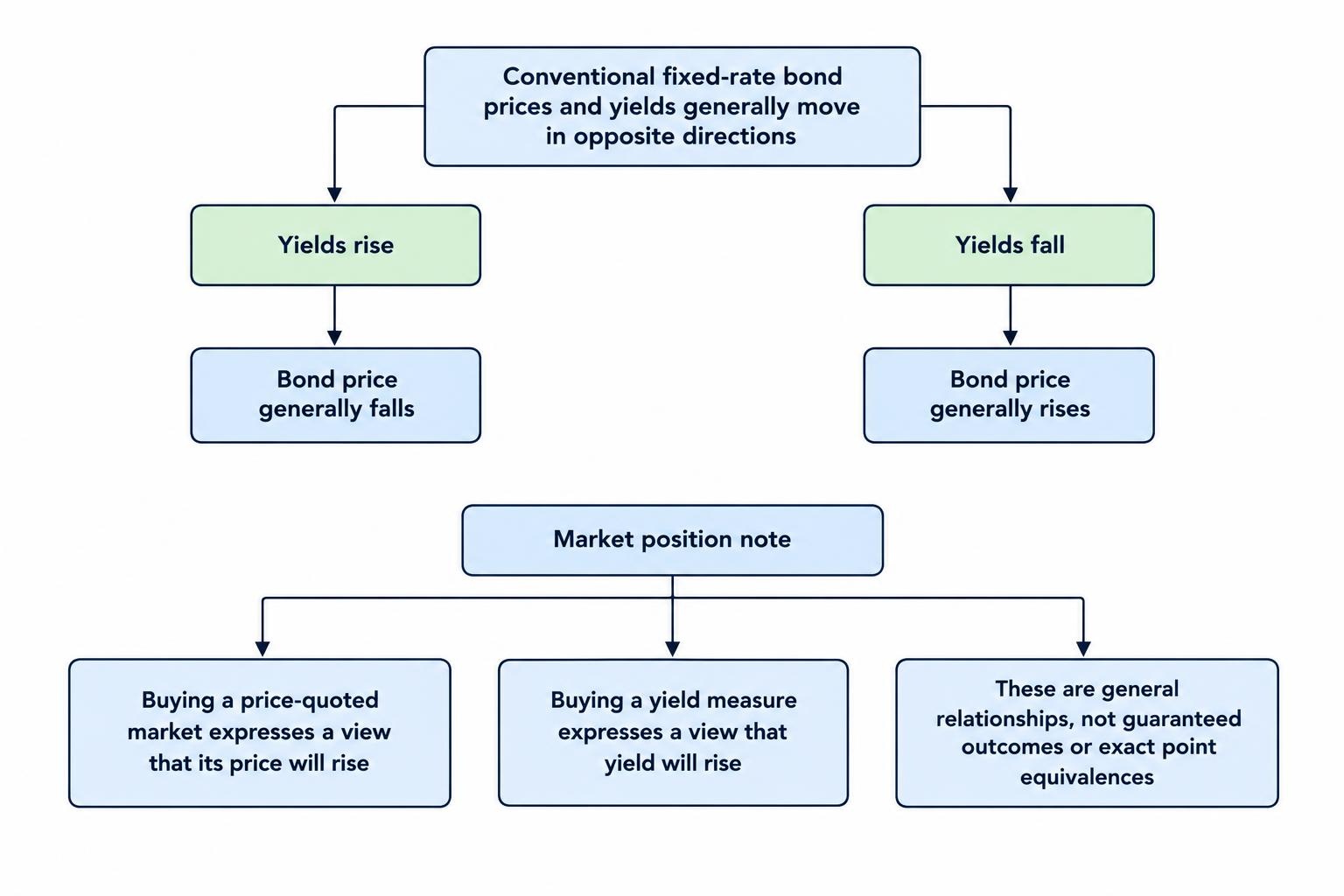
For conventional fixed rate bonds, prices and yields generally move in opposite directions. When the yield investors demand rises, an existing bond’s fixed payments become less attractive and its price falls. Longer maturities generally carry more interest rate risk than otherwise similar shorter bonds. Both relationships are covered in the SEC investor bulletin on bond prices and interest rate risk.
For a price quoted spread bet, the practical consequence is straightforward: buy if your view is that the quoted bond price will rise, and sell if you expect it to fall. A view that yields will rise would normally point towards selling the price market, not buying it.
Yield quoted products reverse that directional logic. Buying a yield measure expresses a view that the quoted yield will increase. Do not assume every product filed under “bonds” uses price quotations; related interest rate spread betting markets can use different conventions.
Duration describes sensitivity to yield changes. It helps explain why two bond markets can react differently to the same shift in yields. It does not mean that a ten basis point yield change equals ten betting points. A basis point measures a change in yield; a betting point is a unit defined by the provider.
What Moves Bond Markets?
Interest Rate Expectations and Inflation
Bond prices reflect expectations about future interest rates, not just the policy rate announced at the latest central bank meeting. Inflation expectations, uncertainty, government debt supply and investor demand also affect prices. The UK Debt Management Office’s explanation of gilt pricing sets out these influences and distinguishes a bond’s fixed coupon from its changing market yield.
For trade planning, compare an announcement with what the market expected. A rate cut does not automatically make a long bond trade profitable. If your position depends on more cuts than the market has already anticipated, an announcement that disappoints that expectation can undermine the trade.
Government Borrowing and Investor Demand
Longer yields contain both expectations of future short term rates and a term premium: compensation for holding longer debt rather than a succession of shorter securities. Changes in borrowing needs, uncertainty and investor appetite can affect that premium. The Bank of England’s analysis of long term yield drivers shows why long yields cannot be reduced to a forecast of the next policy decision.
A practical research calendar should therefore cover inflation releases, employment data, central bank decisions, government borrowing announcements and bond auctions. Record the expectation behind your trade as well as the event itself. “Inflation will fall” is less useful than identifying how much improvement your position requires and what result would invalidate it.
Keep the maturity segment in view too. A forecast about the next few policy meetings is not automatically a forecast about borrowing costs decades ahead. Choose the contract that matches the argument, rather than whichever chart looks busiest.
Reading Bond Quotes and Betting Points
Bond quotations need more care than their tidy price charts suggest. Confirm what the platform calls one point, the minimum stake and the cash result of a small price change. Exchange tick values do not automatically become your spread betting point values.
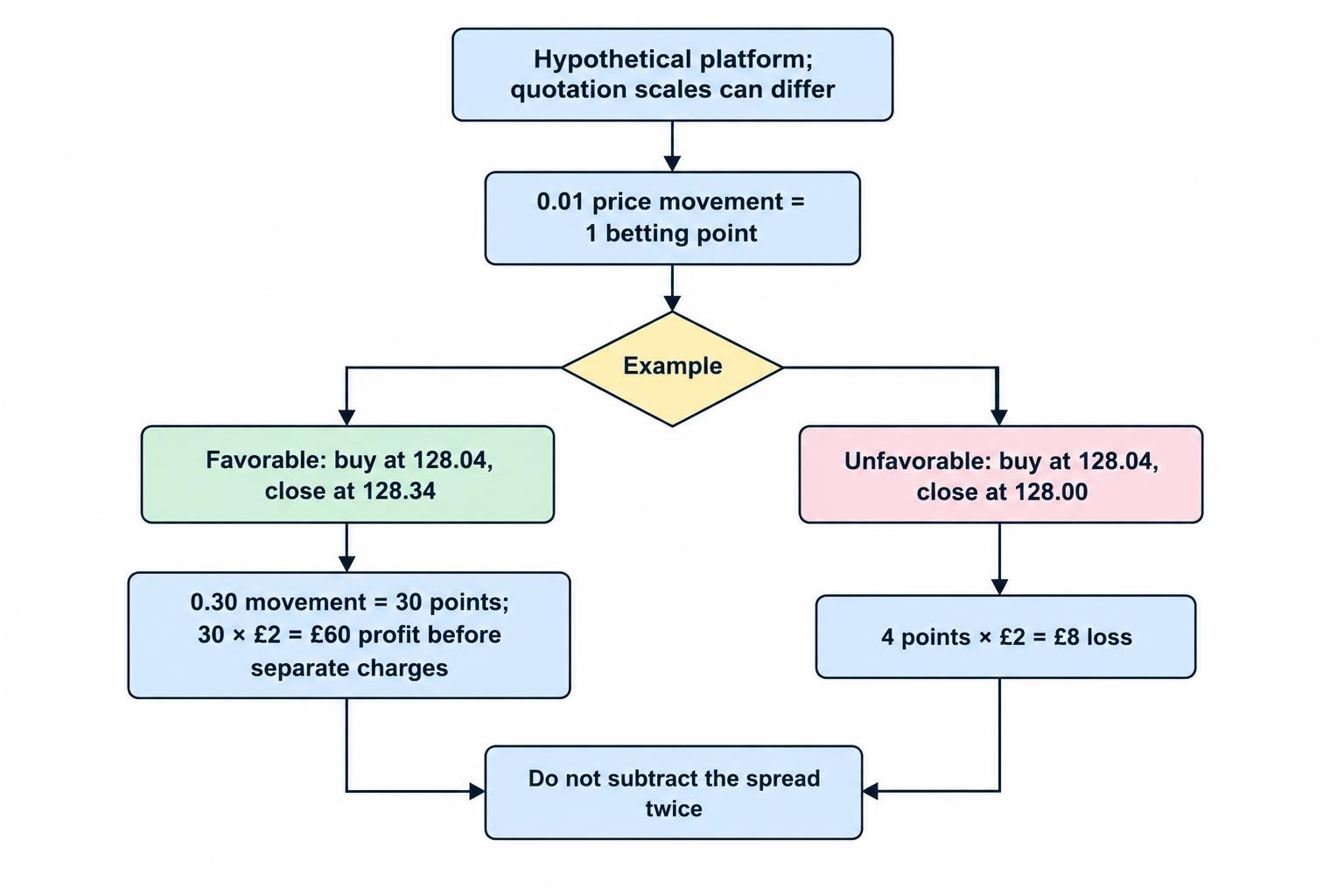
Consider a hypothetical platform that defines a 0.01 price movement as one betting point. Its bond quote is 128.00 to sell and 128.04 to buy. You buy at 128.04 for £2 per point.
If you later close at a selling price of 128.34, the favourable movement is 0.30, or 30 betting points. Your profit is 30 × £2 = £60, before any separate charges. If the closing selling price is 127.74 instead, the adverse movement is 30 points and the loss is £60.
The opening spread is already reflected in those entry and exit prices. Do not subtract it again. If the quote stayed unchanged and you immediately closed at 128.00, the four point difference would produce an £8 loss.
This example does not establish a standard quotation format. Another platform could scale the display differently. Before submitting an order, check that the ticket’s estimated profit or loss agrees with your calculation. A misplaced decimal is an expensive way to learn a contract specification.
Expiry, Holding Costs and Trading Hours
Separate the underlying bond’s maturity from the spread bet’s expiry. A market linked to ten year debt does not give you ten years before your bet expires. A dated spread bet can settle much sooner under the provider’s contract terms.
If you want to maintain exposure beyond that date, check whether the position closes automatically, can roll into another contract or requires a fresh order. A new contract may have a different price. That difference is not, by itself, a trading gain or loss. The guide to futures and forward spread bets covers the product structure.
Compare costs over your intended holding period. Check the quoted spread, any overnight financing, expiry treatment, rollover charges and charges for optional protections. Do not assume that the absence of a separate daily funding entry makes a dated contract free to hold. Use the provider’s terms alongside the spread betting costs guide to identify what applies.
Also distinguish exchange trading hours from the hours your provider accepts orders. Check daily breaks, holiday arrangements, expiry deadlines and the time zone shown on the platform. If you intend to hold through an announcement, establish whether you can trade when it occurs rather than finding out with an open position.
Managing the Risks of Bond Spread Betting
The underlying issuer and the trading structure create different risks. A government’s obligation to repay its debt does not protect the price of your spread bet. Nor does it stop a margin funded position from losing a large share of your account before your longer term forecast has time to develop.
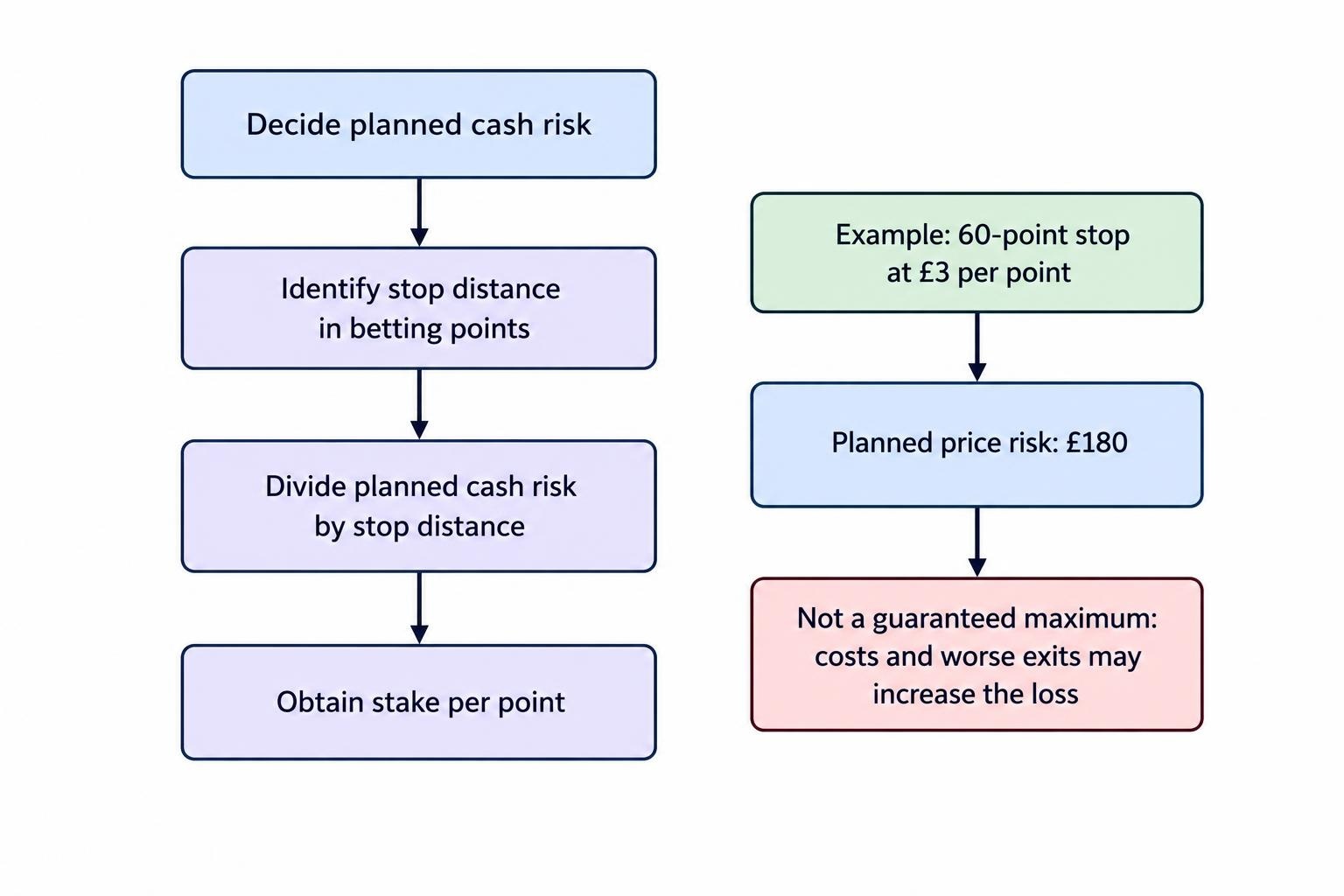
Set the planned loss before choosing the stake. Divide the cash amount you are prepared to risk by the stop distance in betting points, allowing for costs and the possibility of a worse exit. A 60 point stop at £3 per point represents £180 of planned price risk, not a guaranteed maximum. The position sizing guide explains the calculation.
Ordinary stop orders can execute at worse prices when markets move sharply or gap. Where available, a guaranteed stop can protect the exit level subject to the provider’s terms and any premium. Check availability for the actual bond contract; managing risk with guaranteed stops covers the distinction.
For retail accounts covered by the UK rules, the FCA requires account level margin close out at the 50% threshold and protection against losing more than the funds in the relevant trading account. Financial spread bets fall within these FCA retail derivative protections. They do not cap each trade’s loss at its opening margin or protect the money already in the account.
Review positions together, not just individually. Several trades built on the same falling yield forecast should be assessed as a combined exposure. Different country names on the order tickets are not a risk management plan.
Choosing a Bond Market That Fits the Trade
Begin with the economic view, then identify the country and maturity segment that express it. A view about UK borrowing conditions calls for different research from a view about US inflation or German long term yields.
Before opening the position, be able to state the reference contract, whether you are trading price or yield, what one betting point means, the expiry terms and your planned cash risk. Then compare the available stake sizes and trading costs with that plan.
If the smallest permitted stake makes the potential loss too large, leave the trade alone. The market may fit the forecast perfectly and still be the wrong contract for the account.