Forex spread betting lets you take a position on a currency pair without buying or taking delivery of either currency. You choose a stake per point, buy if you expect the pair to rise or sell if you expect it to fall. Your profit or loss depends on the price movement and your stake, after costs.
The arithmetic is straightforward. The harder decisions concern which currency you are backing, how much exposure your stake creates and what happens if prices move sharply. This guide covers forex spread betting for UK retail clients, including currency pairs, trading costs, margin and practical risk controls.
Spread betting is a leveraged product. Losses can exceed the margin used to open a position, and money committed to trading is at risk.
How forex spread betting works
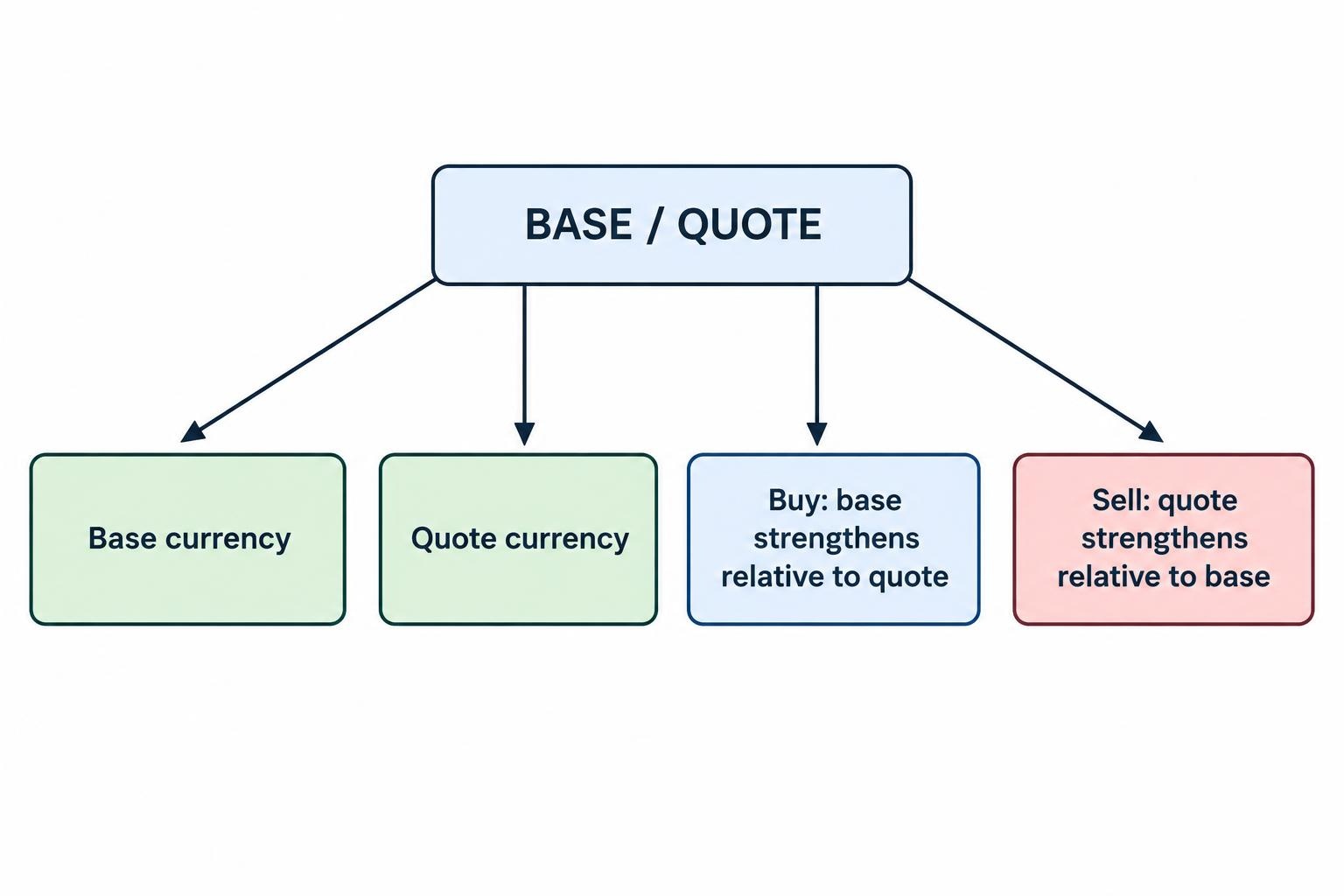
A forex price expresses one currency’s value in another. In GBP/USD, sterling is the base currency and the US dollar is the quote currency. A price of 1.2500 means one pound is worth 1.25 dollars.
Buying GBP/USD backs sterling to strengthen relative to the dollar. Selling backs sterling to weaken relative to the dollar. Neither position requires both currencies to move against every other currency: the relationship between these two is what matters.
The provider quotes two prices. You open a long position at the higher buy price and close it at the lower sell price. For a short position, you sell first and buy back later. The gap between those prices is the spread.
A spread bet is a contract with the provider rather than an order to exchange money in a bank account. You settle the resulting gain or loss in money. The detailed mechanics, including opening and closing positions, are covered in how forex spread betting works.
Pips, points and your stake
For many currency pairs, one pip is a movement of 0.0001. EUR/USD moving from 1.0800 to 1.0830 is a rise of 30 pips. For pairs quoted in Japanese yen, a pip is generally 0.01: USD/JPY moving from 150.00 to 150.30 is also 30 pips.
Check how the provider defines a betting point. A platform may display fractional pips, and its last decimal place is not necessarily the unit to which your stake applies.
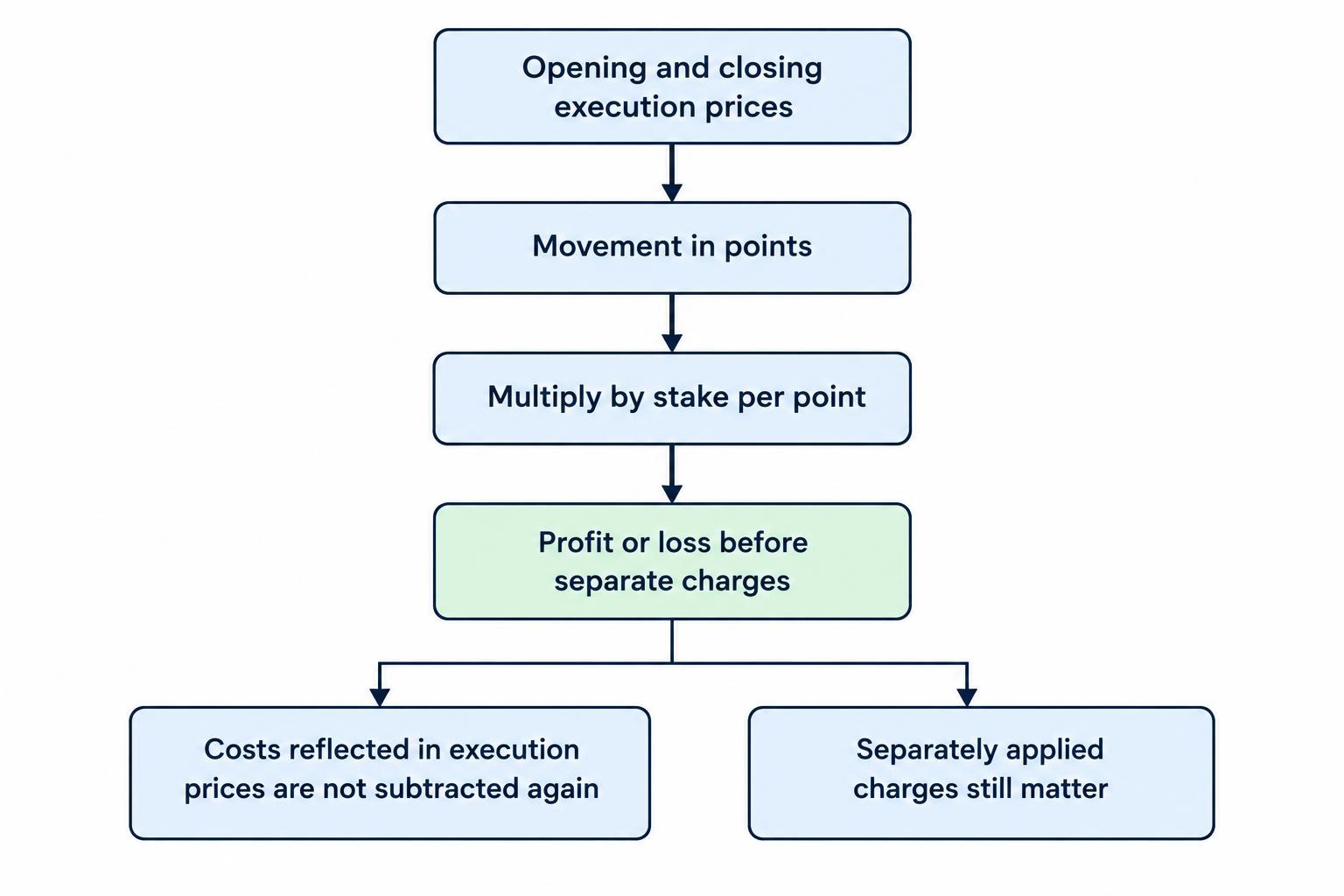
If the contract defines one point as one pip, a £2 stake means every pip changes the position’s value by £2. A 30 pip favourable movement produces £60 before separate charges; a 30 pip adverse movement loses £60.
A sterling stake can also make a non-sterling pair easier to track. On a contract specified as £2 per pip, EUR/USD gains and losses follow that sterling stake. You do not need to convert a dollar pip value yourself, although other account charges depend on the provider’s terms.
A forex spread betting example
Suppose a hypothetical EUR/USD contract quotes 1.0840 to sell and 1.0842 to buy. One betting point equals one pip, making the spread two points. You expect the pair to rise and buy at 1.0842 for £2 per point.
Later, the quote reaches 1.0872 to sell and 1.0874 to buy. You close at the sell price of 1.0872:
Profit before separate charges = 30 points × £2 = £60.
If the sell price instead falls to 1.0812 and you close there, the result is a £60 loss before separate charges. The same stake applies in both directions; there is no smaller multiplier for an inconvenient outcome.
Closing immediately at the original sell price of 1.0840 would lose £4. That is the two point spread multiplied by the £2 stake.
When calculating a result from actual opening and closing execution prices, the spread is already reflected. Do not subtract it again. Financing, guaranteed stop premiums and other separately applied charges still need to be included.
Which currency pairs can you spread bet?
Available pairs vary by provider. Rather than choosing the longest market list, consider which currency relationship you can follow, whether the spread suits your intended holding period and whether the minimum stake allows sensible risk sizing.
| Currency pair | What a buy position backs | Events to monitor |
|---|---|---|
| EUR/USD spread betting | The euro strengthening relative to the US dollar | European Central Bank and Federal Reserve decisions, inflation and employment releases |
| GBP/USD spread betting | Sterling strengthening relative to the US dollar | Bank of England and Federal Reserve decisions, UK and US economic releases |
| EUR/GBP spread betting | The euro strengthening relative to sterling | Differences between euro area and UK monetary policy and economic expectations |
| USD/JPY spread betting | The US dollar strengthening relative to the yen | Federal Reserve and Bank of Japan decisions, interest rate expectations and intervention announcements |
Selling any of these pairs expresses the opposite view. Notice that sterling strength means buying GBP/USD but selling EUR/GBP. Reading only the currency you recognise is an easy way to place the wrong trade.
A cross such as EUR/GBP excludes the US dollar from the quoted pair. That does not make it insulated from US developments, which may change expectations for both currencies. Nor does a familiar currency name make a pair inherently low risk.
Compare spreads and movement in the same units. A ten pip target facing a two pip spread has a very different cost burden from a hundred pip target facing that spread. The cheaper trade is not always the one with the smallest headline number.
What moves forex prices?
Currency trading is relative. Higher domestic interest rates can support a currency by making interest-bearing assets more attractive, but rates elsewhere also matter. The Bank of England’s research on monetary policy transmission describes this exchange rate channel and the role of relative real interest rates.
For a trading decision, distinguish the economic release from the market’s prior expectation. A rate rise does not mechanically produce a rising currency. In a hypothetical case, a central bank could raise rates while suggesting fewer future increases than traders expected. The currency could fall despite the higher announced rate.
Inflation, employment, growth figures and central bank statements deserve attention because they can alter the expected path of policy. Fiscal announcements, political events and changes in demand for risk can also affect the case for holding one currency against another.
Build a trade around a proposition you can assess. “Sterling looks cheap” leaves several questions unanswered. “I expect UK rate expectations to strengthen relative to US expectations over the next week” identifies the relationship, the proposed driver and the time horizon.
That still is not an entry signal. It gives you a claim to test against price, costs and an exit plan rather than a reason to keep a losing position indefinitely.
Forex trading hours and liquidity
Forex trading generally runs through the working week, from Sunday evening to Friday evening in UK time. Your provider sets the dealing hours for its contracts, including maintenance breaks and holiday arrangements. Check the market ticket rather than assuming every pair follows identical hours; our forex trading hours guide covers session timing and clock changes.
Liquidity is typically greater around the London open and during the London and New York overlap, a pattern covered in BIS research on FX market structure. Greater activity does not guarantee calm prices or execution at your requested level.
Choose a trading window you can actually monitor. Holding a position through an economic release while occupied elsewhere is still a trading decision. Alerts can help you follow prices, but they do not replace standing exit instructions or remove the risk of a gap.
The costs of forex spread betting
Spreads and execution
The spread creates an immediate hurdle. At £3 per pip, a 1.5 pip spread represents £4.50 between opening and immediately reversing the trade at unchanged quotes. The price must move enough in your favour to cover that difference before the position shows a trading profit.
Check the spread during the hours you intend to trade, not just the advertised minimum. Also examine how orders trigger and execute. A requested price and an execution price can differ, particularly when prices move quickly.
Overnight funding
A rolling daily forex position can receive a funding debit or credit when held past the provider’s cutoff. The calculation may reflect currency interest rates or swap pricing plus a provider adjustment. Check both direction and amount before keeping the position open.
Do not assume that selling a pair earns interest, or that a favourable interest differential guarantees a net credit. Provider markups matter. The FCA’s findings on overnight funding disclosures highlight concerns about the visibility of charges and funding markups.
Compare the expected charge across your intended holding period, including how weekends and holidays are treated. A small daily amount can become material over several weeks. The overnight financing guide covers the calculations and contract terms to check.
If a provider offers a dated forex contract, compare its total cost with the rolling product. A different charging structure does not mean a cost has disappeared; it may be reflected in the quoted price or spread.
Leverage, margin and UK retail protections
For UK retail clients, minimum opening margin is 3.33% of exposure for major forex pairs and 5% for other forex pairs, corresponding to approximately 30:1 and 20:1 maximum leverage. Providers can require more margin. The rules also require position close-out as soon as market conditions allow if account equity falls below 50% of the required margin. Negative balance protection caps liability for covered positions at the funds in the relevant account. These requirements are set out in FCA COBS 22.5 on retail speculative investments.
Margin is collateral, not your maximum loss on an individual trade. A ticket showing £300 required margin does not mean that £300 is the most the position can lose. Equally, negative balance protection does not protect your deposited trading capital from being lost.
Do not use the account close-out threshold as a substitute for your own exit. It applies across the account, and other open positions affect the calculation.
Check the actual margin category on the ticket. Everyday market labels and regulatory categories are not interchangeable. These retail protections should not be assumed for professional accounts or contracts with a different overseas entity.
Managing risk in a forex spread betting account
Set the stake from the planned loss
Choose the price level that invalidates the trade before deciding the stake. If your intended loss budget is £80 and the stop is 40 pips from entry, a £2 per pip stake gives an £80 price loss if execution occurs exactly at that level.
That calculation leaves no allowance for separate charges or adverse execution. Reduce the stake if you want those allowances within the same budget. The position sizing guide develops this approach without using available margin as the sizing rule.
Check whether the provider’s minimum stake fits. If the smallest permitted stake puts too much money at risk at a sensible stop distance, skip the trade. Moving the stop closer just to make the arithmetic fit changes the trade, not the market.
Know what your stop does
An ordinary stop triggers an instruction to close; it does not guarantee the requested exit price. A weekend gap or rapid repricing can produce a worse fill.
A guaranteed stop, where offered and subject to its terms, fixes the exit level but may involve a premium and minimum distance rules. Review managing risk with guaranteed stops before treating one as a fixed cash loss limit, especially where funding charges remain separate.
Check repeated currency exposure
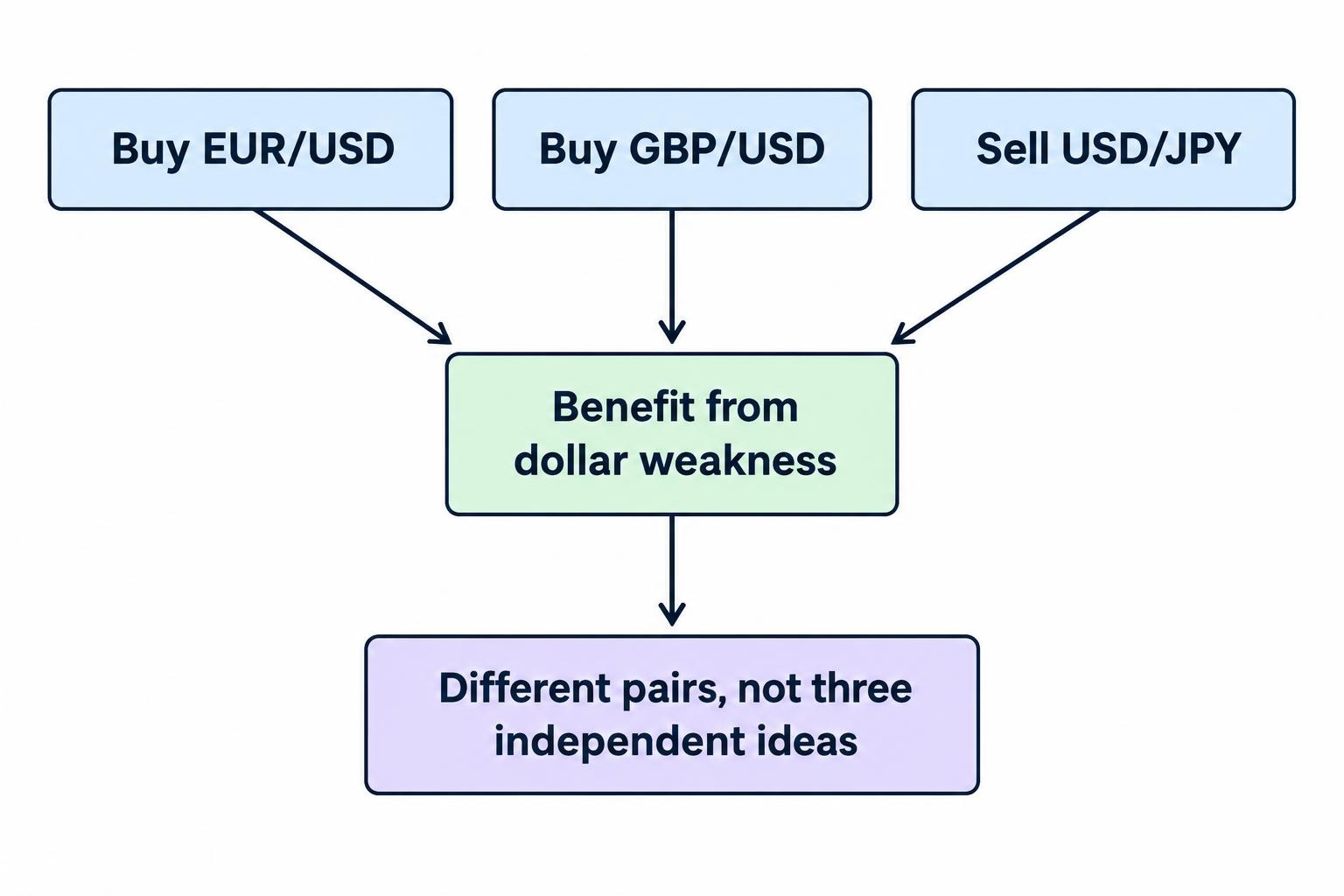
Buying EUR/USD and GBP/USD creates two positions that both benefit from dollar weakness. Adding a USD/JPY short adds another position that benefits from a weaker dollar.
They are different pairs, but not three independent ideas. Assess the loss if the dollar moves against all three together. Our guide to portfolio correlation and spread betting risk covers this overlap and why historical relationships can change.
Choosing a forex spread betting provider
Start with the legal entity named in the account agreement and verify its regulatory status and permissions. Then compare the terms that affect the pairs, stake sizes and holding periods you intend to use.
A useful comparison records typical dealing spreads during your trading window, minimum stakes, point definitions, funding calculations and order rules. Look for clear information about stop triggers, guaranteed stop availability and what happens during platform interruptions.
Do not assume a familiar brand offers identical protections through every entity using its name. Also confirm that the account offers spread betting rather than only CFDs: a similar-looking currency ticket does not make the contract interchangeable.
Use the forex spread betting broker comparison to assess providers against these requirements. A long list of available pairs is less useful than suitable terms on the few you intend to trade.
Is forex spread betting tax-free in the UK?
For ordinary personal financial spread betting, gains generally fall outside UK Capital Gains Tax, and losses are not allowable capital losses. This treatment appears in HMRC’s guidance on financial spread betting and capital gains. It should not be applied automatically to another forex product.
Income Tax requires attention to the contract and the economic substance of the activity, including whether winnings arise from carrying on a trade. HMRC’s spread betting income guidance sets out that distinction.
Use the UK spread betting tax guide for the broader position, and obtain advice where business activity, company accounts or overseas tax residence is involved. A UK tax treatment does not establish the treatment in another country.
A practical routine before placing a forex bet
Use the same preparation each time, whether the proposed position lasts twenty minutes or several days:
- Define the currency view. State which currency you expect to strengthen and confirm whether that means buying or selling the pair.
- Check the contract. Verify the point size, stake currency, spread, dealing hours and funding cutoff.
- Plan the exit. Identify the invalidation level, intended target and events that could change the trade.
- Calculate the stake. Work from an affordable loss budget, then check margin and existing currency exposure separately.
- Review the execution. Record actual entry and exit prices, charges and any difference from the plan.
If you cannot reconcile the ticket with your own calculation, pause and use a demonstration account to check it. Forex spread betting makes expressing a currency view simple. Keeping its costs and exposure within an acceptable cash amount takes more care.