Hedging with spread bets can reduce exposure to a falling portfolio, an exchange rate movement or another financial risk. It does not automatically make the resulting profit tax free. The UK tax treatment depends on the contract, its economic purpose and whether an individual or a company enters into it.
The practical problem is that a hedge and the asset it protects can receive different tax treatment. Two positions may offset each other before tax without producing matching tax deductions and charges.
This guide covers that interaction within the UK spread betting tax framework. It addresses UK treatment rather than obligations in other countries, and provides general information rather than advice on a particular arrangement.
Is a Spread Betting Hedge Tax Free?
Do not assume that the usual treatment of a personal wager applies to a hedge. The distinction between wagering and commercial use matters: a spread bet entered into for a commercial purpose, including hedging, falls outside the ordinary non-taxable wagering treatment identified in HMRC’s guidance on derivatives outside the corporate regime.
That warning does not provide a complete tax calculation for every protective trade. It means the analysis must go beyond the product name. What exposure exists, why the contract was opened and how the arrangement works all need consideration.
For ordinary personal spread betting, no chargeable gains or allowable capital losses arise. That is the starting position set out in HMRC’s financial spread betting guidance. It should not be stretched into a promise covering every commercial hedging arrangement.
Keep three questions separate. Is the contract genuinely a spread bet? What is its purpose? What tax rules apply to the person entering it? A platform’s description of an account as “tax free” cannot answer all three.
For a private investor protecting a share portfolio, the sensible approach is to establish the treatment of the proposed contract before relying on an exemption. Neither “all hedges are taxable” nor “all personal spread bets are exempt” is a safe substitute for examining the facts.
Separate the Hedge From the Underlying Holding
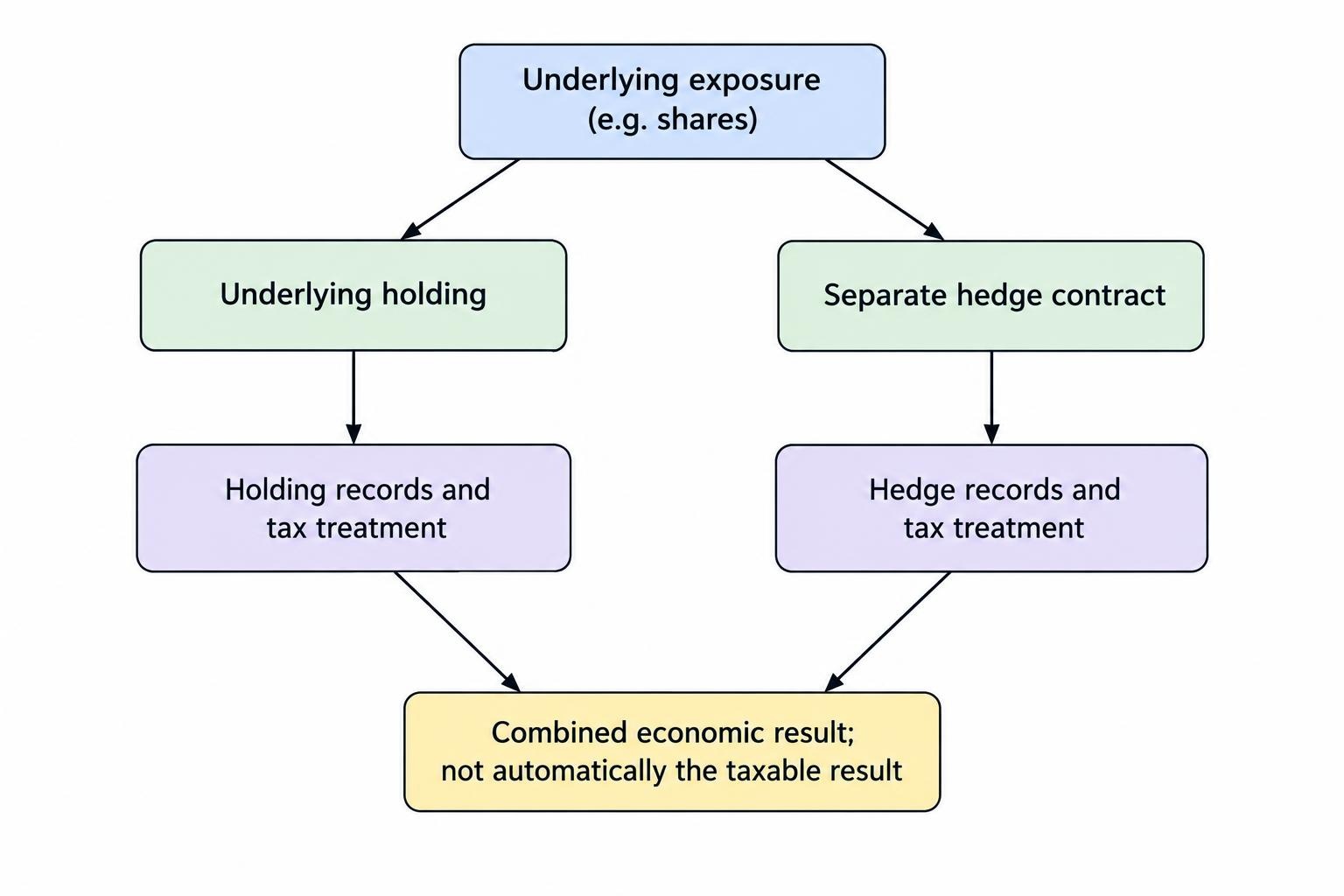
A hedge creates an additional position. It does not erase the original holding or merge the two transactions into one tax asset.
Suppose you own shares and open a short spread bet against their price. Economically, the short may offset some of the shares’ movements. Operationally, you still have a shareholding and a separate contract, with separate statements, cash flows and closing decisions.
The mechanics are covered in our guide to hedging with financial spread betting. For tax planning, the extra step is to keep separate records for the holding, the hedge and the combined economic result.
A combined profit figure answers “Did the protection work?” It does not necessarily answer “What is taxable?” Treating those as the same question is where an apparently tidy hedge can become untidy paperwork.
Start with the underlying exposure. Record who owns it, its acquisition history, its current value and whether it belongs to a private investment portfolio or a business. Then describe what the hedge is intended to protect, for how long and to what extent.
Worked Example: Hedging a Share Portfolio
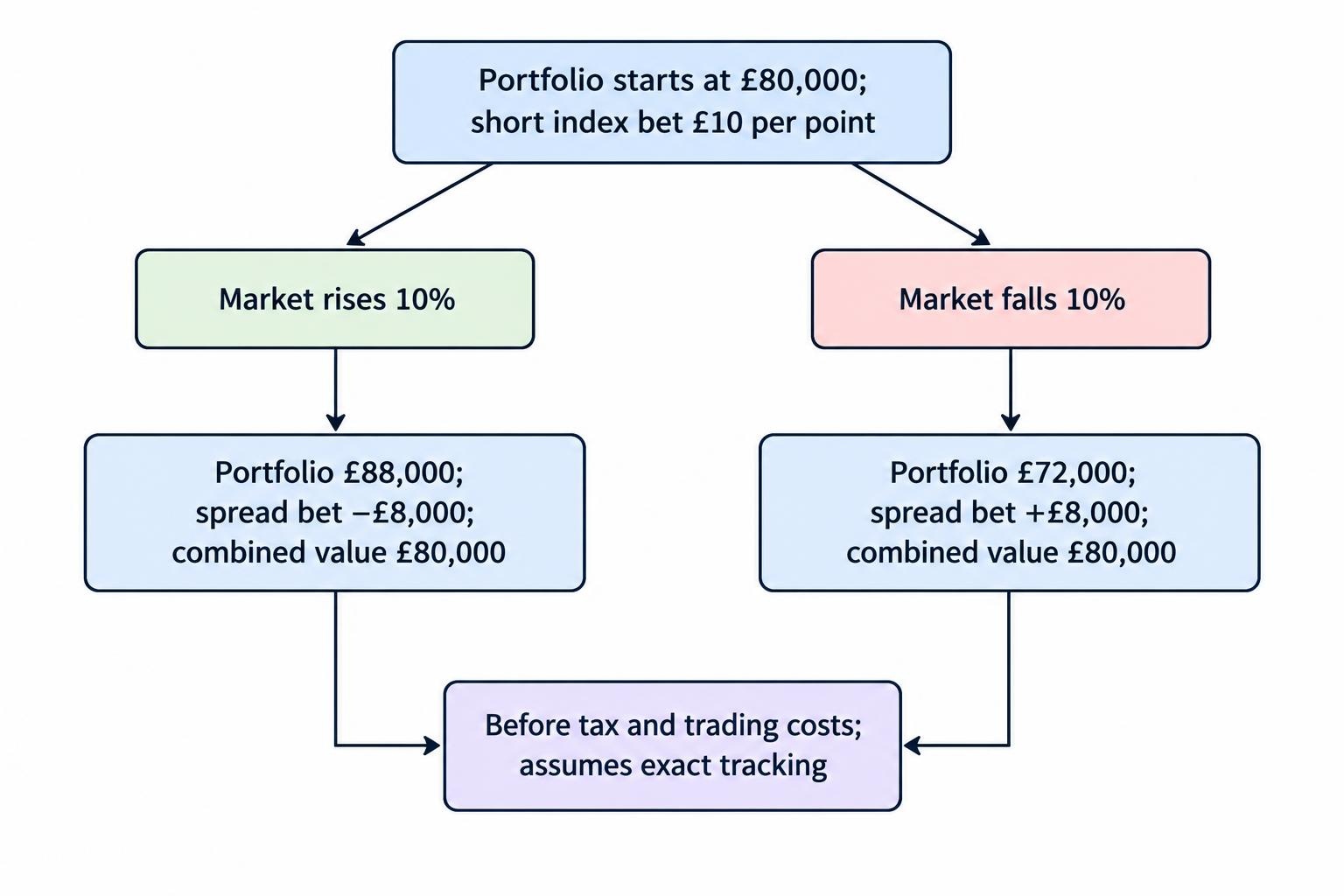
Consider a simplified portfolio with a current value of £80,000 and an acquisition cost of £50,000. Assume it moves exactly with an index standing at 8,000. The investor wants temporary protection against a market fall without immediately selling the shares.
A short index spread bet at £10 per point would produce an £8,000 gross profit if the index fell by 800 points. It would produce an £8,000 gross loss if the index rose by the same amount.
This is deliberately simplified. It ignores spreads, financing, dividend adjustments and execution differences. The relationship between the index quotation and the stake must also be checked; our stake per point guide covers that calculation.
| Item | Market rises 10% | Market falls 10% |
|---|---|---|
| Portfolio value when the hedge starts | £80,000 | £80,000 |
| Portfolio value when the hedge ends | £88,000 | £72,000 |
| Spread bet result | £8,000 loss | £8,000 profit |
| Portfolio value plus hedge result | £80,000 | £80,000 |
| Share gain if the entire portfolio is sold, before allowable costs and reliefs | £38,000 | £22,000 |
Before tax and costs, the protection works perfectly under these assumptions. Both outcomes leave £80,000 of combined value. The share disposal calculations differ because the shares sell for different amounts against the same £50,000 acquisition cost.
If the Spread Bet Receives Ordinary Wagering Treatment
Under that treatment, the losing bet does not provide an allowable capital loss to offset against the share gain. In the rising market scenario, the investor has an £8,000 hedge loss alongside a £38,000 share gain before other adjustments.
That mismatch is the practical issue covered by the rules on spread betting losses: an economic loss is not necessarily a tax deduction.
In the falling market scenario, the shares instead produce a £22,000 gain on sale, while the hedge generates £8,000. The worked example therefore shows why equal results before tax need not produce equal results after tax. It does not establish that a real portfolio hedge qualifies for wagering treatment.
If the Contract Is Taxable
The calculation needs a different analysis. Establish the applicable tax regime, the treatment of receipts and expenditure, and when each amount is recognised. Do not assume that a taxable hedge automatically provides an immediate deduction against any gain or income you choose.
The figures in the table remain useful for measuring market protection. They are not, by themselves, a tax return computation.
What if the Shares Are Not Sold?
The last row assumes a full sale when the hedge ends. If the investor retains the shares, the example instead shows a change in their value alongside the hedge’s cash result. Do not record the assumed sale gain as though a sale actually occurred.
A separate short contract does not, by itself, sell the shares you already own or reset their acquisition cost. Keep the original holding’s history intact. The broader disposal rules belong in the guide to spread betting and Capital Gains Tax, rather than in a combined trading spreadsheet.
Commercial Hedging by a Sole Trader
A business hedge raises a different question from an unrelated personal bet. Where a derivative is held for the purposes of a non-corporate trade, its profits can form part of trading profits. The relevant connection must be established rather than assumed from the fact that the person also runs a business.
For spread betting, taxable winnings must arise from carrying on the trade, not simply from an opportunity associated with it. Contract terms and economic substance determine the analysis under HMRC’s guidance on spread betting and trading income.
Consider a hypothetical importer with an overseas supplier invoice. At the start, settling the invoice would cost £50,000. An adverse currency movement later increases that cost to £53,000. A suitably matched currency position might generate £3,000 before costs, offsetting the additional cash requirement.
That example has a clear commercial exposure: an identified invoice, a payment date and a currency risk. It is different from placing an unrelated market bet because the business happens to have spare cash.
For an actual arrangement, document the invoice, the hedge size and the intended protection period. If the supplier changes the amount or payment date, review the hedge too. A contract left open after the exposure disappears may no longer serve its original purpose.
The distinction between personal activity and spread betting connected with a business should be settled before deciding how to record the result.
Mixed purposes deserve particular attention. If only part of a position relates to the invoice, do not describe the whole contract as a business hedge without analysis. Equally, a separate personal account does not settle the purpose of the transaction. The evidence should match what the contract actually does.
Company Hedges Require a Separate Tax Analysis
A company cannot safely import the treatment commonly associated with an individual’s personal spread betting. A financial spread bet entered into by a company is a contract for differences for the relevant corporate rules; describing it as a wager does not, by itself, prevent those rules from applying. This distinction is addressed in HMRC’s corporate guidance on financial spread bets.
Before a company opens a hedge, its accountant should establish the applicable derivative contract treatment, any exclusions, the accounting entries and the tax adjustments required. The answer should not be postponed until someone downloads the annual statement.
Keep the contracting party clear. If the company owes the supplier but a director opens the hedge personally, that is not the same arrangement as a company contract. Ask how the intended protection, funding and any transfers between the parties should be documented.
Our guide to spread betting through a company covers the wider corporate position. For a hedge, the immediate task is to match the legal contract, the commercial exposure and the accounting records.
Also ask when the relevant amounts enter the tax computation. Do not use money withdrawn from the trading account as a substitute for checking the applicable recognition rules.
Can Hedge Losses or Financing Reduce the Share Gain?
Do not automatically add a spread betting loss to the acquisition cost of the shares it was intended to protect. The permitted deductions in a capital gains calculation are defined categories, not every expense with an investment connection. Those categories appear in section 38 of the Taxation of Chargeable Gains Act 1992.
Calling a hedge “portfolio insurance” does not establish a deduction. Nor does a spreadsheet note saying that the expense protected the investment. The relevant question is which rule permits the deduction in the particular computation.
Keep financing and other contract adjustments visible. A small daily charge can become material when temporary protection stays open for months. Model the expected holding period using the applicable overnight financing costs, rather than judging the hedge solely by its opening spread.
For each charge, distinguish its economic effect from its proposed tax treatment. The economic calculation asks how much protection cost. The tax calculation asks whether that amount is recognised, under which rules and against what.
Where a contract has a commercial tax treatment, ask the adviser to address losses and associated charges expressly. Do not infer that a conclusion about profitable settlements also answers every question about expenditure.
Would a CFD Give a Better Tax Match?
A CFD may create a similar market exposure but a different tax result. For an individual, retail CFD outcomes generally fall within the capital gains regime unless taxable as trading income. Relevant account debits and credits enter the computation when the contract closes under HMRC’s guidance on retail contracts for differences.
That can make tax matching worth examining where the underlying holding is also subject to Capital Gains Tax. It does not establish that a CFD is the better choice for every investor or that every loss will produce an immediate cash saving.
Compare both market directions. A hedge loss during a rising market and a hedge profit during a falling market may affect the comparison differently. Include the underlying holding, contract costs and the timing of any available relief.
The detailed product comparison belongs in spread betting versus CFD tax treatment. For a hedging decision, the useful question is not which product carries the more attractive headline. It is which arrangement produces acceptable protection, costs and tax consequences for the exposure you actually have.
Tax Matching Does Not Solve Cash Flow Risk
A hedge can work economically and still create a funding problem.
Return to the £80,000 portfolio example. If the market rises, the short spread bet loses money while the shares gain value. The increase in the shareholding is not automatically cash available in the spread betting account. The investor may need to fund the losing contract while retaining the shares.
Plan that requirement separately from the tax calculation. Our guide to spread betting margin risk covers the funding side. A hedge sized to the portfolio’s market value should not be confused with a cash reserve sufficient to maintain it.
Timing also affects the usefulness of any expected tax offset. Record when the hedge closes and when the underlying holding is sold or the business transaction occurs. If those events fall in different tax periods, flag the difference for review rather than assuming the results can simply be netted.
Check the exposure itself as well. A broad index may not track a concentrated portfolio closely. Currency positions may differ from the value or timing of the invoice they protect. If the original exposure shrinks, an unchanged hedge can become too large.
These are reasons to review a hedge, not reasons to keep adjusting it without a plan. Set a protection period, a funding budget and a condition for reducing or closing the contract before placing it.
Records That Support the Hedging Purpose
A useful record should let another person reconstruct the arrangement without guessing why it existed. Write down the purpose when the hedge opens, not after the result is known.
For a portfolio hedge, preserve the holdings and valuation used to calculate the exposure. For a business hedge, retain the relevant invoice, order, borrowing agreement or other evidence of the commercial risk. Then connect that evidence to the contract details.
- The underlying exposure: owner, amount, currency, acquisition history where relevant, and expected transaction date.
- The hedge: contracting party, market, direction, stake, opening and closing dates, and contract terms.
- The sizing decision: the calculation, intended proportion protected and assumptions about how the positions would move.
- The result and treatment: settlements, charges, adjustments, changes in purpose and the basis used for the tax computation.
Preserve the original statements as well as your calculations. Deposits and withdrawals help reconcile cash, but they do not explain the market exposure or establish the tax classification.
A consistent approach to spread betting record keeping also helps when a hedge changes. If an invoice is cancelled, shares are sold or protection is reduced, record what happened to the corresponding contract.
Retain any written advice with the facts supplied to the adviser. Advice based on a private portfolio position may not answer a later question about a company’s currency exposure, even if both contracts appear in a similar dealing ticket.
What to Establish Before Opening the Hedge
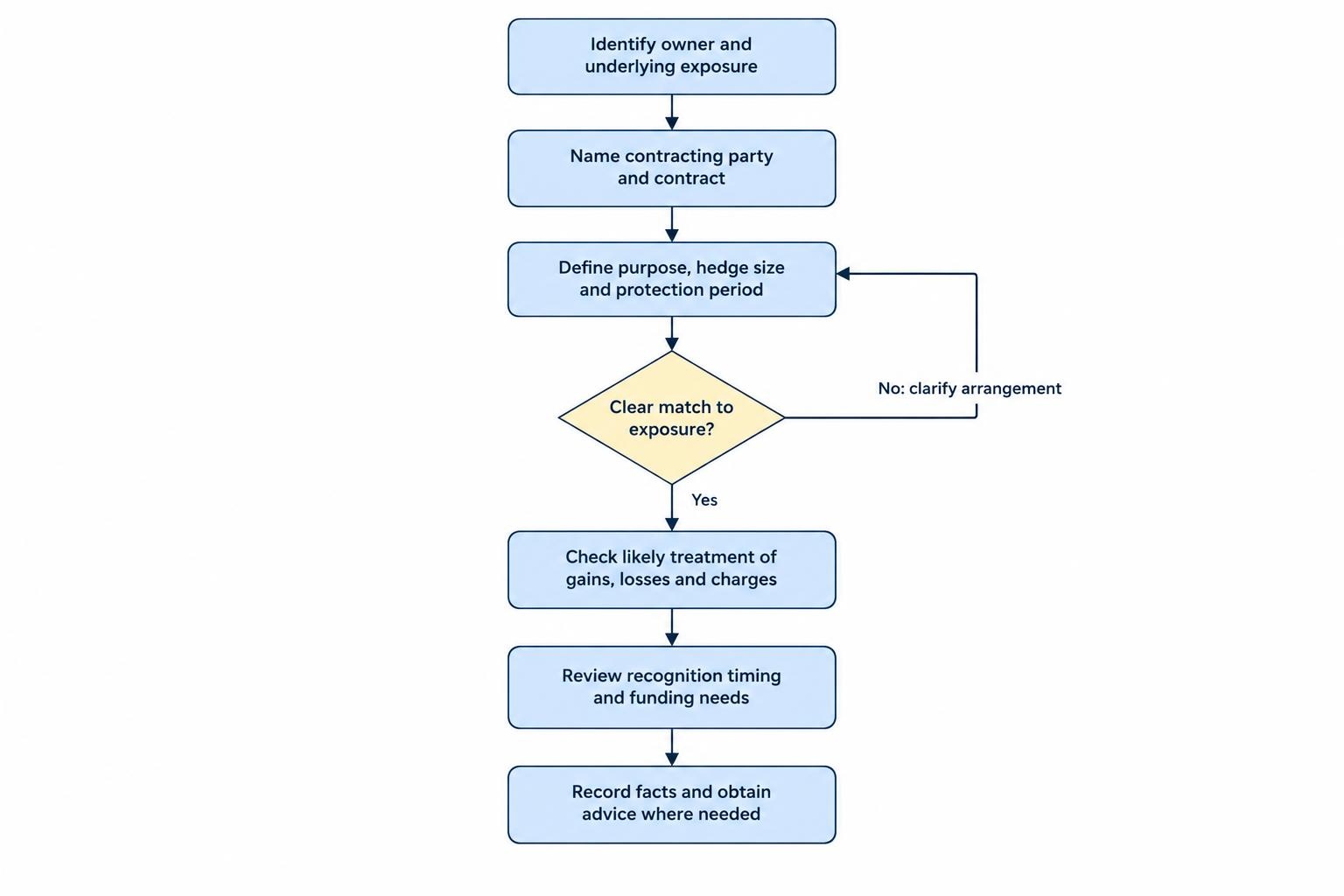
Describe the proposed arrangement in one paragraph: who owns the exposure, who will enter the contract, what risk it protects, how much protection is intended and when it should end. If that description is unclear, resolve it before assessing the tax advantage.
Then ask for a written treatment of both profitable and losing outcomes. The review should cover the underlying holding, the hedge, associated charges, recognition dates and any conditions affecting relief. A statement that “spread betting is normally tax free” is not enough for a commercial hedge.
Finally, compare a rise, a fall and little market movement. Include costs and funding needs in each case. In the flat scenario, the position may provide little market benefit while still generating charges, so the expected duration matters.
The aim is to reduce an identified risk at an acceptable cost. Establish the contract’s tax treatment first, keep the two sides of the arrangement separate in your records, and judge the protection on its result after costs and tax—not just on the profit shown against the hedge.