Spread betting on UK shares lets you take a position on a company’s share price without buying or borrowing the shares yourself. You choose a stake per point, then your profit or loss depends on how far the provider’s price moves between opening and closing the bet.
The practical details matter. Many UK shares are quoted in pence, individual companies can jump after announcements, and a modest stake can create more exposure than the margin deposit suggests. This guide covers those decisions, building on the broader mechanics of share spread betting.
Spread betting is a leveraged, high risk product. An ordinary stop loss does not guarantee your exit price, and losses can exceed the margin allocated to a trade.
How Spread Betting on UK Shares Works
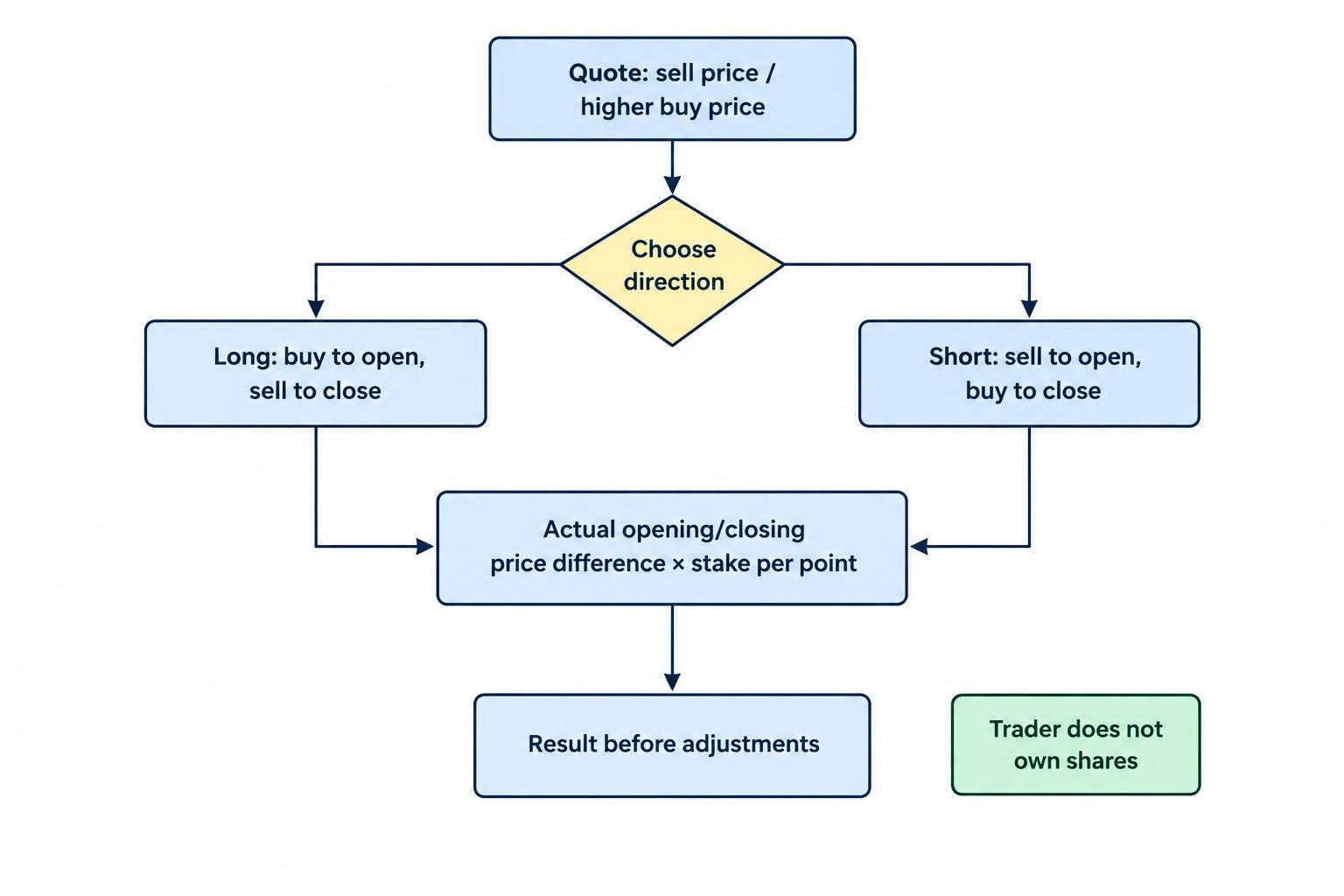
A share spread bet is a contract with your provider, not a purchase through a share dealing account. The provider quotes a sell price and a higher buy price. You buy to open a long position if you expect the price to rise, or sell to open a short position if you expect it to fall.
To close a long bet, you sell at the available sell price. To close a short bet, you buy at the available buy price. The difference between your actual opening and closing prices determines the trading result before financing and other adjustments.
You do not become a shareholder. There are no voting rights, and any dividend related cash adjustment comes from the spread betting contract rather than ownership of the company.
Read the Price in Pence, Not Pounds
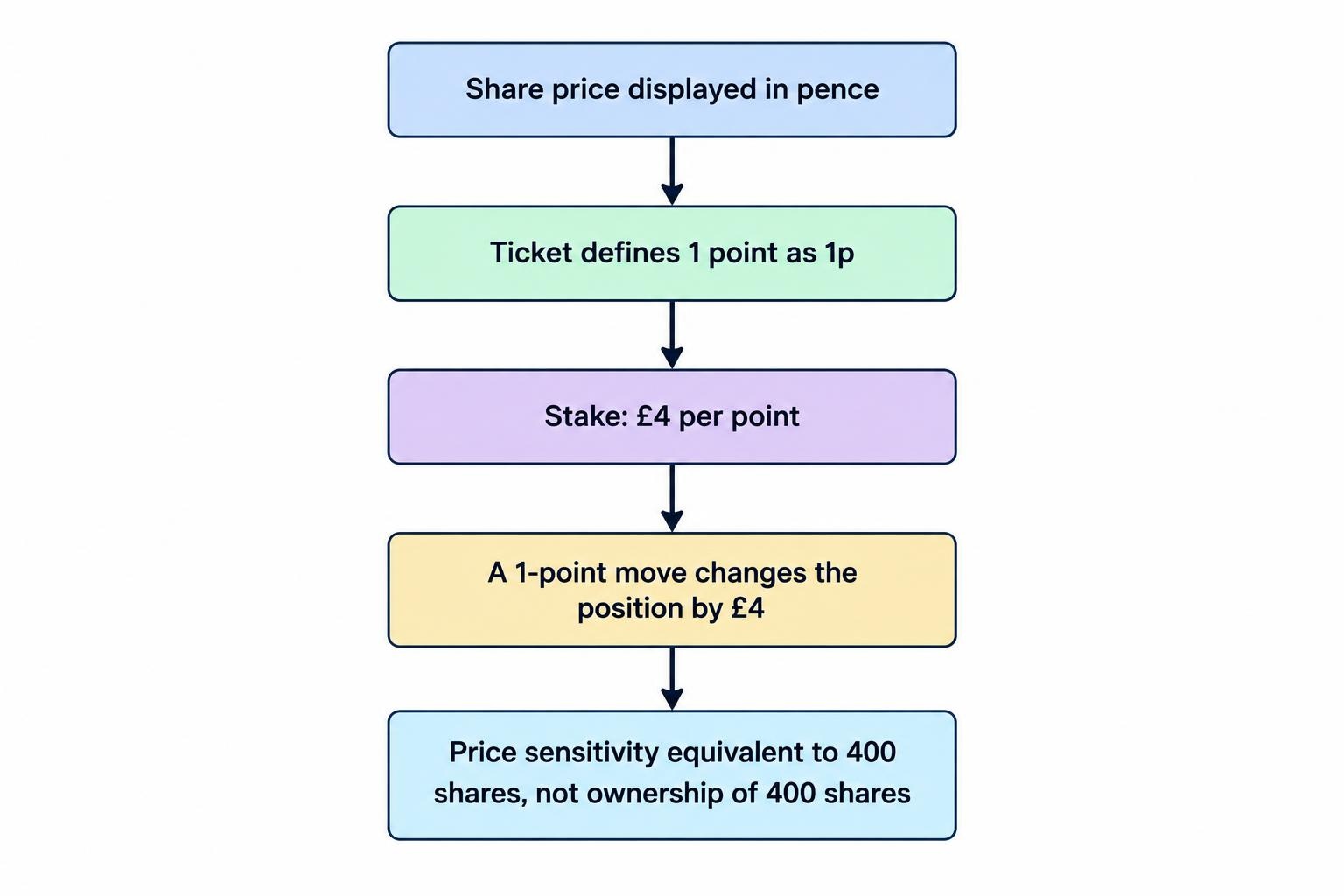
A UK share displayed at 250p costs £2.50 per share in the underlying market, not £250. GBX denotes pence sterling, distinct from GBP; the distinction appears in the London Stock Exchange’s currency field specification.
Check the spread betting ticket’s point definition separately. In the examples below, one point means a movement of 1p in the share price. Under that assumption, a move from 250p to 251p is one point, while a move from 250p to 275p is 25 points.
At £4 per point, that 25 point movement changes the position’s value by £100. The stake is not the price of one share and it is not the amount deposited to open the trade. The relationship is covered in more detail in stake per point explained.
With one point equal to 1p, a £1 per point stake has the same price sensitivity as 100 shares. A £4 stake therefore behaves like 400 shares for price movements. That is an exposure comparison, not ownership of 400 shares.
Before submitting an order, confirm the company, trading currency, point size and contract type. A familiar company name does not make an unfamiliar dealing ticket safe.
A Worked UK Share Spread Bet
Consider a hypothetical UK share quoted at 250–252. These are illustrative prices, not live market quotes. Assume one point equals 1p and you buy at 252 for £4 per point.
The position starts with an £8 running loss because an immediate exit would use the sell price of 250. The following outcomes use the actual opening and closing sides of the quote.
| Outcome | Closing sell price | Movement from entry | Profit or loss |
|---|---|---|---|
| Immediate close | 250 | −2 points | −£8 |
| Price rises | 272 | +20 points | +£80 |
| Price falls | 232 | −20 points | −£80 |
These figures exclude overnight financing, dividend adjustments and other charges. They are alternative outcomes, not trades with a stop already attached.
For a long position, the calculation is:
Profit or loss = (closing sell price − opening buy price) × stake per point.
What Changes With a Short Bet?
Using the original 250–252 quote, a short position opens at 250. If the available buy price later falls to 230, closing a £4 per point short produces a £80 profit before other charges. If the buy price rises to 270, the loss is £80.
Do not assume that every share available to buy is also available to short. Check the direction permitted on the ticket and the provider’s borrowing terms before planning the trade. The separate guide to short selling shares through spread betting covers those restrictions and costs.
Calculate Exposure Before Looking at Margin
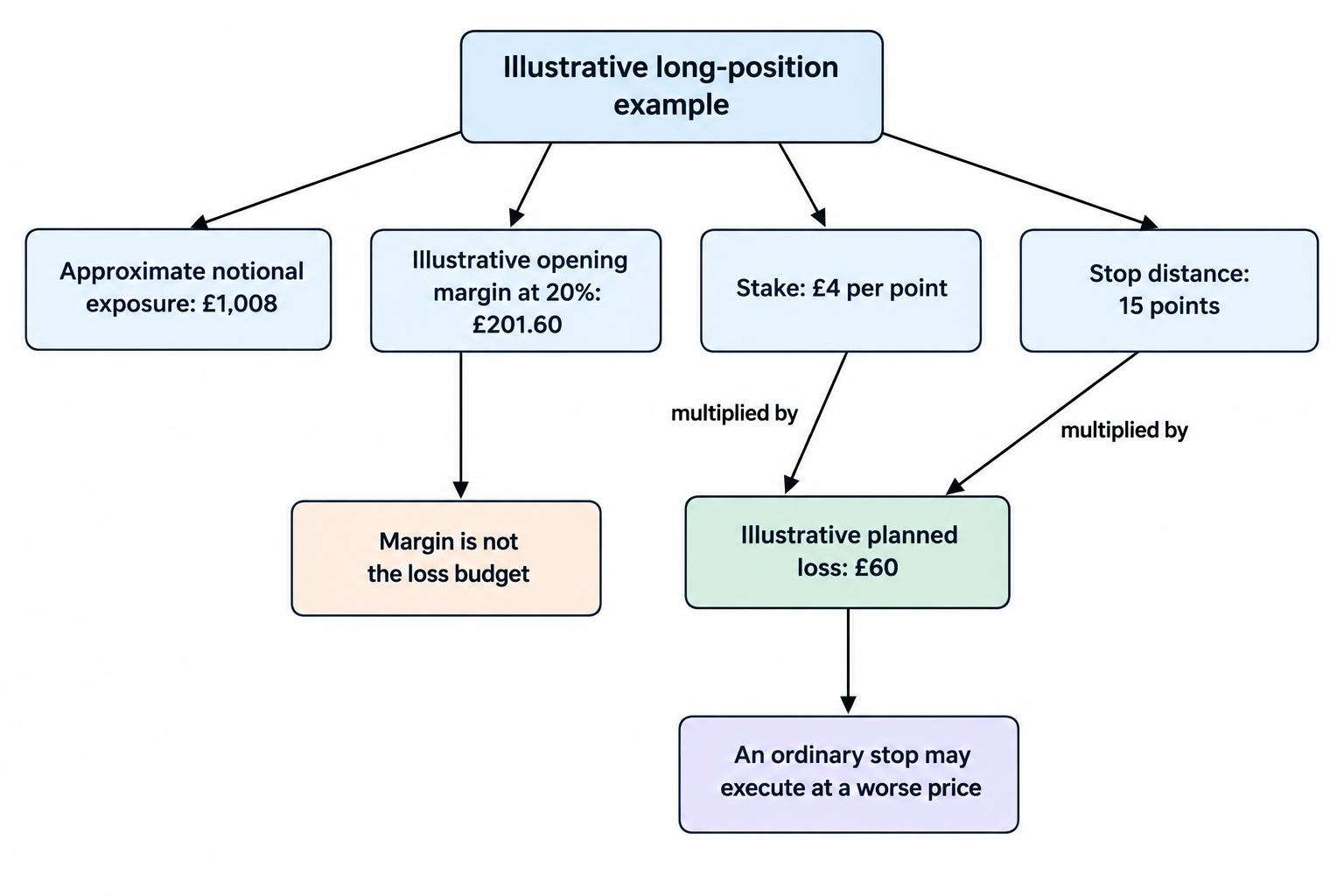
Using the long example, a £4 per point position at 252 has an approximate notional exposure of £1,008: 400 equivalent shares multiplied by £2.52. This is the amount to use when assessing the economic size of the trade.
Under the FCA retail rules, a spread bet whose underlying asset is an individual share requires opening margin of at least 20% of its exposure, equivalent to maximum opening leverage of 5:1. A provider can require more.
The framework also requires account level close out when net equity falls below 50% of the applicable margin requirement, with positions closed as soon as market conditions allow. Negative balance protection restricts a retail client’s liability to funds in the relevant account, not the margin assigned to one trade. These requirements sit within the FCA rules for retail speculative investments.
At a 20% margin rate, the illustrative £1,008 position would require £201.60. That deposit does not make £201.60 an appropriate loss budget. Nor does it mean that only £201.60 of the account is exposed to that trade.
Position size should follow the planned exit and cash risk. Suppose a new long trade at 252 has a planned stop at 237, a distance of 15 points. A £60 planned loss budget gives a stake of £4 per point: £60 divided by 15.
That £60 remains an estimate with an ordinary stop because execution can occur at a worse price. Allow for charges and adverse execution, and round the stake down where necessary. The full method belongs in position sizing for spread betting.
Choose Shares for Tradability, Not Familiarity
Knowing what a company sells is useful background, but it says little about whether its spread bet suits a trade. Familiarity with a supermarket is not a trading thesis.
Assess the instrument through the trade you intend to place. Compare the quoted spread with the movement you are targeting, inspect the minimum stake, and check whether that stake allows a sensible cash risk at your planned stop distance. A share can be available on a platform yet still be unsuitable for your account size.
Liquidity also matters. A thin underlying market can leave less room to enter or exit without accepting an unattractive price. Do not treat a low nominal share price as evidence that a position is cheap or manageable. A 10p share can still produce a large percentage loss.
For smaller companies and AIM traded shares, check availability individually. The market label alone does not tell you whether a provider offers the instrument, permits short positions or accepts the stake you want.
Separate a company view from a market view. If the thesis concerns one business winning a contract or cutting its forecasts, an individual share expresses that view. If the thesis is simply that large UK listed equities will rise, FTSE 100 spread betting offers a different exposure without concentrating the entire position in one company.
Research the Business and the Next Announcement
A share trade needs more than a chart level. Before entering, identify what could change the market’s assessment of the company during your intended holding period.
Start with the issuer’s published results, trading updates and financial calendar. Use the original announcement rather than a headline summary where possible. RNS distributes regulatory and financial communications from companies; LSEG’s description of the RNS service sets out that role.
Read beyond the headline profit figure. Revenue growth can coexist with falling profit margins. Reported profit can rise while cash generation weakens. A reassuring account of the previous six months may sit beside a less reassuring forecast for the next six.
Also distinguish the listing currency from the company’s business exposure. A hypothetical London listed exporter earning dollars and reporting in sterling faces different currency effects from an importer paying dollar invoices. A sterling quote does not remove exchange rate sensitivity from the business.
Build the research around a question you can test. For a retailer, that might concern sales growth and profit margins. For a housebuilder, it could concern reservations, cancellations and financing conditions. For a resources company, it might concern production, costs and commodity prices.
The purpose is not to predict every line in the next report. It is to know what would invalidate the trade. The wider process is covered in fundamental analysis for financial spread betting.
Trading Hours, Announcements and Opening Gaps
The London Stock Exchange’s normal share trading session runs from 08:00 to 16:30 London time. Check holidays, shortened sessions and the trading arrangements for the individual security; the exchange publishes its standard hours in its trading information for investors.
Your provider’s dealing hours are a separate matter. Confirm when it accepts opening orders, closing orders and amendments for the share concerned. Do not assume that an extended hours service available on one market also applies to another.
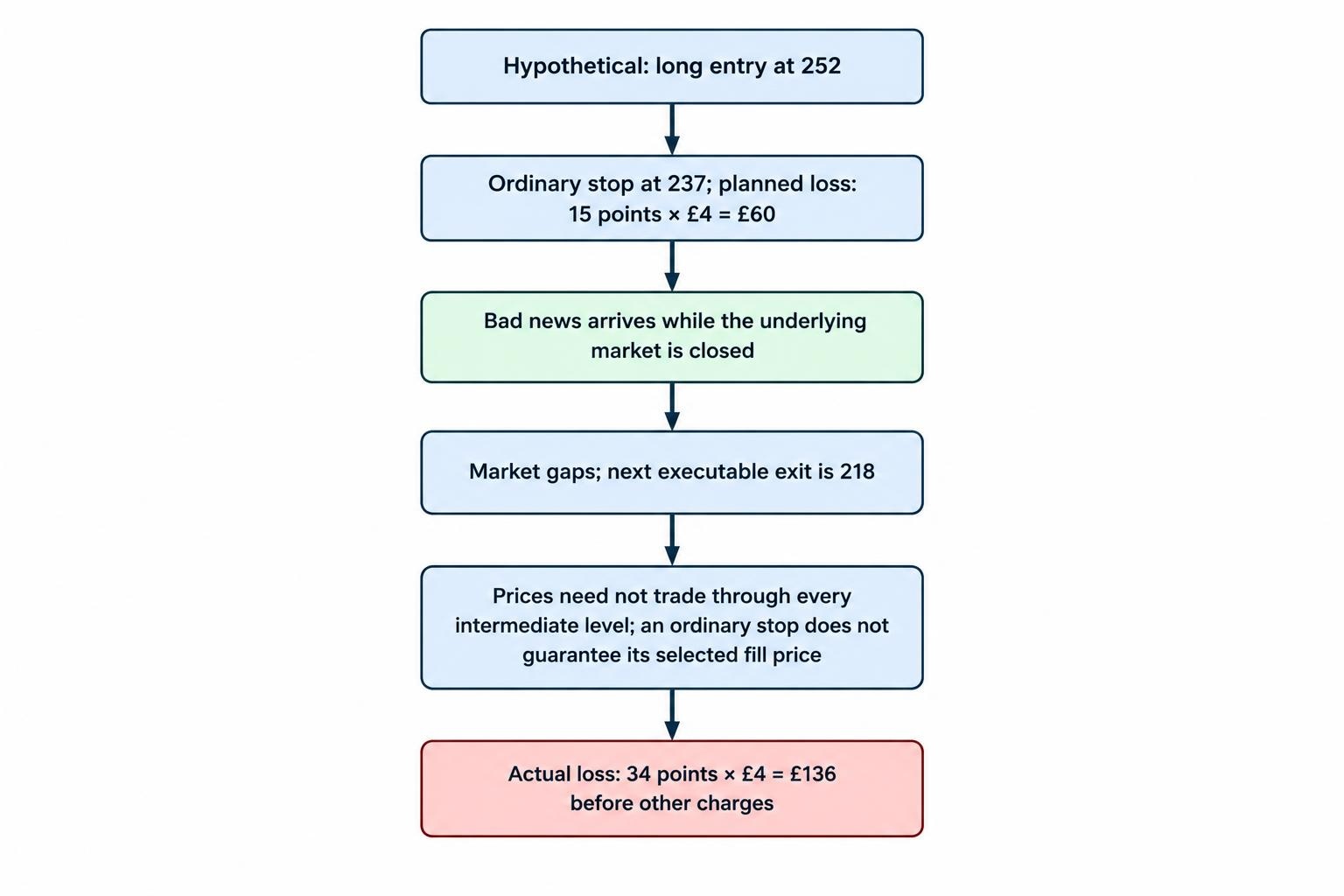
Holding through a company announcement changes the trade. If new information arrives while the underlying market is closed, the next available price may be far from the previous close. There is no requirement for the share to trade through every price in between.
Return to the illustrative long entry at 252 with a stop at 237. If the next executable exit after bad news is 218, a £4 per point position loses £136 before other charges, rather than the planned £60. The calculation is 34 points multiplied by £4.
An ordinary stop becomes an instruction to close after its trigger conditions are met; it is not a promise to fill at the selected level. A limit order controls the price you will accept but may remain unfilled. These differences matter most when prices move abruptly.
Before holding overnight, decide whether the position is intended to carry announcement risk. Reducing exposure or closing beforehand may fit the plan better than relying on an ordinary stop. The mechanics are covered in market gap risk.
Judge Costs Against the Intended Holding Period
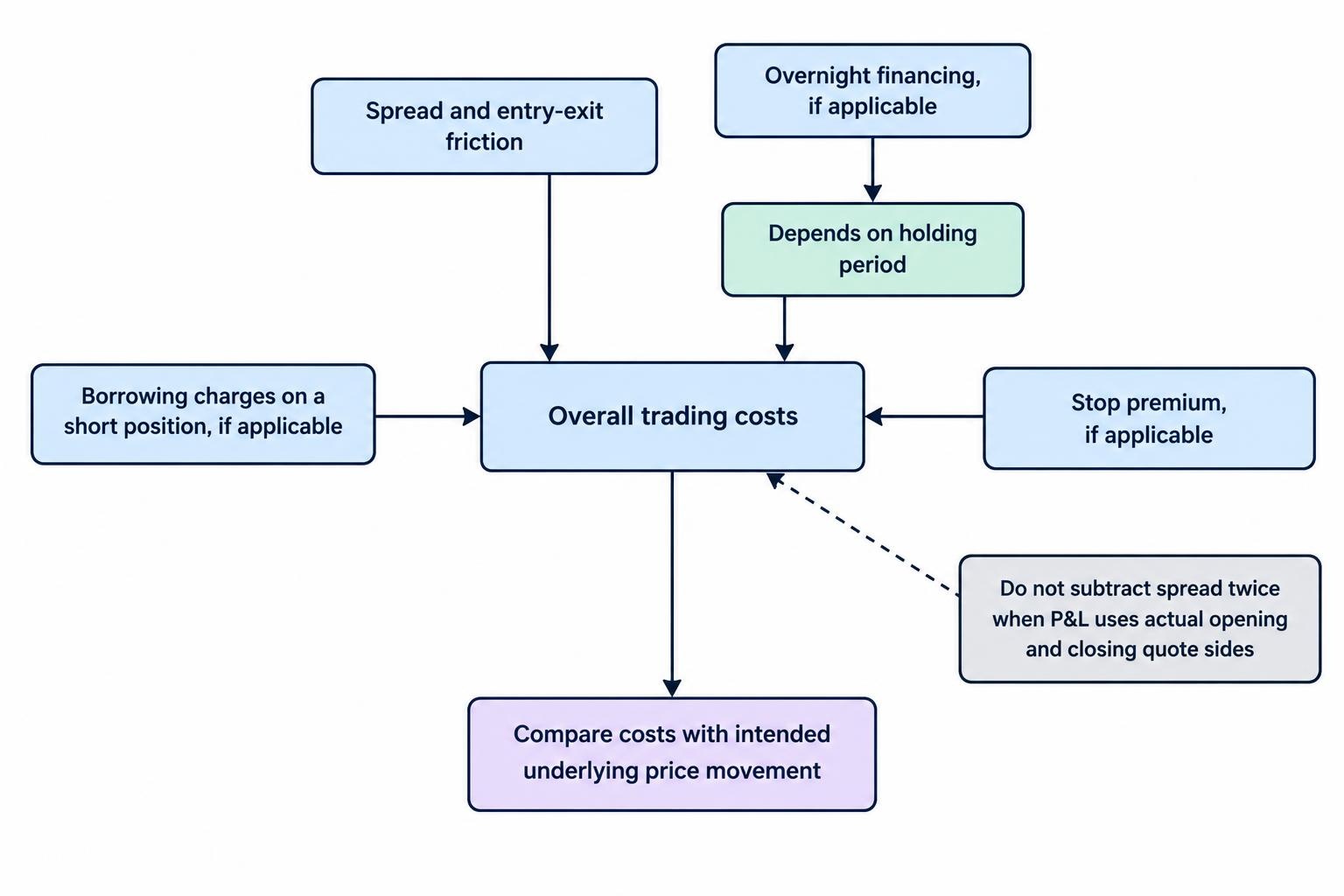
The spread is only part of the cost assessment. A daily funded share bet can also involve overnight financing, and a short position may carry borrowing charges. Check the actual instrument terms rather than assuming that the headline account pricing applies to every share.
Financing deserves particular attention for trades held over several weeks. Assess it against the full notional exposure and the provider’s calculation method, not just the margin deposit. The FCA has identified concerns about overnight charges and their disclosure in its review of CFD and spread betting firms’ charging practices.
Cost matters in relation to the trade’s expected movement. In an illustrative setup targeting a 10 point move in the underlying price, a 2 point quoted spread is a substantial hurdle. The same spread has a different role in a trade targeting 60 points, although a longer holding period may introduce more financing.
Do not subtract the spread twice. If profit and loss already uses the actual opening buy price and closing sell price, that price difference already reflects the spread paid through those quotes.
For a proposed trade, compare entry and exit friction, expected funding, any borrowing charge and any stop premium that applies. The separate guide to share spread betting costs examines those components without mixing them into the stake calculation.
Dividends and Corporate Actions Affect Open Positions
A share price movement around a dividend date is not automatically a trading opportunity. The price can adjust when the share starts trading without entitlement to the next dividend, while the spread betting contract may receive a corresponding cash adjustment.
For a cash style share bet, the usual structure credits an eligible long position and debits an eligible short position, subject to the contract terms. The amount and timing should be checked before the event. It is not shareholder dividend income.
Buying immediately before the adjustment does not create free money. Any cash credit must be considered alongside the share price adjustment, spread and financing. The guide to dividends and share spread bets covers the mechanics.
Other corporate actions also need attention. A share split, consolidation, rights issue or takeover may lead to changes in the position’s quoted price, stake or cash balance. Read the provider’s notice and check the treatment of attached orders. An unchanged company name does not guarantee unchanged contract details.
A Practical Process Before Opening the Trade
Use a repeatable process rather than making the decisions inside a live dealing ticket. Begin by confirming the legal entity holding the account and its relevant permissions. The guide to checking a broker on the FCA Register explains what to verify.
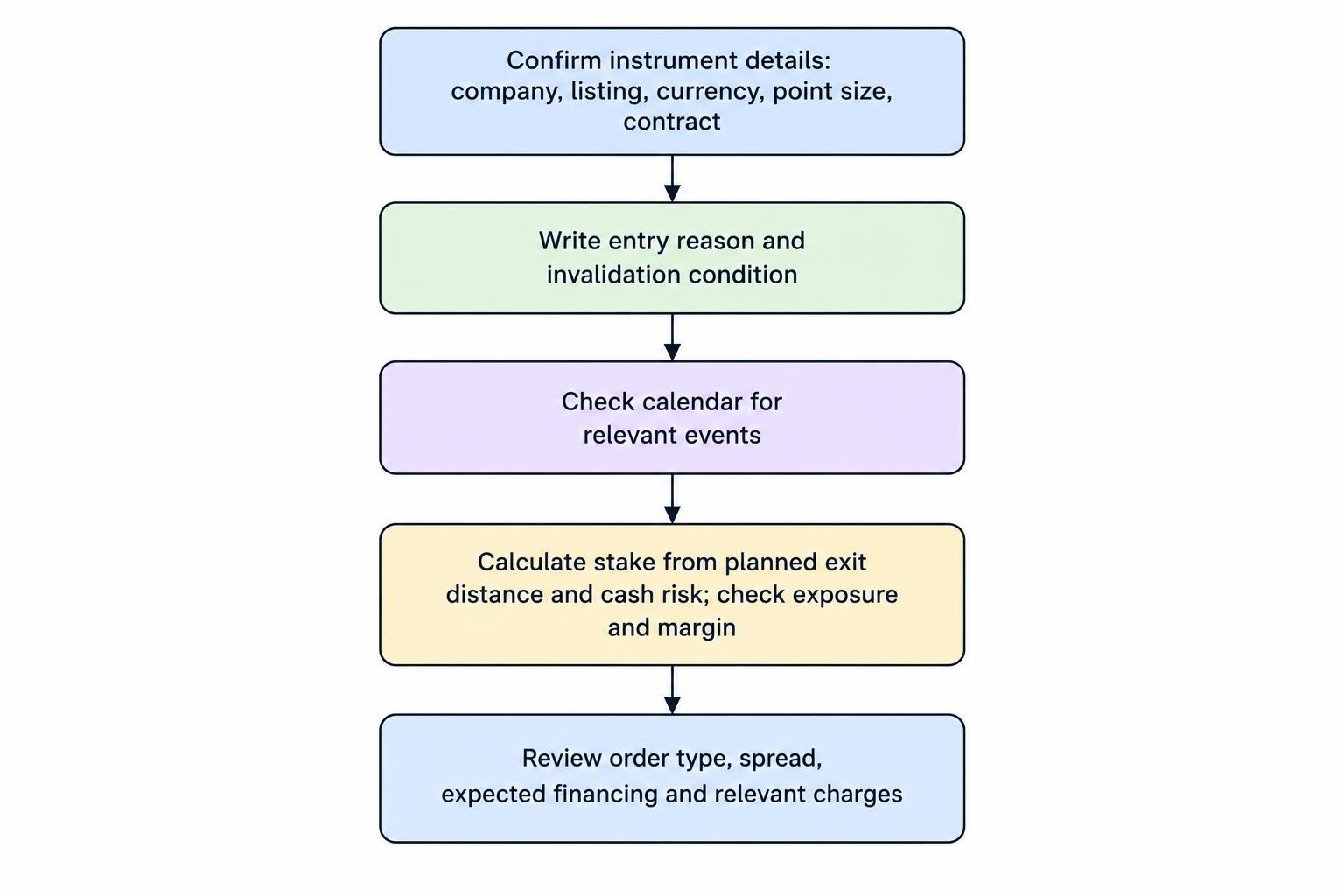
Then work through the trade in this order:
- Confirm the instrument. Match the company, listing, currency, point size and contract type.
- Write the reason for entry. State what you expect to happen, over what period, and what would prove the idea wrong.
- Check the calendar. Review results, trading updates, dividend dates and other known events within the holding period.
- Calculate the stake. Use the planned exit distance and cash risk, then check notional exposure, margin and remaining account funds.
- Review execution and costs. Confirm the order type, spread, expected financing and any borrowing or protection charges.
Read the order confirmation after execution. Check the filled price, stake and attached orders rather than assuming every requested setting was accepted. An instruction entered on a ticket and an order accepted by the platform are not the same thing.
Set a review condition as well as a price exit. A trade based on an expected announcement may no longer make sense once that announcement has passed, even if the stop has not been reached.
A demo account can help check point values and platform controls. Treat it as an operational exercise, not evidence that live execution, dealing availability or results will match.
UK Tax Treatment Needs Careful Wording
For genuine financial spread betting, HMRC’s capital gains guidance states that no assets are acquired or disposed of and no chargeable gains or allowable losses arise. This treatment is set out in HMRC’s financial spread betting guidance.
The loss side matters: a losing spread bet does not normally create a capital loss that can be offset against taxable gains from ordinary shares. A favourable treatment of winnings is not compensation for the absence of loss relief.
Do not extend the UK treatment to another country’s tax rules, or assume every business or corporate arrangement has the same outcome. Personal circumstances and the use of the contract can require professional advice. The broader question is covered in whether spread betting is tax free.
When an Individual UK Share Bet Fits the Objective
An individual share spread bet expresses a view on one company’s price over a defined period. It does not replace share ownership where the objective is voting rights, direct dividend income or holding an unleveraged investment without ongoing spread betting funding charges.
The strongest practical test is whether the trade still makes sense after translating everything into pounds: full exposure, planned loss, a worse exit scenario and expected costs.
If the minimum stake makes the risk too large, the share is unsuitable for that account size. If the next announcement could produce a loss you cannot accept, the position is too large or should not be open. And if the reason for buying is simply that the company is familiar, there is more work to do before placing the bet.