The spread in financial spread betting is the difference between the price at which you can buy and the price at which you can sell. It creates a trading cost because you enter at one side of the quote and close at the other.
A two-point spread might sound small. At £10 per point, however, it represents a £20 hurdle before any other charges. Reading the quote correctly helps you calculate that cost, identify your break-even price and avoid mistaking a chart movement for a profit.
How to Read a Spread Betting Quote
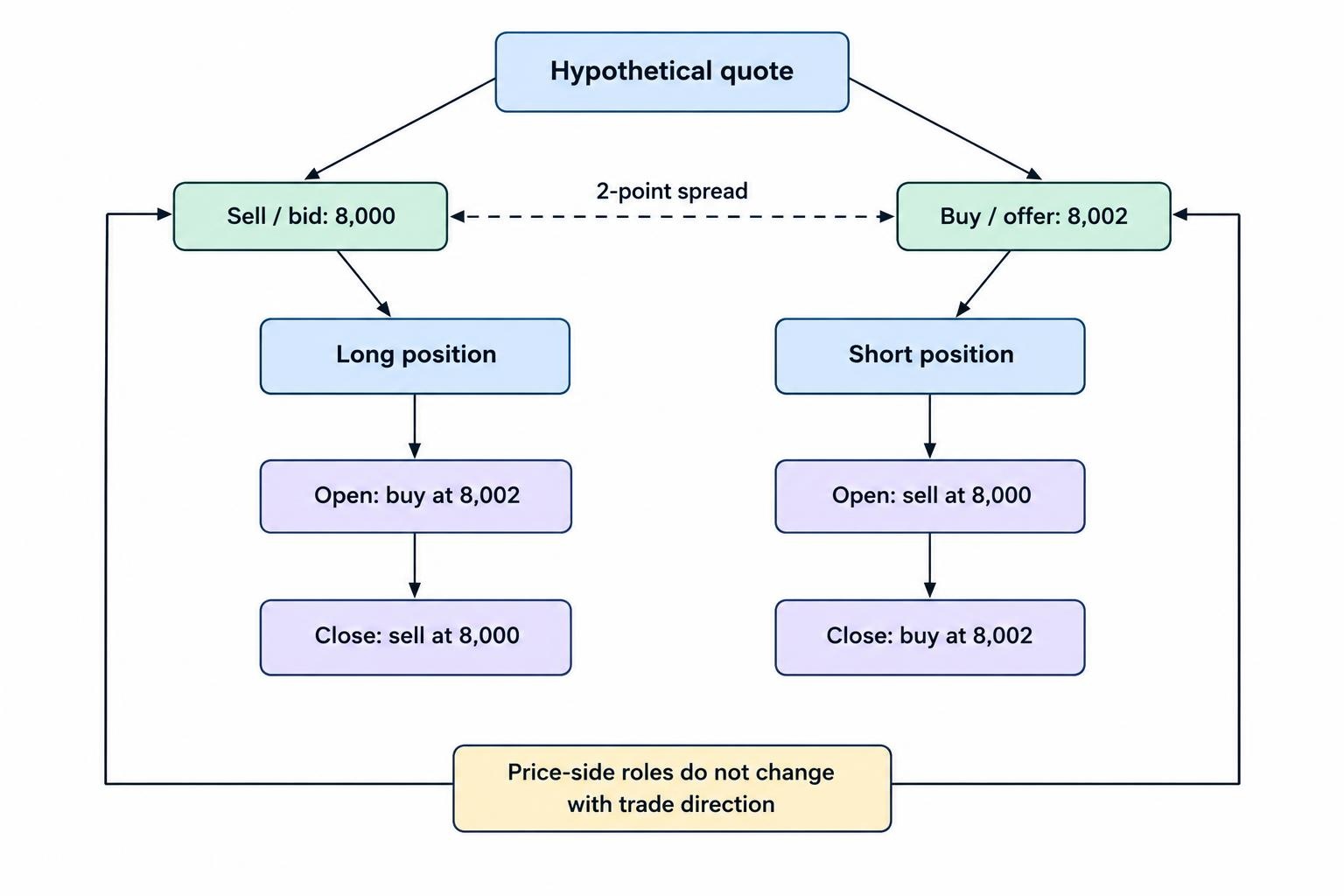
A spread betting quote contains two prices: a lower sell price, called the bid, and a higher buy price, called the offer or ask. The gap between them is the bid-ask spread.
Suppose an index has a hypothetical quote of 8,000 sell / 8,002 buy. The spread is two points:
Spread = buy price − sell price = 8,002 − 8,000 = 2 points.
If you expect the index to rise, you open a buy position at 8,002 and later close it by selling. If you expect it to fall, you open a sell position at 8,000 and later close it by buying.
The prices do not change roles when your view changes. You always buy at the buy price and sell at the sell price, whether you are opening or closing a position. That distinction matters more than the direction of the trade.
Converting the Spread Into Pounds
To express the quoted spread as a cash amount, multiply its width by your stake per point:
Spread cost at the quoted prices = spread in points × stake per point.
With a two-point spread, a £2 stake gives a £4 cost. A £10 stake gives a £20 cost. The quote is identical in both cases; the larger position makes each point more expensive. Our guide to stake per point covers how that stake translates price movements into money.
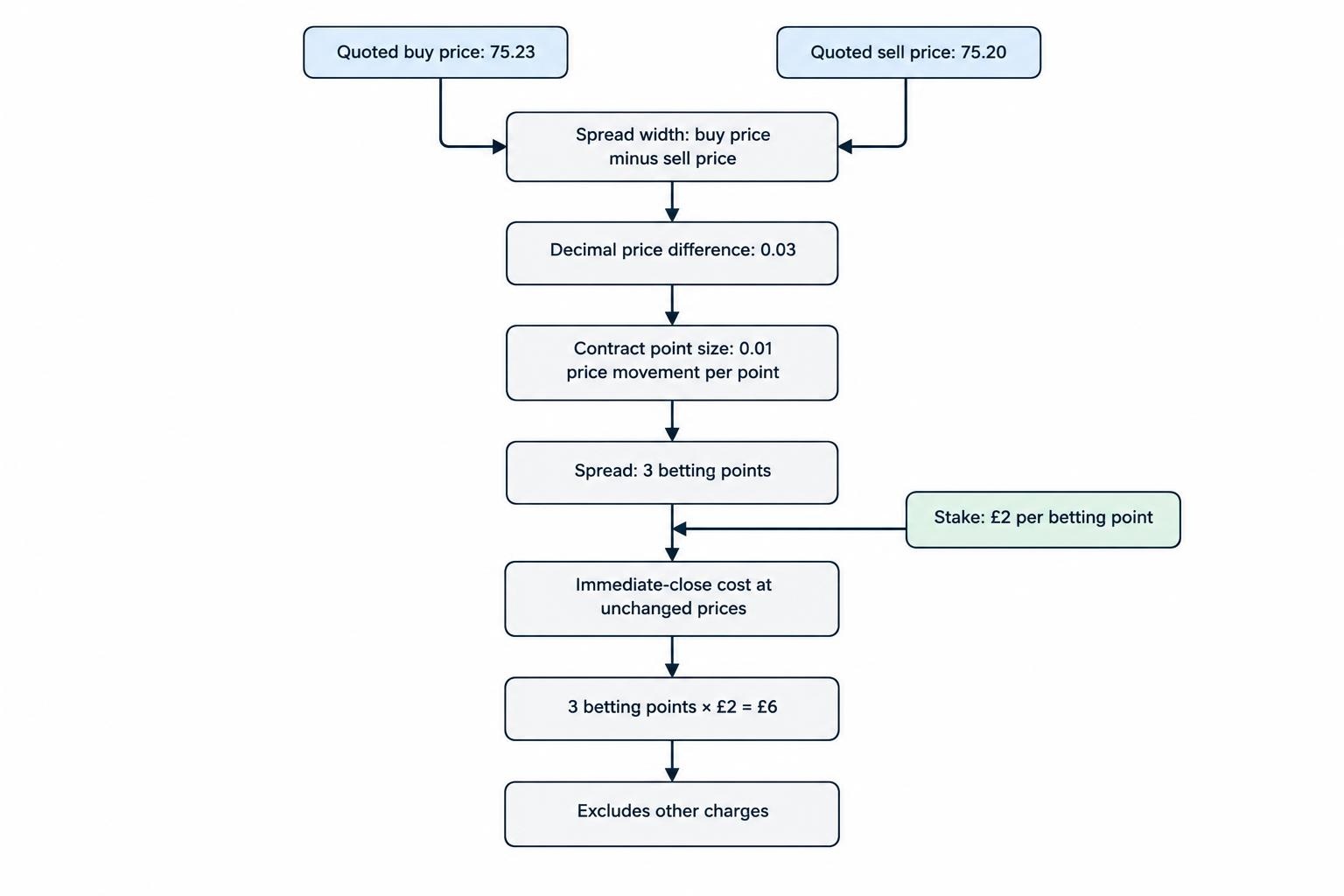
This calculation describes the loss from opening and immediately closing at unchanged prices, before other charges. It does not predict the final cost of a trade whose entry and exit spreads differ.
Check What Counts as One Point
Do not assume that every digit on a dealing ticket represents a whole betting point. The contract’s point size determines how to convert the price gap into stake units.
For a hypothetical contract where one point equals a 0.01 price movement, a quote of 75.20 sell / 75.23 buy has a three-point spread. At £2 per point, the immediate spread cost is £6, not £0.06.
Check the market information for the point size, minimum price increment and stake unit. The arithmetic is simple, the dealing unit deserves the attention.
A Worked Spread Betting Example
Assume you buy the index at 8,002 for £10 per point, using the opening quote of 8,000 sell / 8,002 buy. The following outcomes use hypothetical exit quotes and exclude financing, premiums and other adjustments.
| Exit quote: sell / buy | Price used to close | Calculation | Profit or loss |
|---|---|---|---|
| 8,000 / 8,002 | Sell at 8,000 | (8,000 − 8,002) × £10 | £20 loss |
| 8,002 / 8,004 | Sell at 8,002 | (8,002 − 8,002) × £10 | £0 |
| 8,010 / 8,012 | Sell at 8,010 | (8,010 − 8,002) × £10 | £80 profit |
The first row explains why a newly opened position can show a loss immediately. You bought at 8,002, but its closing value uses the sell price of 8,000.
The second row shows break-even before other charges. The sell price must reach your actual entry price of 8,002. The buy price reaching that level is not enough; that was already the buy price when you entered.
In the third row, both quoted prices have risen by ten points. Your trade earns eight points because the two-point spread separates the opening buy price from the closing sell price. The broader spread betting profit and loss calculation also accounts for trade direction and adjustments.
A short position reverses the calculation. If you sell at 8,000 for £10 per point and later buy back at 7,992, the profit is £80: (8,000 − 7,992) × £10. The closing buy price is the relevant number.
Is the Spread Charged Once or Twice?
The spread is embedded in the dealing prices rather than necessarily appearing as a separate debit. At an unchanged quote, opening and closing a position loses one full spread, not two.
With the 8,000 / 8,002 quote, buying at 8,002 and selling at 8,000 produces a two-point loss. Subtracting another two points as a separate “spread fee” would count the same cost again.
However, “you pay the spread once” is only shorthand. Both entry and exit pricing affect the result, and the spread can change while the position is open. Calculate realised profit or loss from the actual execution prices, then include any separately applied charges.
Why Spreads Differ and Widen
A provider’s quoted spread can contain both the underlying market spread and an added markup. It should not automatically be treated as money retained entirely by the provider. These two pricing layers are covered in the ESMA Q&A on CFD spread markups.
That helps explain why two providers can quote different spreads on products tracking the same market. Their pricing arrangements and contract terms may differ. A comparison needs matching products and observation times, rather than two unrelated headline numbers.
Liquidity and Volatility
Liquidity describes how readily trading can take place without causing a large price movement. During periods of uncertainty, market makers may protect themselves against rapidly changing prices by widening their quotes or offering smaller quantities. The Bank of England’s analysis of market liquidity and volatility examines this relationship.
For a spread bettor, the practical question is whether the live quote still suits the planned trade. Check it again around major announcements rather than assuming that the spread observed earlier remains available.
Time of day also deserves attention. A provider offering a market outside its underlying exchange session does not mean its pricing conditions remain unchanged. Check the contract’s session terms alongside its spread betting trading hours, especially if you expect to close outside the main session.
Fixed, Variable and Minimum Spreads
A variable spread can change with market conditions. A fixed spread is held at a stated width under the conditions set out in the product terms. Check those conditions rather than treating “fixed” as an unconditional promise.
A minimum spread is the narrowest advertised width, not a guarantee that every trade receives it. A typical or average spread describes a different measure and needs context: which trading hours, what observation period and which contract?
For an actual order, the live executable quote matters more than the lowest number in a pricing table.
Why the Chart and Your Position Can Disagree
A chart can display the bid, ask, midpoint or another reference price. Your closing value still depends on the side of the quote needed to exit. Check the chart settings before comparing a candle with the profit or loss shown on your position.
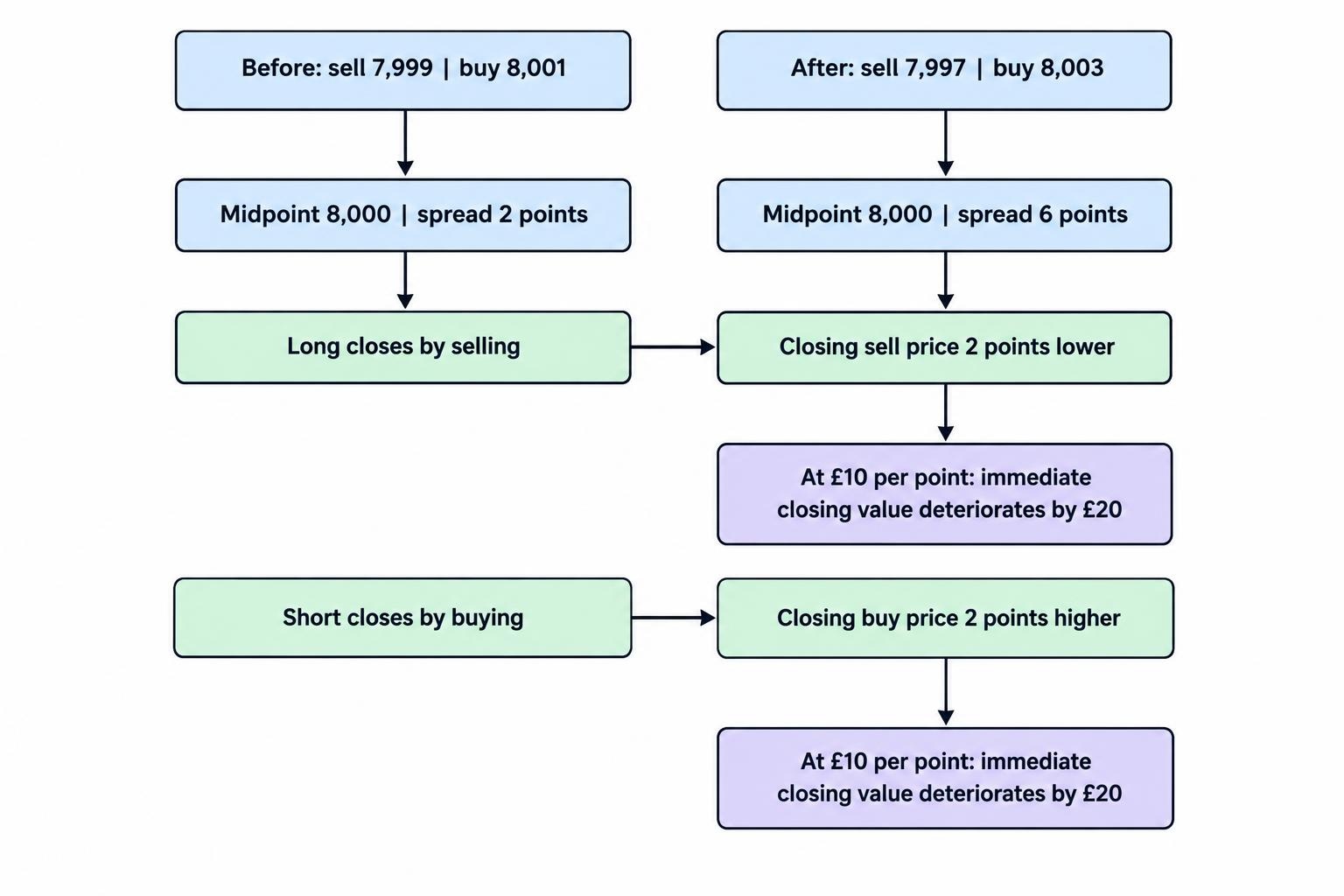
Spread widening can change that closing value without changing the midpoint. Suppose a quote moves from 7,999 / 8,001 to 7,997 / 8,003. The midpoint stays at 8,000, but the spread widens from two points to six.
A long position now has a sell price two points lower. A short position has a buy price two points higher. At £10 per point, either position’s immediate closing value deteriorates by £20, even though the midpoint has not moved.
This is separate from slippage, which is a difference between the expected execution price and the price actually received. A trade can face a wide spread, slippage, or both. For stop orders, also check which price triggers the order; do not assume the chart displays it.
What Counts as a Tight Spread?
A tight spread is a narrow gap between the buy and sell prices. Whether it is acceptable depends on the contract, your stake and the size of the price movement your trade requires.
Consider a two-point spread that remains unchanged. If both sides of the quote move ten points in your favour, the trade captures eight points before other charges. The spread absorbs 20% of that ten-point move. Against a forty-point favourable move, the same spread absorbs 5%.
This is why small price targets are sensitive to dealing costs. It does not make larger targets easier to achieve or justify holding a losing position for longer.
Nor does a two-point spread on one market automatically beat a three-point spread on another. Point definitions, stake sizes and price behaviour can differ. Compare equivalent exposure and cash costs, not just the displayed widths.
For positions held longer, include any applicable financing and other charges. A narrower spread does not necessarily produce a cheaper trade; the total spread betting cost comparison needs the intended holding period as well.
Checks Before Placing a Spread Bet
Before submitting an order, answer five questions:
- Which side opens the trade? Buying uses the higher price; selling uses the lower price.
- What is the live spread in betting points? Use the contract’s point definition.
- What does that represent in pounds? Multiply the spread by your stake.
- Which price must reach break-even? For a long, watch the closing sell price; for a short, watch the closing buy price.
- What could change before exit? Check spread conditions, trading sessions and separately applied costs.
These checks clarify the quote, not the probability of success. A narrow spread does not remove the risks of a leveraged position. Spread betting falls within the high-risk CFD products covered by the FCA’s guidance on contracts for difference.