UK financial spread betting is regulated by the Financial Conduct Authority (FCA). The rules cover how firms offer these products, the protections available to retail clients and the information providers must disclose. Regulation does not make a spread bet safe: you can still lose the money in your trading account.
Before depositing, establish which legal entity will hold your account, whether it has the right permissions and whether you will trade as a retail or professional client. Those details matter more than an FCA logo in a website footer.
Who regulates financial spread betting?
The FCA treats financial spread betting within its regulatory framework for contracts for difference and similar speculative products. Its regulatory requirements for CFD and spread betting providers include retail trading restrictions and warnings about firms encouraging customers to become professional clients or move to overseas entities.
A broker’s brand name is not enough to establish which rules apply. Read the account agreement and identify the contracting company. A group can operate through several companies, so do not assume that every account carrying the same logo receives the same protections.
Our guide to UK spread betting regulation covers the framework in more detail. This page focuses on the checks and protections that affect account selection and trading decisions.
What protections do retail clients receive?
The FCA’s retail rules in COBS 22.5 restrict the risks providers can offer and require safeguards at account level.
| Protection | Practical effect |
|---|---|
| Leverage restrictions | Maximum permitted exposure depends on the underlying asset. A provider cannot offer unrestricted borrowing power to retail clients. |
| Margin close-out | An account-level 50% margin threshold requires firms to close positions when funds fall below the applicable requirement. |
| Negative balance protection | Liability for covered trading is capped at the funds in the relevant trading account, rather than extending to an unrestricted debt. |
| Risk warnings | Providers must disclose the percentage of their retail accounts that lose money, subject to the prescribed calculation rules. |
| Restrictions on incentives | Providers cannot offer cash or other prohibited benefits to encourage retail trading. |
These protections do different jobs. Margin close-out governs when a provider must intervene. Negative balance protection addresses the account’s liability; it does not preserve the deposit or guarantee the execution price of an individual trade.
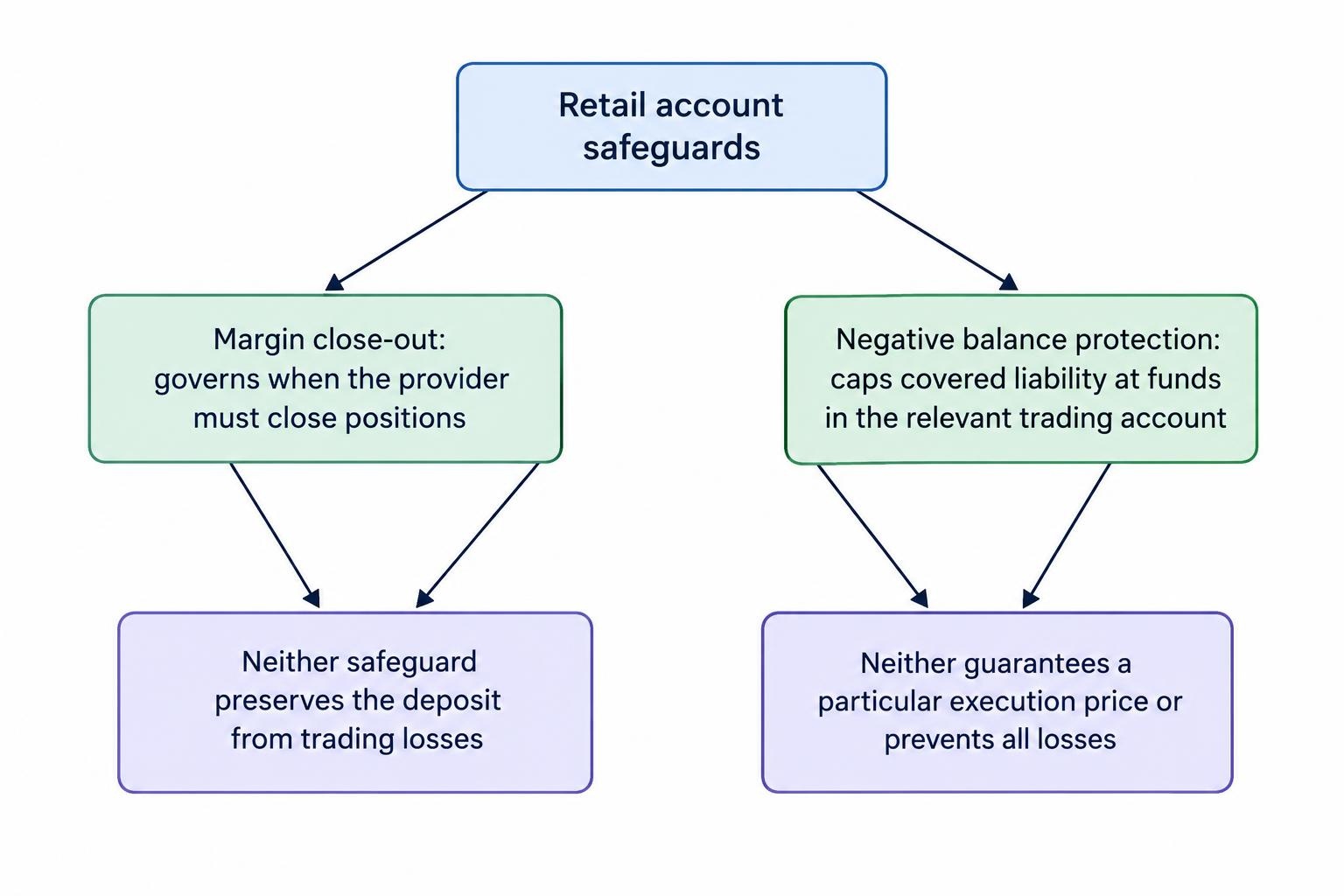
Consider an illustrative account containing £1,000. A planned £100 loss on one position is your trading decision, not a regulatory promise. Other positions, trading costs and adverse price movements can consume more of the account. Treat the amount deposited as money at risk, not money protected from trading losses.
The guide to retail client protections separates these safeguards and their boundaries. None replaces sensible position sizing or sufficient funds to support open trades.
How to check a spread betting broker
Use the FCA’s firm authorisation checks before opening an account. Check the firm’s permission for the service you need, not just whether its name appears in a search result. FCA registration and authorisation are not interchangeable.
- Identify the company. Find the legal name and firm reference number in the account agreement.
- Check its regulatory record. Confirm its status, relevant permissions and any restrictions.
- Match the contact details. Compare the domain and contact information with the FCA’s records before sending money or identification documents.
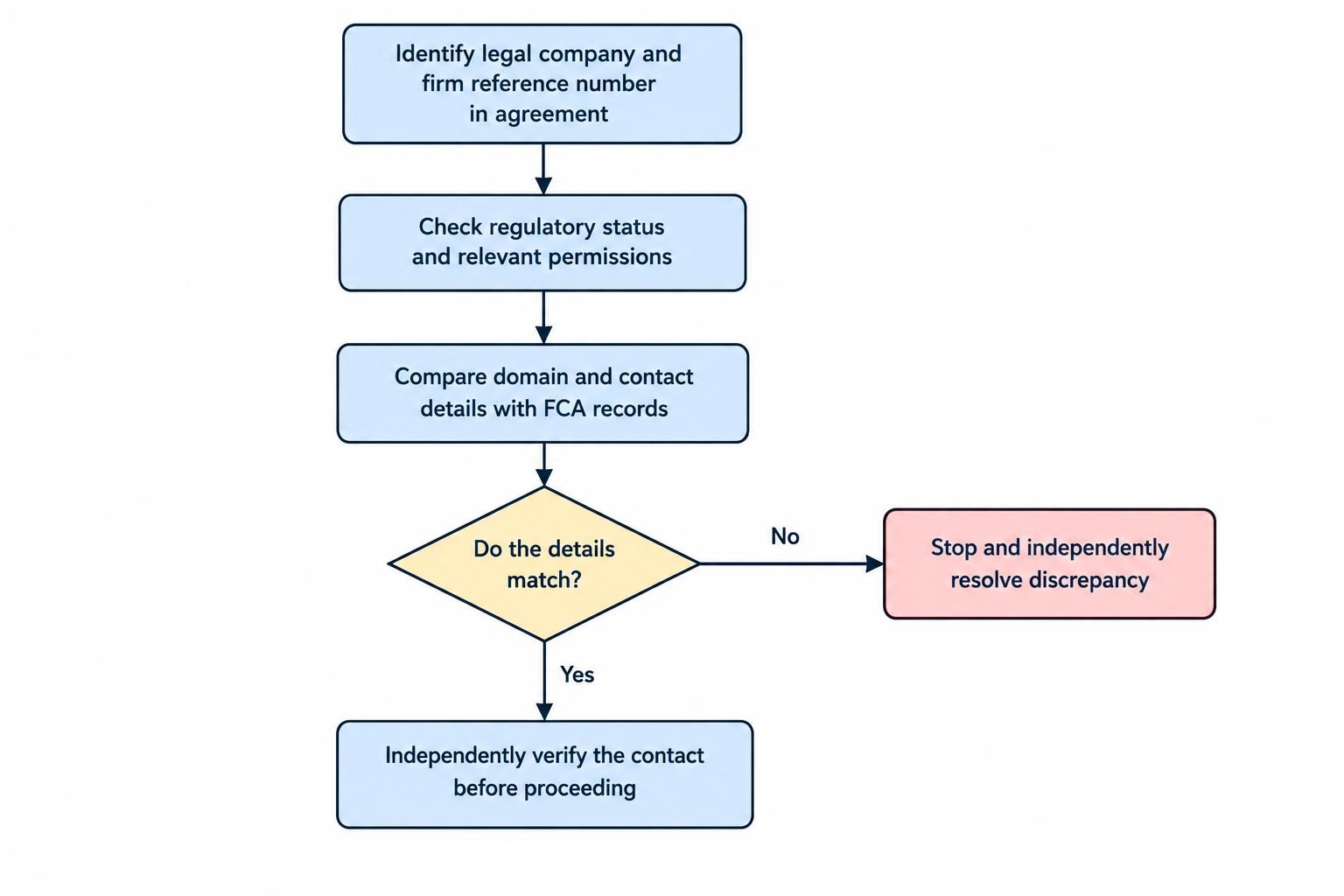
Clone scams can use the identity of a genuine authorised business. A matching company name or reference number therefore does not complete the check. If the contact details differ, stop and resolve the discrepancy independently.
Our walkthrough of checking a broker on the FCA Register covers the process. Keep a copy of the agreement you accept; it provides a useful record if the provider later changes its branding or contractual terms.
Retail and professional accounts are not interchangeable
Do not assess professional status solely through the attraction of higher trading exposure. Before agreeing to any change, ask the provider for a written comparison of the protections attached to each classification. Pay particular attention to account liability, margin arrangements and complaint eligibility.
The practical question is not whether the word “professional” sounds more suitable for an active trader. It is whether the contractual and regulatory differences are acceptable for that person’s circumstances. A larger position is still a larger position, whatever the account is called.
Use the comparison of retail and professional client classification before considering a change. Treat pressure to change classification or transfer to another group company as a reason to pause, not a deadline to meet.
What happens to your money if a broker fails?
Broker failure and a losing trade are separate problems. Before funding an account, ask how the firm holds client money, what arrangements would apply during insolvency and which compensation protections may cover an eligible shortfall. Request answers about your contracting entity rather than the wider group.
The FSCS investment compensation rules provide cover of up to £85,000 per eligible person, per firm for qualifying claims. Protection depends on the regulated firm, activity and circumstances. It is not an automatic payment whenever a trading provider encounters financial trouble.
The FSCS does not compensate poor investment performance. If a market move produces a valid trading loss, compensation protection does not reverse that result. Nor should several accounts with the same firm be treated as separate compensation allowances.
Read the guide to FSCS protection for spread betting accounts before relying on a compensation figure. Ask the provider to confirm the basis of any protection it advertises.
Are all spread betting markets permitted?
No. The FCA’s retail prohibition on cryptoasset derivatives prevents firms within its scope from selling, distributing or marketing covered crypto derivatives to retail clients. This includes relevant cryptocurrency spread bets; do not assume that access to another type of crypto investment permits access to a leveraged spread bet.
Check the cryptocurrency spread betting rules rather than relying on a platform’s market list. Product availability is not proof that an offer is lawful or suitable for your account.
How to raise a complaint
Complain formally to the provider first. Set out the disputed trade or account issue, relevant dates and the outcome you want. Preserve order confirmations, statements, correspondence and screenshots where available.
The Financial Ombudsman Service’s spread betting complaints process allows eligible complaints to be referred after an unsatisfactory final response, or if the firm has not issued one within eight weeks. The service can consider issues involving advice, stop orders and margin calls.
Distinguish a disputed service failure from disappointment with a trade. Explain what the firm did, why you dispute it and what evidence supports your position. Clear records are more useful than a long account of where the market should have gone.
Before you fund an account
Confirm the legal entity, permissions, client classification and account terms before comparing promotional features. Read the margin and closure provisions, ask how client money is held and locate the complaints procedure.
If a provider cannot give clear answers, postpone the deposit. Regulation provides a framework for protection and redress; it does not remove the need to check the firm or control the amount you put at risk.