Natural gas spread betting lets you take a position on rising or falling gas prices using a cash stake per point. You do not buy gas or arrange delivery. Your profit or loss comes from the movement between your opening and closing prices, multiplied by your stake, less any separate charges.
The arithmetic is straightforward. Choosing the right gas market, reading its point size and managing the exposure require more care. A trade labelled “Natural Gas” is not automatically a bet on British wholesale gas, and a small deposit does not mean a small potential loss.
This guide covers the gas market details that matter within commodity spread betting: benchmarks, pricing, contract types, weather, storage reports and practical trade sizing. All trading prices and account examples below are hypothetical, not live quotations.
Which natural gas market are you trading?
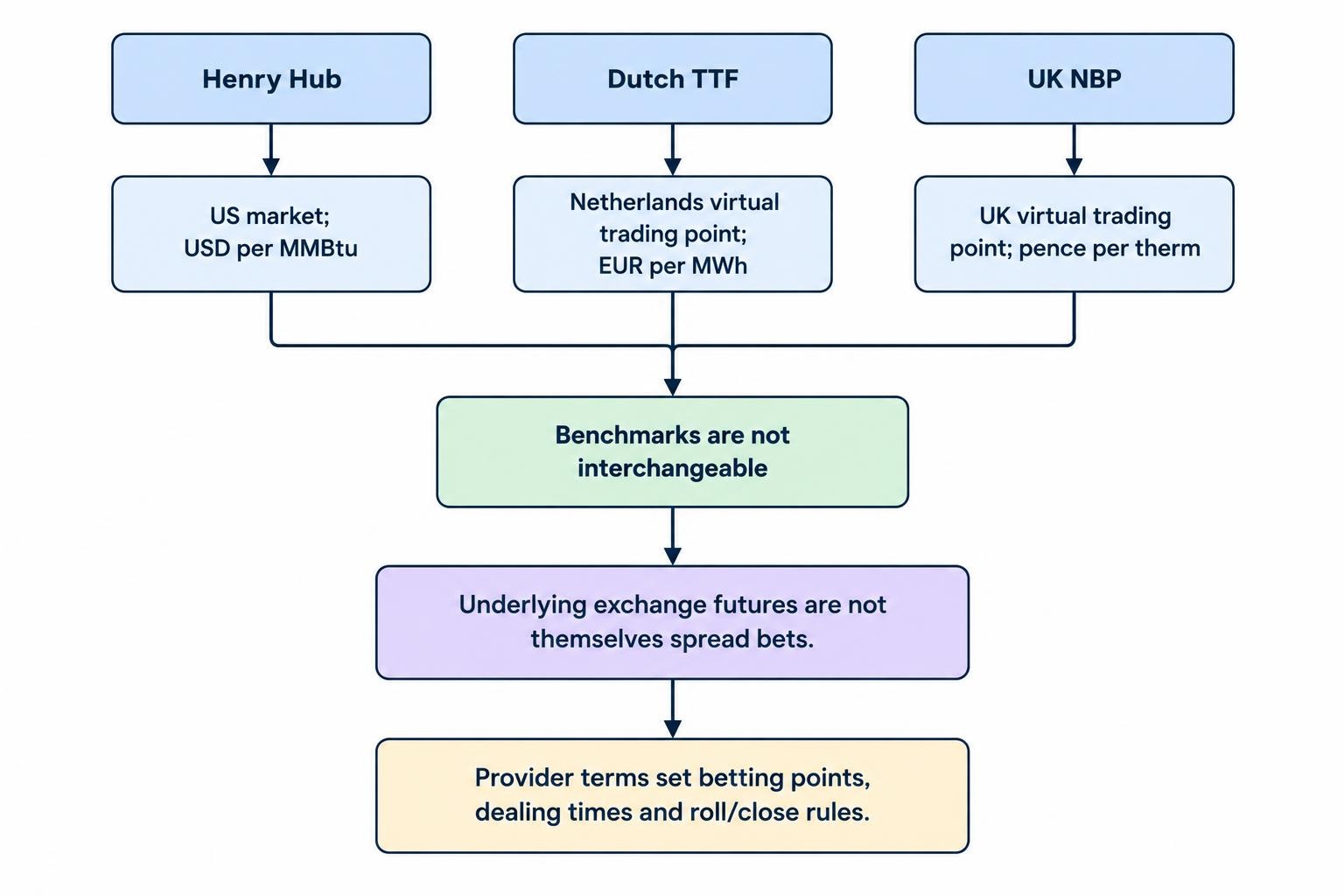
Start with the underlying benchmark. Henry Hub, Dutch TTF and UK NBP refer to different gas markets, quoted in different currencies and energy units. Their prices should not be compared simply by looking at the numbers on a screen.
| Benchmark | Market reference | Underlying futures quotation |
|---|---|---|
| Henry Hub | US gas delivered at Henry Hub in Louisiana | US dollars per million British thermal units, or MMBtu, under the CME Henry Hub natural gas futures rules |
| Dutch TTF | The Netherlands’ Title Transfer Facility virtual trading point | Euros per megawatt hour under the ICE Endex Dutch TTF futures specification |
| UK NBP | The UK National Balancing Point virtual trading point | Pence per therm under the ICE UK NBP natural gas futures specification |
These are underlying exchange contracts, not interchangeable spread betting products. Your provider determines which markets it offers, how it converts the underlying quotation into betting points and when its contracts close or roll.
Before analysing a chart, identify the benchmark and delivery month behind it. A view about European supply does not automatically justify a Henry Hub trade. Nor does a cold morning in Manchester provide much of a thesis for US gas.
Also distinguish the spread bet from the underlying futures contract. A cash settled spread bet does not give you the delivery obligations of an exchange futures position. The exchange rules help identify the reference market; the provider’s contract terms govern your actual bet.
Natural gas points, stakes and profit calculations
The most expensive reading error can be the smallest-looking one: misunderstanding what counts as a point.
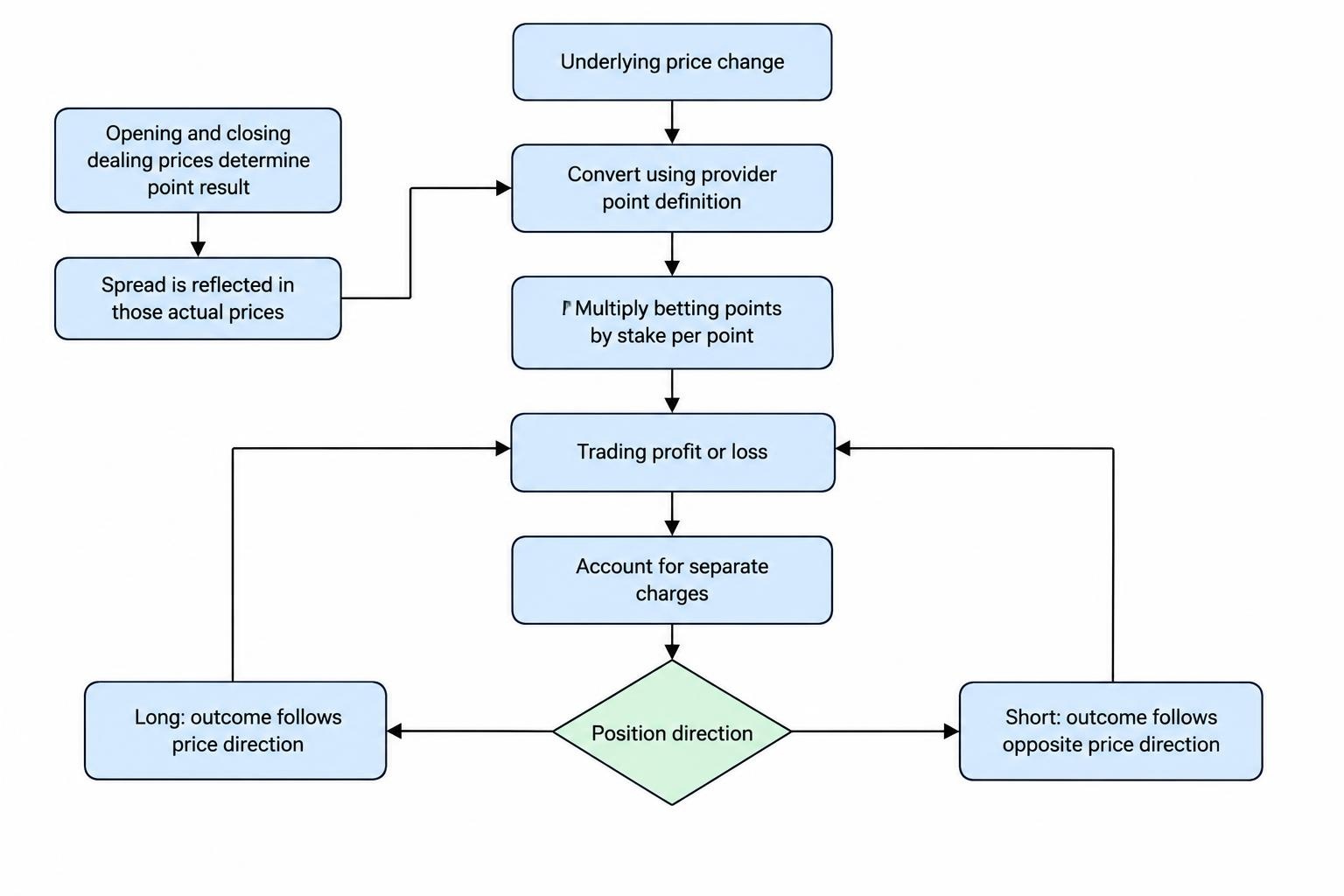
For the following example, assume a provider defines one spread betting point as a $0.001 movement in the underlying Henry Hub price. It displays $3.200 per MMBtu as 3,200 betting points. This is an illustrative convention, not a rule that every provider follows.
Under those assumptions, a move from $3.200 to $3.300 equals 100 points. At £2 per point, that movement changes the position’s value by £200 before separate charges. If a different product defines a point differently, the same underlying price move produces a different result.
Check the cash movement before placing the order
Read the contract’s point value, minimum stake and stake increments together. The useful question is not simply “What is the minimum bet?” It is “How much would this position lose if gas moved against me by this amount?” The stake per point calculation converts a price view into a cash exposure.
Keep three separate measures in mind: the underlying price change, the equivalent betting points and the pounds gained or lost. Mixing them can turn a modest-looking stake into a position far larger than intended.
Worked long and short examples
Assume an opening quote of 3,198 to sell and 3,202 to buy, equivalent to $3.198 and $3.202 under the convention above. The spread is four points. Each example uses a £2 stake per point.
| Position | Opening trade | Closing trade | Point result | Trading profit or loss |
|---|---|---|---|---|
| Long, price rises | Buy at 3,202 | Sell at 3,282 | +80 | +£160 |
| Short, price falls | Sell at 3,198 | Buy at 3,118 | +80 | +£160 |
| Long, price falls | Buy at 3,202 | Sell at 3,122 | −80 | −£160 |
A long position opens at the buy price and closes at the sell price. A short position does the reverse. Using the actual dealing prices already includes the spread in the result, so do not subtract it again.
At an unchanged opening quote, closing immediately would lose four points, or £8. Overnight adjustments, stop premiums and other separate charges would affect the final account result.
A pound denominated stake can express the trading result in pounds even though the reference gas price is quoted in dollars. Check the product’s currency terms rather than automatically applying a dollar conversion to the result a second time.
Rolling gas markets versus dated contracts
Your holding period should influence the contract you choose. A position intended to last an hour raises different cost questions from one intended to last several weeks.
Daily funded and rolling gas bets
For a rolling gas market, establish how the provider constructs its price. Does it reference one futures month, blend nearby months or use another published method? How does that reference change over time, and which adjustments appear on the account?
Do not assume a product labelled “cash” is a direct quotation for immediately deliverable physical gas. Read its pricing method before comparing its chart with an exchange futures chart.
The choice between daily funded bets and futures-style spread bets should reflect the intended holding period and the full charging schedule, not just the opening spread.
For an intraday position, the dealing spread and execution may dominate the cost calculation. For a position held through several adjustment times, daily charges or credits can change the result substantially.
Check the adjustment time, weekend treatment and any separate provider fee. The guide to overnight financing costs covers the broader calculation; for gas, also check whether the adjustment contains a futures curve component rather than treating every debit as ordinary interest.
Dated gas spread bets
A dated contract references a stated period and has an expiry or settlement process. Its charging structure may put more of the holding cost into the dealing price rather than a separate daily financing entry. That does not make it cost free.
Record the provider’s last dealing time, settlement basis and rollover instructions before opening. Do not substitute an exchange expiry date for the provider’s deadline. The general mechanics of spread betting expiry dates apply, but the gas contract schedule supplies the actual dates.
A rollover also needs careful interpretation. If the next contract trades above the expiring one, switching reference months does not create a free gain. The closing and reopening prices, account adjustments, stake and transaction costs must be considered together.
What moves natural gas prices?
Gas prices respond to production, storage, imports, exports and demand. Cold weather can increase heating demand; hot weather can increase gas use for electricity generation through air conditioning demand. Severe cold can also disrupt production. Storage helps bridge changes in supply and consumption, with US inventories generally building during the warmer months and falling during the winter heating season. These relationships are covered in the EIA’s analysis of natural gas price drivers.
For trading purposes, the useful question is how new information changes the expected balance for the market and month you hold. “Gas demand is high” is a description. A trade thesis needs a comparison with what the price already appears to anticipate.
Weather revisions matter more than seasonal slogans
“Buy gas before winter” is not a complete trading plan. It leaves out the entry price, the contract month, the weather already expected and the conditions that would invalidate the position.
Consider a hypothetical forecast change. A trader buys because a cold spell is expected to last two weeks. A later forecast keeps the first few cold days but removes most of the second week. The forecast can still look cold while becoming less supportive of the original trade.
Track revisions against the assumptions behind your position. Avoid treating a weather map as a buy or sell signal without checking its region, forecast period and relevance to the contract.
Production and LNG can pull regional prices apart
Liquefied natural gas, or LNG, links regional markets through export demand and cargo movements. US exports connect domestic gas consumption at export terminals with overseas demand, creating another channel through which international events can affect Henry Hub. CME’s research on US LNG exports and gas trading examines that connection.
This creates a possible split in price effects. Consider a hypothetical US export terminal outage: reduced purchases of US feedgas could weaken domestic demand, while missing export cargoes could tighten supply for overseas buyers. That is a conditional trading scenario, not a forecast that both prices must respond in those directions.
For any outage headline, ask what stopped operating, which flows changed and how long the disruption might last. “Gas supply problem” is too vague to size a position around.
Read the futures curve, not just the nearest price
The futures curve shows prices across delivery months. If a nearby contract is hypothetically $3.200 and a later one is $3.450, they are prices for different delivery periods, not two simultaneous quotations for the same exposure.
A later price above a nearby price is called contango; the reverse is backwardation. These terms describe the relationship between contracts. They do not, by themselves, predict where your position will settle.
Check whether your chart changes contract month during the period being analysed. A jump between reference contracts can distort a comparison with your actual entry, especially if you mistake a continuous chart for one unchanged tradable contract.
Trading around the EIA gas storage report
The US Weekly Natural Gas Storage Report normally arrives on Thursdays at 10:30 a.m. Eastern Time, with exceptions around certain holidays. Check the EIA natural gas storage release schedule before trading and convert the listed time for your location rather than relying on a saved calendar entry.
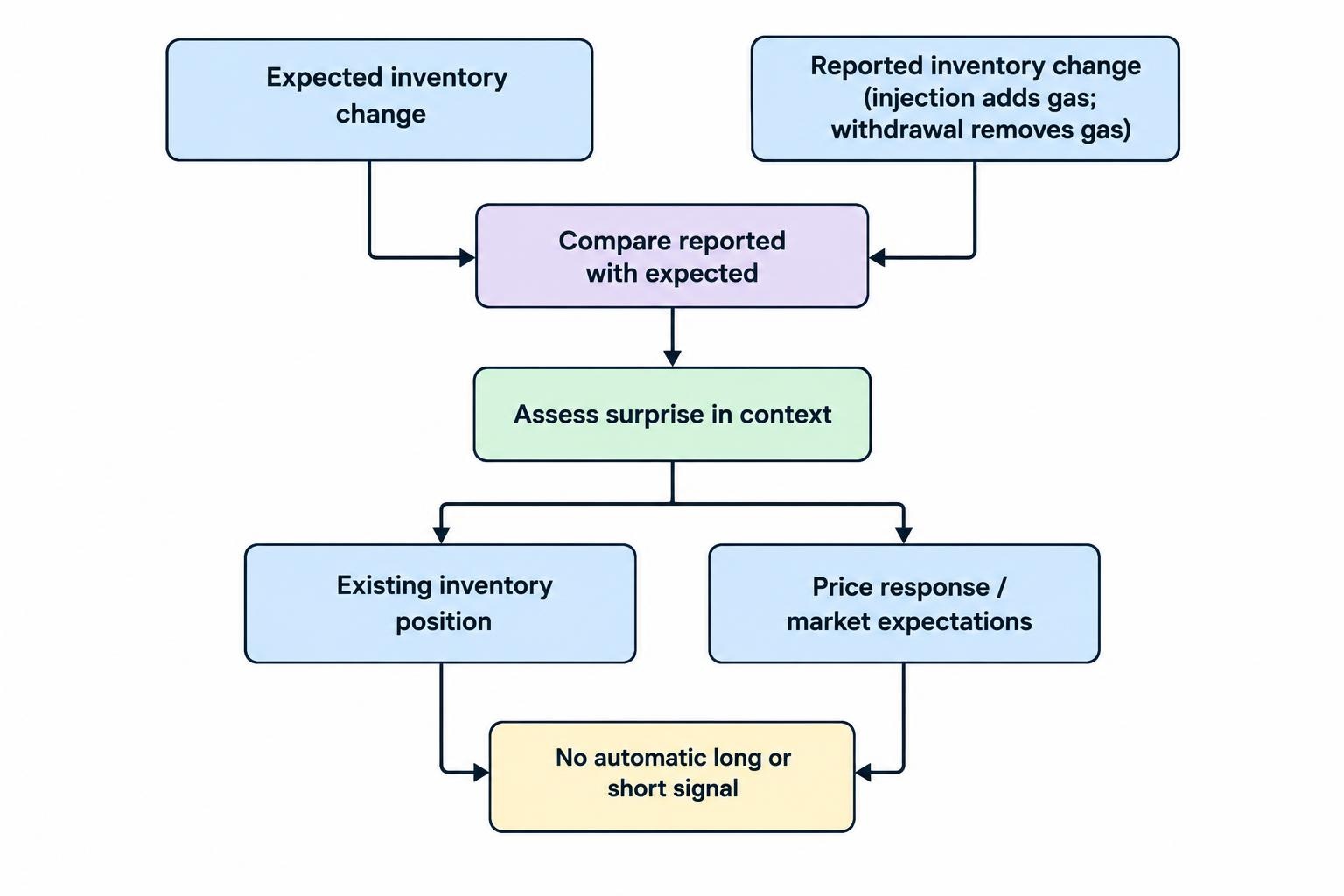
For a Henry Hub trade, prepare a view of both the expected storage change and the existing inventory position. An injection adds gas to storage; a withdrawal removes it. Neither word, on its own, tells you whether a release supports a long or short position.
Suppose traders expect a hypothetical 70 billion cubic feet injection and the reported increase is 55 billion. Storage has risen, but by less than expected. That could support a tighter supply and demand interpretation than the headline “inventories increased” suggests.
The opposite error is treating every smaller injection or larger withdrawal as an automatic buying opportunity. Price, expectations and the wider inventory balance still matter. A release can also challenge a thesis without providing a sensible entry at the first available quote.
Decide beforehand whether you will hold through the announcement, reduce the position or stay out until dealing conditions settle. Set a maximum acceptable spread and avoid improvising a much larger stake after the first move.
The practical problems overlap with news trading with spread bets: reacting quickly does not guarantee a favourable fill, and a stop order does not promise execution at its trigger price. Record the expected figure and your planned response before release, then compare the actual outcome with that plan.
Margin is not your natural gas risk budget
For UK retail accounts covered by the FCA rules, natural gas sits within commodities other than gold: opening margin must be at least 10% of exposure, equivalent to a maximum 10:1 exposure-to-margin ratio at that minimum. The rules also require account level close-out below 50% of required margin as soon as market conditions allow, and negative balance protection for the relevant account funds. These are account protections, not a promise that initial margin is the most a trade can lose. See the FCA rules on retail margin and negative balance protection.
Under the earlier illustrative point convention, a price of 3,200 points at £0.50 per point represents £1,600 of exposure. A 10% margin calculation produces £160. A provider may require more, but neither figure tells you whether the trade fits your planned loss allowance.
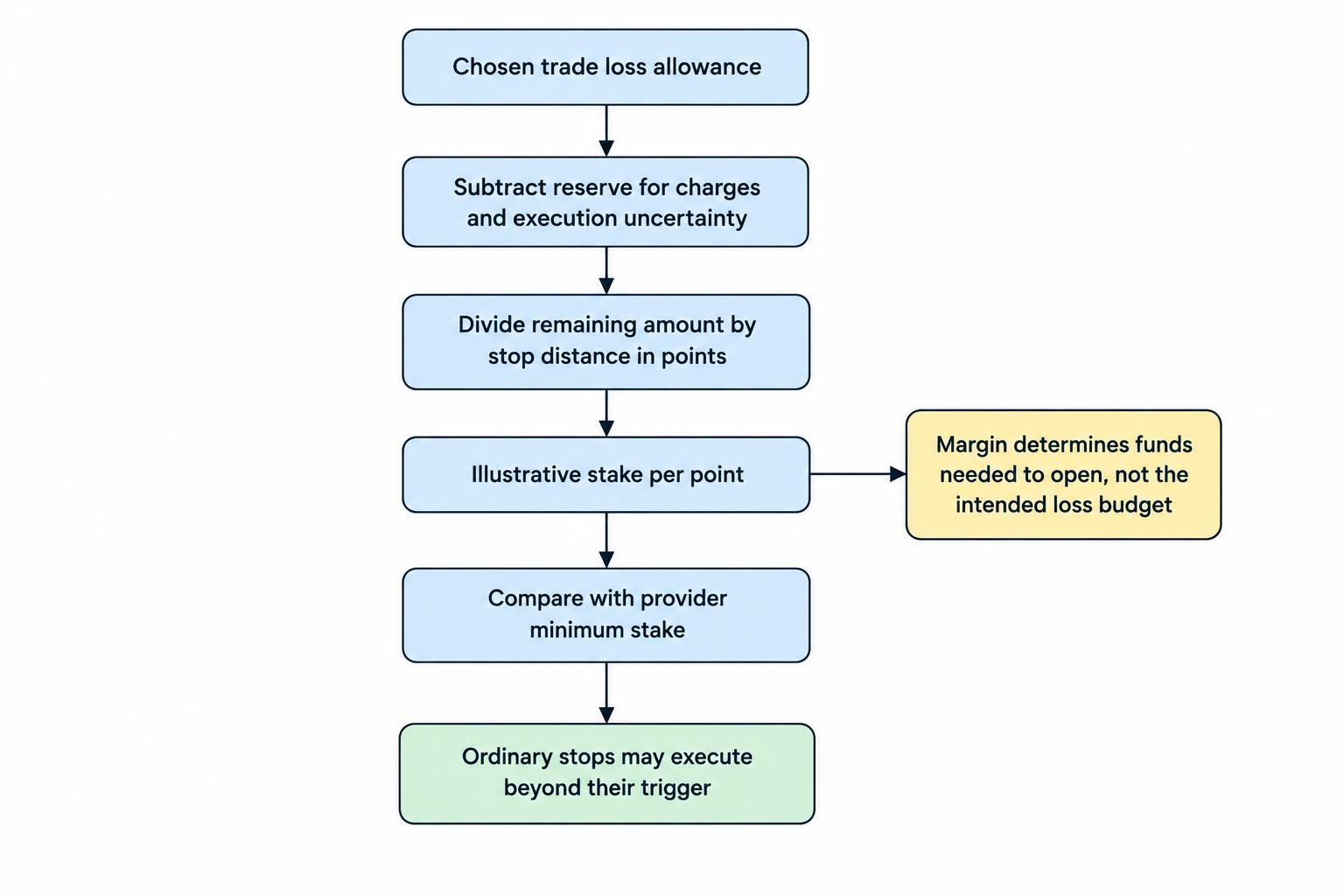
The cash needed to open a position and the cash you are prepared to lose answer different questions. Build the stake from the second question, then check that the account can support the margin and adverse movement.
Size the stake from a realistic exit distance
Assume a hypothetical £10,000 account and a chosen £50 trade loss allowance. This is an illustration, not a recommended risk percentage. Suppose the planned stop is 80 points from the entry and you reserve £10 for charges and execution uncertainty.
Illustrative stake = (£50 − £10) ÷ 80 points = £0.50 per point.
The price loss at the intended stop would be £40, leaving the £10 allowance. If the minimum stake were £1 per point, the same setup would imply an £80 price loss before separate costs. The account can afford the deposit, perhaps, but the trade no longer fits that loss plan.
Use position sizing for spread betting to calculate the stake after selecting a defensible exit. Moving a stop closer simply to fit the provider’s minimum stake changes the trade rather than solving the sizing problem.
Allow for gaps and stop execution
An ordinary stop is a trigger, not a guaranteed closing price. If an intended 80 point exit becomes a 120 point loss, a £0.50 stake loses £60 before separate charges. A planning allowance cannot turn uncertain execution into a fixed maximum loss.
Where available, a guaranteed stop can provide a defined execution price subject to its terms and premium. Check market availability, minimum distance and charging conditions rather than assuming every gas product supports it. The guide to managing risk with guaranteed stops covers those trade-offs.
Check combined exposure too. Two gas positions with different names or expiries are not automatically independent trades. Their shared drivers belong in your portfolio correlation assessment, alongside the cash loss each position could produce.
Match the trading approach to the contract
Intraday trades
An intraday plan should define the event or price behaviour being traded, the invalidation level and the latest intended exit time. Avoid letting a short trade become an overnight position because closing it would recognise a loss.
Compare the spread with the intended target. A hypothetical four point spread consumes one fifth of a 20 point gross target before any other cost or execution error. The same spread matters less relative to a 100 point target, although the wider target may require a different stop and holding period.
Volatility should inform the setup, not justify a larger stake. Average True Range analysis can help compare recent trading ranges with your proposed stop distance. It cannot forecast the next range or tell you that a stop outside a recent average is safe.
Trades held for several days
A longer trade needs a reason to remain open after the entry signal has passed. That might be a conditional view about weather revisions, storage expectations or an outage. Write down what new evidence would weaken that view.
For a hypothetical long based on persistent cold, the review questions could include whether the forecast duration has shortened, whether the relevant demand regions remain affected and whether the contract is approaching its provider deadline.
The principles of swing trading with spread bets still apply: define the holding period, review the thesis and include holding costs. With natural gas, keeping the same market name on screen does not remove the need to check which delivery period supports its price.
Neither approach becomes sound simply because gas is moving. A market can offer plenty of movement and still offer no acceptable trade at your stake, spread and exit distance.
What to check in a provider’s gas specification
Compare providers at the contract level rather than choosing from a headline spread alone. The commodity spread betting broker guide provides the broader comparison framework; for natural gas, use the following checks.
- Benchmark and month: identify the underlying gas market and the delivery period used for pricing.
- Point definition: convert an underlying price move into betting points and cash before entering.
- Minimum stake: confirm that the smallest permitted position fits a realistic stop distance.
- Holding adjustments: check daily charges, credits, pricing adjustments and dated contract costs.
- Exit terms: read stop restrictions, guaranteed stop availability, expiry and rollover instructions.
- Trading access: check dealing sessions, scheduled interruptions and holiday changes.
For session planning, distinguish the underlying exchange timetable from the provider’s dealing hours. Check the actual product schedule rather than assuming continuous access; the commodity trading hours guide covers that distinction.
Also verify the contracting entity and your client classification. The app’s brand is not a substitute for checking the firm that holds the account. Follow the steps for checking a broker on the FCA Register before funding.
Common natural gas spread betting questions
Is spread betting the same as trading a gas calendar spread?
No. Financial spread betting is the product through which you take a cash stake per point. A gas calendar spread is a position in the price difference between delivery periods, typically involving opposing exposures to two months. The shared word “spread” does not make them the same trade.
Can a gas spread bet hedge a household energy bill?
Do not assume it provides a reliable match. First establish which wholesale benchmark, period and price movement would offset the bill exposure. A Henry Hub position is not automatically a hedge for a UK household, and a trading loss can arrive before any hoped-for offset. Without a measured relationship and suitable sizing, it is speculation alongside the bill rather than a dependable hedge.
Does a small minimum deposit make gas trading suitable for a small account?
Not necessarily. The binding constraint may be the minimum stake multiplied by a sensible stop distance, not the deposit requirement. If that cash exposure exceeds your chosen loss allowance, depositing just enough margin does not fix it.
Before opening a natural gas position
You should be able to state the benchmark, reference month, point value, cash stake, intended exit and holding costs without searching through the platform after entry.
Then test the uncomfortable version of the trade: the forecast changes, the report surprises, the spread widens or the market passes through the stop. If the resulting cash exposure is unacceptable, reduce the stake or leave the trade alone. A view on gas prices is not yet a position plan.