A spread betting account statement records what happened to your account over a reporting period: money paid in or withdrawn, trades opened and closed, charges, adjustments and positions still running. Reading it properly means separating those movements rather than treating every increase in your balance as trading profit.
The most useful check is straightforward: can you explain how the opening balance became the closing balance, then reconcile that figure with your account equity? This guide covers the entries to examine, a worked reconciliation and the differences that can make a correct statement look wrong.
Start with the account and reporting period
Before checking individual trades, confirm the account number, account currency, reporting dates and broker’s legal entity. If you hold separate spread betting and CFD accounts, make sure you have downloaded the right statement. Transfers between them are funding movements, not trading returns.
Check the statement’s cut-off time and time zone too. A trade placed late in the evening may fall into a different reporting day from the one you expected. Compare figures at the same timestamp; a historical statement and a live trading screen are not measuring the same moment.
Keep three records distinct: the transaction history shows activity during the period, the open-position summary shows exposure remaining at the cut-off, and individual trade confirmations record executions. FCA rules require applicable execution confirmations to contain details including the instrument, trading time, buy or sell indicator, quantity, price and relevant charges. These fields provide a useful cross-check against the FCA requirements for trade confirmations.
Cash balance, equity and available funds are different figures
Statement labels vary between providers. Use the definitions supplied for your account rather than assuming that “balance”, “account value” and “funds” mean the same thing.
| Statement entry | What it usually represents | What to check |
|---|---|---|
| Cash balance | Posted cash after funding movements, realised trading results, charges and adjustments. | Whether any unsettled or accrued amounts sit outside this figure. |
| Realised profit or loss | The result booked when a position, or part of it, closes. | Whether the reported result includes separately listed costs. |
| Unrealised profit or loss | The valuation of positions still open at the statement cut-off. | The valuation time, price basis and treatment of accrued charges. |
| Equity or account value | Cash balance adjusted for open-position profit or loss and any other amounts included by the provider. | Which adjustments the account definition includes. |
| Used margin | Funds allocated to support open positions. | Whether pending orders also reserve funds. |
| Available funds or free margin | Funds remaining after the account’s margin requirements and other reservations. | Whether this differs from the amount available to withdraw. |
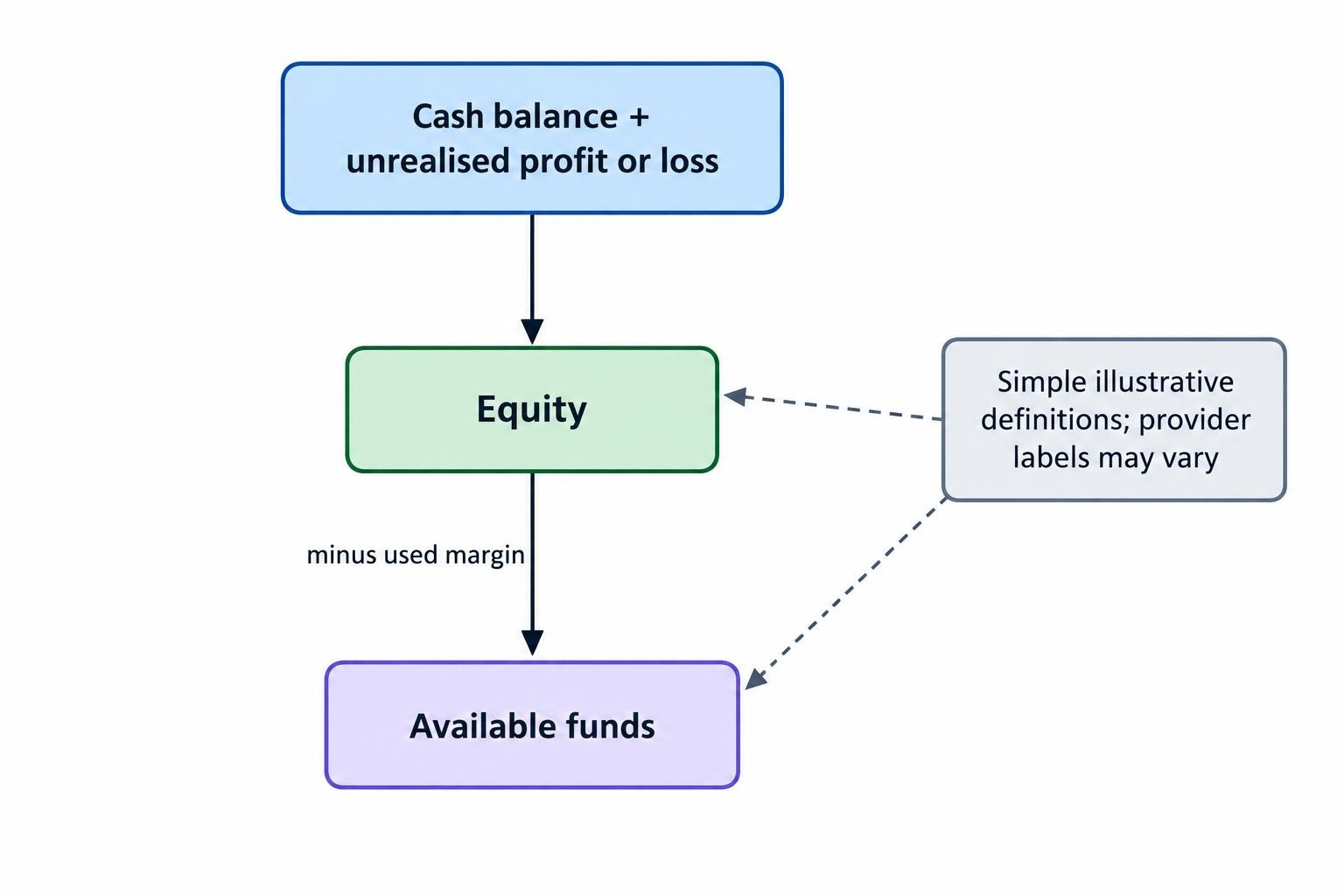
For a simple account with no separate accruals or reservations, equity equals cash balance plus unrealised profit or loss. Available funds then equal equity minus used margin. Treat these as reconciliation formulas, not universal definitions for every platform.
Margin is collateral, not a trading expense. Allocating £1,200 to margin does not itself create a £1,200 loss. Closing the position may release that allocation, but any trading loss remains. The distinction is covered further in how spread betting margin works.
Nor should available funds automatically be treated as withdrawable cash. Check the provider’s withdrawal figure and any pending payments or other account restrictions before requesting a transfer.
How to read the trade entries
Match each execution using its deal reference, market name, direction, stake per point, execution price and timestamp. Similar market names can represent different contracts, such as a daily funded index bet and a dated contract on the same index.
A “sell” entry does not necessarily mean you opened a short position. It may close an earlier buy. Likewise, a buy can close a short. Follow the position reference and opening or closing designation rather than reading each line in isolation.
Suppose a hypothetical index position opens with a buy at 8,002 for £2 per point and closes with a sell at 8,032. The trading result is:
(8,032 − 8,002) × £2 = £60 profit before separately booked costs.
Use the actual execution prices, not the chart’s mid-price or the price requested on an order ticket. Also check the contract’s point convention; a displayed decimal movement does not necessarily equal one chargeable point. The guide to calculating spread betting profit and loss covers the arithmetic for long and short positions.
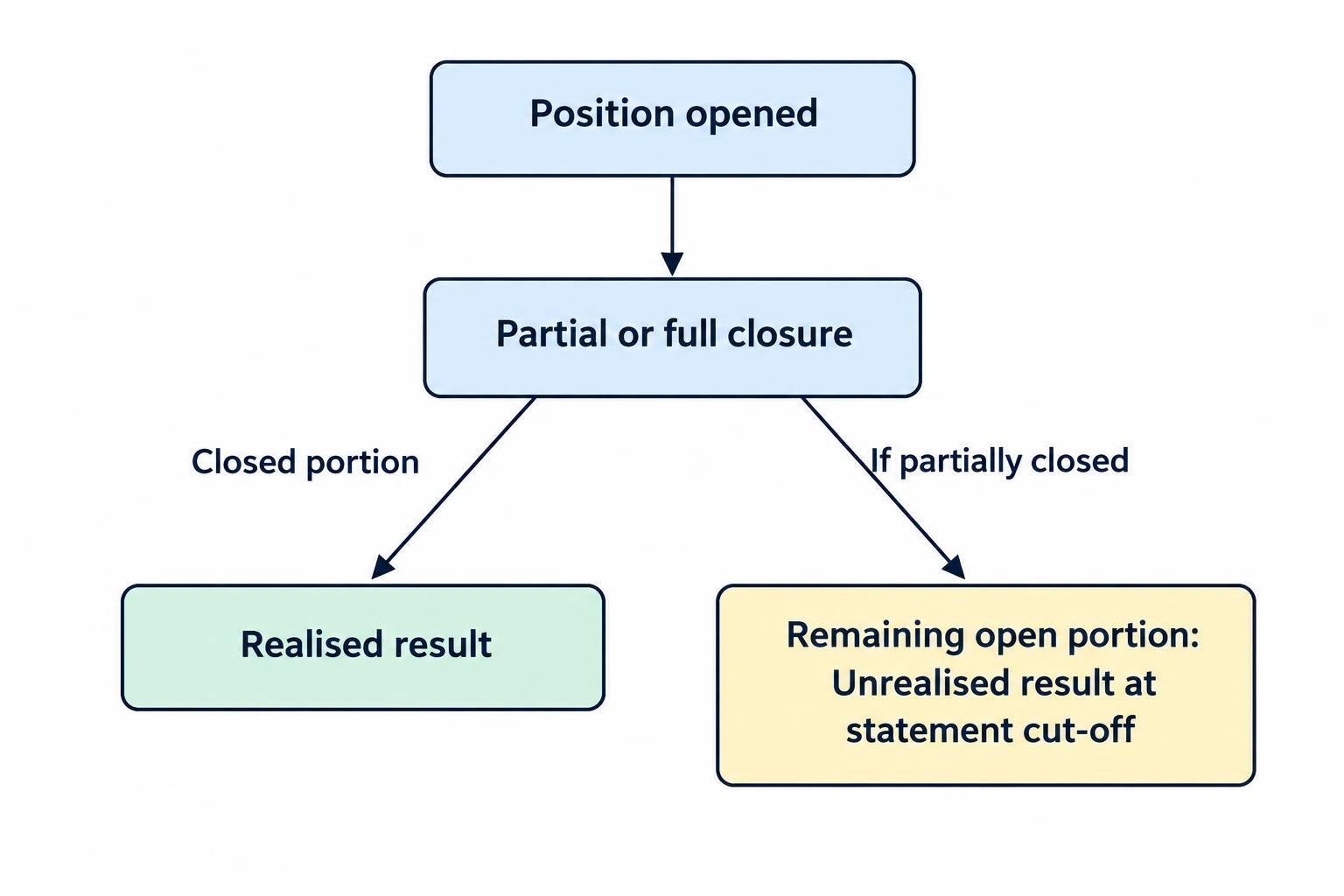
Partial closures need extra care. If you open at £3 per point and close £1 per point, only that closed portion produces a realised result. The remaining £2 per point stays open. Several execution rows may therefore belong to one trading decision, while a single position may produce several realised results.
A worked account statement reconciliation
Consider this illustrative monthly statement for a sterling account. The account starts with no open positions, all charges shown have been posted, and there are no separate accruals or pending payments.
| Cash ledger entry | Amount |
|---|---|
| Opening cash balance | £5,000 |
| Deposits | +£1,000 |
| Withdrawals | −£400 |
| Net realised trading profit before separate charges | +£240 |
| Financing charges | −£36 |
| Dividend adjustments | +£12 |
| Other separately booked fees | −£6 |
| Closing cash balance | £5,810 |
The cash ledger reconciles as £5,000 + £1,000 − £400 + £240 − £36 + £12 − £6 = £5,810.
Now suppose the remaining open positions show an unrealised loss of £180 and require £1,200 of margin. Closing equity is £5,810 − £180 = £5,630. Under the simple definitions used here, available funds are £5,630 − £1,200 = £4,430.
The account has not made £810 just because its cash balance rose by that amount. Net deposits contributed £600. The remaining £210 is the booked result after the listed charges and adjustments.
Including the open loss, the period’s account result is only £30:
Closing equity £5,630 − opening equity £5,000 − deposits £1,000 + withdrawals £400 = £30.
This is a cash amount, not a percentage return. Calculating a return when money enters or leaves during the period requires a method that accounts for those cash flows and their timing.
For an account that already had open positions at the start, use opening equity rather than opening cash balance. Otherwise, you risk counting profit or loss from an earlier period as part of the current one.
Checking charges and account adjustments
Spreads and separately posted fees
The spread affects your entry and exit prices. It does not need to appear as a separate debit to cost you money. If your calculation already uses the actual buy and sell executions, do not subtract an estimated spread again.
Apply the same discipline to commissions, stop premiums or other charges: establish whether they are included in the trade result or posted separately. “Net profit” is only useful once you know what it is net of.
Financing entries
Match financing debits or credits to the relevant positions, holding dates and charging terms. Check the applicable rate, calculation base and number of days charged. Do not assume that the amount must equal a percentage of the margin deposit.
A charge covering several days can look excessive if you compare it with one day’s calculation. Equally, a recurring small debit can become a substantial cost across a month. Keep the reconciliation separate from the decision about whether the holding period makes economic sense; the overnight financing cost guide examines that calculation.
Dividend and currency adjustments
A dividend adjustment is a contractual account adjustment, not evidence that you own the underlying shares. Check the affected market, eligible position size, direction and adjustment date. Long and short exposures can produce opposite cash entries. See spread betting dividend adjustments for their effect on positions.
For currency entries, distinguish the market’s quotation currency, your stake currency and the account’s reporting currency. A dollar-priced market does not, by itself, prove that the trading result needed conversion into sterling. Where a conversion does occur, check the original amount, exchange rate and any separately disclosed charge.
Expiry, rollovers and corrections
A dated position may close at expiry rather than through a manual instruction. Check the contract month and settlement terms before treating an unfamiliar closure as an error.
Where a rollover closes one contract and opens another, the statement can show a realised result alongside a new position at a different price. That price difference is not automatically an additional profit or loss. Reconcile the closure, replacement position and any rollover charge separately. The guide to spread betting expiry dates covers the contract lifecycle.
Corrections need the same line-by-line treatment. If an entry is reversed and replaced, count the final economic effect rather than adding both the original and replacement amounts. Keep the broker’s explanation with the statement so that a later review does not turn the same correction into a fresh mystery.
Why the statement may differ from your trading screen
The first thing to check is timing. A statement records a cut-off; the screen may show prices and account movements that occurred afterwards. Even when both display today’s date, they may refer to different times.
Next, compare like with like. A chart price may differ from the price used to value an open position. A trading dashboard may show gross trade results while the cash ledger includes financing and adjustments. A pending deposit may appear in one view before it becomes a posted transaction.
An annual costs statement is another separate document. Where the relevant ongoing-service condition applies, FCA rules require personalised annual disclosure of costs actually incurred and permit that disclosure to accompany existing periodic reporting. The FCA costs and charges disclosure rules distinguish this reporting from the transaction ledger.
Do not deduct that annual cost total from your closing balance again. First establish which amounts are already reflected in executions or cash entries, and whether the reporting periods match.
A practical statement review routine
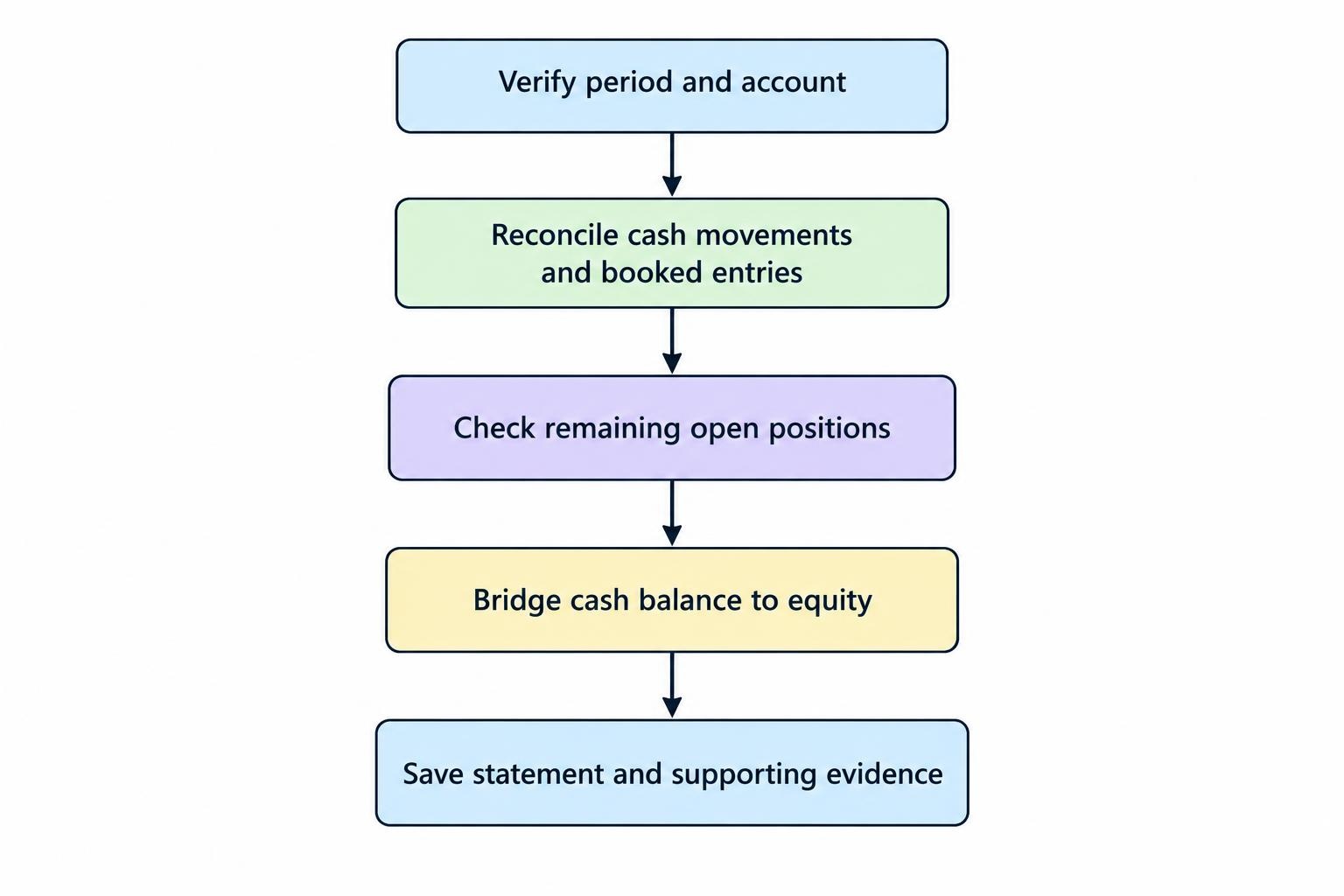
Review statements regularly, not only when something looks wrong. A short, repeatable process makes discrepancies easier to isolate:
- Verify the period: confirm the account, currency, dates and valuation time.
- Reconcile cash: match deposits and withdrawals, then total realised results, posted charges and adjustments.
- Check remaining exposure: compare open positions, stakes and unrealised results with your records.
- Bridge cash to equity: account for open-position valuations and any separate accruals.
- Save the evidence: retain the statement, transaction export and explanations for unusual entries.
Use a PDF for the statement record and a transaction export, where available, for calculations. Preserve the original files before editing a spreadsheet. The spread betting record keeping guide covers organising supporting documents.
If a difference remains, contact the broker with the deal reference, date, amount, your calculation and the explanation you need. Ask for the execution or charge breakdown rather than sending only a screenshot of the account total. If the issue becomes a formal dispute, follow the spread betting complaints process.
The aim is an explainable account: every cash movement reconciled, every open position identified and no cost counted twice. A rising balance can look reassuring, but the statement should show whether trading earned the increase or you funded it yourself.