Day trading with financial spread betting means opening and closing speculative positions within a single market session, using a stake per point to profit or lose from short-term price movements. You can buy (go long) when anticipating a price rise or sell (go short) when anticipating a fall, without taking physical ownership of the underlying asset. Positions can last seconds, minutes or several hours, but the defining rule is finishing the session completely flat. For active traders, the primary appeal is a defined decision window and total insulation from overnight holding risks. The operational challenge is capturing intraday price moves large enough to overcome bid-ask spreads, slippage and execution friction while keeping trade-level losses mathematically controlled.
Spread betting platforms make opening an intraday trade mechanically instantaneous, but dealing simplicity should never be confused with low risk. Modest nominal price movements create substantial cash gains or losses when leverage and stake size are misaligned, and frequent trading rapidly compounds transaction costs. The Financial Conduct Authority (FCA) regulates spread betting under its retail CFD regime, classifying these leveraged derivatives as complex, high-risk financial products. This guide details how intraday spread betting works, who the approach suits, the mathematical friction of daily dealing, and how to execute an auditable intraday trading plan.
Core Principles of Intraday Spread Betting
-
1
Strict Session Liquidation: Close all active tickets before market close (typically 22:00 UK) to eliminate overnight funding and gap risk.
-
2
Spread Friction Awareness: Focus on ultra-liquid instruments (FTSE 100, EUR/USD) where narrow spreads do not consume intraday profit targets.
-
3
Stake Calculated from Stop Distance: Never use arbitrary stakes; derive £/point directly from cash risk divided by stop distance in points.
-
4
HMRC Tax-Exempt Status: UK retail profits are exempt from Capital Gains Tax and Stamp Duty, but losses cannot offset other income.
What Counts as Day Trading?
Day trading is a holding-period discipline, not a standalone technical entry signal. An intraday trader may execute trend-continuation setups, range breakouts, statistical mean reversions or trade high-impact macroeconomic releases, provided every position is closed before the platform’s session cut-off. Scalping represents a sub-discipline focused on micro-ticks over seconds, whereas swing trading deliberately holds exposure across multiple days. A disciplined trader taking a single setup during the London morning open is day trading just as much as an active participant placing ten orders. Defining your session parameters—including an invalidation cut-off time for new orders and a hard liquidation deadline—is essential to prevent intraday trades from drifting into unmanaged overnight positions.
How a Day Trade Works on a Spread Betting Account
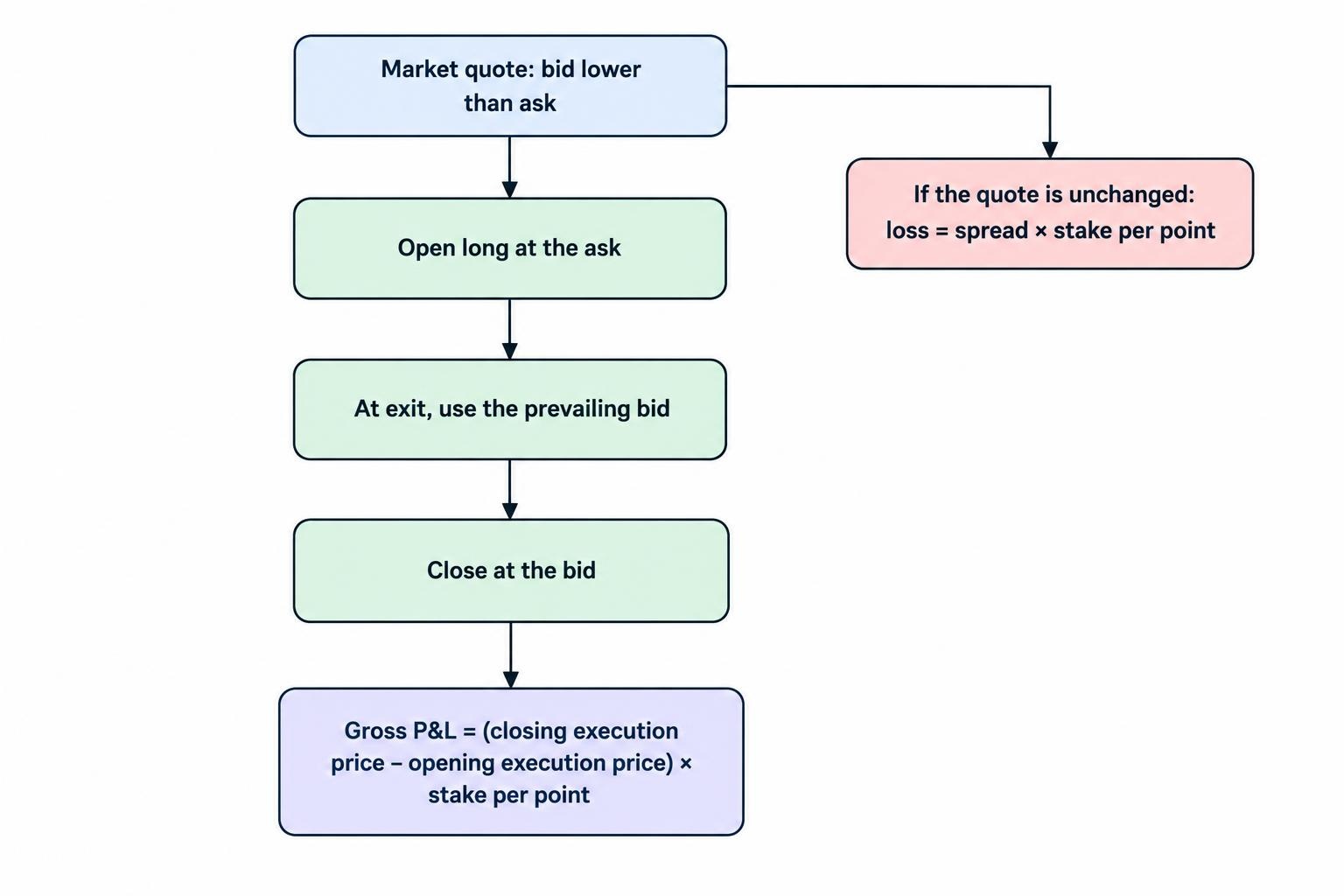
Brokers provide two-way pricing: a lower sell price (bid) and a higher buy price (offer or ask). If a stock index is quoted at 8,000 / 8,002, a long trade enters at the offer of 8,002 and exits at the prevailing bid. A short trade enters at the bid of 8,000 and buys back at the prevailing offer. Gross profit or loss is calculated directly as:
(Closing Execution Price − Opening Execution Price) × Stake per Point = Gross P&L
At a £1-per-point stake, every one-point move in the quoted contract generates a £1 gain or loss. This makes verifying the exact contract point definition crucial: an index point, an FX pip (0.0001) and a penny of equity price change represent vastly different economic exposures.
The bid-ask spread creates an immediate initial deficit upon execution. Entering at 8,002 and immediately closing at an unchanged bid of 8,000 locks in an automatic two-point loss (£2 at £1/pt). The market must move past the spread in your favor before any net profit accrues. When auditing performance using actual executed fills, the spread is already embedded in the P&L and must not be deducted a second time. Platform margin is locked to maintain the trade, but remember that margin requirements do not define maximum possible risk.
Which Markets Are Used for Intraday Spread Betting?
Major equity indices (FTSE 100, DAX 40, S&P 500, Nasdaq 100) and liquid forex pairs (EUR/USD, GBP/USD, USD/JPY) serve as the standard foundation for intraday trading due to their deep liquidity, tight spreads and reliable volume. Individual equities, crude oil and gold also offer substantial intraday volatility, but introduce unique operational risks. Single shares carry unsystematic corporate event risk; energy markets react abruptly to weekly inventory figures; and forex pairs are sensitive to central bank rhetoric. Always inspect dealing spreads during your specific trading window: an instrument offering a razor-thin spread during peak London hours can widen significantly during off-peak sessions.
Who Does Day Trading Suit?
Intraday spread betting suits individuals who can commit uninterrupted focus to a structured session window, conduct thorough pre-market preparation, and maintain psychological detachment when taking repeated small losses. Success does not rely on predicting every chart turn; it demands consistent adherence to an expectancy model. A trader who can dedicate two distraction-free hours during the European cash open has a workable schedule. However, schedule alignment merely removes operational friction—it does not generate a statistical edge on its own.
Day trading is completely unsuitable if your account relies on capital needed for living expenses, if you target guaranteed daily cash income, or if losses provoke emotional “revenge trading.” Attempting to manage active intraday positions while distracted by a separate full-time job invites disaster: price action can move through stops, spreads can widen around sudden news, and session close-out deadlines can be missed. If sustained screen time is unfeasible, higher-timeframe swing trading provides a more manageable framework.
Advantages and Disadvantages of Day Trading Through Spread Betting
The primary advantage of spread betting intraday is operational flexibility: seamless two-way execution (long or short), transparent stake-per-point sizing, and zero overnight market exposure. Closing all open tickets prior to the broker’s daily rollover (typically 22:00 UK time) ensures the account incurs no overnight financing fees on daily funded bets (DFBs). There is no requirement to borrow underlying shares for shorting, and profits are denominated directly in pounds sterling. However, platform convenience provides no directional advantage—profitability still hinges entirely on risk control and setup execution.
The core disadvantages stem directly from this accessible leverage. Frictionless order entry can lead to chronic overtrading, small nominal stakes can mask massive underlying notional exposure, and rapid intraday noise can degrade emotional discipline. Every transaction incurs spread and potential slippage costs, and intraday flash crashes or news spikes can gap past standard stop orders just as easily as overnight events. A trader finishing the session flat has eliminated future market exposure, but has not reversed the capital lost during the day.
| Feature | Potential Advantage | Limitation to Consider |
|---|---|---|
| Positions Closed Within the Session | Avoids carrying those positions into the overnight period | Intraday shocks, volatility spikes, and sudden gaps remain possible |
| Closing Before Funding Cut-Off | Can avoid overnight financing debits on that specific contract | Bid-ask spreads, execution slippage, and other dealing charges still apply |
| Buying or Selling (Long / Short) | Allows expressing views on both rising and falling market directions | Being able to trade both ways does not improve forecasting accuracy or edge |
| Stake Per Point (£/pt) | Makes price profit and loss calculations straightforward and direct | Equal nominal stakes create radically different economic exposures across markets |
| Margin Trading (Leverage) | Requires less upfront cash as collateral than the full notional exposure | Losses are calculated on the full exposure size, accelerating capital depletion |
| Defined Trading Window | Can fit a structured, repeatable daily routine outside work hours | Demands intense focus and does not guarantee viable setups during that window |
*Trading features reflect operational mechanics of spread betting accounts; individual asset volatility and broker execution terms determine the realized risk profile.
The Costs That Matter Most During the Day
For intraday strategies, the dealing spread represents your primary structural hurdle. A 1-point spread on an index targeting a 4-point move consumes 25% of gross profit, whereas the same spread against a 40-point swing trade represents just 2.5% friction. Execution slippage adds further hidden drag when market orders fill past your requested price during fast momentum. High-frequency day trading does not dilute transaction costs—it compounds them. Ten intraday trades losing two points each to spread friction at £2 per point drain £40 in pure overhead before any market movement is realized.
Understanding overnight funding mechanics remains mandatory even for intraday traders. When a day trade is held past the cut-off time—often due to an undisciplined reluctance to accept a loss—it incurs daily interest charges on the full notional exposure. The FCA’s review of CFD price and value highlighted substantial disparities in broker financing formulas and disclosure transparency. More importantly, abandoning your intraday cut-off rule morphs a defined short-term trade into an unmanaged overnight position subject to morning opening gaps.
How Much Capital Do You Need?
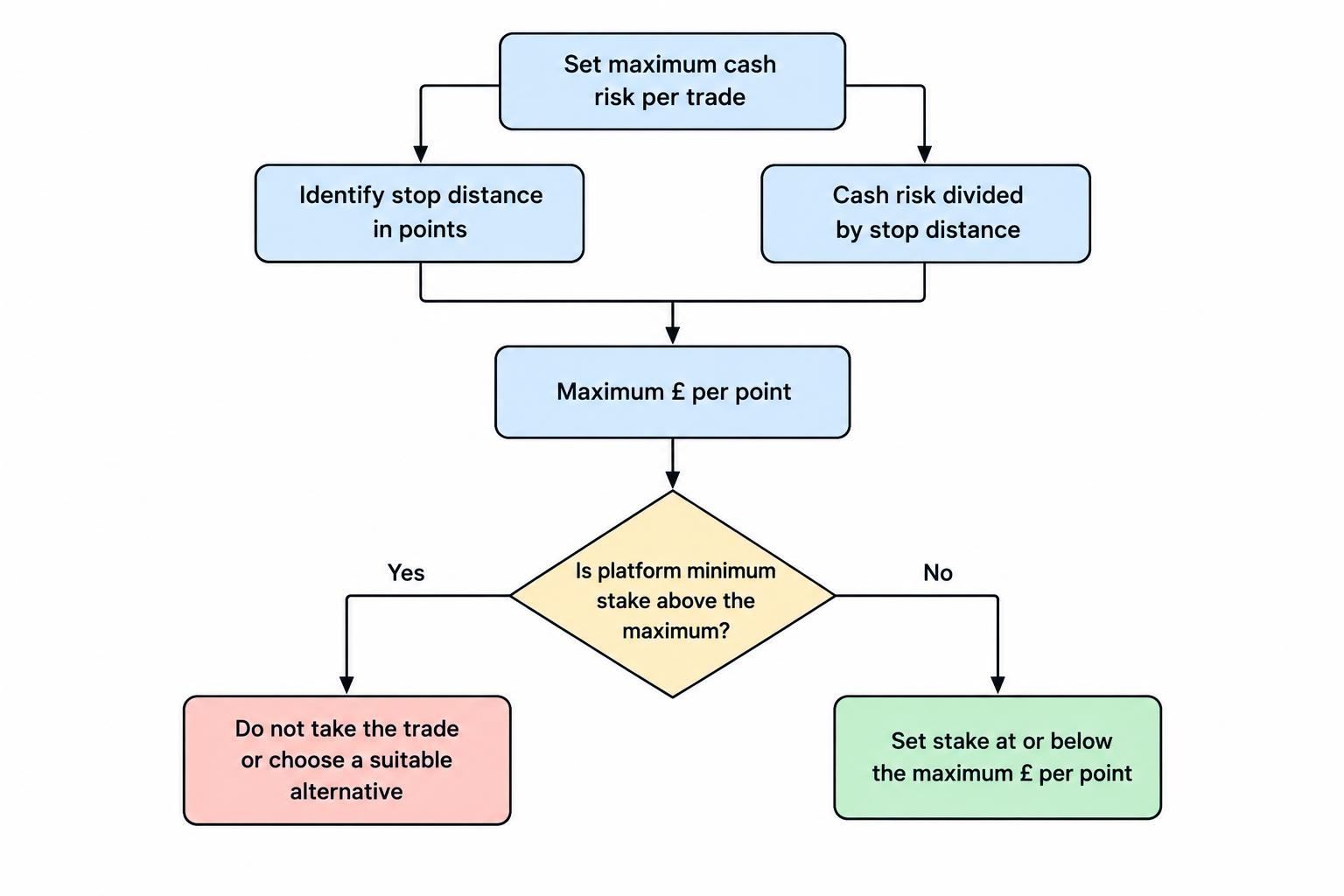
Capital adequacy must be calculated backward from trade-level risk limits and minimum stake sizes, never forward from a broker’s marketing deposit minimum. Assume a £5,000 account adhering to a strict 1% risk model (£50 maximum loss per trade). If a validated setup requires a 20-point stop loss, the maximum permitted stake is £2.50 per point (£50 ÷ 20 points). If a platform enforces a £5-per-point minimum stake on that market, a 20-point stop would risk £100 (2% of the account), violating the risk model. In that scenario, the trader must either locate a wider timeframe setup, find a broker with smaller minimum stakes, or pass on the trade.
Collateral margin operates separately from price risk. Under statutory FCA retail margin rules (COBS 22.5), major stock indices require a minimum 5% initial margin. On an index trade at 8,002 with a £1 stake, the total notional market exposure is £8,002, requiring an initial margin deposit of approximately £400.10. This margin balance merely serves as collateral to maintain the position—it does not define your maximum downside. Accounts must maintain sufficient equity buffers above required margin to absorb adverse market fluctuations without triggering automated margin calls.
Worked Example: Buying an Index During the Session
To examine the mechanical execution of an intraday trade, consider a hypothetical long breakout setup on a cash equity index following morning consolidation:
- Execution Setup: Price breaks above technical resistance with confirmed volume. The live quote is 8,000 / 8,002. The trader executes a buy order at the ask of 8,002 at £1 per point.
- Order Invalidation: An ordinary stop-loss order is placed at 7,982 (20 points risk = £20).
- Profit Target: A limit order is placed at 8,042 (40 points gain = £40), securing a planned 2:1 reward-to-risk ratio.
- Session Boundary: If neither order fills by 16:15 UK cash close, the position is manually liquidated.
If the market advances to 8,042 / 8,044, the position exits at the bid of 8,042 for a £40 gross profit. If the market retreats and hits the stop trigger at 7,982, the trade closes for a £20 loss. However, if sudden volatility causes execution slippage down to 7,975, the realized loss expands to 27 points (£27). The table below outlines these alternate execution paths for the identical trade setup:
| Alternative Outcome | Closing Sell Execution | Price Calculation (at £1/pt) | Price Profit / Loss |
|---|---|---|---|
| Close Immediately at Unchanged Quote | 8,000 | 8,000 − 8,002 | −£2 |
| Profit-Taking Limit Executes | 8,042 | 8,042 − 8,002 | +£40 |
| Ordinary Stop Executes at Trigger | 7,982 | 7,982 − 8,002 | −£20 |
| Ordinary Stop Slips During a Sudden Move | 7,975 | 7,975 − 8,002 | −£27 |
*Illustrative long trade entered at an ask price of 8,002 with a £1 per point stake. Figures represent gross price movement P&L before daily financing or account charges.
Worked Example: Selling a Currency Pair
Now consider an intraday short trade on GBP/USD, where one contract point equals a standard 0.0001 pip. The broker quotes 1.2750 / 1.2752. After identifying a breakdown setup, the trader enters short at the bid of 1.2750 at £1 per point. A stop loss is placed at 1.2765 (15 points of planned price risk = £15). The exchange rate falls to 1.2718 / 1.2720, and the position is closed at the available ask of 1.2720. The 30-point decline generates a £30 gross profit (30 points × £1/pt). Note that short positions always exit on the ask—confusing the ask with the lower bid overstates actual trading gains.
These scenarios highlight why a theoretical 2:1 reward-to-risk ratio does not guarantee profitability. If win rates drop below expectations or slippage inflates average losses, expectancy turns negative. Unplanned time exits, market chop and spread variations continuously alter sample distributions. Every setup must be logged systematically—including scratched trades and maximum adverse excursions—to establish an auditable performance baseline.
Intraday Setups Worth Understanding
Trading a Pullback Within a Trend
Trend-pullback trading pairs higher-timeframe directional structure (e.g., 1-hour chart) with lower-timeframe execution triggers (e.g., 5-minute chart). Traders identify established directional trends via consecutive higher highs/lows, then wait for temporary counter-trend retracements into dynamic moving averages (20 or 50 EMA) or broken support/resistance zones. The primary hazard is whipsaw action during range-bound consolidation, where pullbacks evolve into full structural reversals. Stop-loss distances must conform to technical structure rather than arbitrary point limits.
Trading an Opening Range or Another Breakout
Opening Range Breakouts (ORB) establish high and low boundary levels during the first 15 to 30 minutes of a cash market open (such as 08:00–08:30 UK time for the FTSE 100). A trade triggers when price action violently breaches the range limit with supporting volume. Breakout traders must define strict entry protocols: entering immediately upon limit penetration vs waiting for a confirmed candle close or retest. Executing immediately prior to scheduled Tier-1 economic releases dramatically elevates false-breakout (“whipsaw”) risk.
Trading a Range or Reversal
Intraday range trading seeks to exploit horizontal support and resistance boundaries during low-momentum consolidation periods. Positions are initiated near support extremes with targets set at opposing boundaries. Reversal setups fade overextended moves using technical exhaustion signals, such as extreme RSI divergences or Bollinger Band pierces. The critical pitfall is assuming overbought indicators mandate an immediate turn: strongly trending markets can remain statistically overextended while continuing to trend, triggering rapid account margin depletion.
Getting Started: Verify the Account and Learn the Platform
Before depositing capital, verify the broker’s licensing status on the Financial Services Register to confirm active FCA authorization and client money permissions. Clone firms and unregulated offshore brokers frequently target retail traders with deceptive promotions. Verify that the platform’s commercial terms—minimum stake sizes, execution latency, stop-order choices, and dealing spreads during your active hours—support intraday strategies.
Use a demo spread betting account to master order-ticket mechanics before risking live capital. Practice executing one-cancels-the-other (OCO) contingent orders, setting trailing stops, adjusting order sizes and verifying whether positions automatically net or open as hedging tickets. Configure the demo account balance to reflect your real capital allocation (£2,000 to £5,000) rather than a £100,000 default balance to develop realistic risk perception.
A Practical Routine for the Trading Day
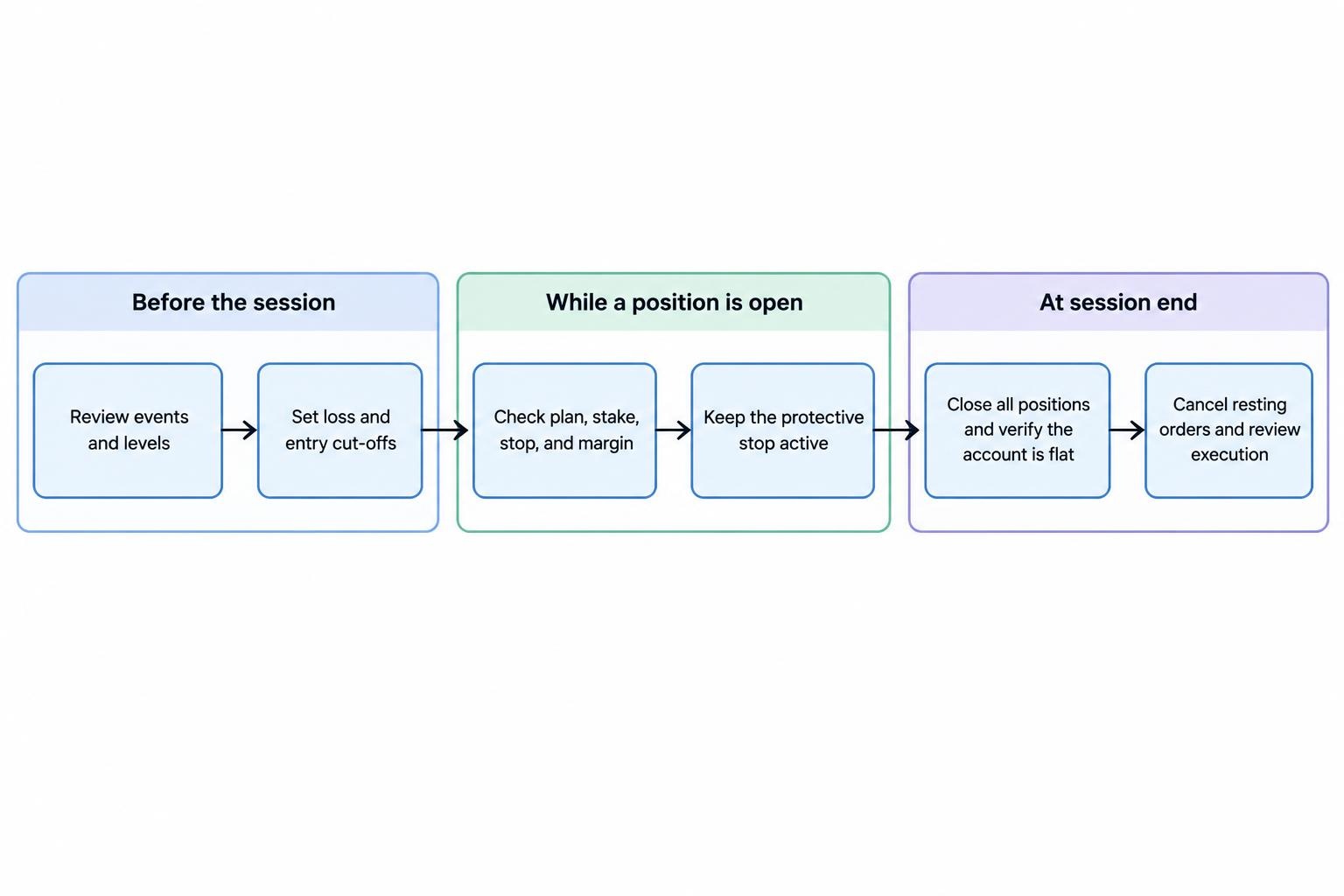
Before the Session
Pre-market preparation begins with reviewing the daily economic calendar to identify high-impact data releases (e.g., US CPI, Bank of England rate decisions). Mark significant support, resistance, and prior-day high/low levels on your charts. Define your daily loss limit (e.g., 2% of total account capital or £100) and set a strict operational cut-off time after which no new positions may be entered. Pre-determining boundaries eliminates emotional decision-making during high-volatility sessions.
While a Position Is Open
Execute only when chart structure satisfies every rule in your trading plan. Before clicking confirm, verify market, direction, stake size, stop level, and required margin. Once filled, confirm that the protective stop loss is active on the broker’s order server. Never widen a stop loss to avoid being taken out—moving stops invalidates your risk-reward calculus and exposes the account to catastrophic drawdowns. If technical connectivity falters or spreads widen abnormally, close active exposure and halt trading for the day.
At the End of the Session
Close all open trades by your planned session deadline and verify that the account is 100% flat. Cancel any active resting orders, as an overlooked limit order can execute overnight in illiquid conditions. Export execution data, calculate net daily P&L after spreads, and log journal entries reviewing rule adherence. A losing session where rules were followed is an operational success; a profitable day driven by oversized stakes or neglected stops is an operational failure.
Stops and Retail Protections Have Different Jobs
A standard stop-loss order is a conditional instruction that converts into a market order once its trigger price is touched, leaving it vulnerable to slippage during high-velocity price moves or market gaps. A Guaranteed Stop-Loss Order (GSLO) guarantees exact execution at your specified price level, eliminating gap risk in exchange for a broker premium (charged only if the stop is triggered). Stop-limit orders restrict exit price slippage, but risk remaining unfilled if the market blows through your limit price.
Broker-level protections mandated by the FCA operate at the account tier rather than individual trade level. Under FCA COBS 22.5, brokers must enforce automated margin close-outs when total account equity drops to 50% of required margin, alongside mandatory negative balance protection to ensure retail debts cannot exceed deposited funds. However, account close-out rules do not protect individual trade capital—holding multiple correlated positions simultaneously can trigger rapid portfolio-level liquidation.
How to Tell Whether the Method Is Improving
Maintain an objective trading journal separating analytical validity from execution quality. Track setups, entry/exit prices, intended risk, realized slippage, holding durations, and rule deviations. Track your expectancy in R-multiples (units of initial risk) rather than relying solely on win rate. A strategy with a 40% win rate can remain highly profitable if average winners yield 2.5R while average losses are capped at 1R.
Backtests and demo practice must incorporate realistic dealing frictions: widen historical spreads by 20–30% and account for execution slippage. If transitioning to real capital, begin with a micro-stakes live trial (£0.10 to £0.50 per point) to evaluate actual execution latency, slippage and broker fills. Expand stake sizes only after an empirical sample size of 50 to 100 live trades demonstrates positive mathematical expectancy.
Common Mistakes That Turn a Short Trade Into a Large Problem
The most destructive intraday mistake is holding a losing day trade overnight in the hope of an opening rebound, turning a controlled intraday loss into an unhedged swing position exposed to catastrophic morning gaps. Other primary pitfalls include revenge trading (increasing stakes after a loss), moving stops away from approaching prices, and overtrading during mid-day consolidation chop. Screen fatigue rapidly degrades cognitive discipline; recognizing that standing aside in cash is an active, valid trading decision is central to long-term survival.
A Note on UK Tax Treatment
A major commercial appeal of financial spread betting for UK residents is its statutory tax status. Under HMRC Business Income Manual BIM22015, spread betting is legally classified as betting rather than investment business, meaning profits are entirely exempt from Capital Gains Tax (CGT) and Stamp Duty. Conversely, trading losses cannot be offset against other taxable income or capital gains.
However, HMRC guidance (BIM22020) outlines specific exceptions where spread betting activity forms part of a broader commercial trade or corporate business entity. Tax laws remain subject to change and depend on individual residency and circumstances. Favorable tax treatment enhances net profitability on winning strategies, but cannot transform a negative-expectancy trading model into a viable venture.
Learning the Process Before Increasing the Stakes
Mastering intraday spread betting requires starting with one liquid benchmark, one verified setup, and a fixed two-hour execution window. Internalize bid-ask spreads, calculate stakes backward from structural stop distances, and enforce strict session close-out rules. Measure progress by execution consistency and risk discipline rather than raw monetary gains. Consistent risk management on micro stakes must always precede capital scaling.